Optimizing Plant Reliability with the Core Types of Maintenance
In my 20-plus years of managing piping systems and heavy rotating equipment in high-pressure petrochemical plants, I have seen firsthand how a single unmonitored component can halt an entire production line. I still remember a cold winter morning at a refinery when a high-pressure bypass valve failed. The root cause was not a design flaw; it was a failure to align our field activities with the correct operational strategies.
Choosing how and when to maintain your assets is not a administrative decision—it is a core engineering discipline. When we look at the various options available to modern plants, we must balance risk, cost, and safety. This guide breaks down the primary methodologies to help you build a robust, code-compliant asset management program.
Key Engineering Takeaways
- Understand the clear boundaries between preventive, corrective, and predictive strategies.
- Learn how to apply reliability formulas to calculate optimal inspection intervals.
- Discover how to align your field maintenance with international standards like API 570 and ASME PCC-2.
- Identify the exact data points needed to build a high-performing maintenance matrix.
Complete Course on
Piping Engineering
Check Now
Key Features
- 125+ Hours Content
- 500+ Recorded Lectures
- 20+ Years Exp.
- Lifetime Access
Coverage
- Codes & Standards
- Layouts & Design
- Material Eng.
- Stress Analysis
Analyzing the Primary Types of Maintenance Strategies
To build a reliable facility, we must categorize our work based on timing and intent. The industry generally divides these activities into three primary pillars: preventive, corrective, and predictive. Each serves a specific purpose, and relying too heavily on just one is a recipe for operational failure.
1. Preventive Maintenance (PM)
Preventive maintenance is performed at scheduled intervals (either time-based or usage-based) regardless of the asset’s current condition. The goal is to reduce the probability of failure. In piping systems, this includes scheduled bolt torque checks, gasket replacements during shutdowns, and regular lubrication of valve stems.
The mathematical basis for scheduling PM intervals relies on the asset’s failure rate (lambda). The reliability of a component over time (t) is expressed as:
Where lambda is the constant failure rate (1/MTBF). By calculating the Mean Time Between Failures (MTBF), we can schedule PM tasks before the reliability drops below an acceptable threshold (typically 90% to 95% for critical process piping).
2. Corrective Maintenance (CM)
Corrective maintenance occurs after a fault or failure has been detected. This is often split into two sub-types:
- Immediate Corrective Maintenance: Action is taken immediately after a failure to restore critical operations (e.g., repairing a ruptured line under ASME PCC-2 guidelines).
- Deferred Corrective Maintenance: The repair is scheduled for a later date because the failure does not pose an immediate safety or production risk.
Relying on corrective maintenance for high-pressure piping or hazardous chemical lines is an unacceptable risk. Run-to-failure is only acceptable for non-critical, redundant assets where the cost of preventive monitoring exceeds the cost of replacement. Always consult your facility’s Process Safety Management (PSM) guidelines before deferring any corrective work.
3. Predictive Maintenance (PdM)
Predictive maintenance uses direct physical monitoring to detect early signs of degradation. Instead of guessing based on time, we use real-time data. For piping and pressure vessels, this involves non-destructive testing (NDT) methods such as:
- Ultrasonic Thickness (UT) Testing: Measuring wall thinning due to corrosion or erosion to calculate remaining life under API 570.
- Vibration Analysis: Monitoring piping span vibrations near reciprocating compressors to prevent fatigue cracking.
- Infrared Thermography: Identifying localized heat loss or insulation breakdown on steam lines.
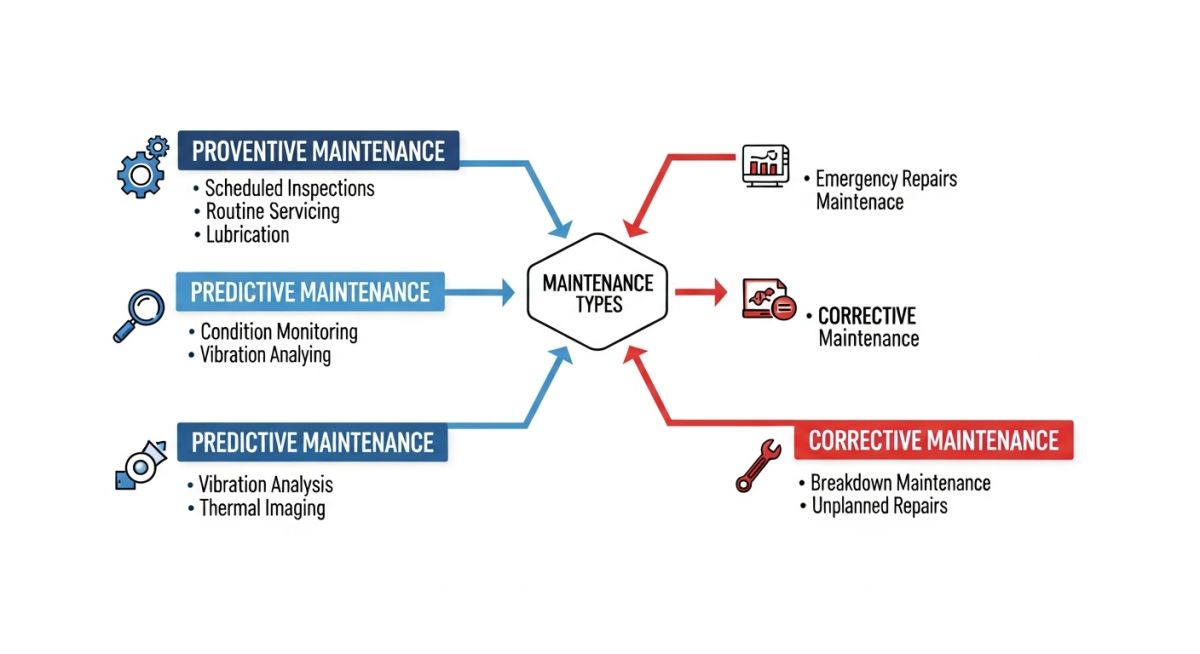
By tracking these parameters, we can perform maintenance only when the asset’s condition warrants it, significantly reducing unnecessary downtime and spare parts consumption.
To help you select the right approach for your facility, I have compiled a comparative analysis of these strategies. This table highlights the cost, complexity, and typical applications of each method.
| Maintenance Type | Trigger Event | Relative Cost | MTTR Impact | Primary Standard |
|---|---|---|---|---|
| Preventive (PM) | Time or Cycles | Medium | Planned / Low | ISO 14224 |
| Corrective (CM) | Asset Failure | High (Unplanned) | High | ASME PCC-2 |
| Predictive (PdM) | Condition Threshold | High (Initial Setup) | Very Low | API 570 / 510 |
| Proactive (RCM) | Root Cause Analysis | Medium-High | Optimized | SAE JA1011 |
Technical Mapping & Specifications Matrix
This matrix maps specific physical parameters and failure modes to their corresponding monitoring technologies and industry codes.
| Physical Parameter | Failure Mode | Monitoring Technology | Applicable Code |
|---|---|---|---|
| Wall Thickness | Internal Corrosion / Erosion | Ultrasonic Testing (UT) | API 570 / ASME Section V |
| Structural Vibration | Mechanical Fatigue | Accelerometers / FFT Analysis | ASME OM Code |
| Surface Temperature | Insulation Failure / CUI Risk | Infrared Thermography | ASTM C1060 |
| Lubricant Chemistry | Bearing Wear / Contamination | Spectrometric Oil Analysis | ISO 4406 |
Implementing Field Verification for Types of Maintenance
A strategy is only as good as its execution in the field. Over the years, I have developed this verification checklist to ensure that our field teams are executing tasks safely and in strict accordance with engineering specifications.
Field Engineer’s Verification Checklist
-
Work Permit & Isolation Verification: Confirm that energy isolation (LOTO) is verified and matches the P&ID before any corrective work begins on pressurized lines.
-
Calibration Records Check: Ensure all NDT tools, ultrasonic thickness gauges, and vibration probes have valid calibration certificates traceable to national standards.
-
Material Traceability (PMI): For corrective repairs involving welding, verify that the replacement piping material matches the line specification using Positive Material Identification.
-
Data Logging Compliance: Verify that all thickness readings and vibration data are logged directly into the CMMS (Computerized Maintenance Management System) within the same shift.
-
Post-Maintenance Testing: Ensure leak testing or hydrotesting is performed in accordance with ASME B31.3 before returning the system to service.
Field Case Study: Real-World Application
At a mid-sized refinery, the Crude Distillation Unit (CDU) experienced three unplanned shutdowns within a six-month period due to localized corrosion-under-insulation (CUI) on the overhead piping. The facility was relying strictly on time-based preventive inspections every two years. This approach failed to capture the accelerated corrosion rates caused by wet insulation, resulting in wall thinning that breached the minimum allowable wall thickness (t-min) calculated under API 570. The unplanned downtime cost the facility over 1.2 million in lost production.
I was brought in to audit the system and restructure their program. We immediately transitioned the CDU overhead piping from a time-based preventive strategy to a predictive, Risk-Based Inspection (RBI) program under API 581. We installed continuous moisture sensors under the insulation and scheduled targeted Pulsed Eddy Current (PEC) testing on high-risk areas.
By implementing this predictive approach, we identified two critical thinning areas three months before they could fail. The repairs were scheduled during a planned, short turnaround, saving the plant an estimated 850,000 in emergency repair costs and preventing any unscheduled production loss.
Frequently Asked Engineering Questions
What is the main difference between preventive and predictive maintenance?
How does API 570 govern the inspection of piping systems?
When is a run-to-failure corrective strategy acceptable?
What role does ASME PCC-2 play in corrective maintenance?
How do you calculate the optimal interval for preventive tasks?
Why is ISO 14224 important for plant maintenance databases?
===