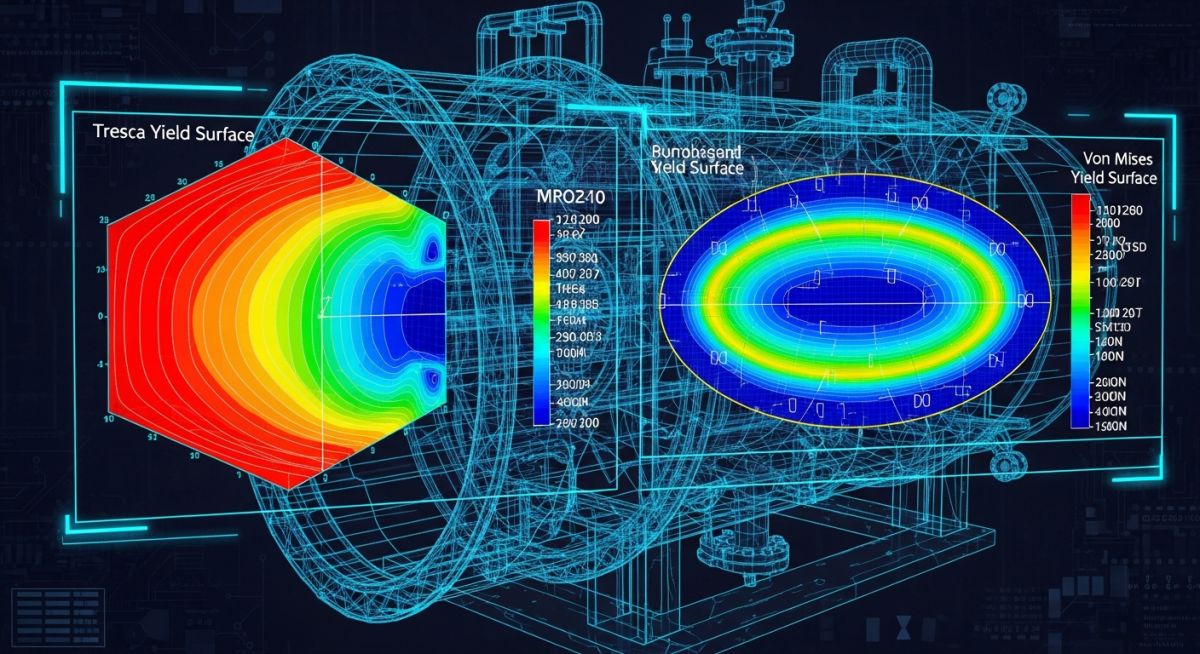
Tresca or Von Mises Yield Criteria in Piping and Pressure Vessels
During my two decades in the piping and pressure vessel design sector, I have witnessed countless debates regarding whether to apply Tresca or Von Mises yield criteria. Many young engineers treat these theories as interchangeable mathematical exercises. However, in the field, selecting the wrong criterion can lead to either an over-designed, prohibitively expensive vessel or, worse, an under-designed system prone to catastrophic plastic deformation.
When we design high-pressure equipment, we rarely deal with simple uniaxial tension. Instead, our components experience complex, multi-axial stress states driven by internal pressure, thermal expansion, wind loads, and seismic forces. To prevent failure, we must map these multi-directional stresses to a single equivalent stress value and compare it against the material’s yield strength. This is where the fundamental differences between Tresca and Von Mises become critical.
Key Engineering Takeaways
- Conservatism: Tresca is always more conservative than Von Mises, predicting yielding up to 15.5% earlier under pure shear conditions.
- Code Alignment: ASME Section VIII Division 1 and older piping codes historically align with Tresca, while modern Division 2 Class 1 and Class 2 rules leverage Von Mises for advanced Finite Element Analysis (FEA).
- Economic Impact: Utilizing Von Mises in FEA-driven designs allows for thinner shell walls, reducing material weight and fabrication costs without compromising safety.
Why Choose Tresca or Von Mises in Design?
To understand these criteria, we must look at their mathematical formulations. The Tresca criterion, also known as the Maximum Shear Stress Theory (MSST), postulates that yielding occurs when the maximum shear stress in a multi-axial state equals the maximum shear stress at yield in a simple uniaxial tension test. Mathematically, it is expressed as:
Equivalent Tresca Stress (sigma_T) = sigma_1 – sigma_3
Where sigma_1 is the maximum principal stress and sigma_3 is the minimum principal stress. This theory completely ignores the intermediate principal stress (sigma_2), which is its primary limitation.
Conversely, the Von Mises criterion, known as the Distortion Energy Theory (DET), states that yielding begins when the distortion strain energy per unit volume reaches the corresponding distortion energy in a uniaxial tension test at yield. This theory accounts for all three principal stresses:
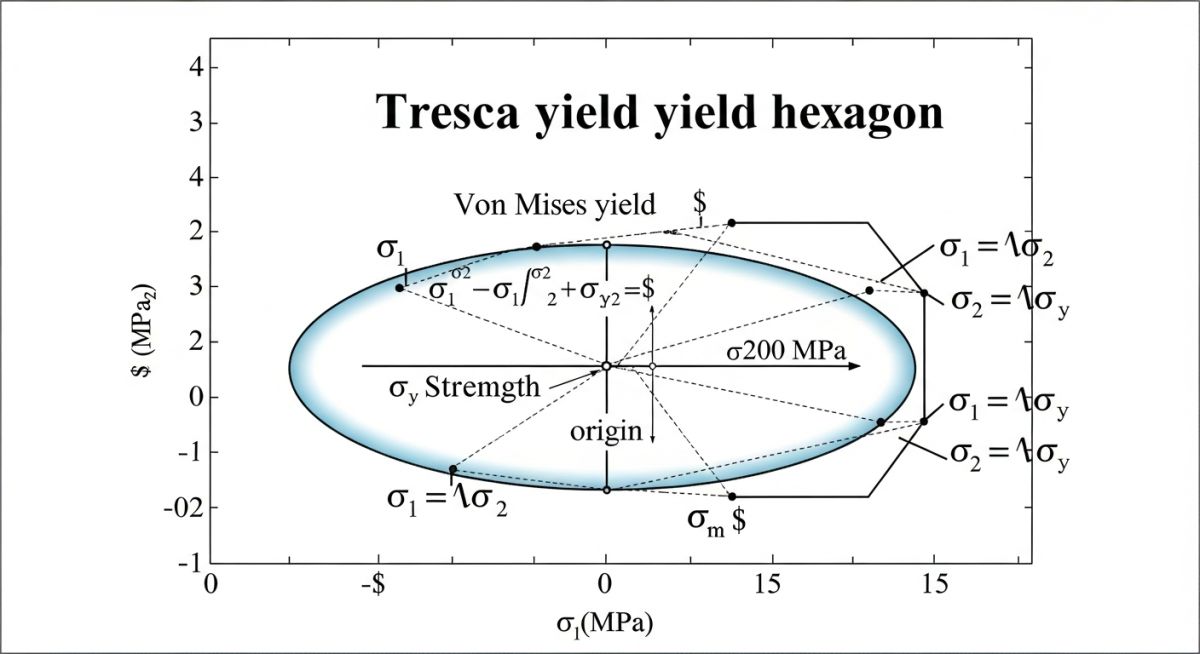
By incorporating the intermediate principal stress, Von Mises provides a continuous, smooth elliptical yield surface, whereas Tresca presents a hexagonal yield surface. The Tresca hexagon is completely inscribed inside the Von Mises ellipse, illustrating why Tresca is always equal to or more conservative than Von Mises.
Code Implementations: ASME Section VIII and B31.3
In my practice, the choice between these criteria is often dictated by the governing design code. For instance, ASME Section VIII Division 1 historically relies on simplified formulas derived from the Tresca criterion (using stress intensity, which is twice the maximum shear stress).
However, ASME Section VIII Division 2 (Alternative Rules) permits and encourages the use of the Von Mises yield criterion for elastic-plastic stress analysis. This shift allows design engineers to utilize advanced Finite Element Analysis (FEA) to optimize wall thicknesses, especially in heavy-wall reactors and high-pressure separators.
For piping systems designed under ASME B31.3, the standard stress evaluation formulas for thermal expansion and sustained loads are based on simplified beam theories. Yet, when dealing with high-pressure piping (Chapter IX), the code mandates more rigorous stress intensity evaluations where Tresca’s conservative boundaries provide an extra layer of safety against burst pressures.
To help you select the correct criterion for your next project, I have compiled a direct comparison of their physical parameters, followed by a technical mapping of how these entities align with major industry standards.
| Parameter | Tresca Criterion (MSST) | Von Mises Criterion (DET) |
|---|---|---|
| Physical Basis | Maximum Shear Stress | Distortion Strain Energy |
| Yield Surface Shape | Hexagonal Prism | Cylindrical/Elliptical |
| Intermediate Stress (sigma_2) | Ignored completely | Fully accounted for |
| Pure Shear Yield Limit | 0.50 * sigma_y | 0.577 * sigma_y (15.5% higher) |
| Conservatism Level | High (Safe bound for all ductile metals) | Moderate (Highly accurate to real tests) |
| Primary Application | Manual calculations, conservative piping design | Finite Element Analysis (FEA), fatigue analysis |
| Design Code | Primary Criterion | Stress Entity Evaluated | Recommended Analysis Method |
|---|---|---|---|
| ASME VIII Div 1 | Tresca | Stress Intensity (S) | Closed-form analytical equations |
| ASME VIII Div 2 (Class 1) | Tresca / Von Mises | Equivalent Stress (sigma_e) | Elastic stress analysis / FEA |
| ASME VIII Div 2 (Class 2) | Von Mises | Von Mises Equivalent Stress | Elastic-Plastic FEA with limit load |
| ASME B31.3 (Ch. II) | Tresca (Modified) | Displacement Stress Range (S_E) | Beam-element piping flexibility analysis |
| ASME B31.3 (Ch. IX) | Tresca | Stress Intensity (High Pressure) | Detailed fatigue and thick-wall analysis |
Stress Analysis Verification Checklist
Before signing off on any stress analysis report, I run through a strict verification protocol. This checklist ensures that the mathematical models match the physical realities of the piping or pressure vessel installation.
Design Review & Verification Steps
-
Identify Governing Code: Confirm if the system falls under ASME Section VIII Div 1, Div 2, or ASME B31.3. This dictates the default yield criterion.
-
Verify Stress State Dimensionality: Determine if the component experiences uniaxial, biaxial, or triaxial stress. Biaxial and triaxial states require equivalent stress mapping.
-
Check Material Ductility: Ensure the material is ductile (elongation greater than 5%). Brittle materials must not use Tresca or Von Mises; they require Mohr-Coulomb or Maximum Normal Stress theories.
-
Assess FEA Post-Processor Settings: If using FEA software (e.g., ANSYS, Abaqus), verify that the equivalent stress output is explicitly set to Von Mises for elastic-plastic evaluations, or Tresca if matching Div 1 stress intensity limits.
-
Evaluate Shear-Dominated Zones: Pay close attention to nozzles, support skirts, and lug attachments. If shear stresses are high, cross-check Von Mises results against Tresca to evaluate the 15.5% safety margin.
-
Document Fatigue & Cyclic Loading: Ensure that cyclic thermal stresses are evaluated using the correct stress range definition specified by the governing code.
Field Case Study: Real-World Application
The Problem: Excessive Wall Thickness in a Hydrogen Separator
On a refinery expansion project in 2018, we were designing a high-pressure hydrogen separator vessel operating at 18.5 MPa and 350 degrees Celsius. The initial design, executed under ASME Section VIII Division 1 (which relies on Tresca-based simplified formulas), resulted in a required shell wall thickness of 92 mm using 2.25Cr-1Mo-V alloy steel.
This thickness presented massive fabrication challenges, including pre-heat requirements, long welding times, and high risks of hydrogen-induced cracking during fabrication. The client asked if we could optimize the design to reduce weight and cost.
The Outcome: Von Mises Optimization via Division 2
I proposed re-routing the design path to ASME Section VIII Division 2 Class 2. By performing a detailed elastic-plastic finite element analysis and applying the Von Mises yield criterion, we were able to account for the beneficial effects of the intermediate principal stress (radial stress through the wall).
The Von Mises stress distribution showed that the material could safely withstand the operating pressure with a shell thickness of only 78 mm—a reduction of over 15%. This saved approximately 42 metric tons of high-alloy steel per vessel, translating to a direct material and fabrication cost saving of 185,000 per unit, while maintaining full code compliance and structural safety margins.
This case study highlights why understanding the underlying mechanics of Tresca and Von Mises is not just academic. It has direct, massive implications on project economics, constructability, and schedule.
Evaluating Tresca or Von Mises Criteria FAQs
Why is Tresca considered more conservative than Von Mises?
Can I use Von Mises for brittle materials like cast iron?
How does ASME Section VIII Division 2 utilize Von Mises?
Which criterion is better for piping stress analysis software like CAESAR II?
Does the intermediate principal stress really affect yielding?
When should I absolutely stick to Tresca instead of Von Mises?
===_END_OF_BLOCKS_===
Complete Course on
Piping Engineering
Check Now
Key Features
- 125+ Hours Content
- 500+ Recorded Lectures
- 20+ Years Exp.
- Lifetime Access
Coverage
- Codes & Standards
- Layouts & Design
- Material Eng.
- Stress Analysis
