Surge Relief Valve Design Function Types and Selection Guide
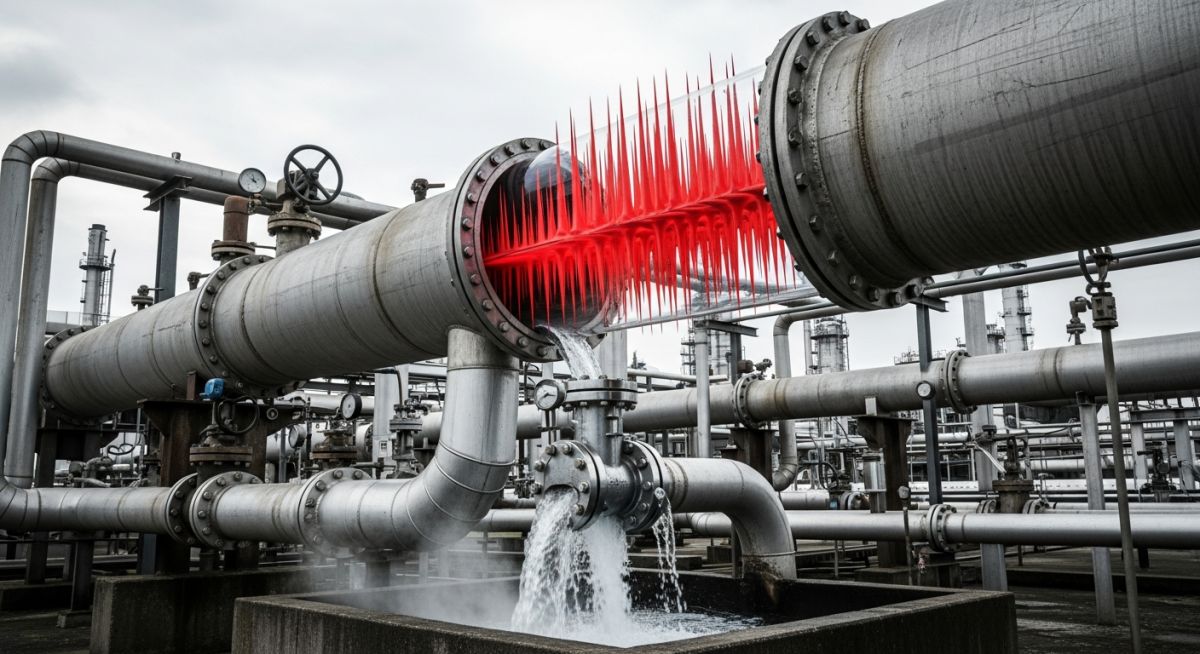
In my 20+ years of handling cross-country pipelines and process plants, I’ve seen surge events destroy perfectly designed systems within seconds. One methanol transfer line I worked on experienced a pressure spike nearly double the design limit during a pump trip — and the standard PSV simply couldn’t react fast enough.
That’s where a properly engineered surge relief valve makes the difference. It’s not just another valve — it’s a transient protection strategy that must be designed with real hydraulic behavior in mind, not theoretical steady-state assumptions.
- Surge relief valves respond within milliseconds unlike conventional PSVs
- Critical for pump trip, power failure, and rapid valve closure scenarios
- Improper sizing leads to ineffective surge suppression or system instability
- Must be integrated with transient hydraulic analysis, not standalone selection
Interactive Engineering Quiz
Q1: What is the primary purpose of a Surge Relief Valve?
Complete Course on
Piping Engineering
Check Now
Key Features
- 125+ Hours Content
- 500+ Recorded Lectures
- 20+ Years Exp.
- Lifetime Access
Coverage
- Codes & Standards
- Layouts & Design
- Material Eng.
- Stress Analysis
How surge relief valve actually works
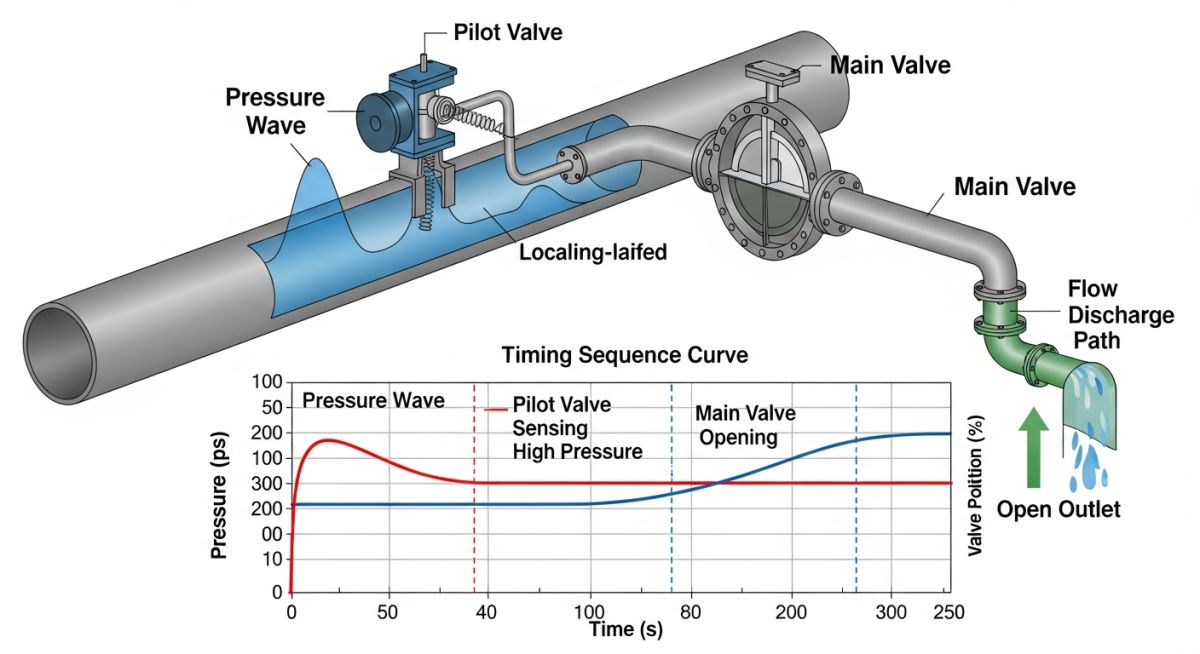
Surge Relief Valve Working Principle: A surge relief valve operates through high-speed pilot sensing of upstream pressure rise and instant opening of the main valve to discharge excess fluid, thereby limiting transient pressure within allowable limits defined by API Standards and ASME Codes.
In my experience on cross-country pipeline systems and process units, the key difference between a system that survives and one that fails is response speed. Surge events occur in milliseconds, and unless the valve reacts within that time frame, the pressure peak has already damaged the system.
Pressure transient generation mechanism explained
Surge pressure (ΔP) in pipelines is typically calculated using the Joukowsky equation:
- ρ = Fluid density (kg/m³)
- a = Wave velocity (m/s)
- ΔV = Change in velocity (m/s)
For a typical water system:
Now imagine this being added instantly to your operating pressure. That’s where surge relief design becomes non-negotiable in critical systems like methanol transfer or cooling water networks.
Types of surge relief valves used
Surge Relief Valve Types: Surge relief valves are classified based on actuation mechanism and control logic, including pilot-operated, direct-acting, and surge anticipation valves designed as per hydraulic system requirements.
- Pilot Operated: Most widely used in large pipelines due to accuracy and fast response
- Direct Acting: Used in smaller systems with limited flow requirements
- Surge Anticipation Valves: Open before surge arrival based on pressure drop sensing
- Air Vessel Integrated Systems: Used along with surge tanks for damping
How surge relief valve sizing is done
Surge Relief Valve Sizing: Valve sizing is based on transient flow discharge required to limit maximum pressure below allowable design pressure, considering worst-case hydraulic transient conditions.
From real EPC projects, sizing is never guesswork. It follows transient simulation tools such as AFT Impulse or Bentley HAMMER. However, quick estimation can be done using:
- Q = Discharge flow (m³/s)
- A = Valve flow area (m²)
- V = Velocity during surge (m/s)
Design checks include:
- Valve opening time less than surge rise time
- Capacity adequate to avoid pressure exceeding MAWP
- Stable closure to prevent oscillation
| Type | Response Speed | Accuracy | Application |
|---|---|---|---|
| Pilot Operated | Very Fast | High | Large pipelines |
| Direct Acting | Moderate | Medium | Small systems |
| Anticipation Valve | Pre-emptive | Very High | Pump trip protection |
What should be validated before commissioning
Surge Relief Valve Commissioning Checklist: Surge relief valve performance must be verified through pressure setpoint calibration, response testing, hydraulic compatibility checks, and installation validation aligned with API Standards and ASME Codes to ensure reliable transient protection under real operating conditions.
From my plant commissioning experience, most surge valve failures are not due to wrong selection — they happen due to poor installation practices, incorrect pilot tuning, or lack of transient testing.
Pre-Commissioning Mechanical Checks
- Verify valve orientation matches P&ID and hydraulic profile
- Ensure no restriction in inlet sensing line
- Check isolation valves are fully open and locked
- Confirm downstream discharge line is free draining
- Inspect flange alignment to avoid stress-induced distortion
Instrumentation and Control Checks
- Pressure pilot setpoint calibrated using certified gauge
- Pilot response tested for rapid opening (milliseconds range)
- Damping needle valve tuned to prevent chatter
- Signal lines purged to remove trapped air pockets
Hydraulic Performance Validation
- Simulate pump trip to observe actual valve response
- Confirm peak surge pressure remains below MAWP
- Ensure valve fully closes without oscillation
- Check discharge capacity matches transient simulation results
Safety and Design Compliance Checks
A surge relief valve is only as good as its commissioning. If not validated under simulated transient conditions, it gives you a false sense of safety.
How surge relief valve selection is finalized
Surge Relief Valve Selection: Surge relief valve selection depends on transient severity, pipeline profile, fluid characteristics, and response time requirements validated through hydraulic simulation and aligned with API Standards and ASME Codes.
In real EPC execution, I never select a surge valve purely from datasheets. It must match the system dynamics—especially pump inertia, pipeline length, and elevation changes.
Key parameters engineers must validate
- Maximum allowable pressure vs predicted surge peak
- Pipeline length and wave travel time (L/a)
- Pump shutdown characteristics and coast down time
- Fluid compressibility and temperature effects
This value defines how quickly the valve must react. If valve opening time exceeds this, pressure reflection already amplifies.
Skid based surge relief valve systems explained
Skid-Based Surge Relief System: A skid-mounted surge relief system integrates valve, pilot controls, dampers, instrumentation, and discharge piping into a pre-engineered package ensuring faster installation, consistent performance, and reduced site errors.
For large facilities like methanol plants or steel industry cooling networks, skid-based systems offer practical advantages:
- Factory-tested response and calibration
- Reduced site erection complexity
- Integrated instrumentation for control logic
- Minimal dependency on site fabrication quality
Field Case Study: Real-World Application
My direct recommendation in such cases is always: validate surge risk early using transient tools and select a surge protection system, not just a valve.
Frequently Asked Engineering Questions
Why surge relief valve is needed in pipelines?
Difference between PSV and surge relief valve?
Where should surge relief valve be installed?
What is response time requirement?
Can surge be fully eliminated?
Is transient analysis mandatory for design?

📚 Recommended Resources: Surge Relief Valve
Read these Guides


Related posts:
![Industrial PEM electrolyzer stack generating green hydrogen in a modern clean energy facility.]()
PEM Electrolyzer Explained: The Ultimate Green Hydrogen Engineering Guide
![Modern green hydrogen plant with integrated solar panels and wind turbines, showcasing renewable energy powering electrolyzer technology.]()
Designing a Green Hydrogen Plant: A Comprehensive Engineering Overview
![Industrial hydrogen compression system facility with stainless steel piping and modern compressor equipment.]()
Mastering Hydrogen Compression Systems: Engineering Design, Selection, and Safety
![Modern industrial hydrogen storage facility with high-pressure tanks and clean energy infrastructure.]()
Hydrogen Storage Technologies: A Comprehensive Engineering and Selection Guide
![Modern industrial hydrogen storage facility with stainless steel tanks and safety piping.]()
Mastering Hydrogen Safety in Industrial Facilities: Engineering and Design Guide
![Conceptual illustration of global hydrogen transportation methods including pipelines, trucks, and ships.]()
How to Select and Design Hydrogen Transportation Methods Safely