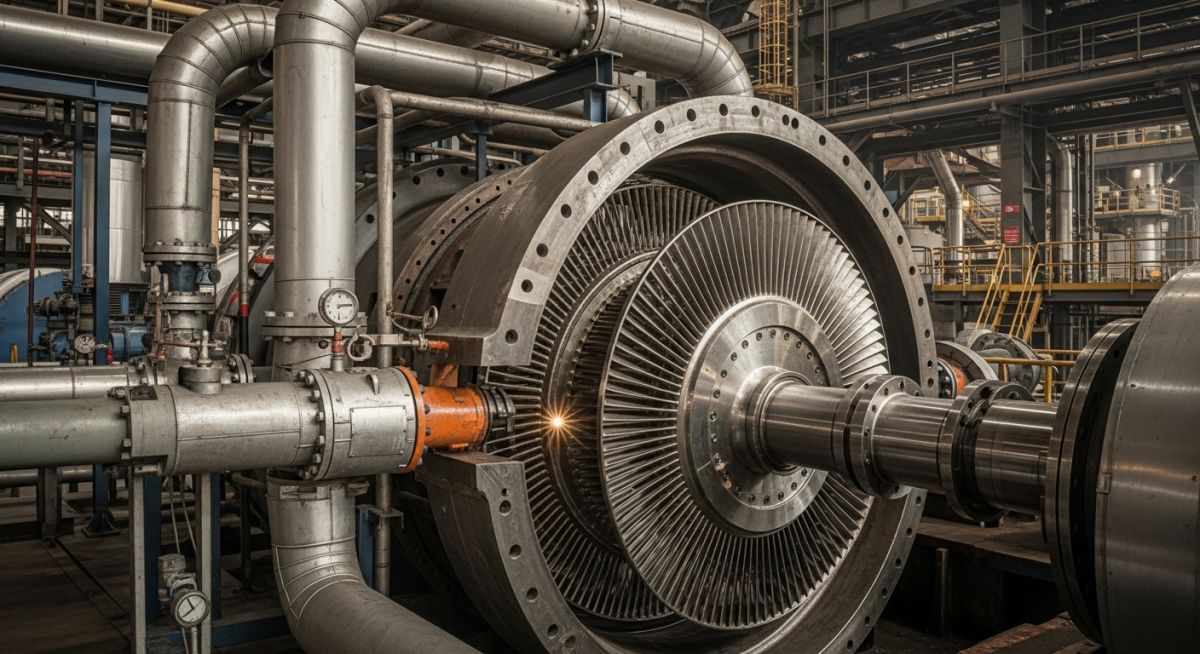
Steam Turbines: Basics, Types, Selection, Components, Construction, Codes & Manufacturers
In my 20+ years working across refineries, power plants, and process industries, steam turbines have remained one of the most critical rotating machines driving efficiency and production reliability. Whether you’re dealing with a high-capacity API 612 turbine or a small backpressure unit, understanding the fundamentals is non-negotiable for avoiding costly shutdowns.
I’ve personally seen million-dollar losses caused by simple issues—incorrect turbine selection, poor steam quality, or lack of monitoring. This guide is designed not just as theory, but as a practical field manual that connects design, operation, and troubleshooting in real engineering conditions.
🔑 Key Engineering Takeaways
- Steam turbines operate on the Rankine cycle converting thermal energy into mechanical work
- Impulse and reaction turbines differ fundamentally in pressure drop and blade design
- Correct turbine selection directly impacts efficiency, reliability, and lifecycle cost
- Monitoring parameters like vibration, temperature, and pressure prevents major failures
- API 611 and API 612 define critical design and operational standards in the industry
📌 Quick Answer (50 Words)
Steam turbines convert steam energy into mechanical work using the Rankine cycle. They are mainly classified as impulse and reaction types, selected based on load and application. Key components include rotor, casing, blades, and seals. Efficiency depends on minimizing losses and adhering to standards like API 611 and API 612.
Interactive Engineering Quiz
Q1. Steam turbines primarily work on which thermodynamic cycle?
Complete Course on
Piping Engineering
Check Now
Key Features
- 125+ Hours Content
- 500+ Recorded Lectures
- 20+ Years Exp.
- Lifetime Access
Coverage
- Codes & Standards
- Layouts & Design
- Material Eng.
- Stress Analysis
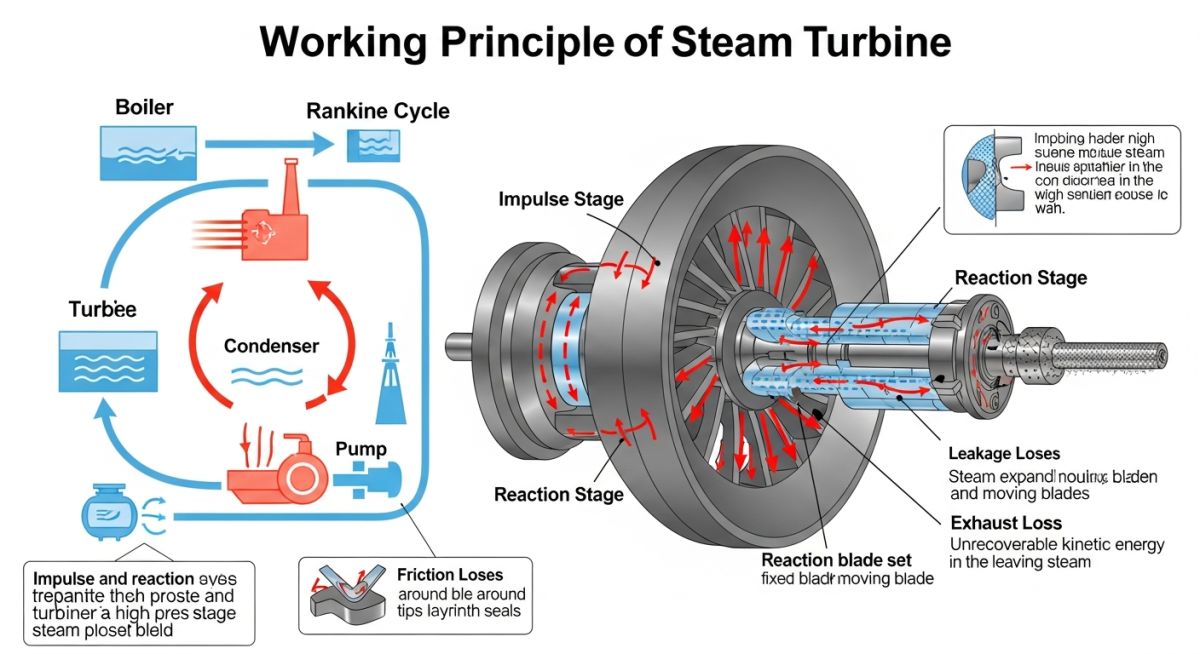
Working Principle of Steam Turbines
In my experience across refinery and power plant projects, understanding the working principle of steam turbines is the foundation for troubleshooting performance and failures. Steam turbines operate by converting thermal energy of high-pressure steam into mechanical work through controlled expansion.
Steam enters the turbine at high pressure and temperature, expands across stationary and moving blades, and produces rotational motion in the rotor. This rotation is then used to drive generators, compressors, or process equipment.
Rankine Cycle
Steam turbines operate on the Rankine cycle, which consists of four key processes—boiler heating, turbine expansion, condensation, and pumping. In real-world plants, inefficiencies such as heat losses and pressure drops reduce ideal cycle performance.
Types of Steam Turbines
Impulse Steam Turbine
In impulse turbines, steam expands completely in nozzles before striking moving blades. The pressure remains constant across the rotor, and only velocity changes. These are typically used in high-speed applications.
Reaction Steam Turbine
In reaction turbines, steam expands partially in stationary blades and further in moving blades. This creates both impulse and reaction forces, improving efficiency in large power plants.
Selection of Steam Turbines
Selection is one of the most critical engineering decisions. In one of my projects, incorrect turbine selection reduced plant output by 12% due to mismatch with process load variation.
- Load type: Constant vs variable load
- Steam conditions: Pressure and temperature
- Application: Power generation or mechanical drive
- Exhaust requirements: Condensing vs backpressure
- Compliance with standards like API codes
Components of a Steam Turbine
- Rotor: Rotating shaft carrying blades
- Blades: Convert steam energy into motion
- Casing: Pressure containment shell
- Nozzles: Convert pressure into velocity
- Bearings: Support rotor and reduce friction
- Seals: Prevent steam leakage
Construction of a Steam Turbine
Steam turbines are constructed with precision-machined rotors and high-strength alloy materials to withstand high temperature and pressure. In refinery service, casing integrity and alignment are critical to avoid vibration issues.
| Category | Type / Code | Application | Key Feature |
|---|---|---|---|
| Turbine Type | Impulse | Small industrial units | Pressure drop in nozzles |
| Turbine Type | Reaction | Large power plants | High efficiency |
| Standard | API 611 | General purpose turbines | Non-critical service |
| Standard | API 612 | Critical refinery service | High reliability design |
| Loss Type | Mechanical & Steam Losses | All turbines | Reduce efficiency |
Field Case Study: Real-World Application
In my experience working across refinery utilities and captive power plants, steam turbine performance issues are rarely due to a single cause. They are usually a combination of mechanical losses, steam quality issues, and poor monitoring practices.
Losses in a Steam Turbine
- Friction Loss: Due to bearings and moving components
- Steam Leakage Loss: Through seals and glands
- Exhaust Loss: Energy lost with exit steam
- Moisture Loss: Wet steam reducing blade efficiency
- Mechanical Loss: Coupling, generator drag
Techniques to Improve Steam Turbine Efficiency
- Maintain dry saturated or superheated steam quality
- Optimize condenser vacuum conditions
- Regular blade inspection and cleaning
- Advanced sealing systems to reduce leakage
- Real-time monitoring of vibration and temperature
Process Surveillance – Why Monitor Closely?
Continuous monitoring is critical to avoid catastrophic failures. In one refinery turbine I handled, early vibration detection saved a complete rotor failure and avoided a shutdown worth crores.
Process Surveillance – What & Where?
- Vibration sensors at bearings
- Temperature at lube oil system
- Pressure and steam flow monitoring
- Shaft displacement measurement
My Recommendation: Always prioritize monitoring and preventive maintenance over reactive repairs. Use standards like API 612 for critical service turbines and API 611 for general applications to ensure design reliability.
Steam Turbine Manufacturers
- Siemens Energy
- GE Steam Power
- Mitsubishi Heavy Industries
- Elliott Group
- Triveni Turbines (widely used in Indian industry)
Online Steam Turbine Courses
Engineers can refer to structured learning platforms like Coursera and Udemy for foundational and advanced turbine training programs.
