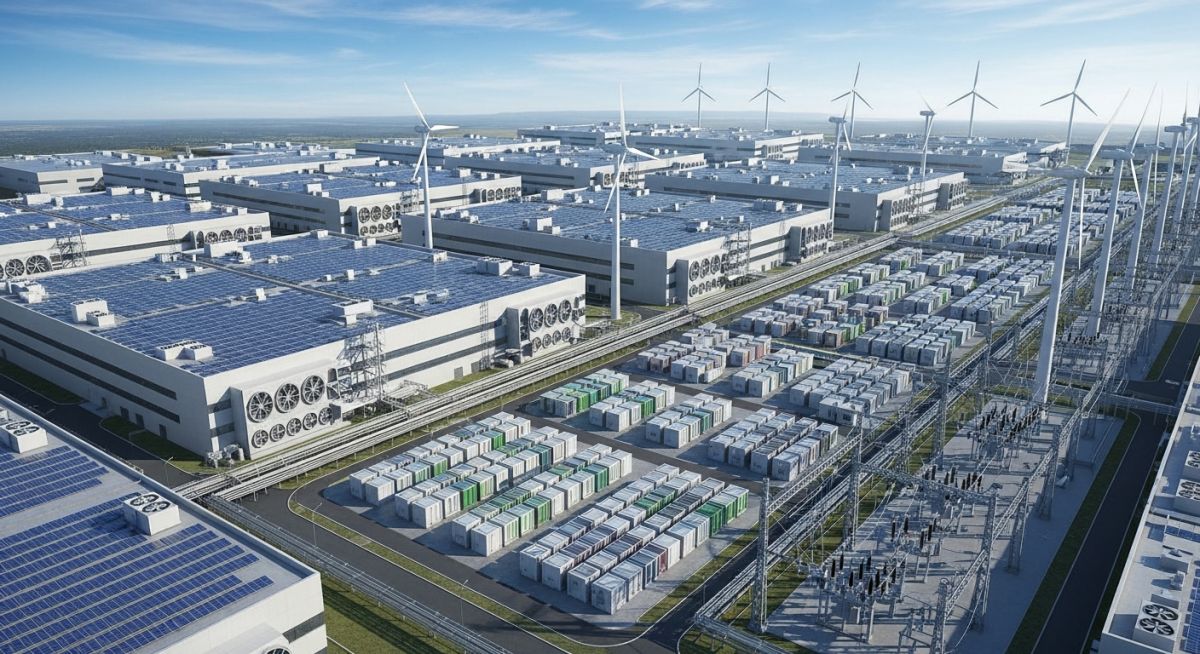
Renewable Energy for Data Centres: Engineering Sustainable Infrastructure
In my two decades of experience within the industrial and utility sectors, I have observed a seismic shift in how we approach power for data centres. The transition from traditional grid-dependent designs to complex, hybrid renewable energy for data centres is no longer a corporate preference—it is an engineering necessity. We are moving beyond simple PPA (Power Purchase Agreement) procurement into the realm of active, onsite generation and sophisticated BESS (Battery Energy Storage System) management.
Designing for high-availability while integrating intermittent sources like solar and wind requires a rigorous understanding of load profiles and transient stability. This guide explores the technical pathways to achieving carbon reduction without compromising the uptime requirements defined by Uptime Institute Tier IV standards.
Key Engineering Takeaways
- Optimizing BESS for peak shaving and frequency regulation.
- Balancing intermittent renewable supply with constant IT load demands.
- Leveraging ISO 50001 frameworks for energy management.
- Mitigating harmonic distortion in hybrid microgrid architectures.
Engineering Renewable Energy for Data Centres
Renewable Energy for Data Centres: The technical implementation of photovoltaic arrays, wind turbines, and electrochemical storage systems to provide a resilient, low-carbon power supply for high-density computing environments.
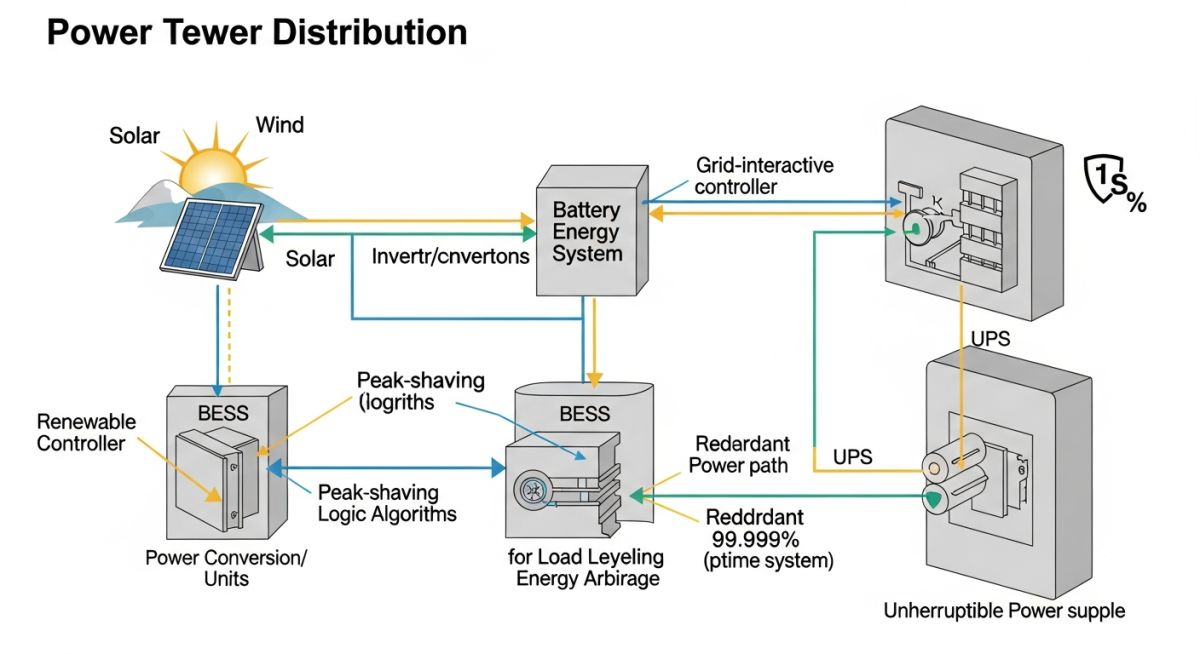
The engineering challenge of implementing renewable energy for data centres lies in the fundamental mismatch between the stochastic nature of renewable generation and the rigid, 24/7 power requirements of server racks. To achieve a stable microgrid, we must employ advanced power conversion systems (PCS) that manage the DC-to-AC conversion with minimal harmonic distortion. In my experience, the integration of BESS is the most critical component, acting as a buffer to smooth out the intermittency of solar and wind inputs.
Load Profile and Generation Matching
When calculating the required capacity for a renewable-integrated facility, we start with the PUE (Power Usage Effectiveness) baseline. If a facility has a 50MW IT load and a PUE of 1.2, the total facility power requirement is 60MW. To offset this with solar, we must account for the capacity factor, which typically ranges from 15% to 25% depending on the geographic location. The calculation for required solar capacity (P_solar) is defined as:
P_solar = (Total_Load / Capacity_Factor) * Efficiency_Loss_Factor
This calculation must be performed in conjunction with IEEE 1547 standards for interconnecting distributed resources with electric power systems. We must also consider the voltage regulation at the point of common coupling (PCC). As we increase the penetration of renewables, the risk of voltage flicker and frequency instability increases, necessitating the use of smart inverters with reactive power control capabilities.
Field Warning: Harmonic Resonance
High-frequency switching in modern power electronics can lead to harmonic resonance within the data centre power distribution unit (PDU) network. Always conduct a comprehensive harmonic analysis using ETAP or similar software to ensure that the total harmonic distortion (THD) remains within the limits specified by IEEE 519.
BESS Integration Strategies
BESS serves as the primary mechanism for frequency regulation and peak shaving. For a data centre, the BESS must be sized not just for energy capacity (MWh), but for power discharge capability (MW) to handle sudden load spikes or renewable generation drops. We typically design for a C-rate that allows for rapid response times, often under 100 milliseconds, to maintain the stability of the critical bus.
The integration of lithium-ion or flow battery technologies requires strict adherence to NFPA 855 for stationary energy storage system installation. This standard dictates the fire suppression, ventilation, and spacing requirements necessary to mitigate thermal runaway risks in high-density storage environments.
Renewable Energy Implementation: The strategic evaluation of onsite generation and storage assets against the operational complexities and capital expenditure requirements of modern data centre power systems.
Advantages
- Significant reduction in Scope 2 carbon emissions.
- Long-term hedge against volatile utility energy pricing.
- Enhanced energy security through microgrid islanding capabilities.
- Improved corporate ESG ratings and regulatory compliance.
- Potential for revenue generation through grid frequency response services.
Disadvantages
- High initial capital expenditure for BESS and solar arrays.
- Increased complexity in power system protection and coordination.
- Significant land footprint requirements for utility-scale solar.
- Maintenance requirements for electrochemical storage systems.
- Intermittency risks requiring robust backup power redundancy.
Renewable Energy Deployment: The practical application of sustainable power architectures across diverse data centre environments, ranging from hyperscale facilities to edge computing nodes.
Hyperscale Campus Decarbonization
Large-scale data centres utilize massive solar PV arrays combined with long-duration BESS to achieve 24/7 carbon-free energy matching. This approach involves sophisticated energy management systems (EMS) that orchestrate load shifting based on real-time generation data and grid pricing signals.
Edge Data Centre Microgrids
For remote edge locations, renewable energy provides a critical lifeline where grid infrastructure is weak or unreliable. By integrating small-scale wind and solar with modular BESS, these facilities maintain high availability while minimizing reliance on diesel-powered backup generators.
Grid-Interactive Data Centres
Modern facilities are increasingly acting as “prosumers,” providing grid services such as frequency regulation and spinning reserves. By utilizing the inherent storage capacity of their BESS, these data centres stabilize the local grid while simultaneously lowering their own operational energy costs.
To effectively evaluate the viability of renewable energy for data centres, engineers must analyze specific performance metrics that dictate system reliability and carbon intensity. The following table outlines the critical operational parameters for various energy sources, focusing on capacity factors, levelized cost of energy (LCOE) trends, and their respective integration compatibility with mission-critical IT loads.
These metrics are derived from industry-standard benchmarks established by IEA and NREL. When selecting a generation mix, I prioritize the correlation between the source’s intermittency profile and the data centre’s 24/7 power demand, ensuring that the PUE (Power Usage Effectiveness) remains within the target range of 1.1 to 1.2.
| Energy Source | Capacity Factor | LCOE Range (USD/MWh) | Integration Complexity |
|---|---|---|---|
| Utility-Scale Solar PV | 20% – 30% | 30 – 50 | Moderate (Requires BESS) |
| Onshore Wind | 35% – 45% | 25 – 45 | High (Grid Balancing) |
| Lithium-Ion BESS | N/A (Storage) | 100 – 150 | Low (Modular) |
The data highlights that while wind offers a higher capacity factor, the integration complexity necessitates robust BESS infrastructure to mitigate frequency fluctuations. My experience suggests that a hybrid approach, combining solar for peak daytime loads and wind for base-load support, provides the most stable path toward achieving net-zero operational goals.
The following matrix maps the core technical entities involved in the deployment of renewable energy for data centres. This framework ensures that all stakeholders, from electrical engineers to sustainability officers, utilize a unified nomenclature when defining system requirements and compliance standards.
By aligning these entities with IEEE and NFPA standards, we minimize the risk of design oversights during the procurement and installation phases. Each entity represents a critical node in the energy value chain, from the point of generation to the final distribution at the server rack level.
| Entity | Standard Reference | Primary Function |
|---|---|---|
| BESS (Battery Energy Storage) | NFPA 855 | Load Shifting & Frequency Regulation |
| PPA (Power Purchase Agreement) | ISO 50001 | Financial Hedging & Carbon Offsetting |
| Microgrid Controller | IEEE 1547 | Distributed Energy Resource Management |
This matrix serves as a foundational reference for project scoping. When I lead site assessments, I verify that every component listed here is accounted for in the single-line diagram and the overall energy management strategy to ensure full regulatory compliance and operational efficiency.
Renewable Energy for Data Centres deployment requires rigorous site verification to ensure that the physical infrastructure can support the integration of intermittent power sources. My checklist focuses on the intersection of electrical safety, structural integrity, and grid synchronization requirements.
- Grid Interconnection Study: Verify that the local utility substation can handle the bidirectional power flow required for large-scale renewable integration per IEEE 1547.
- BESS Fire Suppression: Ensure the battery room design complies with NFPA 855, including thermal runaway mitigation and ventilation requirements.
- Structural Load Analysis: Confirm that roof-mounted solar arrays meet local wind load and seismic codes, especially for retrofitted data centre facilities.
- PPA Contractual Alignment: Validate that the renewable energy credits (RECs) are bundled correctly to meet the specific sustainability goals defined in the corporate ESG charter.
- Harmonic Distortion Mitigation: Install active harmonic filters to manage the power quality issues introduced by high-frequency inverter switching in solar and wind systems.
Before commissioning, I mandate a full-load test under simulated grid-failure conditions. This ensures that the transition from utility power to renewable-backed BESS storage is seamless, maintaining the uptime requirements of Tier III or Tier IV data centre classifications. Always document the response time of the microgrid controller, as this is the primary indicator of system stability during transient events.
The Challenge: Intermittency and Grid Instability
A hyperscale data centre in Northern Europe faced significant power quality issues after integrating a 50MW wind farm directly into their private microgrid.
- Voltage flickers caused by rapid wind speed fluctuations.
- Incompatibility between legacy UPS systems and renewable inverter output.
- Regulatory non-compliance regarding harmonic injection limits at the point of common coupling.
- High operational costs due to excessive reliance on diesel backup during low-wind periods.
The Outcome: Optimized Hybrid Integration
By implementing a comprehensive BESS solution and upgrading the site’s energy management system, the facility achieved a 40% reduction in carbon intensity.
- Installed a 20MW/40MWh lithium-ion BESS to buffer wind intermittency.
- Deployed advanced AI-driven predictive analytics for load forecasting.
- Achieved 99.999% uptime while operating on 85% renewable energy.
- Reduced annual energy expenditure by 15% through peak-shaving strategies.
My recommendation for similar projects is to prioritize the integration of a robust BESS early in the design phase. Relying solely on grid-tied renewables without storage is a recipe for operational failure in mission-critical environments. Always ensure that the inverter control logic is fully compatible with the existing power distribution architecture to avoid costly retrofits.
How does BESS improve data centre reliability?
- Provides seamless transition during grid-to-islanded mode switching.
- Mitigates transient voltage sags that could trigger UPS battery discharge.
- Enables peak-shaving to reduce demand charges from the utility provider.
- Supports black-start capability for the entire facility in the event of a total grid collapse.
What are the primary risks of renewable energy for data centres?
- Harmonic distortion exceeding IEEE 519 limits.
- Thermal runaway risks in lithium-ion BESS if cooling systems fail.
- Cybersecurity vulnerabilities in the microgrid controller software.
- Regulatory compliance gaps regarding grid interconnection agreements.
How do PPAs support sustainability goals?
- Provides long-term price stability against volatile energy markets.
- Facilitates the retirement of fossil-fuel-based generation assets.
- Allows for the procurement of bundled Renewable Energy Certificates (RECs).
- Demonstrates tangible progress toward corporate net-zero sustainability targets.
What is the role of microgrid controllers?
- Coordinates the synchronization of distributed energy resources.
- Optimizes energy dispatch based on real-time pricing and carbon intensity.
- Executes islanding protocols during grid disturbances.
- Monitors system health and provides diagnostic data for predictive maintenance.
How to calculate the ROI of renewable energy?
- Factor in avoided utility costs and peak-demand charges.
- Include the financial benefit of tax incentives and government grants.
- Account for the long-term value of brand equity and sustainability leadership.
- Compare against the projected cost of traditional grid-supplied power.
What standards govern BESS safety?
- NFPA 855 for fire protection and hazard mitigation.
- UL 9540 for system-level safety certification.
- IEC 62619 for safety requirements of lithium-ion cells.
- Local building codes for structural and seismic compliance.
Complete Course on
Piping Engineering
Check Now
Key Features
- 125+ Hours Content
- 500+ Recorded Lectures
- 20+ Years Exp.
- Lifetime Access
Coverage
- Codes & Standards
- Layouts & Design
- Material Eng.
- Stress Analysis

📚 Recommended Resources: Renewable energy for data centres
Related posts:
![Modern Battery Energy Storage Systems integrated into a large-scale data centre power distribution infrastructure.]()
Battery Energy Storage Systems for Data Centres: Engineering Design Guide
![Engineers inspecting a direct-to-chip liquid cooling manifold system inside a high-density AI data centre server rack.]()
Liquid Cooling for AI Data Centres: Engineering High-Density Thermal Solutions
![Modern data centre aisle with cold-aisle containment and precision cooling infrastructure for high-density server racks.]()
Data Centre Cooling Systems: Engineering Design and Efficiency Standards
![Industrial backup generators for data centres installed in a secure, sound-attenuated outdoor enclosure with visible exhaust and fuel infrastructure.]()
Backup Generators for Data Centres: Engineering Design and Reliability
![Industrial Uninterruptible Power Supply cabinet installed in a high-tech control room environment for critical power backup.]()
Uninterruptible Power Supply Systems: Engineering Design and Reliability Guide
![Professional view of high-voltage switchgear and modular UPS systems inside a modern data centre electrical room.]()
Power Systems in Data Centres: Engineering Reliability and Design Standards