Author: Atul Singla | Piping Engineering Expert | Updated: May 2026

Pump NPSH Calculation and Cavitation Prevention Guide
In my 20+ years working across refineries and power plants, I’ve seen one issue repeat itself again and again—pump failures that were not mechanical, not electrical, but purely hydraulic. The root cause? Poor understanding of Pump NPSH.
I’ve handled cases where a perfectly designed pump was blamed for vibration, noise, and seal failures—only to discover that the actual issue was insufficient NPSH available at site. If you don’t control NPSH, cavitation will silently destroy your system.
Key Engineering Takeaways
- Pump NPSH is the most critical parameter for suction reliability
- NPSHa must always exceed NPSHr with safe margin
- Temperature rise directly reduces available NPSH
- Suction piping design impacts NPSH more than most engineers realize
- Cavitation damage starts long before visible failure
Pump NPSH Answer: Pump NPSH defines the suction pressure margin required to avoid vapor formation inside the pump. When NPSH Available drops below NPSH Required, vapor bubbles collapse inside the impeller, leading to cavitation, noise, vibration, and rapid mechanical damage in industrial pumping systems.
Complete Course on
Piping Engineering
Check Now
Key Features
- 125+ Hours Content
- 500+ Recorded Lectures
- 20+ Years Exp.
- Lifetime Access
Coverage
- Codes & Standards
- Layouts & Design
- Material Eng.
- Stress Analysis
Pump NPSH basic concept explained clearly
Pump NPSH Definition: Pump NPSH defines the minimum suction energy available to keep fluid in liquid state during pump entry while complying with hydraulic stability limits defined in standards like API 610 and Hydraulic Institute guidelines. It ensures pressure remains above vapor condition throughout suction flow zones.
In my field experience across refinery units, I’ve seen Pump NPSH misunderstood as a simple pressure value. It is actually an energy balance at pump suction that determines whether the fluid flashes into vapor before entering the impeller eye.
The entire concept revolves around preventing liquid pressure from falling below vapor pressure. The moment this happens, micro vapor bubbles form and collapse violently inside the pump—this is cavitation.
Pump NPSH formula and calculation steps
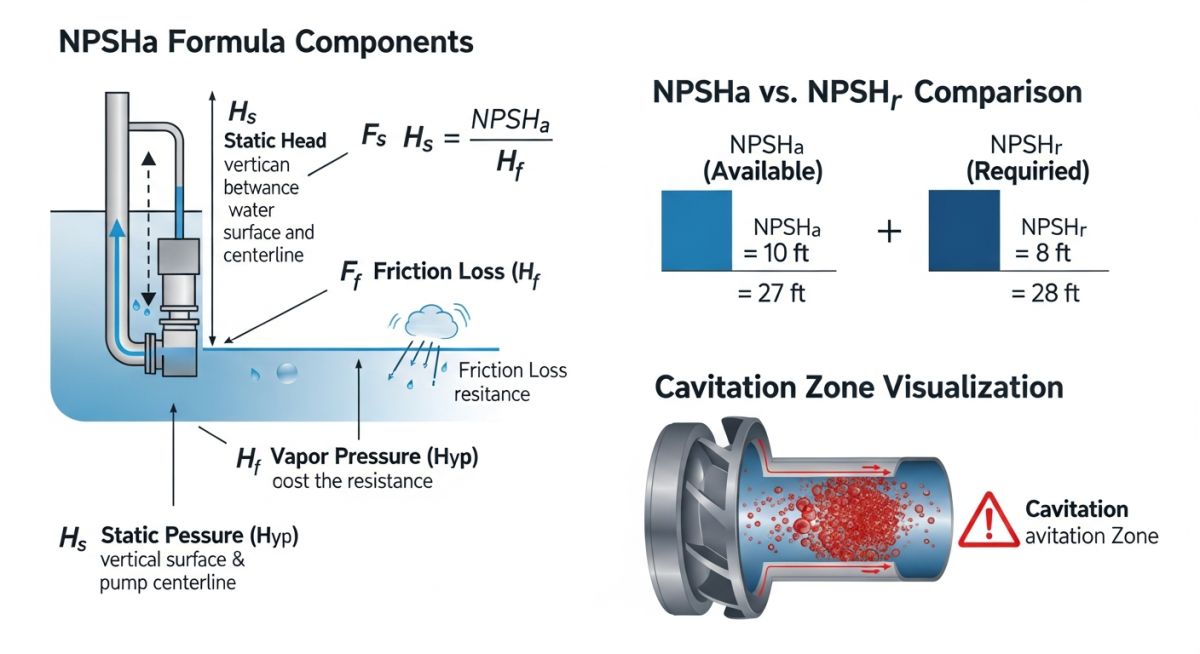
Pump NPSH Calculation Basis: Pump NPSH available is calculated as the net energy head at pump suction minus vapor pressure head of the fluid under operating temperature. This calculation must include static height, friction losses, and absolute pressure consideration based on site elevation.
NPSHa Formula Breakdown:
NPSHa = Absolute Pressure Head + Static Liquid Head − Vapor Pressure Head − Friction Losses
- Absolute Pressure Head: Atmospheric or vessel pressure converted to meters
- Static Head: Elevation difference between liquid surface and pump centerline
- Vapor Pressure Head: Fluid vapor pressure at operating temperature
- Friction Loss: Losses in suction piping including valves and fittings
Typical field mistake I’ve seen: Engineers ignore vapor pressure rise due to temperature. Even a 10°C increase can drastically reduce NPSH margin in hydrocarbons.
Field Warning:
Never use design temperature for vapor pressure calculation during transient operations. Startup and summer conditions often define worst-case NPSH scenarios, not normal operation.
Pump NPSHa versus NPSHr comparison
Pump NPSH Relationship: Pump NPSHa must exceed NPSHr to ensure flow stability through the impeller eye without vapor collapse. NPSHr is determined experimentally by manufacturers as per test standards and reflects minimum safe operating suction head.
From vendor datasheets, NPSHr is measured at a 3% head drop condition. This is already an onset of cavitation—not a safe operating condition. That is why margin is mandatory.
- NPSHa > NPSHr → Stable operation
- NPSHa ≈ NPSHr → Cavitation begins
- NPSHa < NPSHr → Severe damage risk
In critical services like boiler feed pumps, I always recommend designing at least 1 meter margin or 20% higher NPSHa compared to NPSHr.
Pump NPSH parameter reference table data
Pump NPSH Parameters: Pump NPSH depends on multiple hydraulic factors including fluid thermodynamics, piping design, and installation geometry, all of which must be validated against standards such as Hydraulic Institute recommendations.
| Parameter | Typical Range | Impact on NPSH |
|---|---|---|
| Fluid Temperature | 20°C – 200°C | Higher temperature reduces NPSHa |
| Suction Pipe Velocity | 1 – 3 m/s | Higher velocity increases friction loss |
| Static Head | -5 m to +20 m | Higher head improves NPSHa |
| Vapor Pressure | Fluid dependent | Direct deduction from NPSHa |
| Friction Loss | 0.5 – 5 m | Reduces available suction head |
Pump NPSH field validation checklist steps
Pump NPSH Site Verification: Pump NPSH site checks confirm that actual suction conditions match calculated NPSHa values under operating temperature, pressure, and piping losses while complying with API 610 and Hydraulic Institute recommendations. This validation prevents hidden cavitation risk before commissioning and during seasonal operation changes.
In my project commissioning experience, most cavitation failures are not design errors—they are verification failures. Engineers assume design data is preserved, but real site conditions always deviate. This checklist forces you to validate each contributing parameter physically on site.
✅ Pump NPSH Pre-Startup Checklist
- Verify actual liquid level in suction vessel versus design level
- Measure pump centerline elevation from foundation drawing
- Confirm suction line routing matches isometric drawings
- Check all suction valves are fully open and locked
- Ensure suction strainer is clean and not blocked
- Validate piping slopes prevent vapor pocket formation
✅ Pump NPSH Calculation Confirmation
- Calculate actual static head using site measurements
- Confirm fluid temperature using calibrated instruments
- Determine vapor pressure from latest fluid data sheet
- Recalculate friction loss based on installed piping length
- Include minor losses from bends, reducers, and valves
- Convert all pressure values to consistent head units (meters)
✅ Pump NPSH Mechanical Inspection
- Ensure no air ingress points at flanges or seals
- Check suction flange gasket integrity
- Inspect for pipe misalignment causing stress
- Confirm no temporary blinds or restrictions are present
✅ Pump NPSH Operational Checks
- Monitor suction pressure during startup using gauge
- Listen for cavitation noise (crackling sound)
- Observe vibration increase at low suction pressure
- Check for fluctuating discharge pressure
- Track bearing temperature for abnormal rise
Field Insight:
I’ve seen pumps pass factory acceptance tests but fail within days on site. The difference was suction piping deviation and higher fluid temperature than design. Always perform NPSH verification at worst-case operating condition—not ideal condition.
A disciplined Pump NPSH verification approach eliminates guesswork. It ensures that the difference between calculated NPSHa and vendor NPSHr remains positive under all operating scenarios, including startup, shutdown, and summer peak loads.
Field Case Study: Real-World Application
Pump NPSH Case Insight: Pump NPSH failure in operating plants typically originates from mismatch between design assumptions and actual suction conditions, especially temperature-driven vapor pressure rise and piping-induced friction losses as per API 610 guidance.
Problem Observed on Site
During a refinery revamp, a hydrocarbon transfer pump started showing heavy vibration and crackling noise within days of commissioning. The pump had passed factory testing and met all performance curves. However, at site:
- Fluid temperature rose from design 45°C to 62°C
- Suction line had additional undocumented bends
- Measured suction pressure dropped intermittently
- NPSHa reduced below vendor-stated NPSHr
Corrective Action and Outcome
We recalculated NPSHa using actual site data and identified a deficit of nearly 0.8 meters. The solution involved:
- Raising suction vessel level by operational adjustment
- Removing two unnecessary elbows in suction line
- Insulating pipeline to reduce temperature gain
Post-modification, cavitation noise disappeared, vibration reduced significantly, and pump life stabilized. This reinforced a critical lesson: Pump NPSH must always be validated with real field conditions—not static design data.
In my experience, at least 70% of cavitation cases are resolved by correcting suction-side parameters rather than modifying the pump itself. The focus should always remain on NPSHa improvement.
Frequently Asked Engineering Questions
Why Pump NPSH is critical for reliability?
Pump NPSH Importance: Pump NPSH ensures the fluid remains in liquid phase during suction entry preventing vapor bubble formation as defined in Hydraulic Institute standards.
Insufficient NPSH leads to cavitation, which damages impellers, seals, and bearings while reducing efficiency.What is safe NPSH margin in practice?
Safe Margin Rule: Pump NPSH design margin requires NPSHa to exceed NPSHr with a buffer defined by operating variability and testing limits.
Typically 0.5 to 1 meter minimum margin or 20% excess is maintained depending on service severity.How temperature impacts Pump NPSH values?
Temperature Effect: Pump NPSH decreases with temperature rise due to increased vapor pressure of the fluid reducing suction head margin.
Even small temperature variation in hydrocarbons significantly impacts NPSHa.Can suction piping design affect NPSH?
Piping Influence: Pump NPSH strongly depends on suction pipe configuration affecting friction losses and fluid flow stability.
Long runs, high velocity, and excessive fittings reduce NPSHa significantly.How to detect cavitation at early stage?
Early Detection: Pump NPSH failure symptoms appear as noise, vibration, and fluctuating discharge pressure before visible damage occurs.
Monitoring suction pressure trends helps detect issues early.Why factory tested pumps fail on site?
Failure Reason: Pump NPSH issues arise when site conditions differ from controlled factory test setups governed by API 610.
Differences in elevation, piping, and temperature reduce actual NPSHa leading to cavitation.