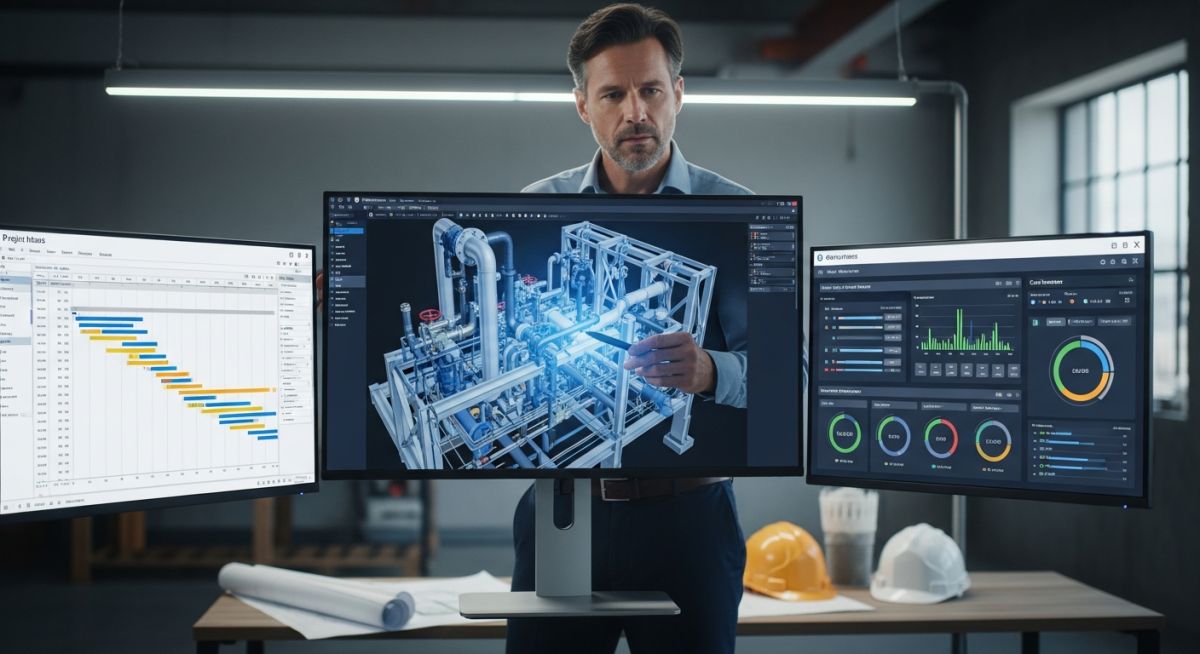
Project Controls Explained: Integrating Cost, Schedule, and Risk
In my two decades of managing complex piping and infrastructure projects, I have observed that the most successful teams are those that treat project controls not as a reporting burden, but as the central nervous system of the project. When we talk about project controls, we are discussing the rigorous application of analytical techniques to predict, understand, and influence the time and cost outcomes of a project.
Without a robust control framework, even the most technically sound engineering design will fail to meet its commercial objectives. I have seen multi-million dollar piping installations stall because the interface between procurement lead times and field installation sequences was not properly synchronized. This guide breaks down the technical mechanics of how we maintain control over these variables.
Key Takeaways for Engineering Success
- Integration of Earned Value Management (EVM) for real-time performance tracking.
- Dynamic forecasting using Critical Path Method (CPM) to identify schedule slippage early.
- Rigorous change management protocols to prevent scope creep in brownfield environments.
- Data-centric risk registers that quantify uncertainty in monetary and temporal terms.
Project Controls Explained: The Technical Framework
Project Controls Explained: This technical framework utilizes standardized metrics such as Cost Performance Index and Schedule Performance Index to quantify project health against the approved baseline.
To effectively manage an industrial project, we must move beyond simple budget tracking. We utilize the AACE International recommended practices to establish a baseline that integrates the Work Breakdown Structure (WBS) with the project schedule. The core of this process is Earned Value Management (EVM), which allows us to compare the Budgeted Cost of Work Performed (BCWP) against the Actual Cost of Work Performed (ACWP).

Calculating Performance Metrics
When I analyze a project’s status, I focus on the Cost Performance Index (CPI) and the Schedule Performance Index (SPI). The CPI is calculated as the ratio of BCWP to ACWP. If the CPI is less than 1.0, the project is over budget. Similarly, the SPI is the ratio of BCWP to the Budgeted Cost of Work Scheduled (BCWS). An SPI below 1.0 indicates that the project is behind the planned schedule.
Field Warning: The Lag Effect
Never rely solely on lagging indicators. In piping construction, the time between material procurement and field installation creates a “data lag.” Always supplement your EVM data with physical progress measurements taken directly from the spool tracking system to ensure your BCWP reflects reality, not just invoice payments.
Risk-Adjusted Forecasting
Forecasting is the art of using current performance to predict the Estimate at Completion (EAC). I typically use the formula EAC = AC + (BAC – BCWP) / CPI, where BAC is the Budget at Completion. This assumes that the current cost inefficiencies will continue for the remainder of the project. For more complex scenarios, we incorporate a Performance Factor (PF) that weights both CPI and SPI to account for schedule-driven cost impacts.
Standardization is critical. We adhere to PMI guidelines for risk management, ensuring that every identified risk in the register has a probability and impact score. This allows us to maintain a management reserve that is statistically defensible rather than based on arbitrary percentages.
Project Controls Implementation: This systematic approach provides the visibility required to make informed decisions, though it requires significant upfront investment in data infrastructure and personnel training.
Advantages
- Early detection of cost overruns through CPI trend analysis.
- Improved stakeholder transparency via standardized reporting formats.
- Objective assessment of contractor performance using earned value metrics.
- Reduced uncertainty through quantitative risk register management.
- Enhanced alignment between procurement, engineering, and construction phases.
Disadvantages
- High administrative overhead for data collection and entry.
- Risk of “analysis paralysis” if metrics are not actionable.
- Requires specialized software proficiency and high-level training.
- Potential for data manipulation if controls are not audited.
- Resistance from field teams who view reporting as non-productive time.
Industrial Project Controls: These methodologies are applied across diverse sectors to ensure that capital-intensive projects remain within their defined financial and temporal constraints.
Refinery Turnaround Management
During major refinery turnarounds, project controls are used to manage thousands of concurrent tasks within a strict shutdown window. By integrating real-time labor tracking with the critical path, we can identify bottleneck activities in the piping replacement sequence before they impact the overall startup date.
Green Hydrogen Plant Construction
The rapid development of hydrogen infrastructure requires precise cost engineering to manage the volatility of specialized material pricing. We apply rigorous change management protocols to track the impact of design iterations on the total installed cost, ensuring that the project remains bankable throughout the construction phase.
Offshore Platform Modification
In the offshore environment, logistics and weather-related delays are the primary drivers of schedule variance. Project controls allow us to model these risks using Monte Carlo simulations, providing a probabilistic range of completion dates that helps in planning vessel mobilization and crew rotations effectively.
Cross-Country Pipeline Expansion
For linear infrastructure projects, project controls focus on the spatial distribution of work fronts and equipment utilization. By tracking the progress of welding and coating crews against the planned linear footage, we can optimize the deployment of resources across multiple work packages to maintain the project’s overall velocity.
In my two decades of managing industrial piping and infrastructure projects, I have found that the efficacy of project controls is entirely dependent on the selection of Key Performance Indicators (KPIs). These metrics serve as the diagnostic tools that allow a project manager to identify variances between the baseline plan and actual field execution before they escalate into critical path delays or budget overruns. By standardizing these metrics across the project lifecycle, we ensure that stakeholders receive consistent, actionable data that aligns with AACE International recommended practices for cost and schedule control.
The following table outlines the primary performance indicators I utilize to maintain project health. These metrics are not merely administrative; they are technical indicators of labor productivity, material procurement efficiency, and financial health. When reviewing these, consider the specific phase of your project, as the weight of these indicators shifts significantly from the Front-End Engineering Design (FEED) phase to the final construction and commissioning stages. Proper implementation requires a robust PMI-aligned reporting structure to ensure that data integrity remains high throughout the project lifecycle.
| Metric | Formula/Definition | Target Threshold |
|---|---|---|
| Schedule Variance (SV) | Earned Value minus Planned Value | Greater than or equal to 0 |
| Cost Performance Index (CPI) | Earned Value divided by Actual Cost | Greater than 1.0 |
| Schedule Performance Index (SPI) | Earned Value divided by Planned Value | Greater than 1.0 |
| Estimate at Completion (EAC) | Actual Cost plus Estimate to Complete | Within 5% of Budget |
Effective project controls require a clear mapping of technical entities to their respective management frameworks. In my experience, the failure to align these entities often leads to “siloed” data, where the cost engineering team and the scheduling team operate on different assumptions. This matrix provides a structural overview of how we categorize project components, ensuring that every element—from piping material procurement to field labor hours—is tracked against a standardized set of industry-recognized codes and management protocols.
By utilizing this matrix, project leads can ensure that their software tools, such as Primavera P6 or SAP, are configured to capture the correct data points. This alignment is vital for maintaining compliance with ISO 21502 project management standards. Whether you are managing a brownfield retrofit or a greenfield refinery construction, the ability to map these entities accurately is the difference between a project that is under control and one that is merely reacting to daily crises.
| Entity | Management Protocol | Standard Reference |
|---|---|---|
| Work Breakdown Structure (WBS) | Scope Definition | PMBOK Guide |
| Cost Account | Budget Allocation | AACE 10R-90 |
| Risk Register | Contingency Management | ISO 31000 |
| Change Order Log | Scope Control | FIDIC Contracts |
Project Controls Implementation: Establishing a robust verification process is the final step in ensuring that your project controls framework is not just a theoretical model, but a functional reality on the job site. I have developed this checklist to help project managers verify that their systems are capturing the necessary data to support informed decision-making. Use this to audit your current project status and identify gaps in your reporting or data collection processes.
-
Baseline Validation: Confirm that the project baseline schedule and budget have been formally approved by all stakeholders and loaded into the project management software. -
WBS Integrity: Verify that the Work Breakdown Structure (WBS) is granular enough to track progress at the discipline level, specifically for piping, electrical, and civil works. -
Change Management Protocol: Ensure that a formal change control process is active, with all potential scope changes documented, quantified, and approved before work commences. -
Risk Register Review: Confirm that the risk register is updated monthly, with mitigation strategies assigned to specific owners and tracked for effectiveness. -
Earned Value Accuracy: Validate that the physical progress measurement rules (e.g., 0/100, 50/50, or weighted milestones) are applied consistently across all subcontractors.
Regular site verification is not a one-time event; it is a continuous cycle of improvement. I recommend conducting these checks at the end of every reporting period to ensure that the data being fed into your dashboards is accurate and reflective of the actual field conditions. If you find discrepancies, investigate the root cause immediately—often, it is a failure in communication between the field supervisors and the office-based controls team.
The Challenge: Uncontrolled Scope Creep in Piping Installation
- Lack of a formal change order process led to undocumented field modifications.
- Piping isometric revisions were being executed without corresponding budget adjustments.
- Subcontractor productivity dropped by 25% due to constant rework and design ambiguity.
- The project schedule slipped by six weeks within the first quarter of construction.
The Outcome: Restoring Project Control and Profitability
- Implemented a strict “No Change Without Approval” policy for all field piping modifications.
- Integrated the design office with the field controls team to synchronize isometric updates.
- Recovered 15% of the lost productivity through improved material staging and clear work packages.
- Successfully brought the project back within 3% of the original budget by the final phase.
This case study highlights the importance of integrating project controls early in the project lifecycle. By establishing clear communication channels and enforcing rigorous change management, we were able to mitigate the impact of scope creep. My recommendation for any project facing similar challenges is to prioritize the establishment of a “single source of truth” for all project data, ensuring that every team member is working from the same set of approved documents and budget constraints.
How do I integrate cost and schedule data effectively?
- Assign budget values to every task in the schedule to create a time-phased budget.
- Use consistent progress measurement rules to ensure that “earned value” reflects actual physical completion.
- Regularly reconcile the cost management system with the scheduling software to identify variances.
- Follow AACE International guidelines for integrated project controls to maintain data integrity.
What is the role of a project controller in piping projects?
- Monitoring piping material procurement status against the construction schedule.
- Tracking labor productivity metrics, such as “welds per day” or “inches of pipe installed.”
- Managing the change order process to ensure that design revisions are captured and costed.
- Providing early warning signals to the project manager when performance deviates from the baseline.
How are risks managed within project controls?
- Perform quantitative risk analysis (QRA) to determine the necessary contingency reserves.
- Assign mitigation owners to each high-impact risk identified in the register.
- Review the register during every monthly project controls meeting to update risk status.
- Ensure that risk-related costs are clearly separated from the base project budget.
What is the difference between EAC and BAC?
- BAC remains static unless there is a formal change in project scope.
- EAC is a dynamic figure that changes as the project progresses and performance data is collected.
- Comparing EAC to BAC allows the project manager to determine if the project is trending toward an overrun.
- EAC calculations should follow PMI standards for accurate forecasting.
How do I handle scope changes in piping projects?
- Document the change request, including the technical justification and impact analysis.
- Quantify the cost and schedule impact before seeking approval from the project sponsor.
- Update the project baseline only after the change has been formally approved.
- Maintain a comprehensive change log to track the history of all scope modifications.
Why is data integrity important in project controls?
- Poor data leads to “garbage in, garbage out” scenarios in forecasting and reporting.
- Consistent data collection ensures that performance metrics are comparable across different project phases.
- High-quality data builds trust with stakeholders and provides a clear audit trail for project expenditures.
- Standardizing data entry processes is essential for maintaining compliance with corporate governance requirements.
Complete Course on
Piping Engineering
Check Now
Key Features
- 125+ Hours Content
- 500+ Recorded Lectures
- 20+ Years Exp.
- Lifetime Access
Coverage
- Codes & Standards
- Layouts & Design
- Material Eng.
- Stress Analysis



