Pour Point of Crude Oil: Definition, Significance, Features, Measurements & Factors
In my 20+ years of piping and pipeline engineering, one property that consistently causes operational surprises is the pour point of crude oil. Many engineers treat it as a laboratory number—but in reality, it directly governs pipeline flow assurance, pump startability, and storage tank performance during winter operations. Ignoring pour point during design has led to shutdowns, wax blockages, and significant financial losses in real EPC projects.
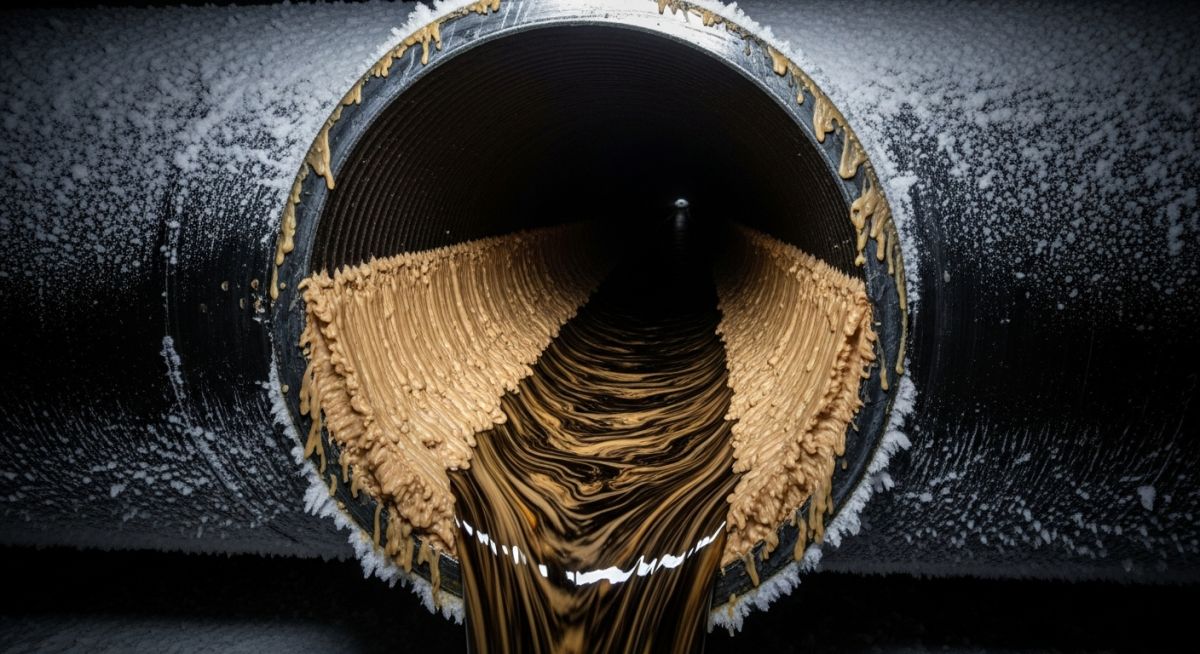
Simply put, the pour point defines the lowest temperature at which crude oil can still flow under specified conditions. Once temperature drops below this limit, wax crystals interlock, and the fluid behaves more like a semi-solid than a liquid—creating major design and operational risks.
💡 Key Engineering Takeaways
- Pour point determines the minimum safe operating temperature of pipelines and storage systems
- High pour point crude oil requires heating systems, insulation, or chemical treatment
- It directly impacts pump selection, especially for cold start conditions
- Wax formation near pour point can cause irreversible pipeline blockage
📌 Quick Answer (50 Words)
The pour point of crude oil is the lowest temperature at which it can still flow. Below this temperature, wax crystallization causes the oil to become semi-solid. It is critical for pipeline design, storage handling, and pump operation, especially in cold environments where flow assurance becomes a major challenge.
Interactive Engineering Quiz
Q1. What does the pour point of crude oil represent?
Complete Course on
Piping Engineering
Check Now
Key Features
- 125+ Hours Content
- 500+ Recorded Lectures
- 20+ Years Exp.
- Lifetime Access
Coverage
- Codes & Standards
- Layouts & Design
- Material Eng.
- Stress Analysis
Definition and Engineering Meaning
In my practical EPC experience, the pour point of crude oil is not just a laboratory value—it is a design constraint. It defines the lowest temperature at which oil can move under gravity. Below this temperature, crude transitions into a gel-like structure due to wax crystal interlocking, ultimately restricting flow in pipelines, valves, and pumps.
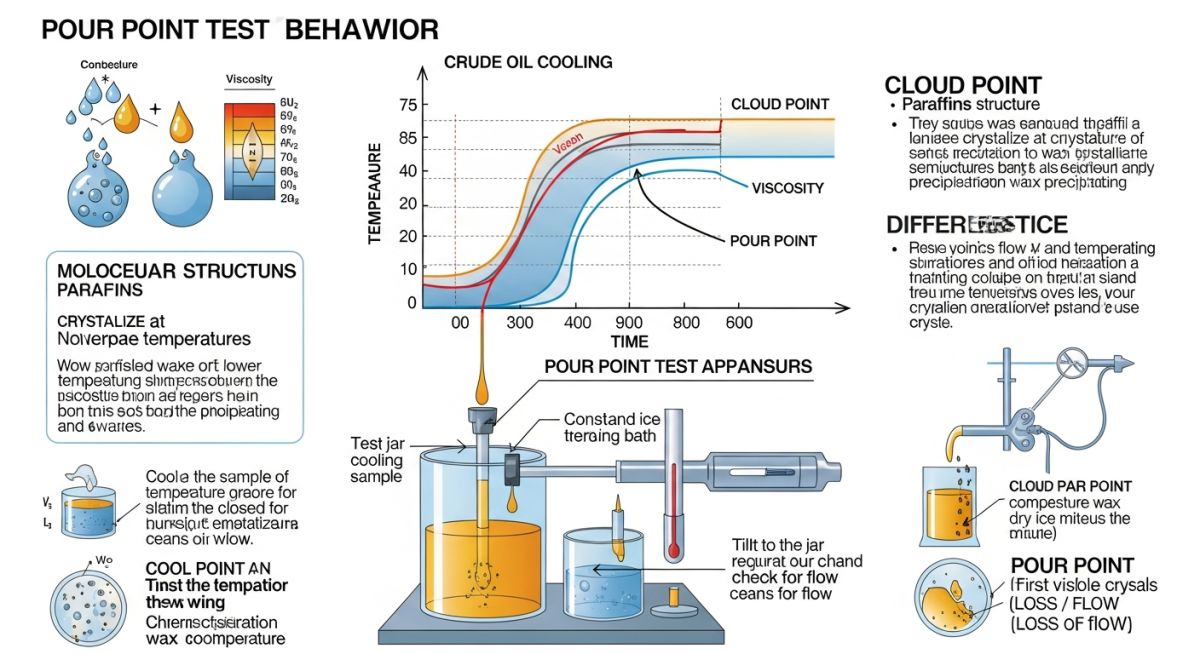
According to ASTM D97 standard, pour point is measured by observing the lowest temperature at which oil movement is detected under controlled cooling.
Significance and Features of Pour Point
- Defines minimum operating temperature for pipelines
- Controls heating system requirements
- Impacts pigging frequency in waxy crude pipelines
- Determines pump start-up feasibility
- Critical for cold climate operations (North India, offshore, Arctic)
Pour Point Measurement Methods
Manual Method (ASTM D97)
In the manual method, crude oil is cooled in a controlled bath and periodically tilted. The temperature at which no movement is observed is recorded as the pour point. This is widely used in laboratories across refineries and EPC projects.
Automatic Method (ASTM D5949)
The automated technique uses optical detection to determine flow cessation. This method provides repeatability and is preferred in modern labs for process control systems. Refer to ASTM D5949 standard for details.
Typical Pour Point Values
Based on my exposure to Indian and Middle Eastern crude oils:
- Light crude oils: -30°C to 0°C
- Medium crude oils: 0°C to 15°C
- Heavy waxy crude oils: 15°C to 40°C
Factors Affecting Pour Point of Crude Oil
- Wax Content: Higher paraffin content → higher pour point
- Cooling Rate: Slow cooling increases wax crystal growth
- Shear History: Mechanical disturbances can delay gel formation
- Additives: Pour point depressants reduce flow restriction
- Storage Conditions: Insulated/Heated tanks prevent solidification
| Crude Type | Typical Pour Point (°C) | Operational Challenge | Recommended Solution |
|---|---|---|---|
| Light Crude | -30 to 0 | Low temperature flow issues | Minimal heating required |
| Medium Crude | 0 to 15 | Partial wax deposition | Insulation + heat tracing |
| Heavy Waxy Crude | 15 to 40 | Pipeline blockage risk | Heating + chemical additives |
| Extra Heavy Crude | >40 | Severe solidification | Continuous heating & specialized pumps |
Field Case Study: Real-World Application
🚨 Problem: Pipeline Blockage During Winter Shutdown
In one of my EPC pipeline projects in North India, we handled a medium-heavy crude with a pour point of ~24°C. During winter shutdown, ambient temperature dropped below 10°C. Since no proper heating or circulation strategy was implemented, wax crystallization started inside the pipeline.
Upon restart, the crude behaved like a semi-solid gel. Pumps tripped repeatedly, pressure surged, and flow was completely blocked. This resulted in nearly 48 hours of production loss and costly mechanical intervention.
- Installed heat tracing along critical pipeline sections
- Minimum temperature maintenance set at Pour Point + 10°C margin
- Startup procedure modified with pre-heating sequence
- Introduced pour point depressant chemicals
👉 My Recommendation: Always design pipeline systems considering shutdown conditions—not just operating conditions. Maintain a safe temperature margin above the pour point and ensure proper restart procedures.
Frequently Asked Engineering Questions
What is the difference between pour point and cloud point?
Which standard defines pour point testing?
How much margin should be kept above pour point in design?
Can pour point be reduced?
Why do pipelines fail below pour point?
What is the best engineering practice for high pour point crude?
