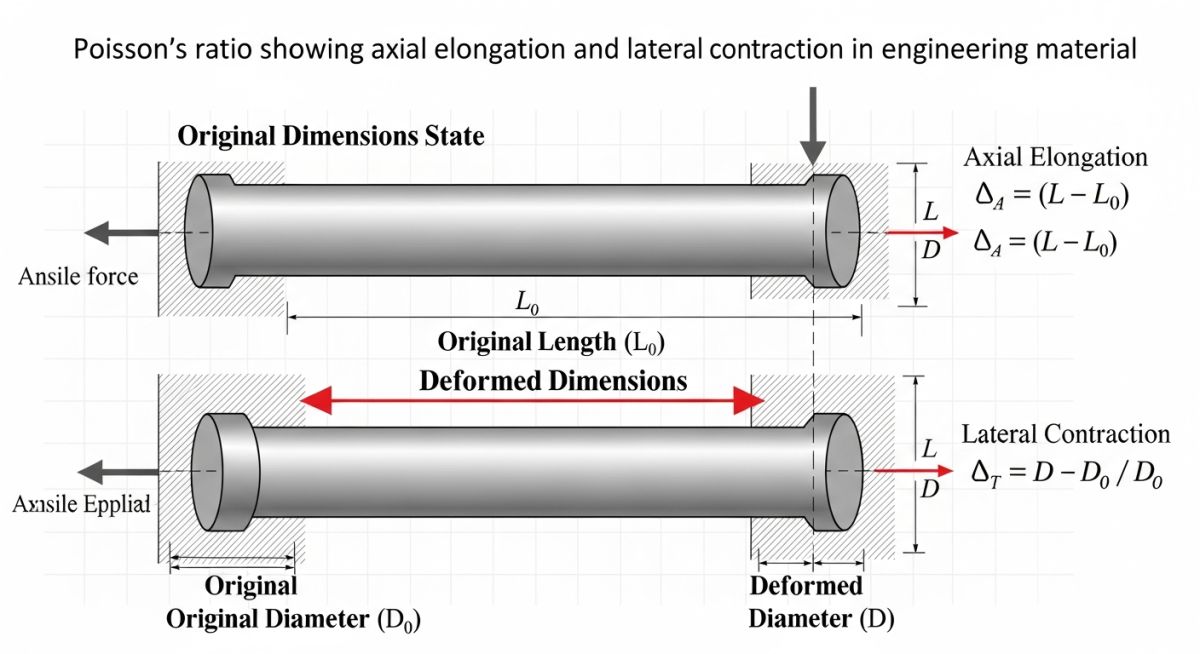
Poisson’s Ratio Explained With Formula, Examples and Engineering Significance
In my 20+ years of EPC and piping engineering—especially while working on high-temperature systems in methanol plants and ZLD pipelines—I’ve seen Poisson’s ratio ignored far too often during design reviews. On paper, it looks like a simple ratio. But on-site, it decides whether your pipe support will crack, your anchor load will fail, or your flow capacity will suddenly drop.
I still remember a case during a plant expansion where a minor assumption error in Poisson’s ratio led to anchor overstressing and redesign of multiple piping supports. That experience changed how I evaluate material deformation forever. This guide is built not just from textbooks—but from real engineering failures and corrections.
Key Engineering Takeaways
- Poisson’s ratio links axial elongation with lateral contraction in real-world materials.
- Incorrect values can lead to pipe stress failures and equipment misalignment.
- Steel typically uses ~0.3, while plastics like HDPE go as high as 0.42.
- Critical for pipe stress analysis under ASME B31.3 design conditions.
- Directly impacts anchor loads, thermal expansion behavior, and deformation limits.
Interactive Engineering Quiz
Q1. What does Poisson’s ratio indicate?
Complete Course on
Piping Engineering
Check Now
Key Features
- 125+ Hours Content
- 500+ Recorded Lectures
- 20+ Years Exp.
- Lifetime Access
Coverage
- Codes & Standards
- Layouts & Design
- Material Eng.
- Stress Analysis
What is Poisson’s Ratio in Real Design
Poisson’s Ratio: Poisson’s ratio defines the ratio between lateral strain and axial strain for a material under load, and it governs how materials deform in stress analysis models used in standards like ASME and ASTM.
In real plant design—especially in piping and structural modeling—you never deal with pure elongation. Whenever a pipe expands due to pressure or temperature, it shrinks in diameter. That shrinkage is what Poisson’s ratio captures.
In my piping stress reviews, this ratio directly affects:
- Anchor load calculations
- Nozzle load transfer to equipment
- Pipe ovalization under pressure
- Thermal expansion flexibility checks
Poisson’s Ratio Formula and Full Derivation
Poisson’s Ratio Formula: Poisson’s ratio is calculated as the ratio of lateral strain to longitudinal strain and must be used with correct sign convention and deformation direction for code-compliant stress calculations.
Start with strain definitions:
- Longitudinal strain = change in length divided by original length
- Lateral strain = change in diameter divided by original diameter
Step-by-step representation:
Longitudinal strain = (l − l₀) / l₀ Lateral strain = (d − d₀) / d₀
Therefore:
Poisson’s ratio = (lateral strain) ÷ (longitudinal strain)
Rearranged form used in engineering calculations:
Poisson’s ratio = l₀(d − d₀) / d₀(l − l₀)
In piping software like CAESAR II, this value is embedded into material properties and directly impacts stiffness matrices used for stress evaluation.
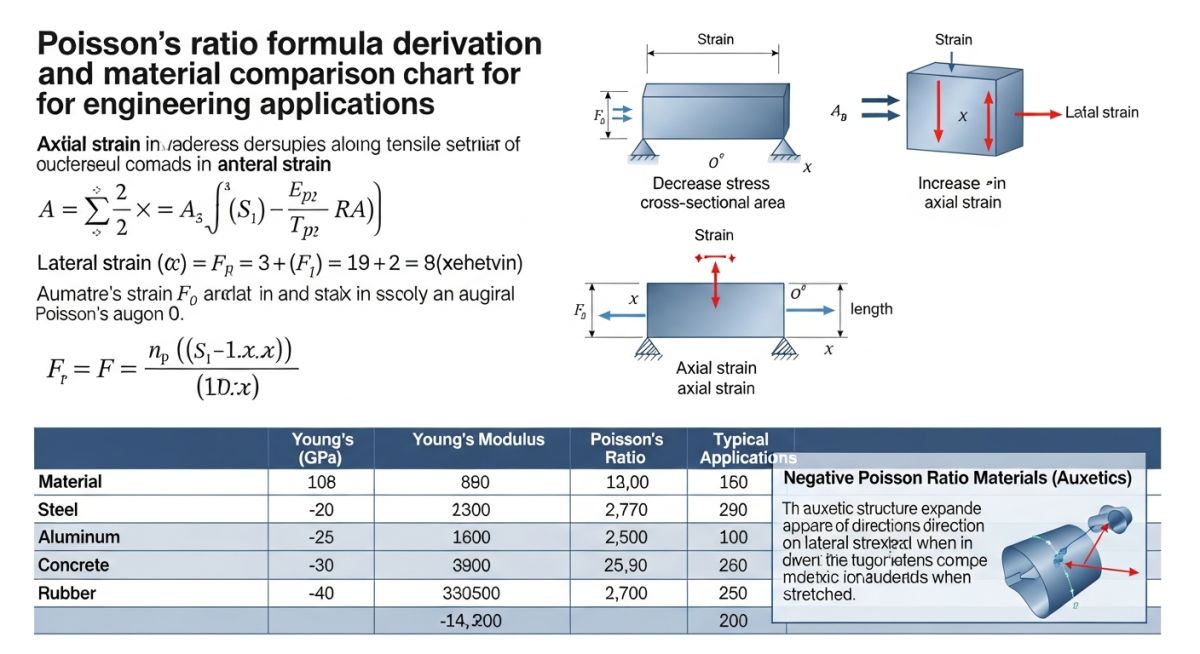
| Material | Poisson’s Ratio | Engineering Relevance |
|---|---|---|
| Carbon Steel | 0.28 – 0.30 | Used in ASME B31.3 piping design |
| Aluminium | ~0.33 | Lightweight structural systems |
| Concrete | 0.15 – 0.20 | Foundation stress analysis |
| Rubber | 0.48 – 0.50 | Nearly incompressible material |
| HDPE | 0.40 – 0.45 | Used in ZLD and utility pipelines |
| Parameter | Symbol | Relation | Engineering Impact |
|---|---|---|---|
| Poisson’s Ratio | ν | Lateral strain / Longitudinal strain | Controls deformation behavior |
| Young’s Modulus | E | Stress / Strain | Defines stiffness |
| Shear Modulus | G | E / 2(1 + ν) | Used in torsion calculation |
| Bulk Modulus | K | E / 3(1 − 2ν) | Material compressibility assessment |
How to Validate Poisson’s Ratio On Site
Poisson’s Ratio Validation: Poisson’s ratio must be verified against material specifications, design software inputs, and applicable engineering codes to ensure deformation and stress results are accurate for real operating conditions.
In my EPC work across piping and structural systems, I’ve seen that Poisson’s ratio errors usually come not from theory—but from wrong assumptions in software libraries, vendor data sheets, or material substitutions during procurement.
This checklist reflects what I personally verify during design review, stress analysis validation, and site audit for projects like methanol plants and ZLD systems.
✅ Engineering Verification Checklist
- Material Property Confirmation: Verify Poisson’s ratio from approved material standards (mill test certificate or datasheet). Example: Carbon steel should be in the range of 0.28 to 0.30.
- Consistency in Stress Analysis Software: Check that CAESAR II or equivalent tool is using correct Poisson’s ratio for each material class. One wrong entry can impact the entire stiffness matrix.
- Thermal Expansion Interaction Check: Ensure Poisson’s ratio is factored while evaluating thermal expansion-induced diameter reduction in high-temperature lines.
- Anchor Load Sensitivity Review: Validate whether anchor loads change significantly with Poisson’s ratio variation. Perform sensitivity check ±0.05 range.
- Plastic and HDPE Pipeline Validation: For ZLD systems, confirm higher values (0.40 to 0.45). This directly affects flow area and pressure drop calculations.
- FEM Model Boundary Conditions: In structural or foundation FEM analysis, verify Poisson’s ratio is correctly linked to material elasticity models.
- Code Compliance Check: Ensure values align with relevant codes such as ASME B31.3 and material standards.
- Vendor Data Cross-Verification: Cross-check OEM equipment models (compressors, vessels) where Poisson’s ratio is internally used for nozzle load evaluation.
- Negative Ratio Material Check: If using advanced or composite materials, verify if auxetic behavior exists and confirm test data before input.
- Units and Sign Convention Check: Confirm that sign (negative for contraction) is handled correctly in simulation results interpretation.
From experience, following this checklist has prevented anchor failures, avoided unnecessary redesigns, and saved weeks of rework during commissioning phases.
What Is Negative Poisson’s Ratio Behavior
Negative Poisson’s Ratio: Negative Poisson’s ratio refers to materials that expand laterally when stretched, exhibiting auxetic behavior that deviates from classical elastic deformation assumptions in standard engineering codes.
In conventional materials like steel and aluminum, when you stretch them, their diameter reduces. But in auxetic materials, the structure behaves differently due to internal geometry, not just composition.
While rare in standard EPC projects, you may encounter such behavior in:
- Special composite linings
- Advanced insulation materials
- High-performance structural panels
Why Poisson’s Ratio Matters in Design
Engineering Importance: Poisson’s ratio directly influences deformation compatibility, stress redistribution, and load transfer behavior across interconnected systems such as piping, structures, and rotating equipment.
From my project experience, ignoring this parameter leads to more real failures than textbook errors.
- Pipe support overstress due to unaccounted contraction
- Nozzle failure from incorrect stress transmission
- Foundation cracks from multi-directional strain interaction
- Reduced flow in HDPE pipelines
What Happens When Ratio Equals Zero
Zero Poisson’s Ratio Meaning: When Poisson’s ratio is zero, there is no lateral deformation under axial loading, meaning material stretches without shrinking or expanding in cross-section.
This is theoretical for most materials but useful in understanding ideal deformation conditions used in simulation boundary checks.
Field Case Study: Real-World Application
I strongly recommend always validating material data before final stress submission. Even small assumptions in Poisson’s ratio can cascade into system-wide design inaccuracies.
