Mastering Pipeline Engineering Interview Questions for Career Success
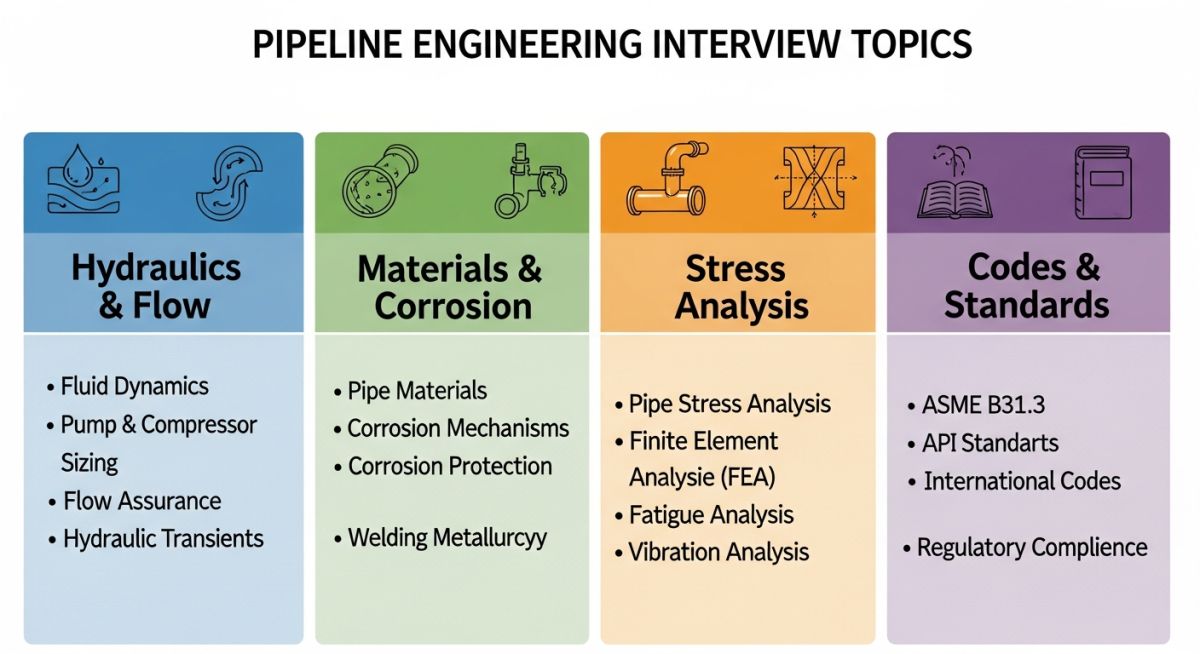
In my two decades of leading pipeline engineering teams across major oil and gas projects, I have sat on both sides of the interview table. I have noticed that candidates who struggle often fail not because they lack general engineering knowledge, but because they cannot bridge the gap between theoretical formulas and the practical realities of codes like ASME B31.4 and ASME B31.8.
When I interview a pipeline engineer, I am not just looking for someone who can memorize equations. I want to see an engineer who understands why we use specific design factors, how soil-pipe interaction affects stress analysis, and how to safely manage transient pressures. This guide is designed to prepare you for those exact high-level technical discussions.
Key Takeaways for Your Interview
- Master the application of Barlow’s formula and understand how class locations dictate design factors.
- Be prepared to explain the distinct differences between liquid transport codes and gas transmission codes.
- Understand the practical execution of hydrostatic testing, including temperature stabilization and pressure hold times.
- Demonstrate a clear understanding of cathodic protection and pipeline corrosion mitigation strategies.
Complete Course on
Piping Engineering
Check Now
Key Features
- 125+ Hours Content
- 500+ Recorded Lectures
- 20+ Years Exp.
- Lifetime Access
Coverage
- Codes & Standards
- Layouts & Design
- Material Eng.
- Stress Analysis
How to Answer Pipeline Engineering Interview Questions Successfully
To excel in a technical interview, you must demonstrate a deep understanding of the fundamental equations governing pipeline design. The most common calculation you will be asked to perform or explain is the determination of nominal wall thickness using Barlow’s Formula.
Barlow’s Formula is expressed as: t = (P * D) / (2 * S * F * E * T)
Where:
• t is the nominal wall thickness (inches or millimeters).
• P is the internal design pressure (psig or bar).
• D is the nominal outside diameter of the pipe (inches or millimeters).
• S is the specified minimum yield strength (SMYS) of the pipe material (psi or MPa).
• F is the design factor (dimensionless, determined by class location).
• E is the longitudinal joint factor (dimensionless, typically 1.0 for seamless or ERW pipe).
• T is the temperature derating factor (dimensionless, 1.0 for temperatures below 250 degrees Fahrenheit).
In my experience, the design factor (F) is where many candidates slip up. For gas pipelines governed by ASME B31.8, this factor changes based on the population density surrounding the pipeline, known as Class Locations.
Understanding Stress States
An interviewer will often ask you to explain the difference between hoop stress and longitudinal stress. Hoop stress acts circumferentially around the pipe wall, trying to burst the pipe open. Longitudinal stress acts along the longitudinal axis of the pipe, caused by internal pressure, temperature changes, and external bending moments.
For buried pipelines, soil restraint prevents the pipe from expanding or contracting longitudinally due to temperature changes. This restraint induces significant thermal stress, which must be combined with pressure-induced longitudinal stress and evaluated against the allowable limits defined in the codes.
| Class Location | Description / Population Density | Standard Design Factor (F) | Road / Railroad Crossings |
|---|---|---|---|
| Class 1 | Offshore or areas with 10 or fewer buildings intended for human occupancy. | 0.72 | 0.60 / 0.50 |
| Class 2 | Areas with more than 10 but fewer than 46 buildings. | 0.60 | 0.50 |
| Class 3 | Areas with 46 or more buildings, or areas where public assembly occurs. | 0.50 | 0.50 |
| Class 4 | Areas where multi-story buildings are prevalent (heavy urban areas). | 0.40 | 0.40 |
| Parameter | Liquid Pipelines (ASME B31.4) | Gas Pipelines (ASME B31.8) | Reference Standard |
|---|---|---|---|
| Primary Design Factor | Typically 0.72 (up to 0.80 under specific conditions) | Variable (0.40 to 0.72) based on Class Location | ASME Codes |
| Hydrostatic Test Pressure | Minimum 1.25 times the Maximum Operating Pressure (MOP) | 1.1 to 1.5 times the MAOP depending on Class Location | API RP 1110 / ASME B31.8 |
| Surge Allowance | 10% over MOP (up to 110% MOP permitted during transients) | 10% over MAOP (up to 110% MAOP permitted during transients) | ASME B31.4 / B31.8 |
| Corrosion Allowance | Typically 1.5 mm to 3.0 mm depending on fluid corrosivity | Often 0 mm for dry gas, but 1.5 mm for wet/sour gas | NACE SP0169 |
Essential Checklist for Pipeline Engineering Interview Questions Prep
Before stepping into your interview, review this checklist to ensure you can confidently discuss field operations and design verification steps. These are the exact areas I focus on when evaluating senior engineering candidates.
-
Barlow’s Formula Mastery: Can you write out and explain every variable in Barlow’s formula, including how temperature and joint factors affect the calculation?
-
Class Location Definitions: Are you able to define Class 1, 2, 3, and 4 locations per ASME B31.8 and explain how they impact the design factor?
-
Hydrostatic Testing Parameters: Do you know the minimum test pressure and hold duration (typically 8 hours) for liquid and gas pipelines?
-
Cathodic Protection Criteria: Can you explain the -850 mV copper-copper sulfate reference electrode criteria for protecting buried steel pipelines?
-
Pigging Operations: Are you prepared to discuss the differences between utility pigs (cleaning, batching) and smart pigs (MFL, UT) for inline inspection?
Field Case Study: Real-World Application
The Problem: Transient Surge Overpressure
During the commissioning of a 24-inch crude oil pipeline, transient hydraulic modeling indicated that an emergency shutdown (ESD) valve closure at the terminal would cause a pressure surge exceeding the pipeline’s Maximum Operating Pressure (MOP) by 25%. This violated the ASME B31.4 code, which strictly limits transient overpressure to 10% above MOP.
The Outcome: Surge Mitigation & Code Compliance
As the lead engineer, I redesigned the system to include a fast-acting nitrogen-loaded surge relief valve system at the terminal. We also optimized the ESD valve closure profile, changing it from a linear 15-second closure to a two-stage closure (fast for the first 80%, slow for the final 20%). This successfully reduced the peak surge pressure to 106% of MOP, fully complying with ASME B31.4 and saving the client from installing expensive thick-walled pipe sections.
Expert Recommendation: When asked about surge analysis in an interview, always emphasize that wall thickness should not be the default solution for surge. Active mitigation (surge relief valves) and operational controls (valve closure timing) are far more cost-effective and elegant engineering solutions.
Frequently Asked Engineering Questions
1. What is the difference between ASME B31.4 and ASME B31.8?
2. How do you define MAOP and how does it differ from Design Pressure?
3. What is the purpose of a pig launcher and receiver?
4. How does cathodic protection prevent pipeline corrosion?
5. What is the significance of the D/t ratio in pipeline design?
6. How do you perform a hydrostatic test on a newly constructed pipeline?