
Is Aluminum Magnetic? Engineering Guide to Paramagnetic Materials
In my 20-plus years of managing piping systems and structural alloy selection for high-spec industrial plants, I have repeatedly encountered misconceptions regarding how non-ferrous metals behave around magnetic fields. Many junior engineers assume that because a metal is highly conductive, it must also be magnetic. This is a costly misunderstanding, especially when designing systems near high-frequency induction equipment, magnetic resonance imaging (MRI) structures, or sensitive electrical enclosures.
Aluminum is a remarkable material. It is lightweight, highly conductive, and exceptionally corrosion-resistant. However, when it comes to magnetism, it behaves very differently from ferromagnetic metals like iron, nickel, or cobalt. Understanding these subtle electromagnetic interactions is not just an academic exercise; it is a fundamental requirement for ensuring structural integrity and system safety in modern industrial environments.
Key Engineering Takeaways
- Aluminum is strictly paramagnetic, displaying a magnetic susceptibility of only 2.2 times 10 to the power of negative 5.
- It does not retain residual magnetism, making it ideal for shielding sensitive electronic components.
- Moving magnetic fields induce eddy currents in aluminum, creating temporary magnetic forces used in industrial sorting and braking systems.
- Alloy composition, such as iron impurities in lower-grade aluminum, can slightly alter magnetic permeability.
Complete Course on
Piping Engineering
Check Now
Key Features
- 125+ Hours Content
- 500+ Recorded Lectures
- 20+ Years Exp.
- Lifetime Access
Coverage
- Codes & Standards
- Layouts & Design
- Material Eng.
- Stress Analysis
Why Is Aluminum Magnetic Only Under Extreme Fields?
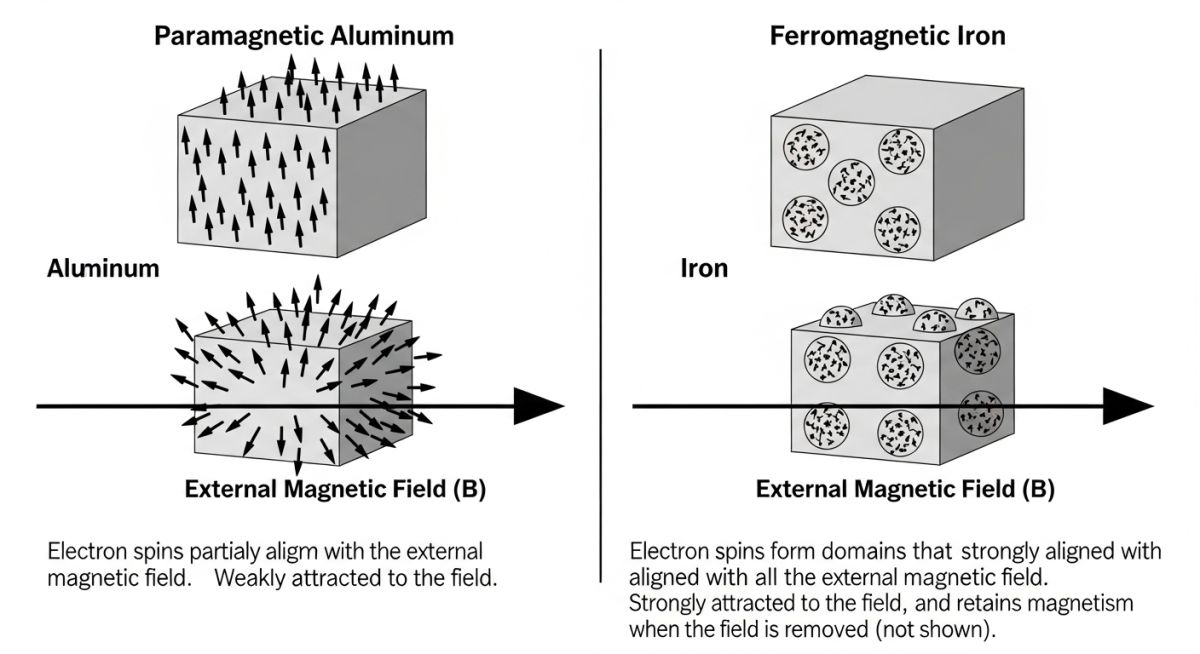
To understand why aluminum behaves this way, we must look at its atomic structure. Aluminum has an atomic number of 13, with an electron configuration of 1s2 2s2 2p6 3s2 3p1. The single unpaired electron in the outer 3p shell is the source of its paramagnetism. When an external magnetic field is applied, these unpaired spins align with the field, creating a weak attractive force.
However, thermal agitation at room temperature easily disrupts this alignment. The magnetic susceptibility (represented by the Greek letter chi) of aluminum is incredibly small:
This means that the induced magnetic field inside the aluminum is only about 0.0022 percent of the strength of the applied external field. In comparison, ferromagnetic materials like structural carbon steel have magnetic susceptibilities in the thousands.
The Role of Eddy Currents and Lenz’s Law
While aluminum does not attract static magnets, it interacts dynamically with moving magnetic fields. Because aluminum is an excellent electrical conductor (with an electrical conductivity of approximately 3.5 times 10 to the power of 7 Siemens per meter), a changing magnetic field induces electric currents within the metal. These are known as eddy currents.
According to Lenz’s Law, these induced currents generate their own magnetic field that directly opposes the change in the original magnetic field. This creates a temporary magnetic drag or repulsive force. This phenomenon is widely utilized in:
- Eddy Current Separators: Used in recycling facilities to separate non-ferrous aluminum cans from municipal waste.
- Magnetic Braking Systems: Employed in high-speed trains and amusement park rides for smooth, wear-free deceleration.
- Induction Heating: Where high-frequency magnetic fields generate localized heat within the aluminum structure for welding or forming.
In my field experience, engineers often specify aluminum in magnetic environments without considering galvanic coupling. If aluminum is placed in direct contact with ferromagnetic steel fasteners in a damp environment, the resulting galvanic cell will rapidly corrode the aluminum. Always use non-magnetic stainless steel fasteners (such as Grade 316) with insulating washers to prevent this catastrophic failure mode, in compliance with ASME B31.3 guidelines.
To assist in material selection for electromagnetic and structural applications, the table below compares the magnetic susceptibility, relative permeability, and typical industrial classification of common engineering metals under standard conditions.
| Metal / Alloy | Magnetic Susceptibility (chi) | Relative Permeability (mu_r) | Magnetic Classification | Standard Reference |
|---|---|---|---|---|
| Aluminum (Pure) | 2.2 x 10^-5 | 1.000022 | Paramagnetic | ASTM B209 |
| Copper | -9.6 x 10^-6 | 0.999990 | Diamagnetic | ASTM B152 |
| Stainless Steel 316 | 3.0 x 10^-3 to 1.0 x 10^-2 | 1.003 to 1.010 | Weakly Paramagnetic | ASTM A240 |
| Carbon Steel (1020) | 2,000 to 5,000 | 2,000 to 5,000 | Ferromagnetic | ASTM A36 |
This matrix maps the core technical entities, structural acronyms, and physical parameters associated with aluminum alloys in electromagnetic design environments.
| Entity / Parameter | Acronym | Physical Value / Range | Engineering Significance | Standard Reference |
|---|---|---|---|---|
| Magnetic Permeability | mu (µ) | 1.2566 x 10^-6 H/m | Indicates the material’s ability to support a magnetic field. | IEEE Std 100 |
| Electrical Conductivity | IACS | 35% to 62% IACS | Determines the magnitude of induced eddy currents. | ASTM E1004 |
| Eddy Current Penetration | Skin Depth (delta) | 2.0 to 8.0 mm (at 1 kHz) | Defines the depth to which electromagnetic fields penetrate. | ASNT CP-189 |
How to Verify Non-Magnetic Aluminum Alloys
When receiving aluminum shipments on-site for projects requiring strict non-magnetic performance, I always enforce a rigorous quality control protocol. Contamination during the casting or extrusion process can introduce iron particles, which can compromise the material’s paramagnetic behavior. Use this checklist to verify your materials before installation.
On-Site Quality Control Checklist
-
1. Review Material Test Reports (MTRs)
Verify that the chemical composition complies with ASTM B209. Ensure that iron (Fe) impurities do not exceed 0.5% by weight, as higher iron content can induce localized magnetic hotspots. -
2. Perform a Static Magnet Test
Pass a high-strength neodymium magnet (Grade N52) within 2 mm of the aluminum surface. There should be zero detectable static attraction. Any physical pull indicates iron contamination or an incorrect alloy grade. -
3. Conduct Eddy Current Testing (ECT)
For critical structural components, use an eddy current conductivity meter to verify the electrical conductivity matches the specified alloy temper (e.g., 6061-T6 should measure approximately 40% to 45% IACS). -
4. Inspect for Surface Contamination
Ensure that the aluminum has not been processed using carbon steel grinding wheels or wire brushes. Iron particles embedded in the surface will rust and create localized magnetic fields. -
5. Verify Permeability with a Low-Mu Meter
In extremely sensitive applications (such as scientific laboratories or MRI rooms), use a calibrated low-mu permeability meter to confirm the relative magnetic permeability is less than 1.0001.
Field Case Study: Real-World Application
During the commissioning of a major silicon wafer processing plant, the engineering team reported severe electromagnetic interference (EMI) and unexpected structural vibration near the high-frequency induction furnaces. The structural supports, which were specified as non-magnetic, were vibrating violently whenever the furnaces cycled. Upon inspection, I discovered that the contractor had substituted the specified high-purity 6061-T6 aluminum structural channels with a cheaper, uncertified import alloy. The imported material contained high levels of iron impurities (exceeding 1.8% Fe), which caused the structural members to react to the intense alternating magnetic fields.
I immediately ordered a halt to operations and initiated a comprehensive material verification program using portable X-ray fluorescence (XRF) analyzers. We identified and replaced all contaminated structural channels with certified domestic 6061-T6 aluminum complying with ASTM B209. Once the certified, low-iron aluminum supports were installed, the structural vibrations ceased entirely, and the EMI levels dropped back within acceptable operating limits. This intervention saved the client an estimated 150,000 per day in potential production downtime.
My direct recommendation for any project involving high-frequency electromagnetic fields is to mandate independent material testing at the receiving dock. Never rely solely on paper mill certificates, especially when sourcing from unverified supply chains.
Answering the Question: Is Aluminum Magnetic?
Does aluminum stick to a magnet?
Why does aluminum slide slowly down a copper pipe or near a magnet?
Can aluminum become magnetic under any circumstances?
What is the difference between paramagnetic and ferromagnetic materials?
Is aluminum safe to use in MRI rooms?
Which aluminum alloys are the least magnetic?
