Table of Contents
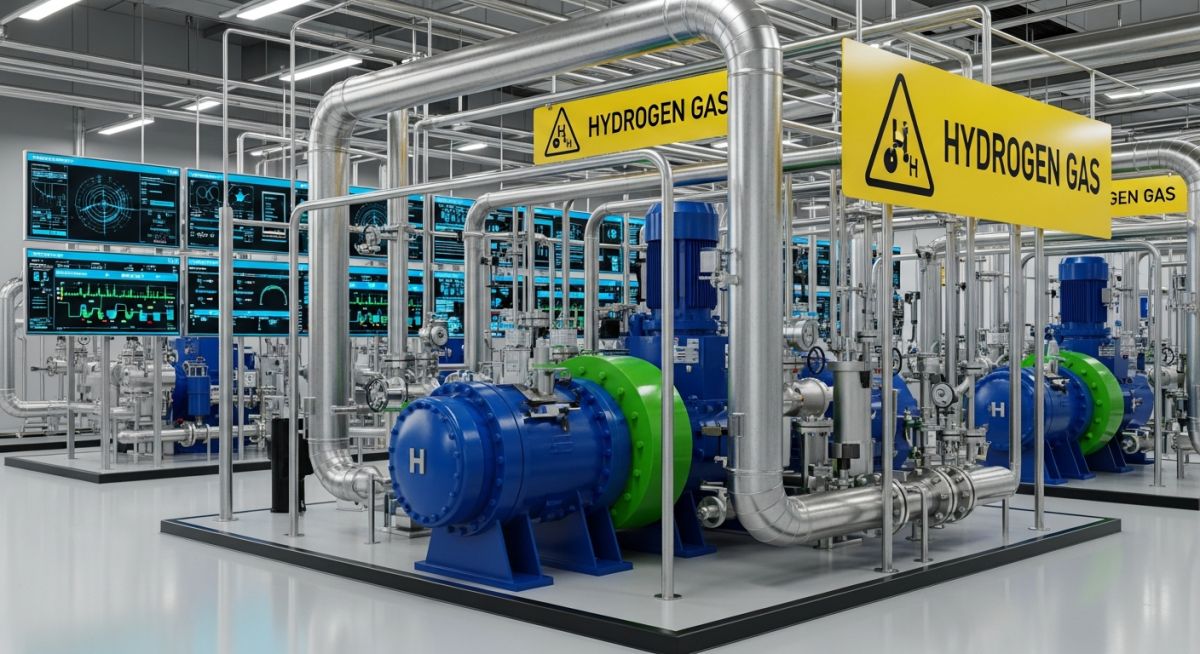
Mastering Hydrogen Compression Systems: Engineering Design, Selection, and Safety
In my 20 years of piping and process engineering, I have seen many engineers underestimate hydrogen. They treat it like natural gas or nitrogen, only to face catastrophic seal failures, embrittled piping, or massive efficiency losses. Hydrogen is a unique beast. With a molecular weight of just 2.016 grams per mole, it is the lightest and smallest molecule in the universe. It slips through microscopic leak paths that would easily contain heavier gases, and it actively degrades high-strength steels.
When designing or selecting compression systems for hydrogen service, you cannot rely on standard off-the-shelf solutions. You must understand the thermodynamic realities of compressing a gas with high thermal conductivity and low density. In this guide, I will share the practical engineering principles, material selection rules, and safety protocols that I have used to deliver reliable, high-pressure hydrogen systems across the globe.
What You Will Learn in This Guide:
- The thermodynamic fundamentals of hydrogen compression and why temperature management is a major challenge.
- A deep comparison of Reciprocating, Diaphragm, and Centrifugal compressors for hydrogen service.
- Critical material selection rules to prevent hydrogen embrittlement in high-pressure piping and compressor components.
- Real-world field verification checklists and safety protocols based on API and ASME standards.
Why Hydrogen Compression Systems Require Special Design
To understand why hydrogen requires specialized compression, we must look at its physical and thermodynamic properties. Hydrogen has an extremely low density (0.089 grams per liter at standard conditions). This means that to store or transport a practical mass of hydrogen, we must compress it to very high pressures—often between 350 to 700 bar for mobility applications, and 50 to 100 bar for pipeline transmission.
The Thermodynamics of Hydrogen Compression
Hydrogen has a high ratio of specific heats (k = Cp / Cv = 1.41). When you compress hydrogen, this high k-value leads to a rapid rise in temperature during the compression cycle. The theoretical discharge temperature for an isentropic compression stage can be calculated using the following formula:
Where:
– T1 is the absolute suction temperature (Kelvin)
– T2 is the absolute discharge temperature (Kelvin)
– P1 is the suction pressure (absolute)
– P2 is the discharge pressure (absolute)
– k is the ratio of specific heats (1.41 for hydrogen)
Because of this rapid temperature rise, single-stage compression to high pressures is impossible without destroying seals and risking auto-ignition. In my practice, I limit the compression ratio per stage to a maximum of 2.5 to 3.0. This keeps the discharge temperature well below the industry-standard limit of 135 degrees Celsius (275 degrees Fahrenheit) specified in API 618. Multi-stage compression with highly efficient interstage water-cooling is mandatory.
Never use high-strength carbon steels (tensile strength greater than 800 MPa) for components in contact with high-pressure hydrogen. Hydrogen atoms will diffuse into the metal lattice, causing micro-cracking and sudden, catastrophic brittle failure. I always specify low-carbon austenitic stainless steels, such as 316 or 316L, with a minimum nickel content of 12% to ensure material stability.
Comparing Compressor Technologies
Three main types of compressors dominate hydrogen service:
- Reciprocating Compressors (API 618): These are the workhorses of the industry. They use pistons and valves to compress gas. They are highly efficient at high pressure ratios but require extensive maintenance due to moving seals, piston rings, and rider bands. For hydrogen, they must be designed with non-lubricated cylinders to prevent oil contamination of the gas.
- Diaphragm Compressors: A subset of reciprocating compressors, these use a flexible metal diaphragm driven by hydraulic fluid to compress the gas. Because the gas is completely isolated from the hydraulic oil and the environment by static metal seals, they offer zero leakage and zero contamination. They are the absolute standard for high-purity hydrogen fueling stations up to 1000 bar, though their flow capacity is limited.
- Centrifugal Compressors (API 617): These dynamic compressors use high-speed impellers to add kinetic energy to the gas. Because hydrogen has an incredibly low molecular weight, a centrifugal compressor must run at extremely high tip speeds (often exceeding 400 meters per second) or use dozens of stages to achieve a reasonable pressure ratio. They are best suited for very high-flow, low-pressure-ratio applications, such as pipeline transmission.
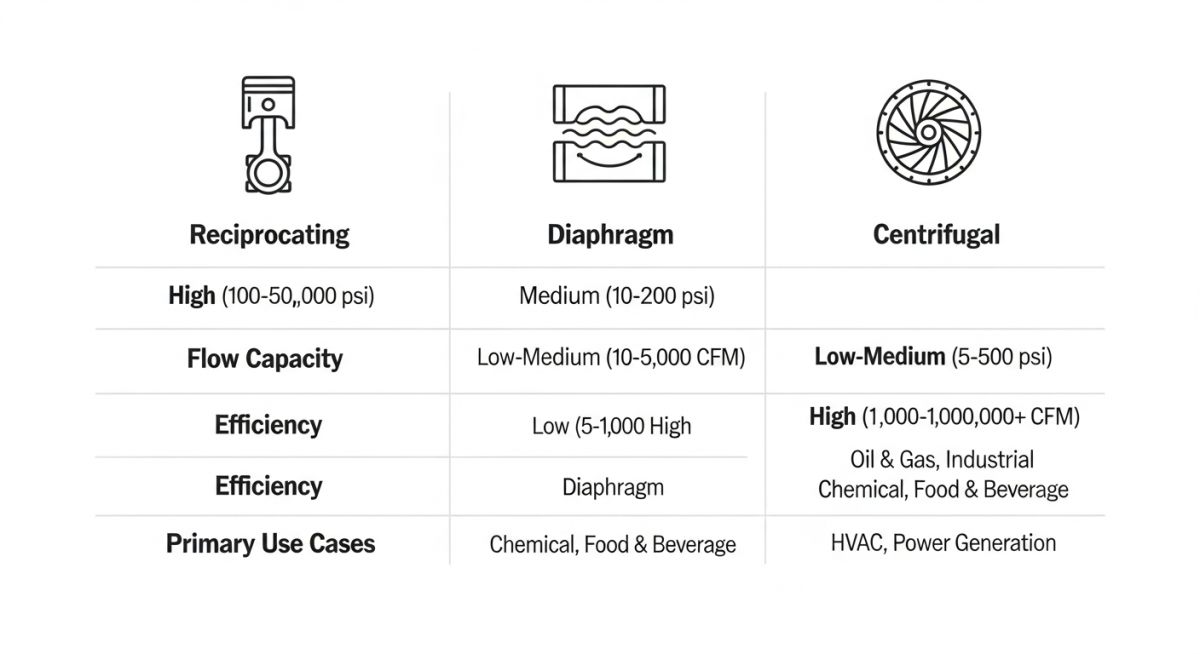
The table below provides a direct comparison of the three primary compressor technologies used in industrial hydrogen systems. Use these parameters during the front-end engineering design (FEED) phase to align your process requirements with the correct equipment class.
| Parameter | Reciprocating (API 618) | Diaphragm (API 618/617) | Centrifugal (API 617) |
|---|---|---|---|
| Max Discharge Pressure | Up to 500 bar | Up to 1,000+ bar | Up to 100 bar |
| Flow Capacity Range | Medium to High (100 – 10,000 Nm³/h) | Low to Medium (10 – 1,000 Nm³/h) | Very High (10,000 – 100,000+ Nm³/h) |
| Gas Purity Level | Moderate (Risk of seal wear particles) | Ultra-High (100% oil/particle free) | High (Dry gas seals required) |
| Isentropic Efficiency | 70% – 80% | 60% – 70% | 75% – 85% (At design point) |
| Maintenance Interval | 2,000 – 4,000 hours (Valves/Seals) | 4,000 – 8,000 hours (Diaphragm) | 24,000 – 48,000 hours (Bearings) |
Technical Mapping & Specifications Matrix
This matrix maps key physical phenomena of hydrogen to their corresponding engineering solutions and governing international standards.
| Physical Phenomenon | Engineering Challenge | Design Mitigation Strategy | Governing Standard |
|---|---|---|---|
| Small Molecular Size | Fugitive emissions, seal bypass | Double-barrier dry gas seals, nitrogen purging | API 682 |
| Low Molecular Weight | Low head per stage in dynamic compressors | High impeller tip speeds, multi-stage design | API 617 |
| High Heat of Compression | Thermal degradation of seals, safety risks | Water-jacketed cylinders, interstage coolers | ASME Sec VIII Div 1 |
| Hydrogen Embrittlement | Loss of material ductility, cracking | Austenitic stainless steel (316L, Ni > 12%) | ASME B31.12 |
How to Verify Compressor Installation Quality
Before introducing hydrogen into any newly installed compressor system, a rigorous field verification protocol must be executed. Hydrogen’s wide flammability limits (4% to 75% in air) and low ignition energy mean that any installation error can lead to a severe fire or explosion. I have developed this checklist over years of commissioning high-pressure gas systems to ensure no critical safety step is missed.
Pre-Commissioning Field Checklist:
-
Material Verification (PMI): Perform Positive Material Identification on all process piping, fittings, and compressor valves to confirm they are 316/316L stainless steel with a minimum of 12% nickel content.
-
Helium Leak Testing: Conduct a high-pressure leak test using helium gas (at 100% of design operating pressure) instead of nitrogen. Helium molecules are small enough to simulate hydrogen leak paths.
-
Pulsation Dampener Inspection: Verify that pulsation dampeners on reciprocating compressors are installed and sized correctly per API 618 to prevent fatigue failure of small-bore piping connections.
-
Nitrogen Purge System: Confirm that the automated nitrogen purge system is fully functional, with dedicated double-block-and-bleed valves to isolate the hydrogen process loop during shutdown.
-
Flame and Gas Detection: Verify that optical UV/IR hydrogen flame detectors and electrochemical gas detectors are positioned at high points in the enclosure (since hydrogen rises rapidly).
-
Electrical Grounding: Test the electrical continuity and grounding of all piping and equipment to prevent static electricity buildup, which can easily ignite a hydrogen leak.
-
Relief Valve Venting: Ensure all pressure safety valves (PSVs) vent to a dedicated, safe outdoor location high above the roofline, equipped with a rain hood and flame arrestor.
Field Case Study: Real-World Application
The Problem: Premature Valve Failures in a Green Hydrogen Plant
At a newly commissioned green hydrogen production facility in Europe, a three-stage reciprocating compressor experienced repeated valve failures within the first 400 hours of operation. The discharge pressure was 250 bar. The operator reported a sudden drop in flow capacity and high interstage temperatures.
Upon inspection, we found that the compressor valves had suffered severe micro-cracking and pitting. The original equipment manufacturer (OEM) had supplied standard high-strength carbon steel valve plates, assuming that dry hydrogen would not cause issues. However, the high cyclic stresses combined with hydrogen exposure led to rapid hydrogen-induced cracking (HIC).
The Outcome: Material Upgrade and Pulsation Optimization
I was brought in to lead the root cause analysis. We immediately suspended operations and implemented the following engineering modifications:
- Replaced all compressor valve plates with custom-machined 316L stainless steel plates, vacuum-annealed to eliminate residual manufacturing stresses.
- Installed high-accuracy temperature transmitters on each cylinder discharge to trigger an automatic shutdown if temperatures exceeded 120 degrees Celsius.
- Re-evaluated the pulsation dampener design and added orifice plates to the piping manifold to reduce cyclic pressure pulsations by 45%.
Following these changes, the compressor ran continuously for over 8,000 hours without a single valve failure. The maintenance costs dropped by 75%, and the plant achieved its target hydrogen delivery rate safely.
My Recommendation: Always demand a complete material test report (MTR) for every wetted component in a hydrogen compressor. Do not trust verbal assurances from suppliers. If the nickel content of your stainless steel is below 12%, reject it.
Frequently Asked Engineering Questions
How to Select Hydrogen Compression Systems Safely
Why is oil-free compression preferred for hydrogen applications?
What is the significance of the Joule-Thomson effect in hydrogen compression?
How do dry gas seals work in centrifugal hydrogen compressors?
What are the main differences between ASME B31.3 and ASME B31.12 for hydrogen piping?
Why are diaphragm compressors limited in flow capacity?
How does gas purity affect compressor selection?
===FAQ_BLOCK===
Complete Course on
Piping Engineering
Check Now
Key Features
- 125+ Hours Content
- 500+ Recorded Lectures
- 20+ Years Exp.
- Lifetime Access
Coverage
- Codes & Standards
- Layouts & Design
- Material Eng.
- Stress Analysis

📚 Recommended Resources: Hydrogen Compression Systems
Read these Guides
🎥 Watch Tutorials

Related posts:
![Modern industrial hydrogen storage facility with high-pressure tanks and clean energy infrastructure.]()
Hydrogen Storage Technologies: A Comprehensive Engineering and Selection Guide
![Modern industrial hydrogen storage facility with stainless steel tanks and safety piping.]()
Mastering Hydrogen Safety in Industrial Facilities: Engineering and Design Guide
![Conceptual illustration of global hydrogen transportation methods including pipelines, trucks, and ships.]()
How to Select and Design Hydrogen Transportation Methods Safely
![Conceptual illustration comparing grey, blue, and green hydrogen production facilities and their environmental impact.]()
Green vs Blue vs Grey Hydrogen: Complete Engineering Comparison Guide
![Modern green hydrogen production plant powered by solar and wind energy.]()
Green Hydrogen Production Process and Industrial Plant Design Guide
![Close-up of a composite-wrapped pipeline on an offshore oil rig showing woven fiber texture.]()
How Anti-Corrosive Composites Protect Critical Oil and Gas Assets