How to Become a Piping Designer? (Complete Career Roadmap 2026)
Learning how to become a Piping Designer is the gateway to a rewarding career in the Oil & Gas, Petrochemical, and Energy sectors. As the backbone of any EPC project, piping designers translate complex process requirements into physical plant models. This comprehensive guide details the skills, software, and certifications you need to succeed in the 2026 job market.
What is a Piping Designer?
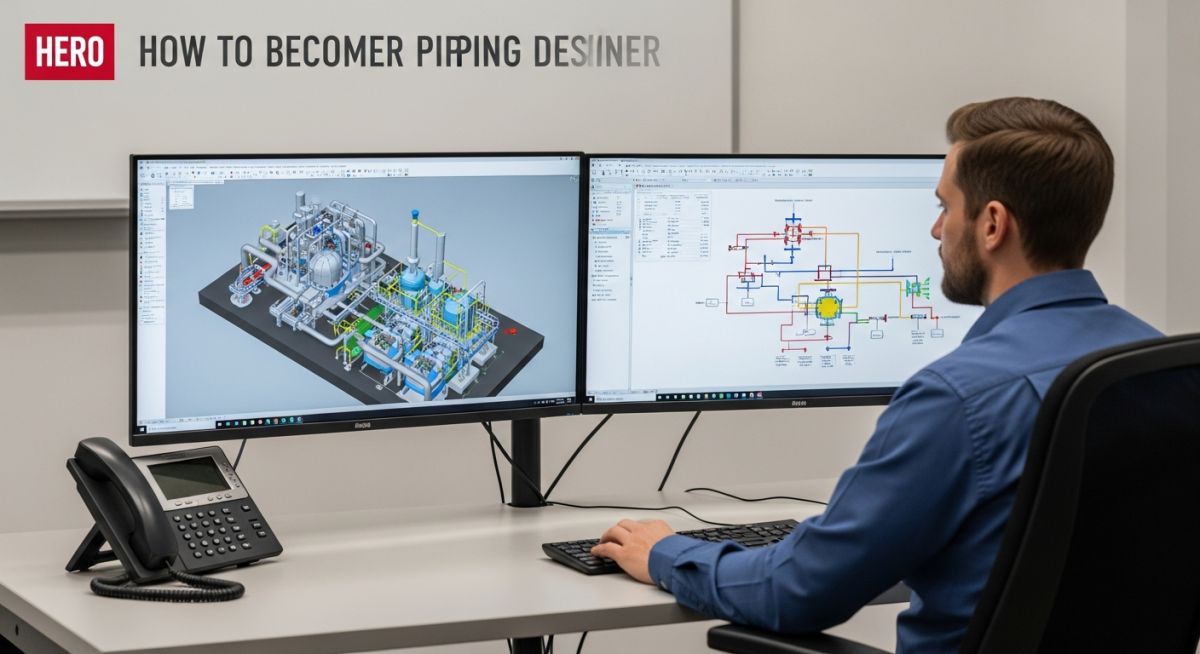
A Piping Designer is a technical specialist responsible for creating the physical layout of piping systems within an industrial plant. They utilize advanced 3D CAD software (like SP3D, E3D, or AutoCAD) to route pipes, place valves, and support structures while ensuring compliance with engineering codes like ASME B31.3. Their primary output includes 3D models, General Arrangement (GA) drawings, and Isometrics for construction.
Read on to explore the specific software skills and salary expectations for this role.
Table of Contents
QUIZ Test Your Piping Knowledge
1. What is the primary input document used by a Piping Designer to start routing?
Complete Course on
Piping Engineering
Check Now
Key Features
- 125+ Hours Content
- 500+ Recorded Lectures
- 20+ Years Exp.
- Lifetime Access
Coverage
- Codes & Standards
- Layouts & Design
- Material Eng.
- Stress Analysis
1. What Does a Piping Designer Actually Do?
At its core, the role of a piping designer is to solve a complex 3D puzzle. While process engineers define what needs to move through the pipes (flow rate, temperature, pressure), the piping designer determines how those pipes physically fit into the plant.
Your primary objective is to develop an optimized Piping Layout and Routing strategy that connects equipment (pumps, vessels, heat exchangers) while adhering to strict safety distances, operation requirements, and maintenance access.

Figure 1: The Standard EPC Design Workflow (From Input to Construction).
The Difference Between Piping Engineer vs. Piping Designer
A common misconception for newcomers is confusing these two distinct roles. In the EPC (Engineering, Procurement, Construction) sector, the division of labor is specific:
👨💻 Piping Engineer
- 🔹Focuses on System Logic & Calculations.
- 🔹Selects Pipe Classes (Material selection).
- 🔹Performs Stress Analysis (Caesar II).
- 🔹Responsible for "Why it works".
👷♂️ Piping Designer
- ✅Focuses on Physical Arrangement & Space.
- ✅Routes pipes in 3D Models.
- ✅Checks for Clashes and Interferences.
- ✅Responsible for "Where it goes".
Key Deliverables: From P&IDs to Isometrics
A designer's output directly fuels the construction team. The workflow typically moves through three stages:
- 3D Model: The digital twin of the plant containing all physical assets.
- General Arrangement (GA) Drawings: Plan and section views showing the overall layout of the piping systems relative to the civil structure.
- Piping Isometrics: Detailed, not-to-scale sketches used by fabricators to cut and weld the pipe spools. These drawings contain the Bill of Materials (BOM).
2. Essential Technical Skills & Software Proficiency
In 2026, manual drafting is obsolete. To be employable, you must master specific 3D Modeling Software suites used by major EPC contractors like Bechtel, Fluor, and Petrofac.
Mastering CAD Tools: AutoCAD, SP3D, E3D, and PDMS
| Software | Usage Level | Industry Application |
|---|---|---|
| AutoCAD (2D/3D) | Foundation | Small projects, P&ID drafting, and simple layouts. |
| Intergraph SP3D | Advanced (Required) | The industry standard for large-scale Oil & Gas projects. |
| AVEVA E3D / PDMS | Advanced (Required) | Dominant in Offshore, Marine, and Power sectors. |
| Navisworks | Review | Used for model review, walkthroughs, and clash detection. |
Understanding Codes: ASME B31.3 and API Standards
Unlike a graphic designer, a piping designer creates systems that transport hazardous fluids under high pressure. Therefore, ASME B31.3 Compliance is non-negotiable. You don't need to memorize the code, but you must know how to apply its rules regarding:
- Support Spacing: Knowing the maximum span between pipe supports to prevent sagging.
- Thermal Expansion: Designing loops or offsets to allow pipes to expand when hot without breaking equipment nozzles.
- Valve Access: Placing valves where operators can actually reach them (usually between 1m to 1.5m from the platform).
3. Step-by-Step Guide: How to Become a Piping Designer in 2026
The path to becoming a top-tier designer is rarely linear. However, based on the current EPC Project Lifecycle requirements, this is the most proven roadmap:
Educational Foundation
Ideally, you need a Diploma in Mechanical Engineering or a Bachelor's Degree (B.E./B.Tech). While a degree is preferred for "Engineering" roles, many Lead Designers have risen to the top with a Diploma and exceptional CAD skills.
Master the "Big 3" Software
Do not rely solely on AutoCAD. To be competitive, you must complete a specialized certification course in SP3D, E3D, or CADWorx. Employers generally test your speed and accuracy in these tools during the interview process.
Gain Field Experience (Site Survey)
Nothing teaches piping better than seeing it installed. Early in your career, volunteer for Site Survey and As-Built assignments. Understanding how a contractor physically welds a pipe spool in a tight rack is knowledge you cannot get from a computer screen.
4. Global Salary Trends: Piping Designer Compensation 2026
Salaries vary significantly based on software proficiency (SP3D/E3D designers earn 30-40% more than AutoCAD drafters) and location. Below is the estimated compensation data for 2026.
| Experience Level | India (INR/Year) | USA (USD/Year) | Middle East (AED/Month) |
|---|---|---|---|
| Junior Drafter (0-2 Yrs) | ₹ 3.0L - ₹ 5.0L | $ 45,000 - $ 55,000 | AED 4,000 - 6,000 |
| Piping Designer (3-7 Yrs) | ₹ 6.0L - ₹ 12.0L | $ 60,000 - $ 85,000 | AED 8,000 - 15,000 |
| Lead Designer (8-15 Yrs) | ₹ 15.0L - ₹ 25.0L | $ 90,000 - $ 120,000 | AED 20,000 - 35,000 |
| Principal/Area Lead (15+ Yrs) | ₹ 30.0L+ | $ 130,000+ | AED 40,000+ |
* Note: Salaries are estimates for 2026 and depend on company tier (MNC vs Local) and contract type.
5. Jobs & Career Hierarchy
The career ladder in Piping Design is well-structured. You typically advance by handling larger areas of the plant or more complex systems.
- 1. Junior Drafter: Converts 2D sketches to CAD files. Focuses on cleanup and simple detailing.
- 2. Piping Designer: Models equipment and routes pipes in 3D. Extracts Isometrics and prepares the Piping Material Specification (PMS) data.
- 3. Senior Designer / Checker: Reviews the work of juniors, runs clash detection reports, and ensures ASME compliance.
- 4. Area Lead: Manages the design of a specific plant unit (e.g., Sulfur Recovery Unit), coordinating with Civil and Electrical teams.
Core Math: The Rolling Offset
Piping designers frequently need to calculate the "Travel" length when a pipe changes direction in both the horizontal and vertical planes (a Rolling Offset). This uses the Pythagorean theorem.
Where Run is the horizontal distance, and Set is the vertical distance.
Bonus: The Piping Designer's Career Toolkit
Preparing for an interview at a major EPC firm? Use this interactive checklist to ensure you are ready for the technical round, and review the glossary to sound like a pro.
Interview Readiness Check
Quick Glossary
EPCLand YouTube Channel
2,500+ Videos • Daily Updates
🧮 Piping Rolling Offset Calculator
Calculate the exact "Travel" length (hypotenuse) required for a pipe spool connecting two offset points. Essential for determining cut lengths during design.
Required Travel Length
Formula: √(Run² + Set²)
Frequently Asked Questions
Is Piping Design a good career choice in 2026?
Can a Diploma holder become a Lead Piping Designer?
How long does it take to learn SP3D or E3D?
Do Piping Designers need to visit the construction site?
Ready to Start Your Engineering Journey?
Becoming a Piping Designer is about bridging the gap between theory and reality. Master the software, respect the codes, and never stop learning from the site team.
© 2026 Epcland Engineering. All Rights Reserved.
Content Verified by Atul Singla (Senior Piping Lead).

Related posts:
![High-grade industrial Wing Nut Types and Applications for mechanical assemblies.]()
Wing Nut Types and Applications: The 2026 Engineering Guide
![Industrial Monorail Crane Systems installed in a modern manufacturing plant 2026.]()
Monorail Crane Systems: Design, Types & 2026 Standards Guide
![Lead engineer performing a Factory Acceptance Test FAT on an industrial skid system 2026]()
Factory Acceptance Test FAT: The 2026 Engineering Guide to Zero-Defect Delivery
![Professional engineering workspace showing a Basis of Design document layout for a 2026 project.]()
Basis of Design: How to Write a BOD for Engineering Projects in 2026
![Industrial Flare Knockout Drum Sizing and installation in a refinery relief system.]()
Flare Knockout Drum Sizing: Design & API 521 Standards (2026 Guide)
![Advanced Reboiler Control Systems in a modern petrochemical refinery 2026.]()
Reboiler Control Systems: Engineering Guide to Precision Control 2026