Understanding the Galvanized Pipe Meaning in Modern Piping Systems
Over my 20 years in the piping industry, I have seen countless materials fail prematurely because engineers underestimated atmospheric corrosion. I remember a project in a coastal chemical plant where standard carbon steel lines degraded within months. That is when we had to re-evaluate our material selection and look closely at the galvanized pipe meaning and its practical limits. Galvanizing is not just a paint job; it is a metallurgical marriage of zinc and steel.
Key Engineering Takeaways
- Zinc acts as a sacrificial anode, protecting the underlying steel even if the surface is scratched.
- Hot-dip galvanizing provides a much thicker, more durable coating than electro-galvanizing.
- Galvanized pipes should not be used for high-temperature service (above 200 degrees Celsius) or for carrying highly acidic fluids.
Complete Course on
Piping Engineering
Check Now
Key Features
- 125+ Hours Content
- 500+ Recorded Lectures
- 20+ Years Exp.
- Lifetime Access
Coverage
- Codes & Standards
- Layouts & Design
- Material Eng.
- Stress Analysis
What is the Galvanized Pipe Meaning in Engineering?
To truly grasp the galvanized pipe meaning, we must look at the chemistry of the hot-dip galvanizing process. When clean carbon steel is submerged in molten zinc at approximately 450 degrees Celsius (842 degrees Fahrenheit), a series of zinc-iron alloy layers form. These layers are metallurgically bonded to the steel, making them far more durable than simple painted coatings.
The Four Metallurgical Layers
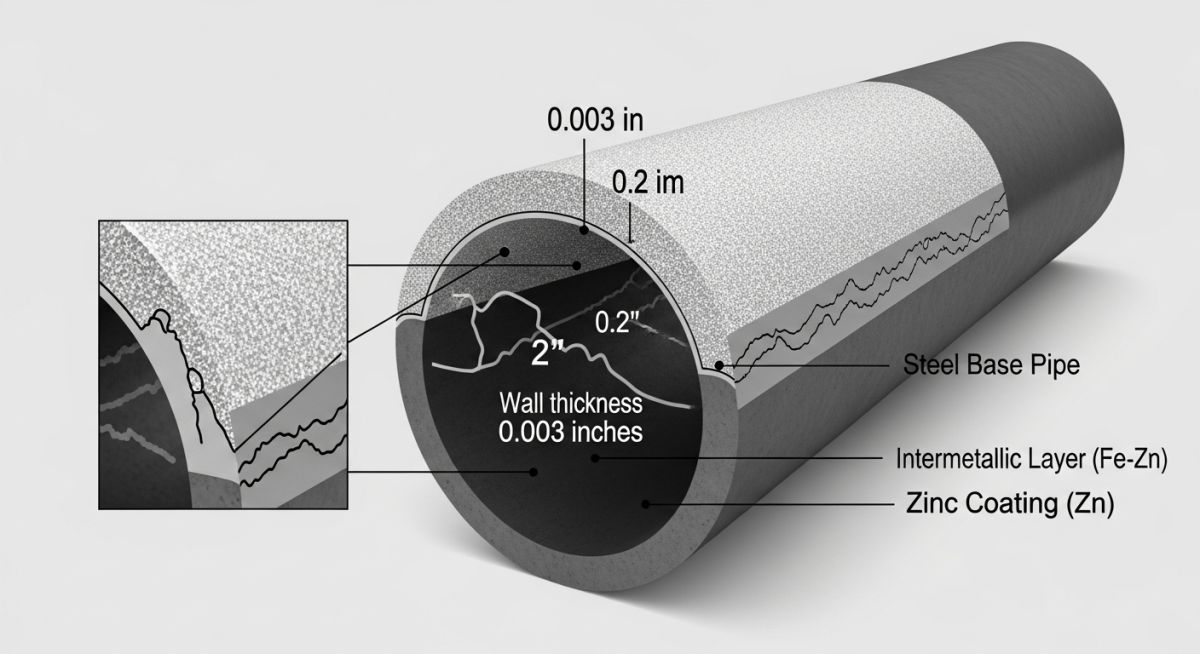
The resulting coating consists of four distinct layers, each with unique properties:
- Eta Layer (100% Zn): The outer layer, which is ductile and absorbs impact.
- Zeta Layer (94% Zn, 6% Fe): A hard, crystalline layer that resists abrasion.
- Delta Layer (90% Zn, 10% Fe): A dense layer providing excellent corrosion resistance.
- Gamma Layer (75% Zn, 25% Fe): The thin alloy layer closest to the steel substrate, ensuring strong adhesion.
Coating Weight and Thickness Calculations
In my practice, we calculate the zinc coating weight per unit area using the standard empirical relationship:
For example, if a specification requires a minimum average coating thickness of 85 micrometers (as per ASTM A53 for Schedule 40 pipes), the coating weight is calculated as:
85 * 7.06 = 600.1 grams per square meter.
Selecting the correct standard is key to ensuring the longevity of your piping system. Below are the primary standards governing galvanized piping and coatings.
| Standard | Scope | Minimum Coating Thickness | Common Application |
|---|---|---|---|
| ASTM A53 | Black and Hot-Dipped Zinc-Coated Welded and Seamless Steel Pipe | 85 micrometers (average) | Fire protection, HVAC, utility water lines |
| ASTM A123 | Zinc (Hot-Dip Galvanized) Coatings on Iron and Steel Products | Varies by material thickness (45-100 micrometers) | Structural steel, handrails, large fabricated pipe spools |
| ASTM A153 | Zinc Coating (Hot-Dip) on Iron and Steel Hardware | Varies by class (typically 50-85 micrometers) | Threaded fasteners, pipe hangers, brackets |
Technical Mapping & Specifications Matrix
| Parameter | Technical Specification | Engineering Limit / Value | Reference Code |
|---|---|---|---|
| Maximum Operating Temperature | Temperature at which zinc coating remains stable without peeling or diffusing | 200 degrees Celsius (392 degrees Fahrenheit) | ASME B31.3 |
| Fluid pH Range | Allowable acidity/alkalinity of the fluid carried inside the pipe | pH 6.0 to pH 12.0 | NACE SP0169 |
| Joining Methods | Approved methods for connecting galvanized pipe lengths | Threaded, Grooved (Victaulic), Flanged | ASME B1.20.1 / ASME B16.5 |
Verifying the Galvanized Pipe Meaning on Site
When galvanized pipes arrive at the construction site, you must perform a rigorous quality check. Do not assume that every pipe marked “galvanized” meets the engineering requirements of your project.
Field Inspection Checklist
-
Visual Surface Inspection: Check for bare spots, blisters, flux inclusions, or dross. The coating must be continuous and free of defects. -
Thickness Verification: Use a calibrated magnetic dry-film thickness (DFT) gauge to verify coating thickness meets ASTM A53 requirements. -
Thread Inspection: Ensure threads are clean, sharp, and free of excess zinc buildup that could prevent proper engagement. -
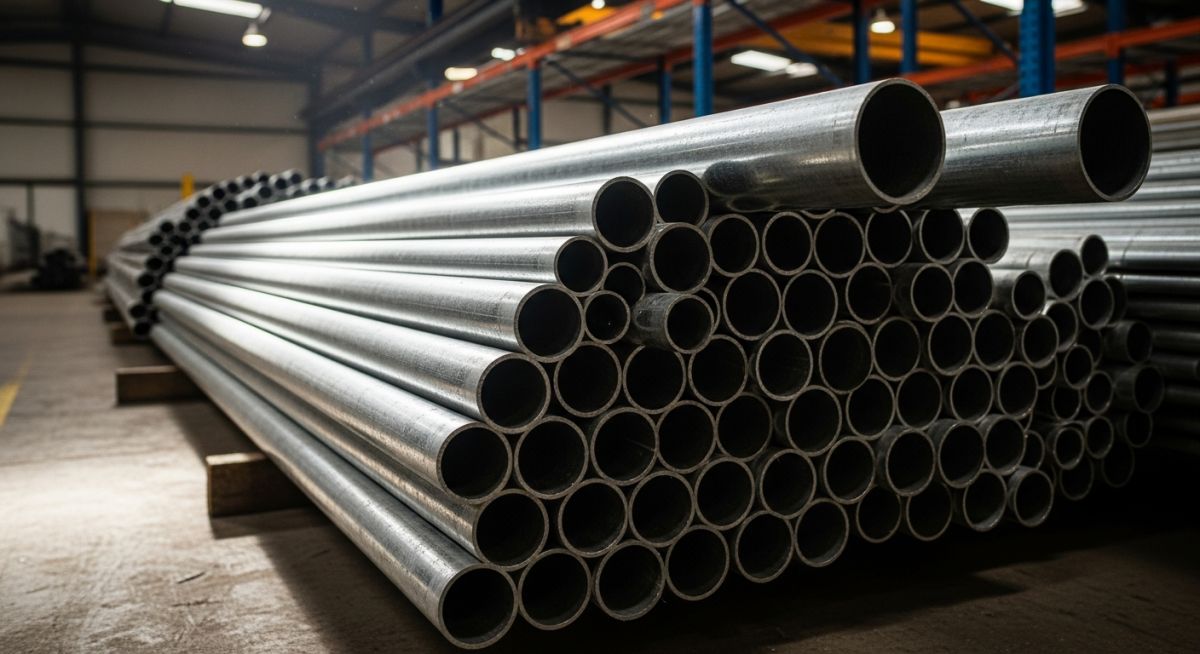
Storage Check: Confirm pipes are stored off the ground with wooden spacers to prevent wet storage stain (white rust). -
Marking Verification: Confirm each pipe length is stenciled with the manufacturer’s name, ASTM standard, and heat number.
Field Case Study: Real-World Application
The Problem
A coastal chemical plant installed standard carbon steel utility water lines. Within 18 months, atmospheric salt spray and high humidity caused severe external pitting corrosion, leading to multiple pinhole leaks and unplanned shutdowns. The maintenance team had initially selected standard carbon steel to save on upfront material costs, ignoring the aggressive coastal environment.
The Solution & Outcome
I was brought in to consult on the material replacement. We specified hot-dip galvanized steel pipes conforming to ASTM A53. The zinc coating provided both barrier and sacrificial protection. After 8 years of continuous service in the same corrosive coastal environment, the lines show zero signs of corrosion or wall loss, proving that understanding the galvanized pipe meaning and its proper application saves significant maintenance costs over time.
Frequently Asked Engineering Questions
What is the difference between galvanized pipe and black steel pipe?
Can galvanized pipes be used for drinking water systems?
How long do galvanized pipes typically last in industrial environments?
Why does white rust form on galvanized pipes, and how can it be prevented?
Can you thread galvanized pipes after they have been galvanized?
What is the maximum operating temperature for galvanized steel piping?
===

