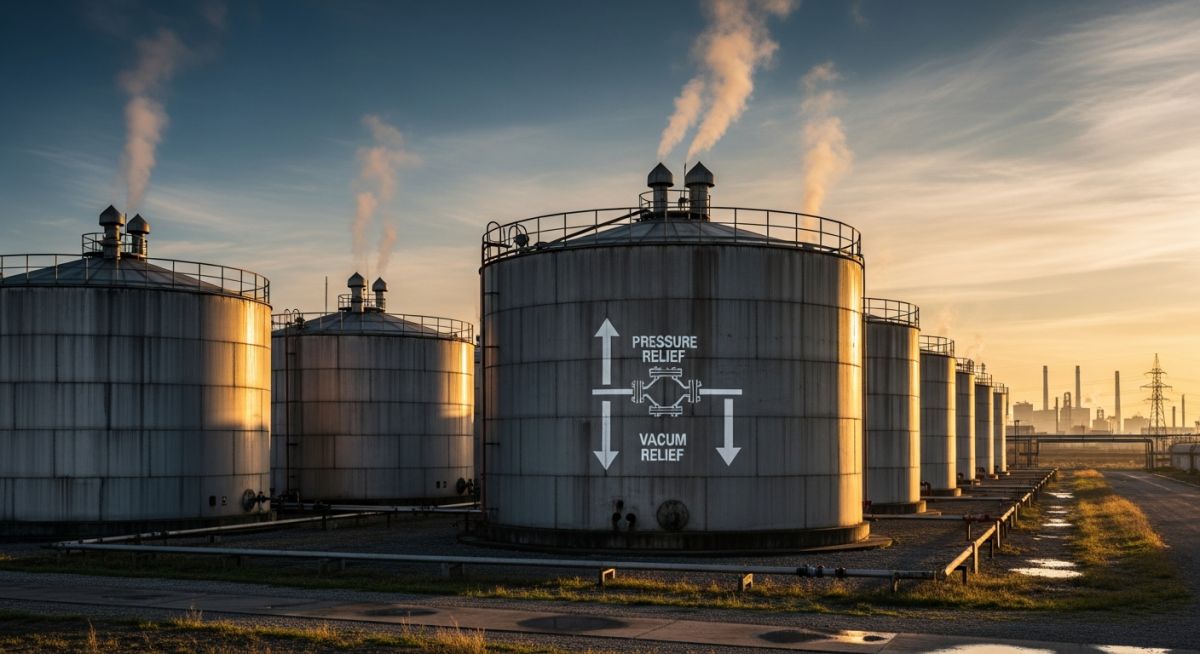
What is a Breather Valve? | Breather Valve for Tanks
I still remember a floating roof tank in Gujarat that collapsed inward like a crushed can. Not due to explosion. Not due to corrosion. But because of a simple failure—a breather valve that couldn’t handle vacuum conditions during rapid pump-out. In the field, tank failures like this don’t scream—they silently happen in seconds.
A breather valve might look like a small accessory sitting on top of a tank, but trust me, it’s the last line of defense between safe operation and catastrophic deformation. Many engineers underestimate it—until something goes wrong.
- A breather valve (pressure vacuum valve) maintains safe internal tank pressure.
- It protects storage tanks from overpressure and vacuum collapse.
- Improper sizing can lead to tank deformation or product losses.
- Design must align with API 2000 requirements.
- Material selection and maintenance directly impact reliability.
A breather valve for a tank is a safety device that regulates pressure by allowing air or vapors to enter or exit during filling and emptying. It prevents tank damage caused by overpressure or vacuum conditions and is designed based on API 2000 standards for proper venting capacity.
1. What is the primary purpose of a breather valve in a storage tank?
2. Which standard is commonly followed for breather valve sizing?
3. What happens if a breather valve is undersized during tank emptying?
What is a Breather Valve?
In my field work across tank farms, I define a breather valve (pressure vacuum valve) as a precise mechanical safety device installed on atmospheric storage tanks to control internal pressure within safe design limits. It opens under calibrated pressure and vacuum conditions to allow vapor out or air in—protecting the tank shell against deformation.
Working of a Breather Valve
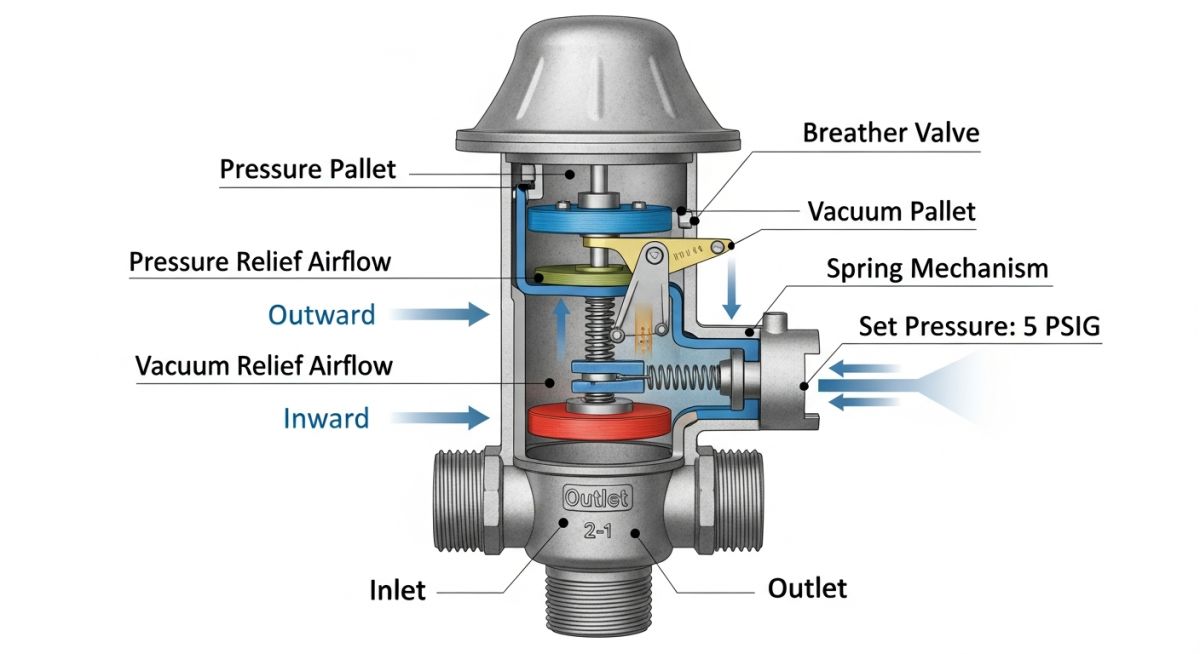
A breather valve operates through two independent pallets:
- Pressure pallet: Opens when internal pressure exceeds set point → releases vapor
- Vacuum pallet: Opens when vacuum exceeds design → allows atmospheric air in
But here is the catch—in the field, we always validate against API 2000. The venting capacity must match:
- Maximum pump-in (liquid filling rate)
- Maximum pump-out (liquid withdrawal rate)
- Thermal expansion due to weather changes
I’ve seen tanks fail not because the valve didn’t exist—but because it was undersized. A wrong vent capacity calculation directly translates into structural failure risk.
Types of Breather Valves
- Pressure Vacuum Valve (Conventional type)
- Weight-loaded breather valve
- Spring-loaded breather valve
- Pilot-operated breather valve (high accuracy control)
Functions of a Breather Valve
- Prevents overpressure damage
- Prevents vacuum collapse
- Reduces vapor emission losses
- Maintains tank integrity during operation
Common Standards for Breather Valve
| Standard | Scope |
|---|---|
| API 2000 | Venting of atmospheric tanks |
| API 650 | Tank design considerations |
| ISO 28300 | International venting standard |
Advantages of Breather Valve
- Improves tank safety
- Minimizes product loss
- Reduces environmental impact
- Extends tank service life
Installing Breather Valves
In the field, I always recommend:
- Install at the highest point of tank roof
- Avoid long inlet piping (causes pressure drop)
- Provide flame arrestor when handling hydrocarbons
- Ensure easy access for maintenance
Parameters Affecting Breather Valve Performance
- Set pressure accuracy
- Flow capacity (sizing)
- Temperature variation
- Material corrosion resistance
Selection of Breather Valves
Selection is never random. I evaluate:
- Tank capacity and diameter
- Maximum filling/emptying rates
- Stored fluid volatility
- Applicable design code (API 2000)
Materials for Breather Valves
- Carbon Steel – General service
- SS304 – Mild corrosion
- SS316 – Offshore / aggressive media
- PTFE internals – Chemical compatibility
A diesel storage terminal was experiencing continuous vapor losses and unexpected pressure fluctuations during normal storage conditions.
I was called to investigate. On inspection, I found the breather valve set pressure was too low. The valve was opening frequently even under minor thermal expansion. The actual design requirement based on API 2000 calculations was significantly higher.
We recalculated venting rates considering ambient temperature swings and tank capacity, then replaced the valve with correctly calibrated pressure settings and higher sealing efficiency.
✔ Vapor loss reduced by 38%
✔ Stable pressure control achieved
✔ ROI achieved within 4 months
Field Lesson Learned: Never treat set pressure as a default vendor value—it must be engineered for your tank.
Frequently Asked Questions
What is the difference between breather valve and safety valve?
Can a breather valve fail?
Why API 2000 is important?
Where is breather valve installed?
What happens if breather valve is oversized?
Do breather valves need maintenance?
Complete Course on
Piping Engineering
Check Now
Key Features
- 125+ Hours Content
- 500+ Recorded Lectures
- 20+ Years Exp.
- Lifetime Access
Coverage
- Codes & Standards
- Layouts & Design
- Material Eng.
- Stress Analysis
