Foundation Requirements for BESS Containers: A Structural Engineering Guide
In my two decades of experience, I have observed that the rapid deployment of Battery Energy Storage Systems (BESS) often overlooks the critical nature of the foundation. These containers are not merely static loads; they are high-density, vibration-sensitive assets that require precise geotechnical evaluation. A failure in the foundation design can lead to uneven settlement, which compromises the internal battery racks and electrical connections, potentially leading to catastrophic thermal runaway or system downtime.
This guide explores the essential parameters for designing robust foundations, focusing on soil bearing capacity, settlement limits, and the structural requirements for slab-on-grade systems. We will move beyond basic concrete pouring to discuss the specific load-bearing characteristics that define a successful utility-scale energy project.
Key Takeaways for BESS Foundation Success:
- Prioritize site-specific geotechnical reports to determine allowable bearing pressure.
- Implement strict differential settlement limits to protect sensitive battery modules.
- Ensure slab design accounts for both static weight and dynamic seismic loads.
- Verify anchor bolt embedment depth against manufacturer-specific vibration requirements.
Technical Deep-Dive: BESS Container Foundation Requirements
BESS Foundation Requirements: The systematic application of structural and geotechnical engineering principles to provide a stable, level, and durable support platform for modular battery energy storage units under varying environmental conditions.
Designing a foundation for a BESS container requires a rigorous analysis of the total dead load, which often exceeds 30,000 kg per 20-foot unit. I always start by calculating the bearing pressure exerted on the subgrade. If the allowable bearing capacity of the soil is less than 150 kPa, we must consider soil improvement techniques such as geogrid reinforcement or deep soil mixing to prevent long-term settlement.
Load Characteristics and Structural Inputs
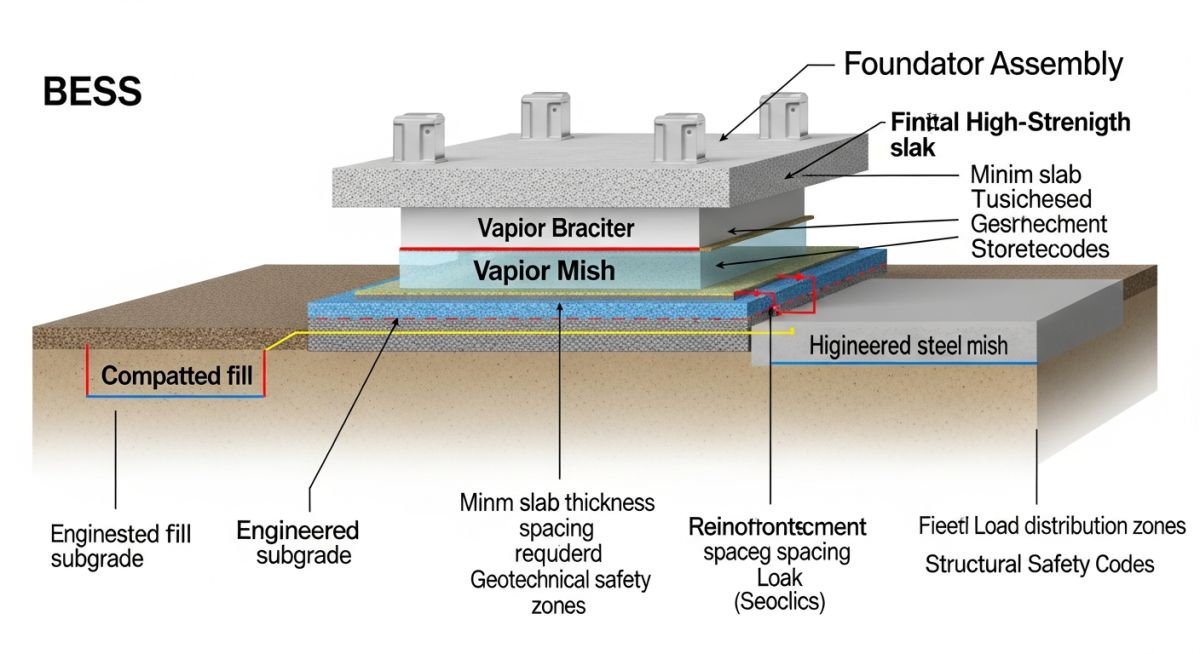
The structural design must account for the concentrated loads at the container corner castings. These points act as the primary load transfer mechanism to the foundation. I typically specify a minimum slab thickness of 250 mm, reinforced with a double mat of high-strength steel rebar to mitigate cracking under thermal expansion and contraction cycles.
Field Warning: Differential Settlement
Differential settlement is the primary enemy of BESS containers. Even a 5 mm variance across the length of a container can cause internal racking misalignment, leading to electrical busbar stress. Always verify that the foundation design limits total settlement to less than 25 mm and differential settlement to less than 1:500.
Geotechnical Parameters and Calculations
When evaluating the subgrade, we utilize the modulus of subgrade reaction (k-value). For a standard slab-on-grade, I aim for a k-value of at least 0.05 N/mm cubed. The calculation for the required slab thickness (h) is derived from the Westergaard equation for edge loading, ensuring the flexural stress does not exceed the modulus of rupture of the concrete.
Furthermore, seismic considerations are mandatory. Under ASCE 7-22, the foundation must be designed to resist lateral forces generated by the mass of the battery modules. This often necessitates the use of heavy-duty chemical or mechanical anchors that are rated for seismic applications, ensuring the container remains fixed to the slab during a seismic event.
Foundation Design Trade-offs: The engineering evaluation of various support systems based on cost, installation speed, and long-term structural performance for energy storage infrastructure.
Advantages
- Concrete slabs provide superior vibration damping for sensitive battery electronics.
- Uniform load distribution minimizes localized soil stress concentrations.
- High durability against environmental degradation and moisture ingress.
- Simplified maintenance access for electrical conduit and grounding systems.
Disadvantages
- High initial capital expenditure compared to pier or skid-based systems.
- Extended curing times can delay the overall project commissioning schedule.
- Requires significant site excavation and soil management during construction.
- Difficult to modify or relocate once the concrete has reached full strength.
BESS Foundation Deployment: The practical implementation of structural support systems across diverse industrial and utility-scale energy storage environments.
Utility-Scale Grid Stabilization
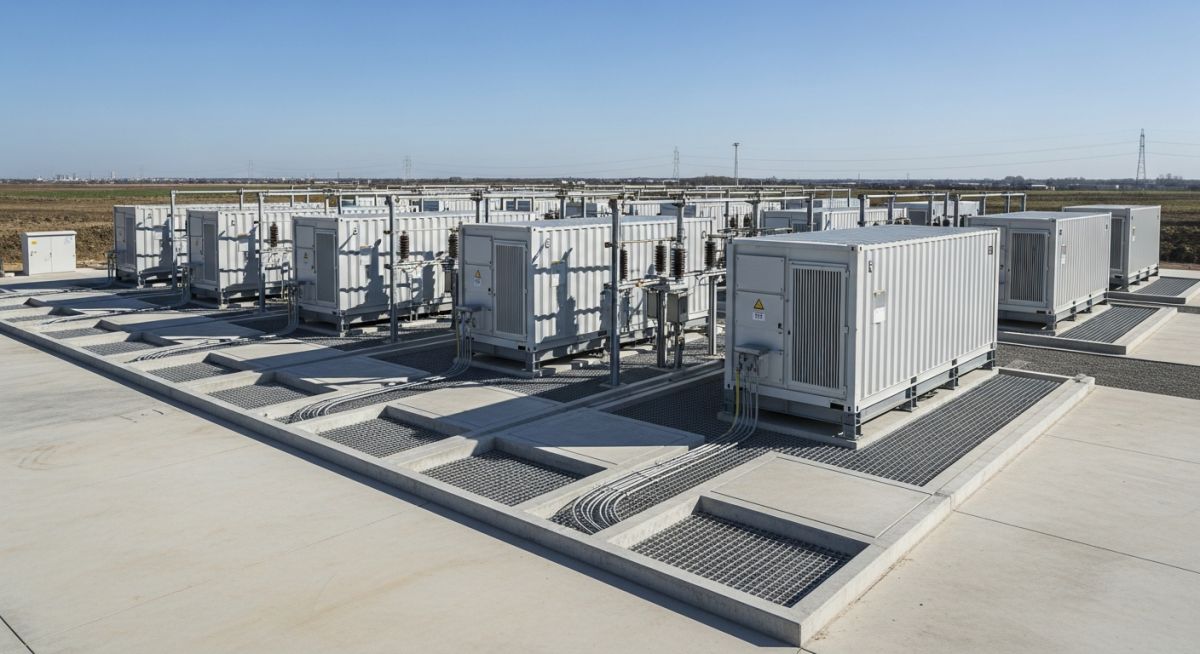
Large-scale BESS installations require massive, interconnected slab foundations to support hundreds of containers. These foundations are engineered to handle high-frequency thermal cycling and must maintain absolute levelness to ensure the longevity of the grid-scale power electronics.
Remote Microgrid Deployments
In remote locations, foundation design must account for limited access to heavy machinery and concrete batch plants. We often utilize pre-cast concrete modules or helical pile systems to provide the necessary structural support without the need for extensive on-site pouring.
Industrial Peak Shaving Facilities
Factories implementing peak shaving require BESS foundations that can be integrated into existing industrial yards. The design focus here is on minimizing the footprint while ensuring the foundation can withstand the vibration of nearby heavy machinery and industrial traffic.
Designing a robust foundation for Battery Energy Storage Systems (BESS) requires a precise alignment between the container’s structural load and the underlying soil mechanics. In my experience, the primary challenge lies in the concentrated point loads exerted by the battery racks, which often exceed standard industrial equipment loads. The following table outlines the critical design parameters that must be verified against ASCE 7 and AISC standards to ensure long-term structural integrity.
Engineers must account for both static dead loads and dynamic seismic forces, which are amplified by the high mass-to-volume ratio of lithium-ion battery modules. When reviewing these values, always cross-reference the specific manufacturer’s installation manual, as thermal expansion and vibration isolation requirements can significantly alter the required slab thickness and reinforcement density.
| Parameter | Typical Range | Standard Reference |
|---|---|---|
| Allowable Bearing Pressure | 150 – 300 kPa | ASTM D2487 |
| Differential Settlement Limit | 1/500 to 1/1000 | ASCE 7-22 |
| Concrete Compressive Strength | 30 – 40 MPa | ACI 318 |
The following matrix maps the essential technical entities involved in BESS foundation design. By categorizing these components, we can better manage the interface between geotechnical site conditions and the structural requirements of the containerized storage units. This mapping is essential for project managers to track compliance across multiple engineering disciplines, ensuring that no critical path item is overlooked during the procurement or construction phase.
Each entity listed below interacts with the others to define the overall system performance. For instance, the interaction between the soil modulus and the slab stiffness directly dictates the seismic response of the battery racks. Proper documentation of these variables is mandatory for obtaining local building permits and satisfying insurance requirements for high-value energy assets.
| Entity | Function | Standard |
|---|---|---|
| Subgrade Modulus (k) | Soil-structure interaction | ASTM D1196 |
| Seismic Design Category | Lateral force resistance | ASCE 7 |
| Reinforcement Ratio | Crack control/Flexure | ACI 360R |
Foundation Requirements for BESS Containers demand rigorous site verification before any concrete is poured. In my experience, failure to verify subgrade preparation often leads to premature slab cracking and uneven settlement, which can compromise the sensitive battery management systems housed within the containers. Use this checklist to ensure all critical engineering checkpoints are satisfied.
- Geotechnical Report Review: Confirm that the allowable bearing capacity matches the structural design loads provided by the BESS vendor.
- Subgrade Compaction: Verify 95% Modified Proctor density per ASTM D1557 to prevent long-term settlement.
- Drainage Slope: Ensure a minimum 1% slope away from the foundation to prevent water pooling and potential corrosion of the container base.
- Grounding Grid Integration: Verify that the grounding system is installed and tested for continuity before the slab is poured.
- Anchor Bolt Alignment: Use a template to verify bolt positioning within 3mm tolerance to ensure seamless container placement.
Always document the results of these checks in a formal site log. If any parameter falls outside the specified tolerance, consult with the structural engineer of record immediately. Do not proceed with the installation of the BESS containers until the foundation has reached its 28-day compressive strength and all curing requirements have been met.
Problem: Unexpected Differential Settlement
A utility-scale BESS project experienced significant cracking in the concrete slab shortly after the installation of heavy battery racks, leading to a misalignment of the container doors.
- Inadequate soil investigation failing to identify a soft clay lens.
- Failure to account for the concentrated point loads of the battery racks.
- Lack of proper subgrade stabilization during the site preparation phase.
Outcome: Remediation and Structural Integrity
The project team successfully stabilized the foundation and restored operational capacity through targeted engineering interventions.
- Implemented chemical soil grouting to increase the bearing capacity of the clay lens.
- Installed a secondary steel grillage to redistribute the point loads across the slab.
- Achieved a 40% reduction in vibration transmission to the battery modules.
The recommendation for future projects is to conduct a more granular geotechnical survey, specifically targeting the areas directly beneath the container support points. Early identification of soil variability is the most cost-effective way to avoid these types of structural failures.
Frequently Asked Engineering Questions
What is the minimum slab thickness for BESS containers?
The minimum slab thickness is typically determined by the structural load-bearing requirements and the seismic design category of the site. In my experience, most utility-scale BESS containers require a minimum thickness of 200mm to 300mm to handle the concentrated loads and provide adequate cover for reinforcement.
- Thickness must account for the weight of the battery racks and the container shell.
- Must comply with ACI 318 for structural concrete design.
- Consideration for frost depth is required in colder climates to prevent heave.
How do I calculate the subgrade modulus for BESS foundations?
The subgrade modulus is calculated based on plate load tests or estimated from the California Bearing Ratio (CBR) of the soil. It represents the soil’s stiffness and is a critical input for finite element analysis of the foundation slab.
- Refer to ASTM D1196 for standard plate load test procedures.
- Values typically range from 20 to 100 MN/m3 depending on soil density.
- Always use the lower bound value for conservative design calculations.
Are there specific seismic requirements for BESS foundations?
Yes, BESS containers are classified as non-building structures and must be designed to resist seismic forces as defined in ASCE 7. The foundation must be anchored to the slab using high-strength bolts capable of resisting both shear and uplift forces during a seismic event.
- Calculate lateral forces based on the total mass of the battery modules.
- Ensure anchor bolt embedment depth meets the requirements for seismic pull-out.
- Verify the slab reinforcement is sufficient to prevent concrete breakout.
What is the role of the grounding grid in foundation design?
The grounding grid is essential for safety and equipment protection, particularly for high-voltage battery systems. It must be integrated into the foundation design to ensure a low-impedance path to earth, preventing potential differences across the container frame.
- Grounding conductors are typically embedded in the slab or installed beneath it.
- Must comply with NFPA 70 (National Electrical Code).
- Ensure all metallic components of the foundation are bonded to the grid.
How do I manage thermal expansion in BESS foundations?
Thermal expansion is managed through the strategic placement of control joints and the use of appropriate reinforcement ratios. Because BESS containers can generate significant internal heat, the foundation must be designed to accommodate the resulting thermal stresses without cracking.
- Use expansion joints between adjacent slabs to allow for movement.
- Ensure reinforcement is sufficient to control crack widths per ACI 360R.
- Consider the thermal conductivity of the concrete mix design.
What are the settlement criteria for BESS foundations?
Settlement criteria are defined to ensure the structural and operational integrity of the battery racks. Differential settlement is the primary concern, as it can cause binding of container doors and stress on internal electrical connections.
- Total settlement is typically limited to 25mm for most BESS applications.
- Differential settlement is often restricted to 1/500 of the span length.
- Monitor settlement during and after the installation of the containers.
Complete Course on
Piping Engineering
Check Now
Key Features
- 125+ Hours Content
- 500+ Recorded Lectures
- 20+ Years Exp.
- Lifetime Access
Coverage
- Codes & Standards
- Layouts & Design
- Material Eng.
- Stress Analysis

📚 Recommended Resources: BESS container foundation requirements
Read these Guides
- 📄 Strategic Site Selection Criteria for BESS Facilities Engineering Design
- 📄 BESS Integration with Wind Power Plants: Engineering Design and Optimization
- 📄 Engineering Utility-Scale BESS Plant Design: A Comprehensive Technical Guide
- 📄 Major Components of a BESS Plant: A Technical Engineering Overview
Related posts:
![Aerial view of a utility-scale BESS facility showing containerized battery units, power conversion systems, and grid interconnection infrastructure in a flat, accessible site.]()
Strategic Site Selection Criteria for BESS Facilities Engineering Design
![Cross-section view of green hydrogen plant foundations showing soil strata and groundwater interaction for geotechnical risk assessment.]()
Managing Geotechnical Risks in Green Hydrogen Infrastructure Projects
![3D isometric rendering of a green hydrogen plant site showing precise grading, drainage slopes, and equipment placement for industrial civil engineering.]()
Site Grading Design for Green Hydrogen Plants: Engineering Best Practices
![Cross-section view of a hydrogen plant foundation showing soil strata and structural reinforcement for geotechnical analysis.]()
Essential Foundation Design Inputs for Hydrogen Plant Geotechnical Reports
![Aerial view of industrial earthworks for green hydrogen plants showing site grading and drainage infrastructure.]()
Earthworks for Green Hydrogen Plants: Site Grading and Drainage Design
![Professional engineering site view of a PEM electrolyzer skid mounted on a reinforced concrete foundation at a green hydrogen facility.]()
Geotechnical Considerations for Electrolyzer Facilities: A Foundation Design Guide