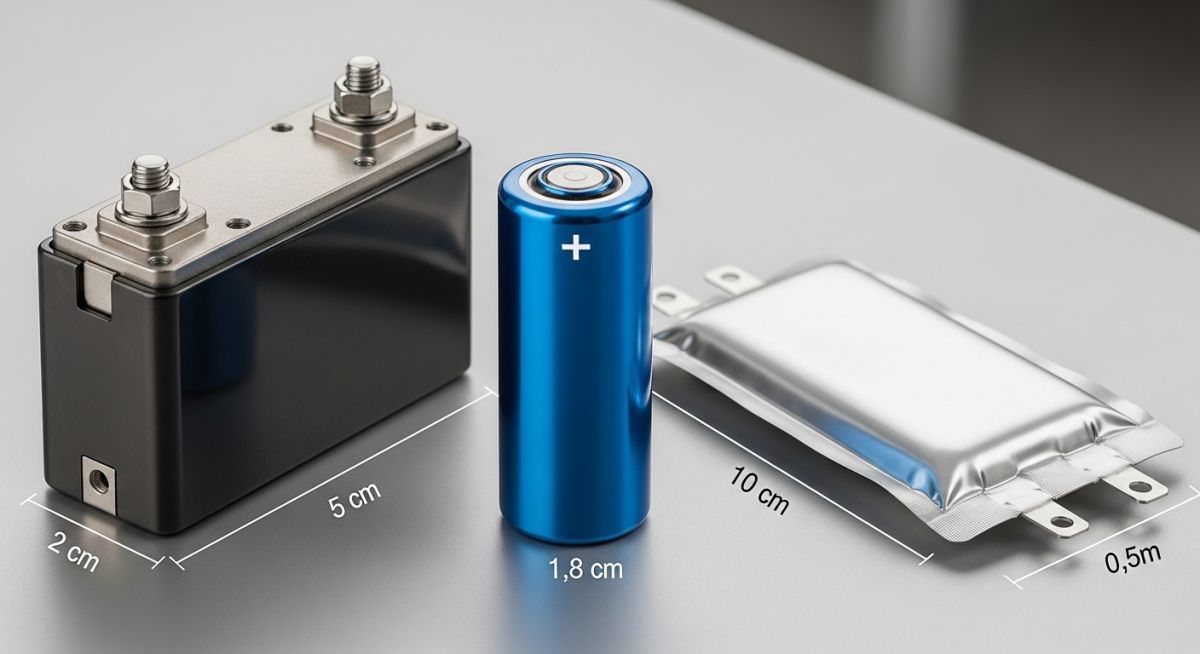
Battery Chemistry Comparison: LFP vs NMC vs Sodium-Ion
In my two decades of engineering experience, I have seen the energy storage landscape shift from a “one-size-fits-all” approach to a highly specialized discipline. Selecting the right battery chemistry is no longer just about capacity; it is a complex trade-off between safety, cost, and longevity. Whether you are designing a grid-scale storage facility or a localized industrial backup system, understanding the nuances of LFP, NMC, and Sodium-Ion is mandatory.
This guide breaks down the technical realities of these chemistries, moving beyond marketing brochures to provide the data you need for your next project. We will examine the electrochemical stability of Lithium Iron Phosphate (LFP), the high energy density of Nickel Manganese Cobalt (NMC), and the emerging potential of Sodium-Ion technology.
Key Takeaways for Engineers:
- LFP offers superior thermal stability and cycle life, making it the standard for stationary storage.
- NMC provides higher energy density, essential for space-constrained or weight-sensitive applications.
- Sodium-Ion is the emerging alternative for cost-sensitive, large-scale deployments where lithium supply chain risks are a concern.
- Standardization via IEC 62619 and UL 9540A remains the primary benchmark for safety validation.
Technical Deep-Dive: Battery Chemistry Comparison
Battery Chemistry Comparison: The rigorous analysis of cathode and anode material properties, specifically focusing on ion mobility, thermal degradation kinetics, and cost-per-cycle metrics under varying discharge rates.
When evaluating battery chemistries, we must first look at the cathode material, as it dictates the cell’s primary characteristics. LFP (Lithium Iron Phosphate) utilizes a polyanion structure, which provides exceptional structural stability. In my experience, this stability is the primary reason LFP cells rarely experience thermal runaway compared to other chemistries. The P-O bond in the phosphate group is significantly stronger than the metal-oxygen bonds found in NMC, preventing oxygen release during high-temperature events.
NMC (Nickel Manganese Cobalt) chemistries, conversely, rely on a layered oxide structure. By adjusting the ratio of Nickel, Manganese, and Cobalt (e.g., NMC 111, 622, or 811), engineers can tune the cell for either power or energy density. Nickel increases capacity but reduces thermal stability, while Manganese improves safety and Cobalt enhances structural integrity. The design challenge here is managing the heat generation during high C-rate discharges, which requires sophisticated Battery Management Systems (BMS) and active cooling.
Engineering Limitation: Thermal Runaway Thresholds
NMC cells typically exhibit exothermic decomposition at lower temperatures than LFP. When designing for high-density storage, you must account for the NFPA 855 requirements for fire suppression and spacing. Always verify the specific cell’s “onset temperature” for thermal runaway, as this dictates the required fire-rated enclosure design and ventilation capacity.
Sodium-Ion technology represents a paradigm shift. Because Sodium is more abundant and cheaper than Lithium, these cells are gaining traction for stationary storage. The ionic radius of Sodium is larger than Lithium, which necessitates different electrode materials—typically Prussian Blue analogues or layered oxides. While energy density is currently lower than LFP, the ability to discharge to zero volts without damaging the cell makes them highly attractive for long-term storage and transport safety.
From a calculation perspective, we evaluate the “Specific Energy” (Wh/kg) and “Energy Density” (Wh/L). NMC 811 can reach upwards of 250-300 Wh/kg, whereas LFP typically sits in the 160-190 Wh/kg range. Sodium-Ion currently hovers around 140-160 Wh/kg. However, the “Levelized Cost of Storage” (LCOS) calculation must include the cycle life. LFP often achieves 6,000 to 10,000 cycles, whereas NMC might be limited to 2,000-3,000 cycles in high-stress environments. Sodium-Ion is showing promising cycle life data, often exceeding 4,000 cycles in recent pilot tests.
Battery Chemistry Trade-offs: A technical assessment of the operational benefits and inherent limitations of LFP, NMC, and Sodium-Ion systems in industrial energy storage applications.
Advantages
- LFP Thermal Stability: High resistance to thermal runaway due to strong covalent P-O bonds.
- NMC Energy Density: Superior volumetric energy density for space-constrained installations.
- Sodium-Ion Cost: Lower raw material costs due to the abundance of sodium precursors.
- LFP Cycle Life: Exceptional longevity, often exceeding 8,000 cycles at 80% Depth of Discharge (DoD).
- Sodium-Ion Safety: Ability to be transported at zero volts, reducing fire risk during logistics.
Disadvantages
- NMC Thermal Risk: Higher susceptibility to exothermic reactions requiring complex BMS.
- LFP Energy Density: Lower gravimetric energy density requires larger physical footprints.
- Sodium-Ion Maturity: Limited supply chain and manufacturing scale compared to established lithium chemistries.
- NMC Cost Volatility: High dependence on Cobalt and Nickel prices, leading to project budget uncertainty.
- Sodium-Ion Density: Lower energy density necessitates larger battery containers for equivalent capacity.
Industrial Battery Deployment: Strategic selection of electrochemical storage based on specific site requirements, load profiles, and environmental constraints.
Grid-Scale Stationary Storage
LFP is the preferred chemistry for large-scale utility storage due to its long cycle life and safety profile. The ability to maintain capacity over thousands of cycles makes it ideal for frequency regulation and peak shaving applications where reliability is paramount.
Electric Heavy-Duty Transport
NMC is utilized in heavy-duty electric vehicles where weight and volume are critical constraints. The high energy density allows for longer range and higher power output, which is necessary for demanding logistics and public transit operations.
Low-Cost Residential Backup
Sodium-Ion technology is emerging as a viable solution for residential energy storage systems where cost is the primary driver. Its performance in cold climates and safety during transport make it a strong contender for decentralized energy markets.
Selecting the optimal energy storage solution requires a granular understanding of how LFP, NMC, and Sodium-Ion chemistries behave under varying thermal and electrical loads. In my experience, engineers often focus solely on energy density, yet the operational reality of a project is dictated by cycle life, thermal stability, and the specific discharge characteristics required by the application.
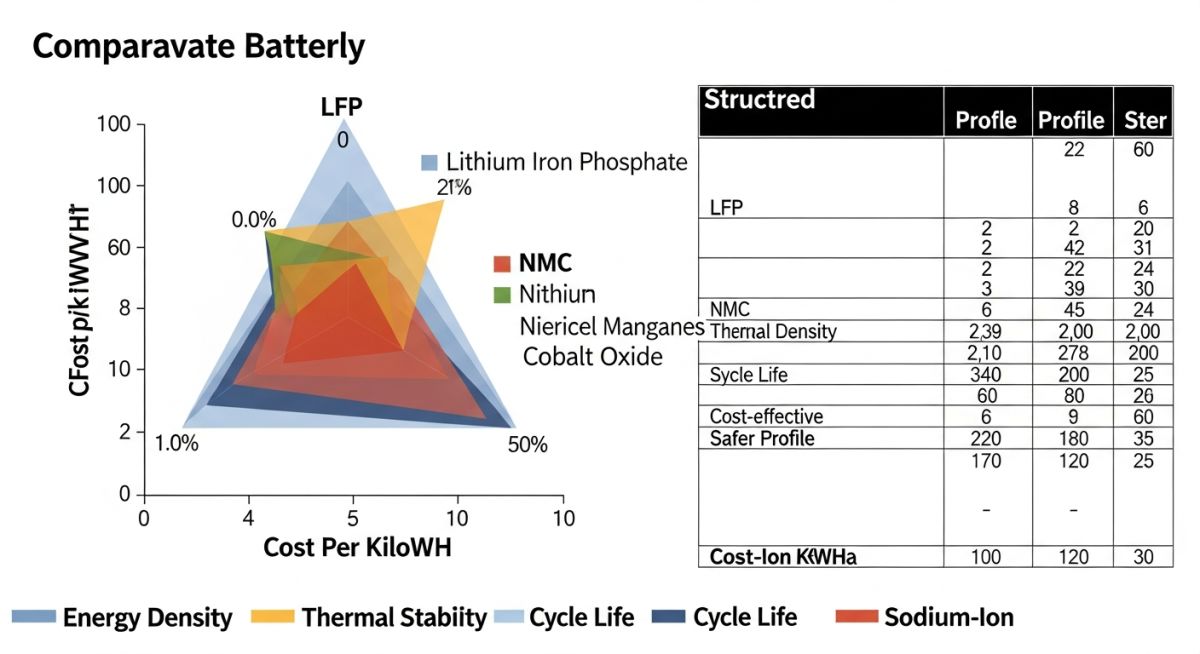
The following table provides a standardized comparison of these chemistries based on typical commercial cell performance. Note that these values represent industry averages; specific manufacturer data sheets should always be consulted for final design calculations, especially when evaluating ASME or IEC safety compliance for large-scale stationary storage systems.
| Parameter | LFP (LiFePO4) | NMC (LiNiMnCoO2) | Sodium-Ion |
|---|---|---|---|
| Energy Density (Wh/kg) | 160-190 | 200-250 | 140-160 |
| Cycle Life (80% DoD) | 3000-6000 | 1000-2000 | 2000-4000 |
| Thermal Runaway Temp | High (270C) | Moderate (210C) | High (250C+) |
| Cost Profile | Low | High | Very Low |
This data highlights the trade-off between the high energy density of NMC and the superior safety and longevity of LFP and Sodium-Ion. When designing for grid-scale storage, the lower cost and improved safety profile of LFP often outweigh the density advantages of NMC.
To effectively manage battery integration, engineers must map the physical and chemical entities to their respective regulatory and performance standards. This matrix serves as a technical bridge between raw material properties and the final system-level requirements for industrial energy storage.
By aligning these entities, we ensure that the UL 9540 standards for energy storage systems are met, regardless of the underlying chemistry. This mapping is essential for procurement teams and design engineers to maintain consistency across the project lifecycle.
| Entity | Standard/Ref | Primary Function |
|---|---|---|
| LFP Cathode | ASTM D7432 | Thermal stability and longevity |
| NMC Cathode | ISO 12405 | High energy density output |
| Sodium-Ion | IEC 62619 | Low-cost, sustainable storage |
Utilizing this matrix allows for rapid identification of potential failure modes during the design phase. It is my recommendation to cross-reference these standards with local fire codes to ensure full site compliance.
Battery Chemistry Selection: The following checklist provides a structured approach to verifying that your chosen battery chemistry aligns with project-specific operational requirements and safety standards. In my experience, skipping these verification steps often leads to premature degradation or, in severe cases, thermal management failures.
-
Thermal Load Analysis: Confirm that the cooling system capacity exceeds the maximum heat dissipation rate of the chosen chemistry under peak discharge. -
Cycle Life Validation: Ensure the projected cycle life at the expected depth of discharge (DoD) meets the project’s 10-year minimum requirement. -
Safety Standard Compliance: Verify that the cell design complies with UL 1973 for stationary battery safety. -
Environmental Sensitivity: Assess the impact of ambient temperature fluctuations on the specific chemistry’s internal resistance and capacity retention. -
Supply Chain Resilience: Evaluate the availability of raw materials (e.g., Cobalt for NMC vs. Iron for LFP) to mitigate long-term procurement risks.
Site verification must include a physical inspection of the battery management system (BMS) settings to ensure they are calibrated for the specific chemistry. Never assume default BMS parameters are sufficient for high-performance applications. Always document the initial state-of-health (SoH) and state-of-charge (SoC) calibration data during the commissioning phase to establish a baseline for future performance monitoring.
Problem: Premature Degradation in High-Cycle Microgrid
A remote industrial microgrid experienced a 30% capacity loss within 18 months of operation due to improper chemistry selection for high-frequency cycling.
- NMC chemistry was selected for its high energy density, ignoring the high-frequency, shallow-cycle nature of the load.
- Inadequate thermal management led to localized hot spots within the battery racks.
- The BMS was not optimized for the specific voltage curves of the chosen NMC cells.
Outcome: Successful Transition to LFP Chemistry
Replacing the NMC modules with LFP chemistry resulted in a stabilized system with significantly improved longevity and safety.
- Achieved a 40% increase in cycle life compared to the original NMC installation.
- Reduced cooling energy consumption by 15% due to the higher thermal stability of LFP.
- Eliminated thermal runaway risks, lowering insurance premiums and site safety requirements.
The recommendation is to prioritize cycle-life-optimized chemistries like LFP for stationary applications where weight and volume are not the primary constraints. Always conduct a thorough load profile analysis before finalizing the chemistry selection to avoid the costly pitfalls of mismatched technology.
Frequently Asked Engineering Questions
Why is LFP preferred for stationary storage?
- Higher thermal runaway threshold reduces fire suppression system complexity.
- Lower cost of raw materials like iron and phosphate compared to cobalt.
- Excellent performance in high-cycle-count environments typical of grid-balancing.
What are the main risks of using NMC?
- Higher risk of exothermic reactions if the cell temperature exceeds safety limits.
- Increased sensitivity to deep discharge cycles, which can accelerate capacity fade.
- Higher cost volatility due to the reliance on cobalt and nickel supply chains.
Is Sodium-Ion ready for industrial use?
- Exceptional performance at low temperatures compared to lithium-ion.
- Inherently safer chemistry with lower risk of thermal runaway.
- Sustainable supply chain due to the global abundance of sodium.
How does temperature affect battery chemistry?
- Elevated temperatures increase the rate of electrolyte decomposition.
- Cold temperatures increase internal resistance, leading to voltage drops under load.
- Thermal management systems must maintain an optimal range to maximize lifespan.
What is the role of the BMS?
- Cell balancing to ensure uniform voltage across all modules.
- Real-time monitoring of state-of-health (SoH) to predict maintenance needs.
- Communication with the inverter to optimize power flow based on grid demand.
How to choose the right chemistry?
- Define the primary application: grid-scale, residential, or industrial.
- Analyze the expected duty cycle and depth of discharge requirements.
- Evaluate the total cost of ownership, including maintenance and safety systems.
Complete Course on
Piping Engineering
Check Now
Key Features
- 125+ Hours Content
- 500+ Recorded Lectures
- 20+ Years Exp.
- Lifetime Access
Coverage
- Codes & Standards
- Layouts & Design
- Material Eng.
- Stress Analysis
