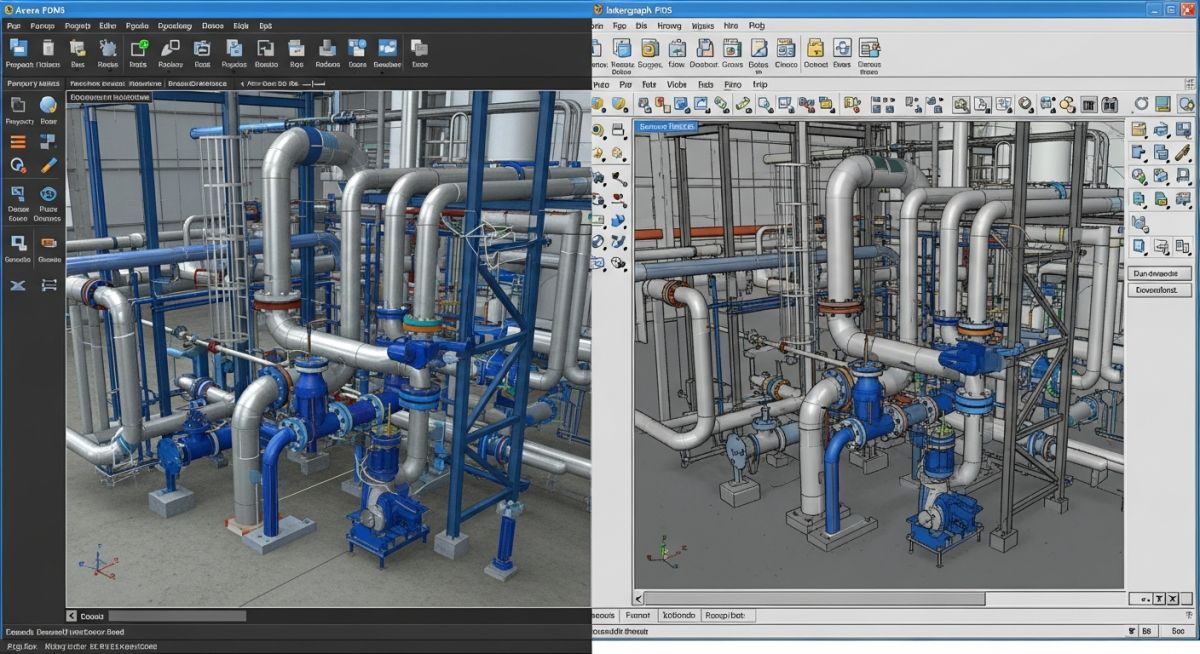
Why Aveva PDMS Outperforms Intergraph PDS in Plant Design
In my 20 years of piping engineering, I have managed mega-projects using both Aveva PDMS and Intergraph PDS. I remember a specific offshore platform project where our PDS database corrupted mid-way through routing a high-pressure steam line. That incident cost us three weeks of rework. When we transitioned to Aveva PDMS, the difference was night and day. The object-oriented database structure of PDMS handled concurrent multi-user routing without a single database lock or crash.
- Aveva PDMS uses a non-locking object-oriented database that eliminates the synchronization lag common in Intergraph PDS.
- PDMS supports real-time clash detection, reducing field rework by up to thirty percent.
- Intergraph PDS requires extensive database administration overhead, whereas PDMS offers streamlined administrative workflows.
Complete Course on
Piping Engineering
Check Now
Key Features
- 125+ Hours Content
- 500+ Recorded Lectures
- 20+ Years Exp.
- Lifetime Access
Coverage
- Codes & Standards
- Layouts & Design
- Material Eng.
- Stress Analysis
Analyzing Aveva PDMS vs Intergraph PDS Databases
To understand the performance gap, let us calculate the database transaction overhead during concurrent piping routing. Suppose we have a team of fifty piping designers working simultaneously on a complex refinery module. In Intergraph PDS, each designer’s action requires a write operation to the relational database and a file-lock on the MicroStation DGN file. The total network traffic can be calculated using the transaction frequency formula: Total Traffic equals the number of concurrent users multiplied by the average transaction size multiplied by the frequency of database commits.
If fifty users generate transactions of one hundred and fifty kilobytes at a frequency of zero point five transactions per second, the network must support three thousand seven hundred and fifty kilobytes per second of continuous, low-latency data transfer. Because PDS uses file-locking, any network latency exceeding fifty milliseconds causes database timeouts and file corruption. In contrast, Aveva PDMS uses a data-streaming protocol that only transmits incremental object changes, reducing the average transaction size to less than ten kilobytes. This reduces the total network traffic to two hundred and fifty kilobytes per second, allowing seamless collaboration even across low-bandwidth global networks.
Furthermore, the integration of piping specifications under ASME B31.3 is handled natively within the PDMS database. When a designer selects a piping class, the software cross-references the material limits in real-time. In PDS, this requires querying external relational tables, which introduces a lag that compounds as the model size grows.
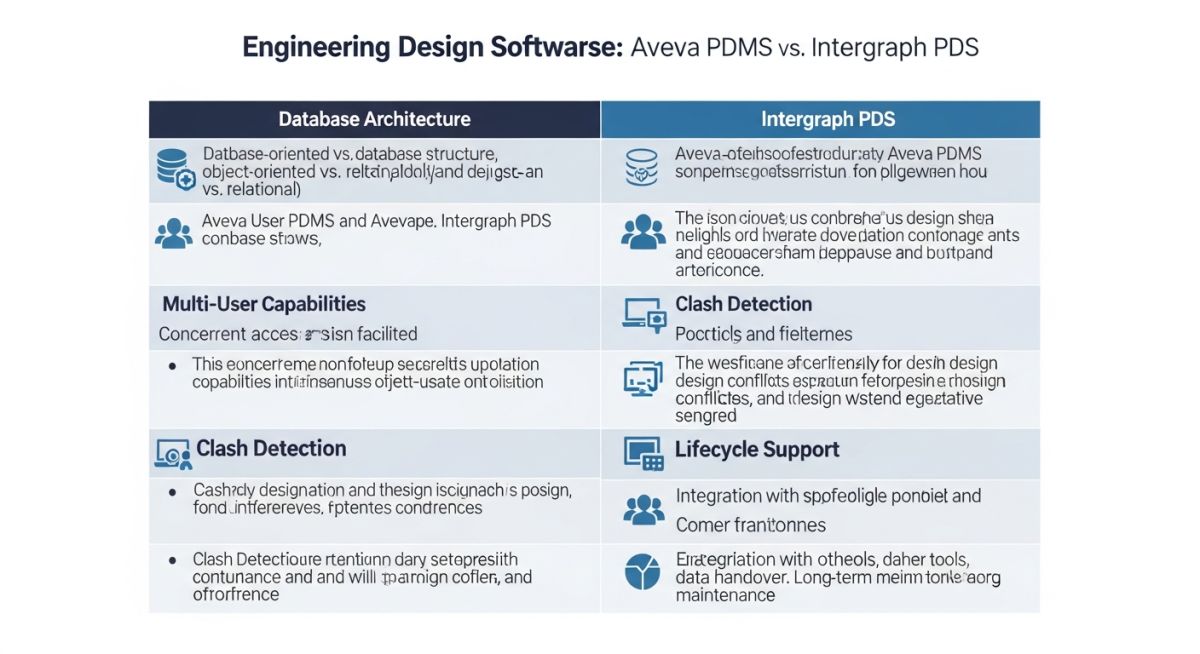
| Feature | Aveva PDMS | Intergraph PDS | Engineering Impact |
|---|---|---|---|
| Database Engine | Proprietary Object-Oriented (DABCON) | Relational (Oracle/SQL) + DGN Files | PDMS prevents file corruption and synchronization lag. |
| Clash Detection | Real-time interactive checking | Batch processing utility | PDMS identifies interferences during routing, saving design hours. |
| Multi-Site Sync | Aveva Global (Incremental streaming) | Database replication (High bandwidth) | PDMS supports global workshare over standard internet connections. |
| Entity / Acronym | PDMS Implementation | PDS Implementation | Standard Reference |
|---|---|---|---|
| Piping Specification | Cats & Specs Module (Natively integrated) | Reference Database (External Oracle tables) | ASME B31.3 / PIP PES1101 |
| Isometric Generation | Isodraft (Direct database extraction) | ISOGEN (Batch file transfer) | ISO 128 / PIP Piping Standards |
| Data Exchange | Native XML / ISO 15926 compliance | Neutral File (Intergraph format) | ISO 15926 |
How to Migrate Plant Design Databases Safely
Migrating from a legacy system like Intergraph PDS to Aveva PDMS requires a rigorous validation process. In my experience, skipping database integrity checks before migration leads to broken piping specs and misaligned coordinates in the target model.
-
Verify database schema alignment with ISO 15926 standards. -
Run a full database diagnostic in PDS to identify orphaned graphic elements. -
Export piping specifications to neutral formats (XML or CSV) and validate against ASME B31.3 material codes. -
Perform a trial migration of a single piping pipeline and generate test isometrics to verify dimensional accuracy. -
Validate coordinate system origins and orientation vectors to prevent global offset errors.
Field Case Study: Real-World Application
During a major brownfield expansion of a petrochemical refinery, the engineering team utilized Intergraph PDS for the existing model and attempted to integrate new piping designs. The legacy relational database suffered frequent synchronization failures, resulting in mismatched piping coordinates and incorrect material take-offs. The project fell six weeks behind schedule due to manual clash detection and database recovery efforts.
I recommended migrating the entire project database to Aveva PDMS. By utilizing the object-oriented database structure of PDMS, we eliminated database synchronization lag. The real-time clash detection engine identified over four hundred design interferences before fabrication. The project team recovered four weeks of the lost schedule, and the final piping installation was completed with zero field-fit welds.
For any complex brownfield or greenfield project exceeding ten thousand piping lines, I strongly advise using Aveva PDMS over Intergraph PDS to ensure database stability and minimize field rework.
