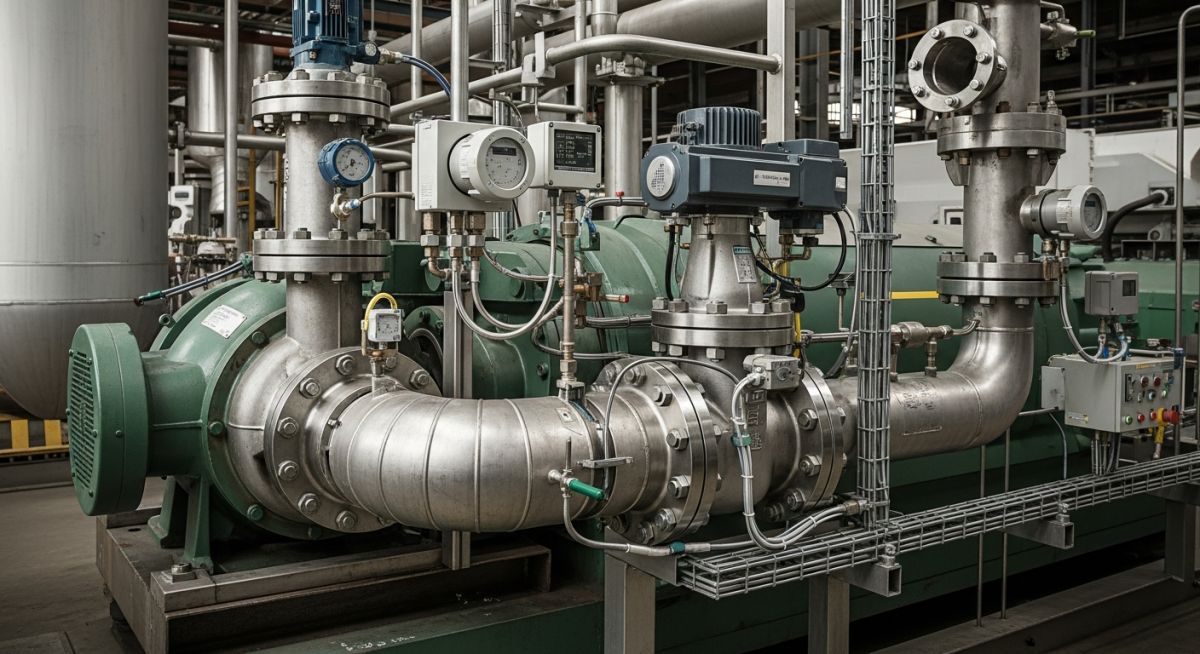
Author: Atul Singla | Senior Piping Engineer | Last Updated: May 2026
What is an Anti-surge Valve? Its Functions, Working, Design, Requirements, Manufacturers
I’ve seen compressors fail in seconds—not because of mechanical defects, but because the anti-surge valve didn’t react fast enough. Surge is brutal. It reverses flow, hammers internals, and trips entire plants. On-site, I don’t treat anti-surge valves as “just another control valve”—I treat them as the last line of defense.
✅ Key Takeaways
- Anti-surge valves prevent compressor surge by recycling excess flow back to suction.
- They are fast-acting control valves with response times often below 1 second.
- Improper sizing or actuator delay can destroy compressors within minutes.
- These valves operate based on surge control logic using flow, pressure, and speed signals.
- Design involves high Cv capacity, low hysteresis, and fail-open configuration.
Featured Snippet (50 words):
An anti-surge valve is a fast-response control valve used in compressor systems to prevent surge by recycling discharge gas back to suction. It operates based on surge control logic using real-time process parameters and is designed for high capacity, quick opening, and reliable fail-safe operation to protect rotating equipment.
🔍 Technical FAQs Engineers Actually Ask
1. Why does a compressor enter surge condition?
Surge occurs when flow drops below the compressor’s minimum stable flow. At this point, the pressure head exceeds system resistance, causing flow reversal. I’ve seen this triggered during startup, shutdown, or sudden load drops.
2. How fast should an anti-surge valve respond?
In the field, we demand sub-second response—typically 0.5 to 1 second. Anything slower increases surge risk. Actuator sizing and instrument air availability directly impact this.
3. What happens if the anti-surge valve fails?
If it fails closed, the compressor is exposed to surge immediately. That’s why most designs use fail-open configuration with spring return or air-fail logic.
4. Is anti-surge valve same as recycle valve?
Functionally similar, but not identical. All anti-surge valves are recycle valves, but not all recycle valves meet the speed and control precision needed for surge protection.
5. Which signals are used in surge control logic?
Typically flow, suction pressure, discharge pressure, and compressor speed. Advanced systems include temperature and molecular weight compensation.
6. Why is valve sizing critical in anti-surge systems?
Because the valve must handle maximum recycle flow instantly. Undersized valves cause oscillation near surge line—I’ve seen this shorten compressor life drastically.
🧠 Quick Field Quiz: Anti-Surge Valve
On-site, I use these checks to validate whether someone really understands surge protection.
1. What is the primary function of an anti-surge valve?
Functions of an Anti-Surge Valve
In my field experience, I never describe an anti-surge valve as just a control valve. It is a dynamic protection device that continuously reacts to compressor instability conditions.
- Prevents surge by maintaining flow above the surge line
- Recycles discharge gas back to suction during low flow
- Provides fast corrective action during transient events
- Maintains stable compressor operation across load variations
- Acts as a mechanical safety barrier when control logic fails
Working of Anti-Surge Valves
This is where most engineers get it wrong. On paper, the working looks simple. In the field, it’s extremely sensitive.
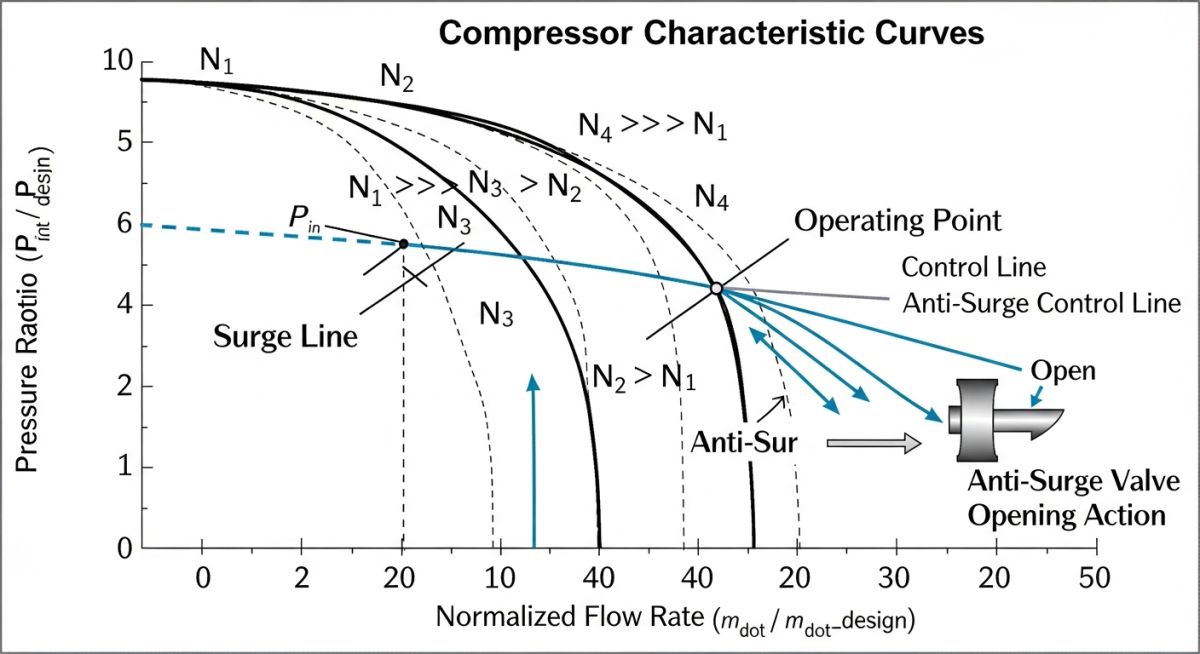
The anti-surge control system calculates a parameter called distance from surge line using inputs like:
- Flow rate
- Suction pressure
- Discharge pressure
- Compressor speed
When the operating point moves dangerously close to the surge line, the system sends a signal to the valve to open instantly, allowing gas to recycle.
⚠️ Field Warning: I’ve seen systems where control logic was perfect—but valve stroking took 2 seconds. That delay alone caused a surge trip. Logic doesn’t protect compressors — response time does.
Anti-Surge Valve Requirements
When I review vendor datasheets, these are non-negotiables:
- Ultra-fast response (< 1 second full stroke)
- High flow coefficient (Cv) to handle full recycle
- Low hysteresis for accurate control
- Fail-open configuration for safety
- Precision actuator + positioner combination
Design of Anti Surge Valve
In real EPC projects, I always push for conservative design margins. Vendors tend to design for normal flow — but surge conditions require much more aggressive sizing.
- Valve type: Globe or rotary control valve
- Actuator: Pneumatic piston (preferred over diaphragm)
- Trim: Anti-cavitation / low noise design
- Positioner: High-speed digital positioner
- Air system: Dedicated volume booster + air reservoir
⚠️ Field Reality: If you don’t provide an air reservoir, your actuator becomes dependent on plant air lag. That’s how response times silently increase over time.
Anti-Surge Valve Specification
| Parameter | Typical Requirement | Standard Reference |
|---|---|---|
| Response Time | < 1 second | API Guidelines |
| Failure Mode | Fail Open | ISO Standards |
| Cv Sizing | Max surge flow capacity | Control Valve Practices |
| Actuator Type | Piston actuator | Industry best practice |
| Positioning Accuracy | High precision | Performance requirement |
Manufacturers of Anti-Surge Valves
In projects I’ve worked on, these OEMs consistently deliver reliable anti-surge valve systems:
- Emerson (Fisher)
- Baker Hughes (Masoneilan)
- Flowserve
- Metso (Neles)
- IMI Critical Engineering
Anti Surge Valves in Compressors
Inside compressor systems, the anti-surge valve is installed in a recycle loop connecting discharge to suction.
But here is the catch — layout matters more than engineers expect.
- Long piping increases response delay
- Poor routing creates pressure losses
- Incorrect tapping points distort measurement signals
⚠️ Site Lesson: I once saw a perfectly designed anti-surge valve fail just because the recycle line was oversized and too long. The valve opened correctly—but the system responded too late.
📉 Real Field Case: Surge Incident During Startup
During a refinery commissioning job, we faced repeated compressor trips during startup.
- Compressor type: Hydrogen recycle compressor
- Valve response time: ~2.3 seconds
- Design expectation: < 1 second
Problem: The anti-surge valve actuator was undersized, and no volume booster was installed.
What I pushed for:
- Actuator upgrade to piston type
- Installation of volume booster
- Addition of air receiver tank
Result after modification:
- Response time reduced to 0.8 seconds
- Zero surge trips after restart
- Startup stability improved significantly
That’s when it became clear — anti-surge design isn’t about meeting specification sheets. It’s about beating real-world delays.

