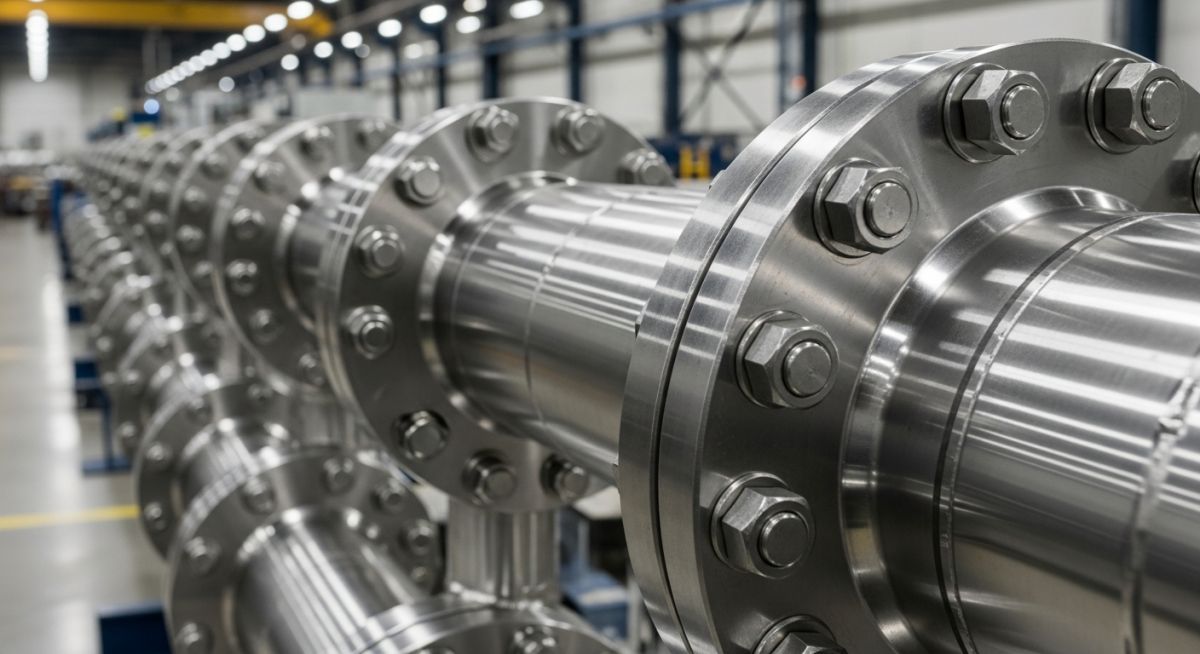
What is Alloy 625? Properties, Grades, and Applications of Alloy 625
In my 20-plus years of managing piping stress analysis and material selection for offshore platforms and chemical processing plants, I have seen many alloys fail under the combined assault of high pressure, extreme temperatures, and corrosive media. When standard stainless steels give up, Alloy 625 is the material I turn to. This nickel-chromium-molybdenum powerhouse has saved countless projects from catastrophic stress corrosion cracking and thermal fatigue.
Often referred to by its proprietary name, Inconel 625, this superalloy is a staple in aerospace, marine, and chemical processing industries. Its unique chemistry allows it to retain high mechanical strength without requiring complex precipitation hardening heat treatments. In this guide, I will break down the metallurgy, mechanical properties, and practical field applications of this remarkable material.
- Excellent resistance to pitting, crevice corrosion, and intergranular attack in chloride-rich environments.
- High tensile, creep, and rupture strength from cryogenic temperatures up to 1800°F (982°C).
- Immunity to chloride-induced stress corrosion cracking, making it ideal for marine and offshore piping.
- Available in two distinct grades (Grade 1 and Grade 2) optimized for different temperature regimes.
Complete Course on
Piping Engineering
Check Now
Key Features
- 125+ Hours Content
- 500+ Recorded Lectures
- 20+ Years Exp.
- Lifetime Access
Coverage
- Codes & Standards
- Layouts & Design
- Material Eng.
- Stress Analysis
Why Does Alloy 625 Excel Under Extreme Stress?
Alloy 625 Performance: The exceptional mechanical integrity of this superalloy stems from the solid-solution strengthening effect of niobium and molybdenum within its nickel-chromium matrix. This unique atomic structure eliminates the need for precipitation hardening treatments while maintaining outstanding resistance to pitting and crevice corrosion.
The secret to the high strength of Alloy 625 lies in its microstructure. Unlike other nickel-based superalloys that rely on gamma-prime or gamma-double-prime precipitates (such as Alloy 718), Alloy 625 is a solid-solution strengthened material. The addition of niobium (3.15% to 4.15%) and molybdenum (8.0% to 10.0%) distorts the face-centered cubic (FCC) nickel-chromium matrix. This lattice distortion acts as a highly effective barrier to dislocation movement, significantly increasing the yield and tensile strength of the material.
To quantify its resistance to localized corrosion in chloride environments, we look at the Pitting Resistance Equivalent Number (PREN). The formula is calculated as:
For Alloy 625, with a nominal chromium content of 21.5% and molybdenum content of 9.0%, the PREN value typically exceeds 51. This is exceptionally high compared to standard 316L stainless steel, which has a PREN of approximately 25. This high value explains why the alloy remains virtually immune to pitting and crevice corrosion in warm seawater.
Understanding Grade 1 vs. Grade 2
When specifying this material under standards like ASTM B443, you must choose between two distinct grades:
- Grade 1 (Annealed): Typically annealed at 1600°F (871°C) minimum. This grade is optimized for high tensile and yield strength at room and moderate temperatures. It is the standard choice for wet corrosion applications and pressure vessels operating under moderate temperatures.
- Grade 2 (Solution Annealed): Solution annealed at 2000°F (1093°C) minimum with a rapid cool. This heat treatment coarsens the grain structure, which dramatically improves creep resistance and stress-rupture strength at operating temperatures above 1200°F (649°C).
If Grade 1 material is exposed to temperatures between 1000°F and 1400°F (538°C to 760°C) for extended periods, chromium carbides can precipitate at the grain boundaries. This depletes the adjacent areas of chromium, making the alloy susceptible to intergranular corrosion. Always specify Grade 2 for continuous high-temperature service.
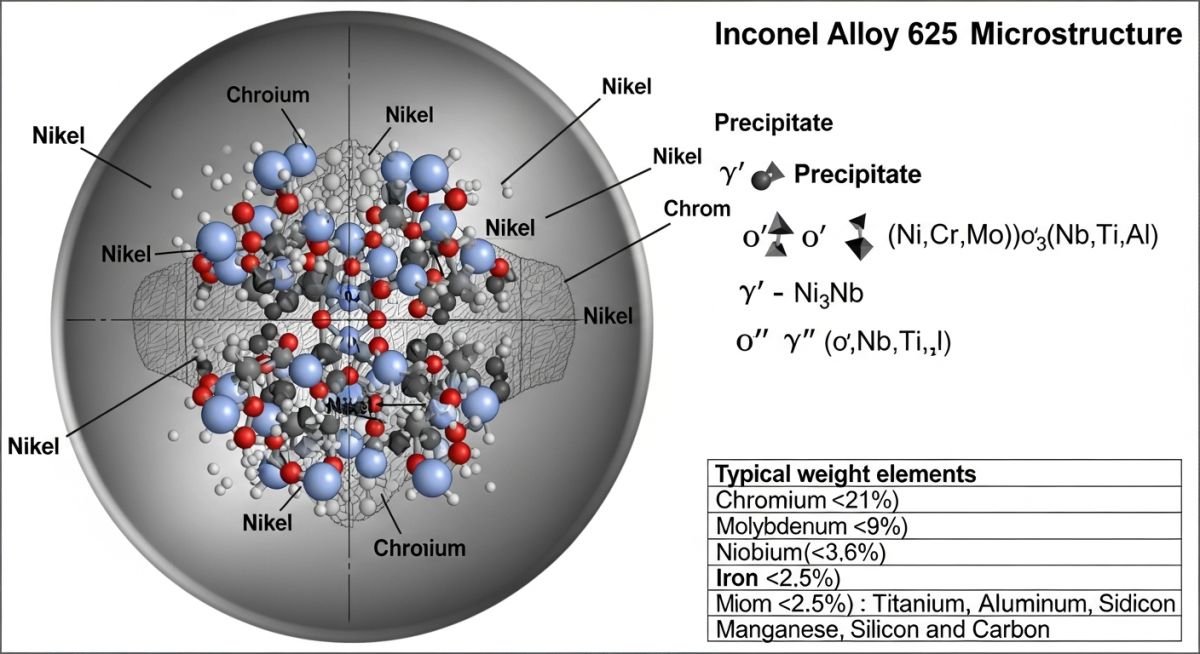
To design safe piping and pressure systems, engineers must rely on precise chemical and mechanical limits. Below are the standardized values for UNS N06625 as specified in ASME SB-443.
| Element | Minimum (%) | Maximum (%) | Metallurgical Role |
|---|---|---|---|
| Nickel (Ni) | 58.00 | Balance | Provides FCC matrix, resistance to chloride stress cracking |
| Chromium (Cr) | 20.00 | 23.00 | Ensures oxidation and high-temperature scaling resistance |
| Molybdenum (Mo) | 8.00 | 10.00 | Enhances pitting resistance and solid-solution strength |
| Niobium + Tantalum (Nb + Ta) | 3.15 | 4.15 | Stabilizes against sensitization, increases yield strength |
| Iron (Fe) | – | 5.00 | Residual element from melting process control |
Mechanical Properties Comparison
| Property | Grade 1 (Annealed) | Grade 2 (Solution Annealed) |
|---|---|---|
| Tensile Strength (Minimum) | 120 ksi (827 MPa) | 100 ksi (690 MPa) |
| Yield Strength (0.2% Offset) | 60 ksi (414 MPa) | 40 ksi (276 MPa) |
| Elongation in 2 inches (Min) | 30% | 30% |
| Primary Application Focus | Wet corrosion, high pressure | Creep resistance above 1200°F |
| Standard Body | Designation / Grade | Product Form Covered | Reference Link |
|---|---|---|---|
| UNS | N06625 | Unified Numbering System (All forms) | SAE International |
| EN / DIN | 2.4856 (NiCr22Mo9Nb) | European standard equivalent | DIN Standards |
| ASTM | B443 / B444 | Plate, Sheet, Strip, and Seamless Pipe | ASTM Portal |
| NACE | MR0175 / ISO 15156 | Sour gas service limits (Up to 35 HRC) | AMPP / NACE |
How to Inspect Alloy 625 Piping Systems?
Alloy 625 Inspection: Field verification of nickel-alloy installations requires strict adherence to non-destructive testing protocols and positive material identification to prevent grade mixing. These quality control measures ensure compliance with ASME B31.3 and NACE MR0175 requirements.
When managing field installations of high-value alloys, you cannot afford to make assumptions. I have witnessed projects where standard stainless steel welding rods were mistakenly used on nickel-alloy joints, leading to rapid failure during commissioning. Implementing a rigorous site verification checklist is the only way to safeguard your asset.
-
Positive Material Identification (PMI):
Perform 100% PMI on all incoming pipes, fittings, and weld joints using handheld XRF analyzers to verify nickel (minimum 58%) and molybdenum (8-10%) content. -
Liquid Penetrant Testing (PT):
Conduct PT on all root passes and completed welds to detect surface-breaking defects, complying with ASME Section V Article 6. -
Heat Treatment Verification:
Verify material test reports (MTRs) to confirm whether Grade 1 (annealed) or Grade 2 (solution annealed) was supplied, matching the design stress calculations. -
Hardness Testing:
Confirm that the maximum hardness of welded joints does not exceed 35 HRC to maintain compliance with NACE MR0175/ISO 15156 for sour service. -
Shielding Gas Purity:
Ensure that the welding gas used for Gas Tungsten Arc Welding (GTAW) is high-purity Argon (minimum 99.99%) to prevent weld pool oxidation.
Field Case Study: Real-World Application
An offshore production platform operating in the North Sea experienced repeated failures in its high-pressure seawater injection manifold. The original piping, constructed from super duplex stainless steel (UNS S32750), suffered from severe localized pitting and stress corrosion cracking within 18 months of commissioning. The operating temperature hovered around 140°F (60°C) with high chloride concentrations, causing costly unplanned shutdowns.
As the lead materials consultant, I recommended replacing the critical manifold sections with Alloy 625 (UNS N06625 Grade 1) piping. The high molybdenum and nickel content provided immediate immunity to chloride-induced stress corrosion cracking. Following the upgrade, the system has operated for over 12 years without a single recorded leak, crack, or localized corrosion defect, saving the operator millions in maintenance costs.
This case highlights why the initial capital expenditure of a premium superalloy is often the most economical choice over the lifecycle of an asset. When designing for aggressive environments, looking beyond the initial material cost is vital.
Frequently Asked Engineering Questions
What is the difference between Grade 1 and Grade 2 Alloy 625?
Can Alloy 625 be welded to carbon steel?
Why is Alloy 625 highly resistant to pitting corrosion?
What are the temperature limits for Alloy 625 in pressure vessel design?
Does Alloy 625 require post-weld heat treatment (PWHT)?
How does Alloy 625 compare to Alloy 825?
