
How Advanced Process Control Optimizes Complex Industrial Plants
In my 20 years of commissioning petrochemical plants, I have seen operators struggle to balance interactive loops manually. Traditional Proportional-Integral-Derivative (PID) controllers are excellent for single-loop stability, but they fail when faced with highly interactive, multivariable processes. When a change in feed rate impacts column temperature, pressure, and product purity simultaneously, standard regulatory systems fall short. This is where modern industrial automation relies on advanced software layers to drive efficiency.
Throughout my career, implementing these high-level control strategies has consistently proven to be the most cost-effective way to squeeze extra capacity out of existing hardware. Instead of rebuilding a distillation column or installing larger heat exchangers, we can use mathematical models to run the process closer to its true physical limitations without risking safety shutdowns.
Key Engineering Takeaways
- Understand how multivariable predictive algorithms manage interactive process loops simultaneously.
- Learn the structural relationship between basic regulatory control (DCS) and advanced optimization layers.
- Discover the mathematical foundations of constraint handling that protect physical plant assets.
- Identify the exact steps required to execute a successful step-test and model identification phase.
Why Advanced Process Control Outperforms Traditional DCS
Model Predictive Control: This mathematical control strategy utilizes dynamic process models to predict future output behaviors based on past inputs and calculate optimal control moves. It directly replaces manual setpoint adjustments by solving a constrained quadratic programming problem at every execution interval.
To understand why this technology is necessary, we must look at the limitations of standard Distributed Control Systems (DCS). A DCS relies on individual PID loops. If Loop A interacts with Loop B, a correction in Loop A causes a disturbance in Loop B. This leads to continuous cycling, forcing operators to back away from optimal operating limits to maintain a safe buffer.
Advanced systems solve this by using a mathematical model of the process. The controller looks ahead over a specified time horizon (the prediction horizon) and calculates a series of future control moves (the control horizon) to minimize deviation from the target.
If your physical process changes due to catalyst deactivation, heat exchanger fouling, or piping modifications, the mathematical model inside the controller will no longer match reality. This model mismatch can cause severe controller instability, leading to aggressive valve movements and potential plant trips. Regular model validation is mandatory.
The Mathematical Objective Function
The core of Model Predictive Control (MPC) is the minimization of a quadratic cost function. The controller solves this optimization problem at every execution step (typically every 10 to 30 seconds):
J = Sum[ w_yi * ( y(k+i) – r(k+i) )^2 ] + Sum[ w_ui * ( delta_u(k+i-1) )^2 ]
Where:
• J is the total performance cost to be minimized.
• y(k+i) is the predicted process variable (PV) at step i.
• r(k+i) is the future target or setpoint path.
• delta_u(k+i-1) is the calculated change in the manipulated variable (MV).
• w_yi and w_ui are weighting factors that prioritize tracking accuracy versus control effort.
By adjusting the weights, we can make the controller highly aggressive or highly conservative. This optimization is subject to real-world constraints, such as maximum valve travel speeds and safe operating pressures, which are defined in compliance with standards like ISA-95.
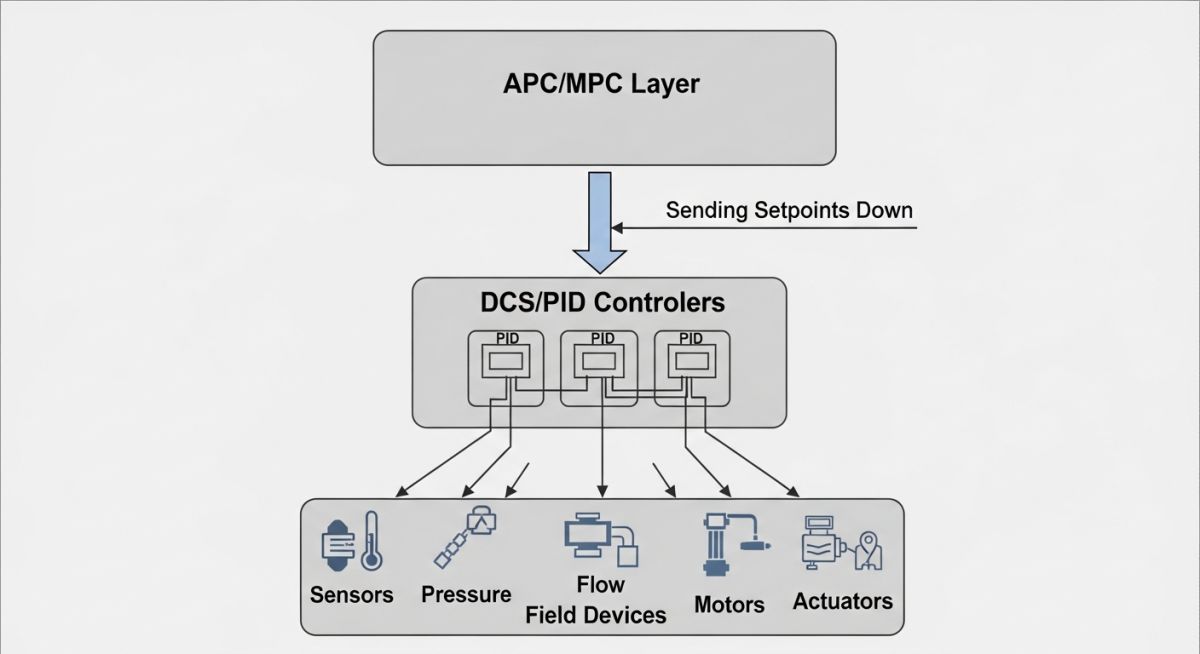
The architecture relies on a continuous feedback loop. The state estimator (often a Kalman Filter) takes noisy measurements from the field instruments, filters the data, and updates the dynamic model. The optimizer then calculates the best setpoints and sends them down to the regulatory DCS PID loops.
| Parameter | Regulatory Control (DCS PID) | Advanced Process Control (MPC) |
|---|---|---|
| Control Structure | Single-Input, Single-Output (SISO) | Multi-Input, Multi-Output (MIMO) |
| Interaction Handling | Ignored or decoupled via complex feedforward logic | Inherent in the multivariable mathematical model |
| Constraint Management | Reactive (trips or overrides via select blocks) | Predictive (calculates moves to avoid constraints) |
| Optimization Goal | Hold process variable at a fixed setpoint | Drive process to the most profitable limit |
| Execution Frequency | Fast (100 milliseconds to 1 second) | Medium (10 seconds to 30 seconds) |
| System Entity | Technical Acronym | Primary Physical Parameter | Standard Reference |
|---|---|---|---|
| Manipulated Variable | MV | Control valve position, pump speed, feed rate | ISA-5.1 Instrumentation Symbols |
| Controlled Variable | CV | Product purity, operating temperature, pressure | ISA-75 Control Valve Standards |
| Disturbance Variable | DV | Ambient temperature, feed composition changes | API RP 554 Process Instrumentation |
| Real-Time Optimizer | RTO | Economic utility costs, raw material pricing | ISA-95 Enterprise-Control Integration |
How to Implement Advanced Process Control Successfully
APC Implementation Protocol: This structured deployment methodology governs the assessment, design, step-testing, model identification, and commissioning of multivariable controllers. It ensures that regulatory loops are fully stabilized before layering advanced optimization algorithms.
Before you write a single line of code or purchase optimization software, you must ensure your physical plant is ready. If your basic regulatory loops are poorly tuned, or if your control valves suffer from high hysteresis, your advanced controller will fail. I always tell my project teams: “You cannot build a skyscraper on a foundation of sand.”
Pre-Commissioning Field Checklist
Ensure at least 95% of all PID loops are in automatic mode and tuned for stable response without excessive oscillation.
Verify that critical control valves have less than 1% stiction and hysteresis. Replace or service faulty positioners.
Calibrate all primary instruments (flow, temperature, pressure transmitters) to ensure accurate feedback to the state estimator.
Design a step-testing schedule to systematically bump manipulated variables and record dynamic process responses.
Conduct training sessions so operators understand when to trust the controller and how to shed loops safely during upsets.
Field Case Study: Real-World Application
The Problem: Distillation Column Instability
At a major refinery in Southeast Asia, a depropanizer column suffered from severe feed rate fluctuations. The existing DCS PID loops could not handle the interactions between the reboiler steam flow and the reflux rate. This resulted in frequent off-specification product, forcing operators to run the reboiler at maximum steam flow to guarantee purity. This practice wasted significant energy and increased carbon emissions.
The Solution & Outcome
We deployed a multivariable Model Predictive Control application containing 4 Manipulated Variables and 6 Controlled Variables. By performing systematic step-tests, we identified the exact dynamic relationships between feed changes, reflux, and overhead purity.
Within three weeks of commissioning, the controller reduced process variability by 45%. This stability allowed the system to safely push the column closer to its impurity limit, reducing reboiler steam consumption by 8.2% and increasing overall throughput by 3.5%.
This project demonstrated that the key to success is not just the software, but the quality of the step-testing phase. Without clean data, the model would have been inaccurate, and the controller would have been switched off by the operators within a week.
Frequently Asked Engineering Questions
What is the difference between APC and DCS?
How does Model Predictive Control handle process constraints?
What is step-testing in an APC project?
Can APC run if a critical instrument fails?
What are the typical maintenance requirements for APC?
Which industrial standards govern APC design and integration?
===FAQ_BLOCK===
Complete Course on
Piping Engineering
Check Now
Key Features
- 125+ Hours Content
- 500+ Recorded Lectures
- 20+ Years Exp.
- Lifetime Access
Coverage
- Codes & Standards
- Layouts & Design
- Material Eng.
- Stress Analysis



