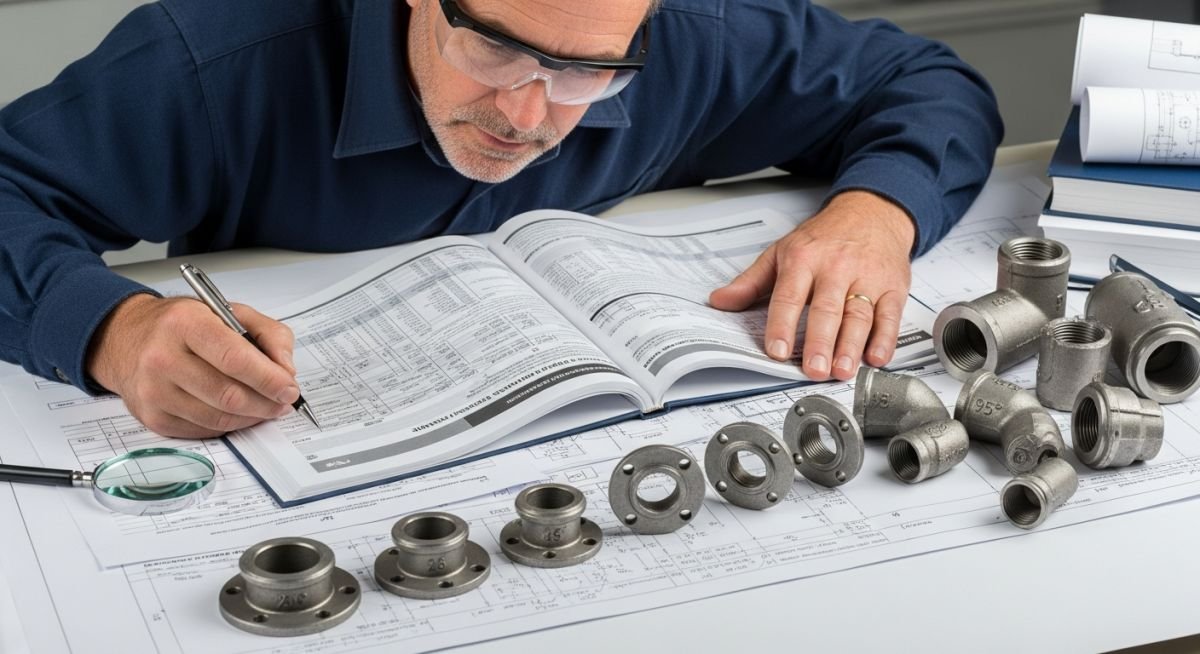
Technical Requirements for Pipes and Fittings in Purchase Requisitions
In my two decades of experience, I have seen countless projects stall because of ambiguous language in a purchase requisition. When you are specifying pipes and fittings, you are not just ordering metal; you are defining the safety boundary of a high-pressure system. A single oversight in wall thickness or material certification can lead to catastrophic failure during hydrostatic testing or, worse, during operational service.
This guide focuses on the technical rigor required to translate engineering design data into actionable procurement documents. We will move beyond simple part numbers to address the nuances of ASTM material grades, ASME dimensional tolerances, and the critical importance of supplementary testing requirements that often get overlooked until the material arrives on site.
Key Takeaways for Procurement Success:
- Standardize material selection using ASME B31.3 and ASTM material specifications.
- Define precise dimensional requirements per ASME B36.10M and ASME B16.9.
- Mandate Material Test Reports (MTRs) and traceability for all pressure-retaining components.
- Incorporate specific NDT and heat treatment requirements directly into the requisition line items.
Technical Requirements for Pipes and Fittings Design
Piping Component Specification: The rigorous process of selecting material, wall thickness, and end-connection geometry to satisfy the pressure-temperature ratings defined by the piping class and the governing code of construction.
When preparing a purchase requisition, the engineer must bridge the gap between the Piping and Instrumentation Diagram (P&ID) and the physical material. The primary calculation for pipe wall thickness is governed by ASME B31.3, specifically the pressure design thickness formula. I always remind my team that the nominal wall thickness must account for the pressure design thickness, the corrosion allowance, and the mill tolerance (typically 12.5% for seamless pipe).
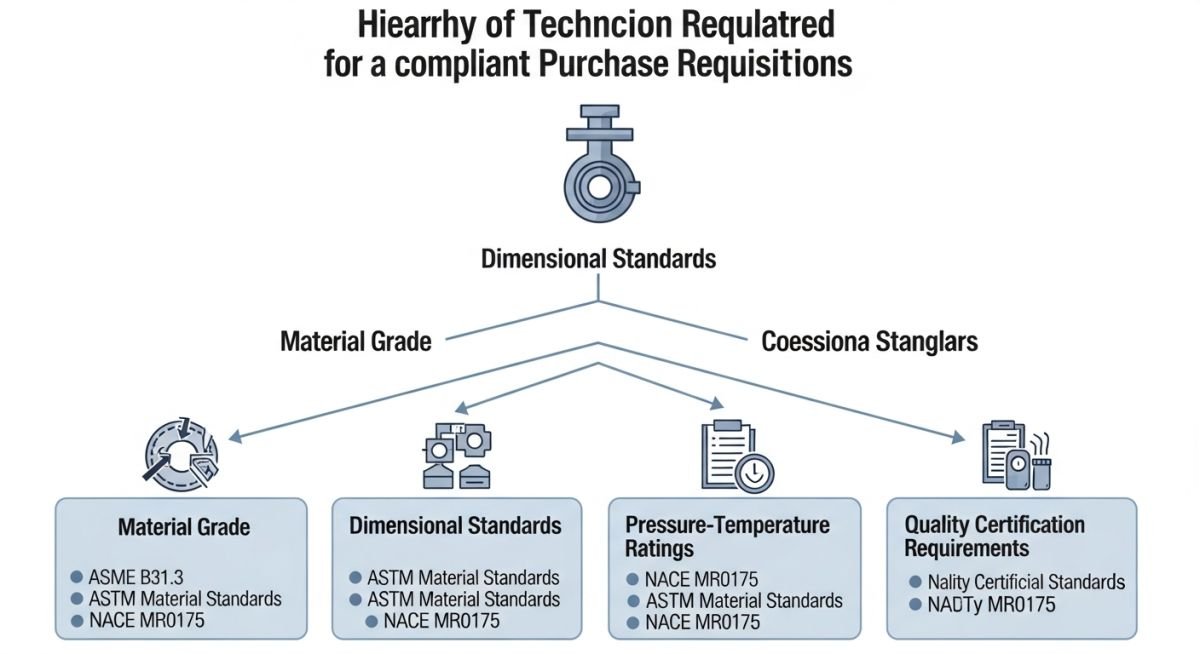
For fittings, the requirements shift toward dimensional consistency and pressure integrity. We rely on ASME B16.9 for factory-made wrought butt-welding fittings. A common pitfall is failing to specify the “long radius” or “short radius” requirement for elbows, or neglecting to define the branch connection type (e.g., tee vs. weldolet) in the requisition. If the fitting is for high-pressure service, the requisition must explicitly state the required schedule or pressure class (e.g., Class 3000 or 6000 for forged fittings per ASME B16.11).
Field Warning: Material Traceability
Never accept “generic” material certificates. For critical service, the requisition must mandate full heat-number traceability. If the material is for sour service, ensure the requisition specifies compliance with NACE MR0175/ISO 15156. Failure to verify these requirements at the requisition stage often leads to expensive site rejections and project delays.
Beyond the basics, consider the end-prep requirements. Are the pipe ends beveled for welding, or are they plain-end for socket welding? For larger diameters, specify the bevel angle (typically 37.5 degrees) to ensure compatibility with the field welding procedure specifications (WPS). Always cross-reference the material grade with the project’s piping material specification (PMS) to ensure that the chemical composition, particularly carbon equivalent (CE) values, remains within the weldability limits defined by the project’s welding engineer.
Procurement Specification Strategy: The evaluation of standardized versus custom-engineered piping components to balance project cost, lead time, and long-term operational reliability.
Advantages
- Standardization: Using ASME-compliant components ensures global availability and interchangeability.
- Regulatory Compliance: Adherence to B31.3 simplifies the permitting and inspection process with local authorities.
- Predictable Performance: Established pressure-temperature ratings reduce the need for complex finite element analysis (FEA).
- Supply Chain Efficiency: Standardized specifications allow for competitive bidding among multiple qualified vendors.
Disadvantages
- Over-Specification Costs: Selecting higher-than-necessary schedules increases material weight and procurement costs.
- Lead Time Constraints: Specialized alloys or non-standard dimensions often require long manufacturing cycles.
- Documentation Burden: Strict traceability requirements increase the administrative overhead for both vendor and purchaser.
- Rigidity: Standardized components may not be optimized for unique, high-vibration, or extreme-temperature process conditions.
Industrial Piping Implementation: The application of rigorous procurement standards across diverse sectors to ensure structural integrity and process safety in high-stakes environments.
High-Pressure Hydrocarbon Processing
In refinery environments, the procurement of pipes and fittings must account for high-temperature hydrogen attack and potential sulfide stress cracking. We specify ASTM A106 Grade B or A335 P11/P22 materials, ensuring that all fittings are normalized and impact-tested to meet the stringent requirements of the process safety management (PSM) program.
Cryogenic Liquefied Natural Gas (LNG) Facilities
LNG service requires materials with excellent notch toughness at temperatures as low as -162 degrees Celsius. The requisition process mandates austenitic stainless steel (e.g., 304L or 316L) or 9% nickel steel, with mandatory Charpy V-notch impact testing performed at the design minimum temperature to prevent brittle fracture.
High-Purity Pharmaceutical Water Systems
For WFI (Water for Injection) systems, the focus shifts from pressure rating to surface finish and material purity. We specify 316L stainless steel with electropolished internal surfaces (Ra < 0.4 micrometers) and mandate full documentation of weld coupons to ensure no crevice corrosion or bacterial growth sites exist within the piping network.
Geothermal Power Generation
Geothermal piping must withstand highly corrosive brine and high-temperature steam. Procurement specifications often require corrosion-resistant alloys (CRAs) or specialized coatings, with a heavy emphasis on the chemical analysis of the base metal to ensure resistance to chloride-induced stress corrosion cracking over the plant’s 30-year design life.
When preparing a purchase requisition for piping components, the selection of material grades must align strictly with the design temperature and pressure ratings defined in ASME B31.3. My experience dictates that engineers must verify the compatibility of the base metal with the process fluid to prevent premature degradation, such as hydrogen embrittlement or stress corrosion cracking. The following table summarizes the common material specifications I utilize for standard process piping, ensuring that the procurement team selects items that meet both mechanical strength and chemical resistance requirements.
Always ensure that the material test reports (MTRs) are requested as part of the vendor data requirements (VDR) to validate these specifications upon delivery. Discrepancies between the requisitioned grade and the supplied material can lead to catastrophic failure during hydrostatic testing or operational cycles.
| Component Type | Material Specification | Standard Reference | Primary Application |
|---|---|---|---|
| Carbon Steel Pipe | ASTM A106 Gr. B | ASME B36.10M | General Process Service |
| Stainless Steel Pipe | ASTM A312 TP316/L | ASME B36.19M | Corrosive/Cryogenic Service |
| Forged Fittings | ASTM A105N | ASME B16.11 | High-Pressure Small Bore |
| Buttweld Fittings | ASTM A234 WPB | ASME B16.9 | General Piping Systems |
Effective procurement relies on a clear understanding of the relationship between physical piping entities and their governing standards. In my practice, I maintain a mapping matrix to ensure that every line item in a purchase requisition is cross-referenced against the correct dimensional and material standards. This prevents the common error of specifying a fitting that is dimensionally incompatible with the pipe wall thickness or the flange rating.
The matrix below serves as a foundational reference for junior engineers and procurement specialists to verify that the technical requirements for pipes and fittings are consistently applied across all project phases. By standardizing these mappings, we reduce the risk of field rework and procurement delays caused by mismatched component specifications.
| Entity | Governing Code | Key Parameter |
|---|---|---|
| Pipe Dimensions | ASME B36.10 | Nominal Pipe Size (NPS) |
| Flange Ratings | ASME B16.5 | Pressure-Temperature Class |
| Valve Dimensions | ASME B16.34 | Face-to-Face Length |
| Gasket Specs | ASME B16.20 | Spiral Wound Compatibility |
Before finalizing any purchase requisition, I perform a rigorous site verification to ensure that the technical requirements for pipes and fittings are not just theoretically sound, but practically executable. This checklist is designed to catch common oversights that occur during the transition from design office to procurement. It is imperative that you validate these points against the latest Piping and Instrumentation Diagrams (P&IDs) and the project-specific piping material specification (PMS).
- ✓ Verify that the pipe schedule matches the calculated pressure containment requirements per ASME B31.3.
- ✓ Confirm that all fitting end-preparations (bevel, threaded, socket weld) match the mating pipe ends.
- ✓ Ensure that material certificates (MTRs) are explicitly requested for all pressure-retaining components.
- ✓ Check for any special cleaning requirements (e.g., oxygen service or degreasing) that must be noted in the requisition.
- ✓ Validate that the corrosion allowance specified in the design basis is reflected in the wall thickness of the ordered pipe.
- ✓ Confirm that the quantity includes a standard 5-10% contingency for field waste and cutting losses.
By systematically reviewing these items, you minimize the risk of procurement errors that lead to site downtime. Always document the verification process in the project file to ensure traceability for future audits or maintenance activities.
The Problem: Mismatched Fitting Schedules
During a recent refinery expansion, the procurement team ordered standard weight (STD) buttweld elbows for a high-pressure line that required Schedule 80 wall thickness.
- Inconsistent wall thickness between pipe and fitting created a stress concentration point.
- The discrepancy was only identified during the pre-weld inspection phase.
- Project schedule was delayed by three weeks due to the lead time for correct components.
- Significant costs were incurred for expedited shipping and re-mobilization of welding crews.
The Outcome: Implementation of Rigorous Verification
We successfully mitigated the issue by implementing a mandatory dual-signature verification process for all piping requisitions.
- Established a mandatory cross-check between the P&ID, the line list, and the purchase requisition.
- Introduced a visual inspection step for all incoming materials against the approved material list.
- Reduced procurement-related field rework by 40% in subsequent project phases.
- Improved communication between the design office and the procurement department.
My recommendation is to always involve a senior piping engineer in the final review of the purchase requisition before it is released to the vendor. This simple step acts as a final safety barrier against the common pitfalls of technical miscommunication.
Frequently Asked Engineering Questions
How do I determine the correct pipe schedule for my application?
- Calculate the pressure design thickness using the Barlow formula or the more precise Lamé equation.
- Add the required corrosion allowance and the mill tolerance (typically 12.5%) to the calculated thickness.
- Select the next standard pipe schedule from ASME B36.10M that meets or exceeds this total value.
- Always verify that the chosen schedule is compatible with the pressure rating of the flanges and valves in the same piping class.
What is the difference between ASTM A106 and ASTM A53 pipe?
- ASTM A106 Grade B is a seamless pipe, making it the preferred choice for high-pressure process piping.
- ASTM A53 can be either seamless or welded, but it is not typically rated for the same high-temperature stress levels as A106.
- In my experience, always specify A106 for process lines to ensure compliance with ASME B31.3 requirements.
- Check the chemical composition limits, as A106 has stricter requirements for silicon and manganese content.
Why is the material test report (MTR) so important?
- It provides traceability back to the original heat of steel, which is vital for quality assurance.
- It confirms that the material has undergone the necessary heat treatments, such as normalizing or quenching.
- It serves as legal documentation in the event of a material failure or safety audit.
- Always ensure the MTR is signed by the manufacturer and matches the heat number stamped on the pipe or fitting.
How do I handle special cleaning requirements in a requisition?
- Reference the specific industry standard for cleaning, such as CGA G-4.1 for oxygen service.
- Specify the required cleanliness level, such as “oil-free” or “particle-free.”
- Require the vendor to provide a certificate of cleanliness with the shipment.
- Ensure that the ends of the pipes and fittings are capped and sealed immediately after cleaning to prevent re-contamination.
What are the implications of using non-standard fittings?
- You must perform a proof test or a finite element analysis (FEA) to validate the pressure rating.
- The design must be approved by a professional engineer and documented in the project design basis.
- Non-standard fittings often have longer lead times and higher costs due to the custom manufacturing requirements.
- Avoid them whenever possible by selecting standard components that meet the design criteria.
How do I ensure compatibility between different piping materials?
- Use dielectric kits or isolation flanges when joining metals with significantly different galvanic potentials.
- Analyze the thermal expansion stresses at the joint to ensure the piping supports can handle the movement.
- Verify that the welding procedure specification (WPS) is qualified for the specific combination of base metals.
- Consult the project piping material specification (PMS) for approved material combinations and transition joint requirements.
📚 Recommended Resources: Pipes and Fittings
Read these Guides


Complete Course on
Piping Engineering
Check Now
Key Features
- 125+ Hours Content
- 500+ Recorded Lectures
- 20+ Years Exp.
- Lifetime Access
Coverage
- Codes & Standards
- Layouts & Design
- Material Eng.
- Stress Analysis
