Geotechnical Requirements for Data Centres: Ensuring Structural Stability
In my two decades of experience, I have seen too many high-value projects falter because the soil beneath the server racks was treated as an afterthought. Data centres are not typical commercial buildings; they are heavy, vibration-sensitive, and absolutely intolerant of differential settlement. When we design for these facilities, we are not just looking at the weight of the concrete; we are calculating the long-term interaction between massive floor loads and the underlying geological strata.
A robust geotechnical investigation is the bedrock of site selection and structural integrity. Without precise data on soil shear strength, groundwater fluctuations, and liquefaction potential, the risk of catastrophic structural failure or service downtime increases exponentially. This guide explores the technical rigour required to ensure your data centre remains operational for its entire design life.
Key Takeaways for Engineering Teams:
- Differential settlement must be strictly controlled to prevent server rack misalignment.
- Groundwater assessment is critical for basement waterproofing and buoyancy calculations.
- Seismic design parameters must account for site-specific soil amplification factors.
- Borehole density must align with the footprint of high-load server halls.
Technical Analysis of Geotechnical Requirements for Data Centres
Geotechnical Requirements for Data Centres: These parameters define the necessary soil-structure interaction analysis, including bearing capacity verification, settlement prediction, and seismic site classification, to ensure the long-term stability of high-density server environments under ASCE 7 and ASTM D2487 guidelines.
Data centre loads are unique in the construction industry. Unlike office buildings, where live loads are transient, data centres impose sustained, high-intensity loads from server racks, cooling units, and battery energy storage systems (BESS). These loads often exceed 15 to 25 kilo-Newtons per square meter. When we perform a geotechnical assessment, we must calculate the stress bulb propagation to ensure that the underlying soil layers do not experience shear failure or excessive consolidation.
Borehole Planning and Soil Characterization
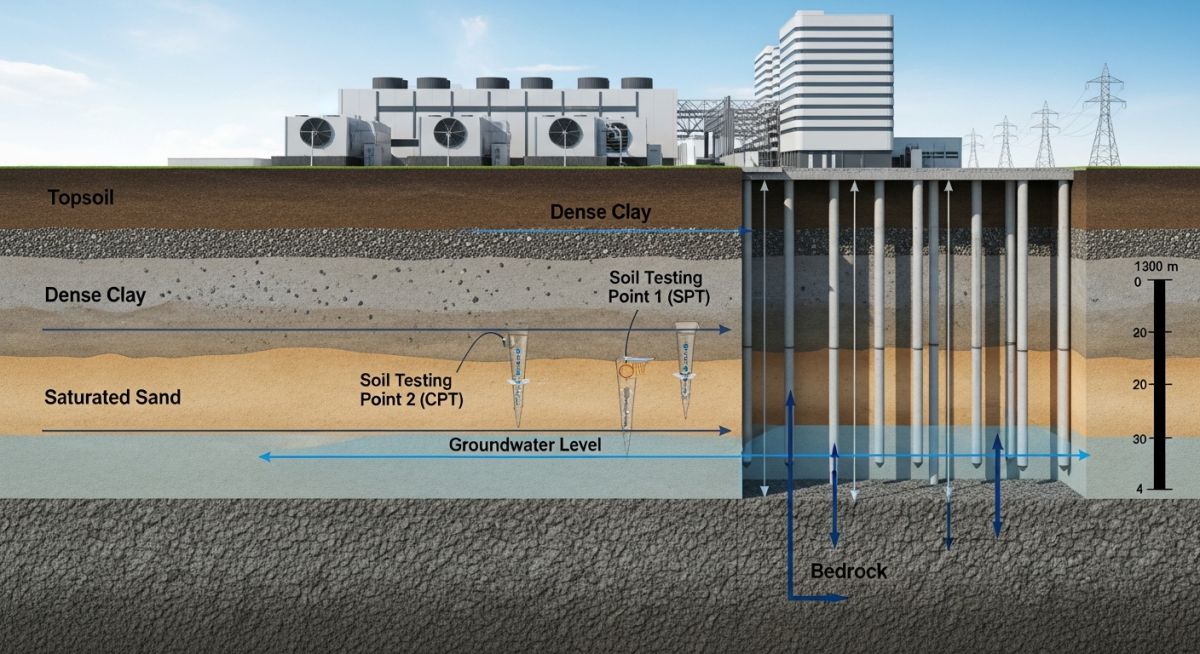
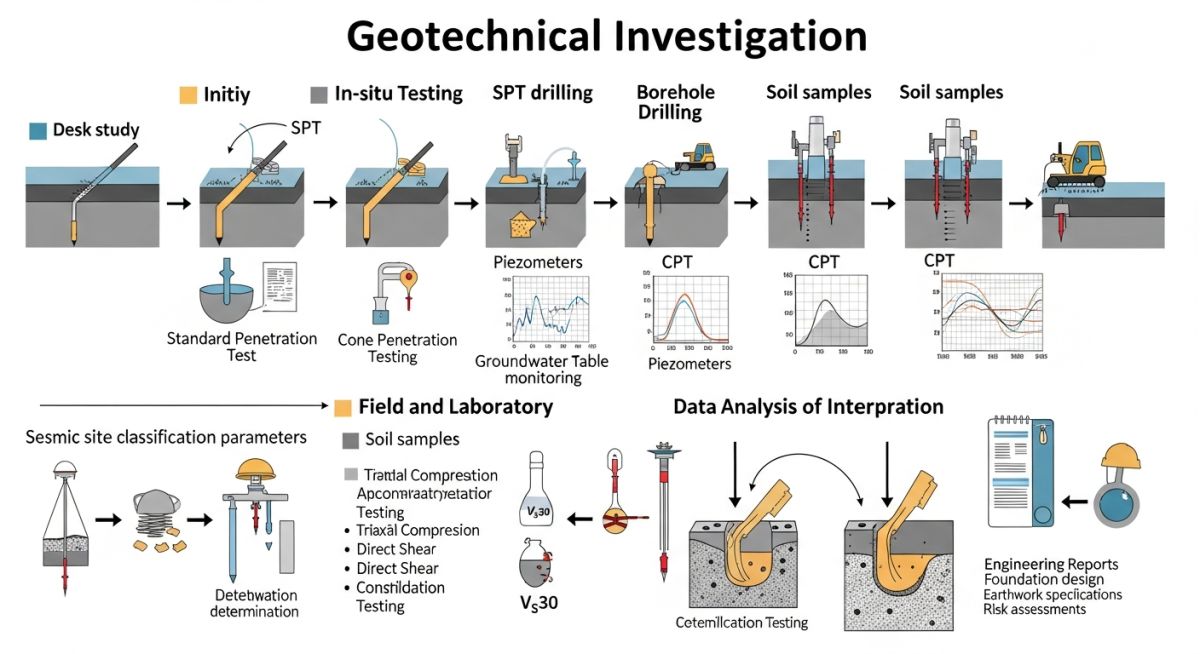
The density of boreholes must be sufficient to capture the spatial variability of the site. For a typical data centre, I recommend a minimum of one borehole per 500 square meters of the building footprint, with depths extending at least 1.5 times the width of the largest foundation element. We must perform Standard Penetration Tests (SPT) and Cone Penetration Tests (CPT) to derive the soil’s internal friction angle and cohesion parameters.
Field Warning: Groundwater Sensitivity
High groundwater tables pose a dual threat: they reduce the effective stress of the soil, thereby lowering the allowable bearing capacity, and they introduce significant hydrostatic uplift forces on basement slabs. Always install piezometers to monitor seasonal fluctuations over a minimum of one hydrological cycle before finalizing foundation depths.
Settlement Considerations and Bearing Capacity
Differential settlement is the primary enemy of server hardware. Even minor tilting can cause mechanical stress on high-density cabling and cooling pipe connections. We calculate the total and differential settlement using the consolidation theory, ensuring that the angular distortion remains within the limits defined by AISC and ACI standards. For mat foundations, the modulus of subgrade reaction must be carefully calibrated to the actual stiffness of the soil-foundation system.
When dealing with soft clays or loose sands, ground improvement techniques such as stone columns, deep soil mixing, or rigid inclusions are often required. These methods increase the composite stiffness of the soil mass, allowing for higher allowable bearing pressures and reducing the risk of long-term creep settlement.
Geotechnical Investigation Benefits: These include the mitigation of structural risk, optimization of foundation costs, and the prevention of long-term operational downtime through proactive soil-structure interaction management.
Advantages
- Precise foundation sizing reduces concrete and steel waste.
- Early identification of liquefaction risks prevents catastrophic failure.
- Optimized ground improvement avoids expensive deep pile foundations.
- Accurate settlement predictions protect sensitive server hardware.
- Regulatory compliance ensures insurance and permitting success.
Disadvantages
- High initial cost for comprehensive site investigation programs.
- Extended project timelines due to seasonal groundwater monitoring.
- Complexity in interpreting variable soil strata in urban sites.
- Potential for unforeseen site conditions despite rigorous testing.
- Increased engineering overhead for specialized soil modeling.
Data Centre Geotechnical Applications: These encompass the specialized engineering solutions required for diverse site conditions, ranging from high-seismic zones to reclaimed coastal land, ensuring mission-critical reliability.
High-Seismic Zone Data Centres
In regions prone to seismic activity, geotechnical requirements focus on soil liquefaction mitigation and site-specific response spectra. We utilize deep soil mixing or jet grouting to stabilize the soil matrix, ensuring that the foundation remains coupled to the ground during peak ground acceleration events.
Brownfield Redevelopment Projects
Redeveloping industrial sites for data centre use requires extensive environmental and geotechnical characterization to identify legacy contaminants and buried obstructions. We implement rigid inclusion systems to bypass weak fill layers, providing a stable platform for heavy server hall floor slabs.
Coastal and Reclaimed Land Sites
Data centres built on reclaimed land face significant challenges from soft, compressible marine clays and high water tables. We employ pre-loading with vertical drains to accelerate consolidation, followed by deep foundation systems to transfer loads to competent bearing strata.
Hyperscale Campus Expansion
For large-scale campus developments, geotechnical requirements involve mapping the spatial variability of soil properties across vast areas. We use geophysical methods like seismic refraction to supplement borehole data, ensuring consistent foundation performance across multiple interconnected server halls.
When evaluating the structural integrity of a data centre, engineers must reconcile the high-density equipment loads with the specific soil mechanics of the site. The following table outlines the typical geotechnical design parameters that dictate foundation selection, ranging from shallow spread footings to deep pile systems. These values are derived from ASCE 7 standards and ASTM D2487 soil classification protocols.
It is critical to note that these parameters are indicative; site-specific borehole data must always supersede general guidelines. Variations in moisture content, void ratios, and effective stress paths can significantly alter the allowable bearing capacity, particularly in regions prone to liquefaction or expansive clay behavior. Always consult with a licensed geotechnical engineer to validate these inputs against your specific site investigation report.
| Parameter | Typical Range | Standard Reference |
|---|---|---|
| Allowable Bearing Capacity | 150 – 300 kPa | ASCE 7-22 |
| Modulus of Subgrade Reaction | 20 – 80 MN/m3 | ASTM D1196 |
| Internal Friction Angle | 28 – 36 Degrees | ASTM D3080 |
The following matrix maps the core technical entities involved in data centre geotechnical design to their respective industry standards and physical performance metrics. This mapping ensures that structural, mechanical, and electrical teams remain aligned on the site’s geotechnical constraints, preventing costly foundation failures or equipment vibration issues during the operational phase of the facility.
By standardizing these entities, we create a common language for project stakeholders. Whether dealing with seismic base isolation or heavy server rack floor loading, the relationship between soil stiffness and structural response remains the primary driver of design safety. Refer to the linked standards for detailed testing methodologies and compliance requirements for each entity listed below.
| Entity | Acronym | Standard |
|---|---|---|
| Standard Penetration Test | SPT | ASTM D1586 |
| Cone Penetration Test | CPT | ASTM D5778 |
| Unified Soil Classification | USCS | ASTM D2487 |
Before breaking ground on any mission-critical facility, a rigorous site verification process is mandatory. My experience has shown that skipping these steps often leads to differential settlement, which can cause catastrophic failure in high-density server racks and cooling infrastructure. Use this checklist to ensure your geotechnical investigation meets the necessary rigor for modern data centre requirements.
- ☐ Borehole Density: Ensure a minimum of one borehole per 500 square meters of building footprint to capture soil variability.
- ☐ Groundwater Monitoring: Install piezometers to monitor seasonal water table fluctuations over at least one full cycle.
- ☐ Seismic Site Class: Perform shear wave velocity testing to determine the correct Site Class per ASCE 7.
- ☐ Corrosivity Analysis: Test soil for pH, resistivity, and sulfate content to protect concrete and steel foundation elements.
- ☐ Vibration Sensitivity: Evaluate the soil’s damping characteristics to ensure it can mitigate vibrations from backup generators and cooling systems.
Verification is not a one-time event. During the excavation phase, it is vital to perform proof-rolling and plate load tests to confirm that the actual soil conditions match the design assumptions made during the preliminary geotechnical report. If discrepancies arise, the structural design must be re-evaluated immediately to prevent long-term operational downtime.
The Problem: Unforeseen Differential Settlement
A major data centre project in a coastal region experienced unexpected settlement during the installation of heavy UPS battery arrays, leading to floor slab cracking.
- Inadequate characterization of soft alluvial clay layers during initial site investigation.
- Failure to account for the consolidation time of saturated soils under sustained high-density loads.
- Lack of deep foundation elements in areas with high water table proximity.
The Outcome: Remediation and Stabilization
The project team successfully stabilized the facility by implementing a targeted ground improvement strategy that restored structural integrity.
- Injection of high-density polyurethane foam to densify loose soil pockets beneath the slab.
- Installation of micro-piles to transfer critical equipment loads to deeper, more competent strata.
- Implementation of a real-time structural health monitoring system to track future settlement trends.
My recommendation for future projects is to prioritize deep-soil testing in coastal or alluvial environments. Never rely solely on shallow SPT data when the facility footprint includes high-density, vibration-sensitive equipment that requires absolute floor levelness for operational continuity.
Why is soil corrosivity testing critical for data centres?
- High sulfate levels in soil can lead to concrete sulfate attack, compromising structural durability.
- Low soil resistivity significantly accelerates the corrosion rate of buried copper grounding conductors.
- Failure to mitigate these factors can lead to grounding system failure, risking sensitive IT equipment during power surges.
How do seismic requirements impact foundation design?
- Foundation systems must be designed to resist lateral forces that could cause sliding or overturning.
- Liquefaction potential must be assessed in saturated granular soils to prevent loss of bearing capacity during an earthquake.
- Base isolation systems may be required to decouple the building from ground motion, protecting high-value server infrastructure.
What is the role of the modulus of subgrade reaction?
- It allows structural engineers to perform finite element analysis on mat foundations under heavy rack loads.
- Accurate values prevent the over-design or under-design of slab thickness, optimizing material costs.
- It is highly dependent on the size of the loaded area, requiring careful interpretation of plate load test data.
Can groundwater affect data centre cooling systems?
- High water tables require robust hydrostatic pressure relief systems to prevent basement flooding.
- Groundwater temperature can be leveraged for geothermal cooling, but requires precise thermal conductivity testing of the soil.
- Fluctuating water tables can cause buoyancy issues for underground tanks and piping, necessitating proper anchoring.
How often should geotechnical investigations be updated?
- If the building footprint is expanded or the structural load increases, new boreholes are required.
- If the site has remained dormant for more than two years, re-verification of soil properties is recommended.
- Any major environmental event, such as flooding or seismic activity, necessitates a re-evaluation of the site’s geotechnical stability.
What are the risks of ignoring soil variability?
- Differential settlement can cause misalignment of critical cooling and power distribution piping.
- Localized soft spots can lead to slab failure under high-density server rack loads.
- Unpredictable soil behavior can result in massive cost overruns during the construction phase due to emergency foundation redesigns.
Complete Course on
Piping Engineering
Check Now
Key Features
- 125+ Hours Content
- 500+ Recorded Lectures
- 20+ Years Exp.
- Lifetime Access
Coverage
- Codes & Standards
- Layouts & Design
- Material Eng.
- Stress Analysis

📚 Recommended Resources: Geotechnical Requirement
Read these Guides
- 📄 Avoiding Common Mistakes Found in Geotechnical Reports for Piping Projects
- 📄 Essential Geotechnical Investigations: Field and Laboratory Testing Methods Explained
- 📄 Rock Classification Systems for Geotechnical Engineering: A Practical Guide
- 📄 How to Interpret SPT N-Values for Reliable Geotechnical Foundation Design
Related posts:
![Civil 3D interface showing a 3D site grading model with color-coded cut and fill zones for earthwork optimization.]()
Optimizing Cut and Fill Operations Using Civil 3D and GIS
![3D digital terrain model showing site grading, flood protection levels, and cut-fill zones for industrial infrastructure development.]()
Establishing FPL and Estimating Cut Fill Quantities for Site Grading
![3D engineering model showing cut and fill optimization for industrial site grading and earthwork balancing.]()
Cut and Fill Optimization: 8 Engineering Studies for Site Grading
![3D engineering visualization of industrial site grading showing cut and fill earthwork operations on uneven terrain.]()
Optimizing Cut and Fill Quantities for Industrial Site Development
![3D topographical site model showing color-coded cut and fill zones for civil engineering earthworks planning.]()
Calculating Cut and Fill Quantities for Efficient Civil Earthworks Projects
![Senior engineer analyzing geotechnical reports on a construction site with a soil drilling rig in the background.]()
Avoiding Common Mistakes Found in Geotechnical Reports for Piping Projects