Edge Data Centres Explained: Infrastructure Design and Deployment Standards
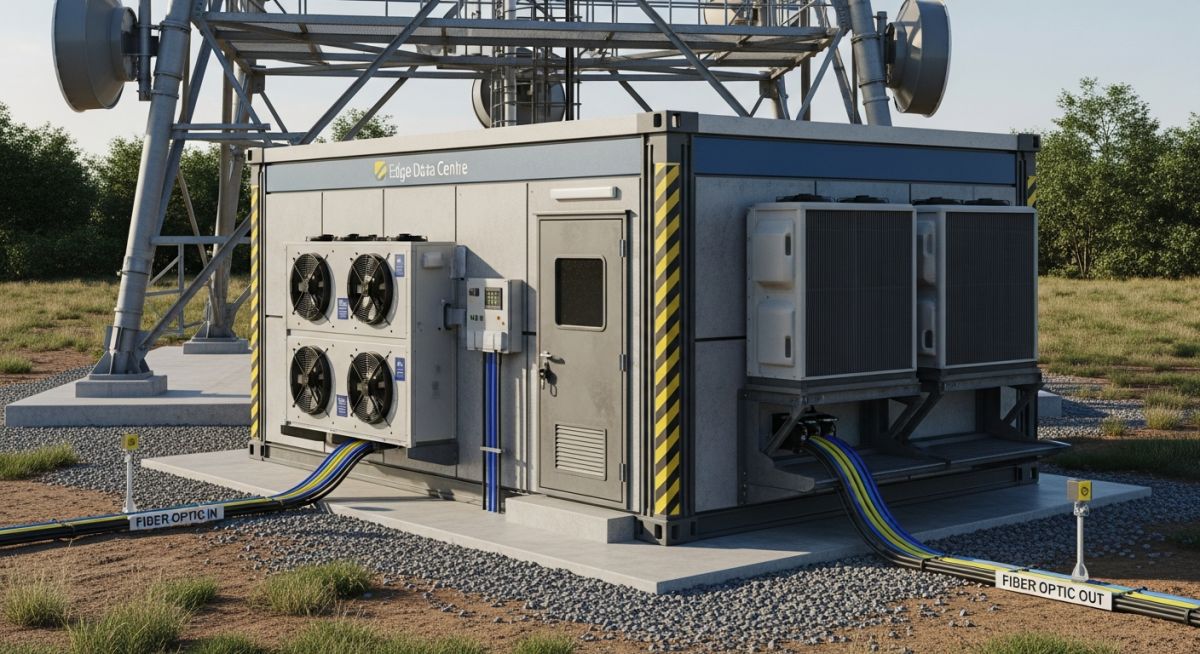
In my two decades of managing complex industrial infrastructure, I have observed a fundamental shift in how we process data. We are moving away from massive, centralized cloud repositories toward localized, high-performance hubs. An edge data centre is not merely a smaller server room; it is a sophisticated, self-contained engineering environment designed to operate in harsh, non-traditional locations.
Designing these units requires a rigorous approach to thermal management, power redundancy, and structural integrity. As we push compute power to the network edge, we face unique challenges in cooling density and physical security that traditional data centres rarely encounter. This guide provides the technical framework for deploying resilient edge infrastructure.
Key Engineering Takeaways:
- Latency reduction through localized processing nodes.
- Modular infrastructure design for rapid site deployment.
- Advanced thermal management for high-density rack configurations.
- Compliance with ASHRAE guidelines for equipment reliability.
Technical Architecture of Edge Data Centres
Edge Data Centre Architecture: This framework defines the physical and logical integration of power, cooling, and compute resources within a constrained footprint to ensure high availability and low-latency data processing.
When I evaluate a site for an edge deployment, the primary constraint is almost always the power-to-space ratio. Unlike hyperscale facilities, edge units must maximize compute density within a modular, often prefabricated, enclosure. We utilize IEEE standards to govern the electrical distribution, ensuring that harmonic distortion is minimized even when operating on localized microgrids.
Thermal Management and Cooling Density
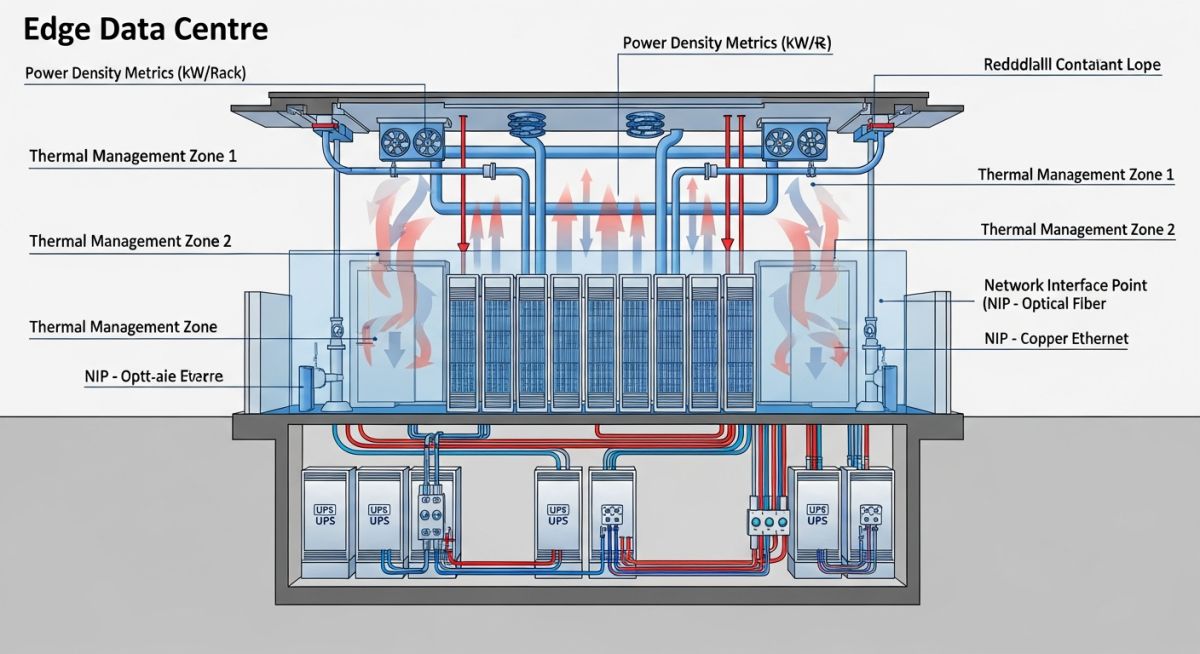
Cooling is the most significant engineering hurdle in edge environments. Because these units are often placed in uncontrolled environments, we cannot rely on traditional chilled water loops. Instead, we implement closed-loop, refrigerant-based cooling systems or direct-to-chip liquid cooling for high-performance computing (HPC) nodes.
Field Warning: Thermal Runaway
In confined edge enclosures, the failure of a single cooling fan can lead to rapid thermal runaway. I mandate the use of N+1 or 2N redundancy for all cooling components, coupled with automated airflow management systems that adjust based on real-time rack temperature sensors.
Structural and Environmental Hardening
The structural design must account for seismic activity and environmental ingress. I specify NEMA 4X or IP66-rated enclosures for outdoor deployments to prevent dust and moisture contamination. The structural frame must be calculated to support the static load of battery energy storage systems (BESS), which often exceed 1,500 kg per rack.
Calculation of the cooling load (Q) is performed using the formula Q = m * Cp * deltaT, where m is the mass flow rate of the coolant, Cp is the specific heat capacity, and deltaT is the temperature differential. In edge units, we aim for a deltaT of at least 10 degrees Celsius to maintain efficiency. If the ambient temperature exceeds 40 degrees Celsius, we must incorporate adiabatic cooling stages to maintain the required inlet temperature for the servers.
Edge Infrastructure Performance: This assessment balances the operational gains of localized processing against the inherent complexities of managing distributed, remote hardware assets.
Operational Advantages
- Latency Reduction: Processing data at the source eliminates backhaul delays, enabling real-time decision-making for autonomous systems.
- Bandwidth Optimization: Filtering data locally reduces the volume of traffic sent to the central cloud, lowering operational network costs.
- Modular Scalability: Prefabricated units allow for “pay-as-you-grow” deployment, reducing initial capital expenditure.
- Resilience: Localized nodes continue to function during wide-area network outages, ensuring critical process continuity.
Engineering Disadvantages
- Maintenance Complexity: Servicing geographically dispersed sites increases travel time and requires highly skilled, mobile technical teams.
- Physical Security Risks: Unmanned edge sites are more vulnerable to physical tampering compared to centralized, guarded data centres.
- Environmental Variability: Exposure to extreme temperatures and humidity requires expensive, specialized hardening of all IT and power equipment.
- Integration Overhead: Managing a distributed fleet requires sophisticated software orchestration to maintain consistent security and update policies.
Edge Computing Deployment: These industry-specific applications demonstrate how localized data processing solves critical performance bottlenecks in high-stakes operational environments.
Autonomous Industrial Manufacturing
In smart factories, edge data centres process high-frequency sensor data from robotic arms to enable sub-millisecond adjustments. This prevents mechanical collisions and optimizes production throughput by eliminating the latency inherent in cloud-based control loops.
Smart Grid Energy Management
Utility providers deploy edge nodes at substations to manage distributed energy resources like solar arrays and battery storage. These units perform real-time load balancing and frequency regulation, ensuring grid stability without relying on centralized command centers.
Telecommunications 5G Infrastructure
The rollout of 5G requires Multi-access Edge Computing (MEC) to handle the massive data throughput of mobile networks. By placing compute resources at the base station, telcos can support augmented reality and low-latency streaming services for end-users.
Healthcare Remote Diagnostics
Edge centres in hospitals enable real-time analysis of high-resolution medical imaging and patient monitoring data. This allows for immediate diagnostic feedback during surgical procedures, where even a minor delay in data processing could impact patient safety.
Designing for the edge requires a fundamental shift from traditional hyperscale metrics. In my experience, the primary constraint is not just power density, but the physical footprint and the environmental resilience of the enclosure. When we evaluate these facilities, we must look at the interplay between cooling capacity, power distribution efficiency, and the physical security of the rack space.
The following table outlines the critical performance thresholds I typically enforce during the design review phase. These values are derived from TIA-942 standards and ASHRAE TC 9.9 guidelines for mission-critical environments. Note that as we move closer to the network edge, the tolerance for thermal fluctuations decreases significantly due to the high-density nature of modern GPU-accelerated compute nodes.
| Parameter | Standard Range | Engineering Note |
|---|---|---|
| Power Density | 15kW – 30kW per rack | Requires liquid cooling integration |
| Latency Target | Less than 10ms | Fiber path optimization critical |
| Cooling Efficiency | PUE 1.1 – 1.3 | Closed-loop systems preferred |
| Availability | Tier II to Tier III | Redundancy vs cost trade-off |
These metrics serve as the baseline for our site selection process. If a proposed location cannot support the power density requirements without significant utility upgrades, we must re-evaluate the edge node placement to ensure the Uptime Institute tiering requirements are met within the project budget.
The complexity of modern edge deployments necessitates a clear mapping of physical infrastructure to logical network functions. I often find that project teams struggle with the integration of disparate systems, such as fire suppression, physical security, and remote power management. By standardizing these entities, we reduce the risk of integration failures during the commissioning phase.
The matrix below categorizes the core components of an edge data centre. Each entity is mapped to its primary function and the relevant industry standard that governs its installation. This structure is essential for maintaining compliance with NFPA 75 for fire protection and IEEE standards for power distribution.
| Entity | Function | Standard |
|---|---|---|
| UPS System | Power conditioning and backup | IEC 62040 |
| CRAC/CRAH | Thermal management | ASHRAE 90.4 |
| Fire Suppression | Clean agent gas discharge | NFPA 2001 |
| Rack Enclosure | Physical security and airflow | ISO 27001 |
Using this matrix, engineers can quickly identify the regulatory requirements for each subsystem. This approach ensures that we are not just building a server room, but a hardened, compliant, and scalable edge node that meets the rigorous demands of modern distributed computing architectures.
Verification is the most critical phase of any edge data centre project. Because these sites are often unmanned and located in remote or semi-remote areas, the infrastructure must be self-healing and remotely manageable. I have developed this checklist to ensure that every site meets the necessary operational readiness standards before the IT equipment is energized.
-
Structural Integrity: Verify floor loading capacity meets the 1500 kg/m2 requirement for high-density racks. -
Power Redundancy: Confirm dual-feed utility power or N+1 generator backup with automatic transfer switch (ATS) testing. -
Cooling Redundancy: Validate that CRAC units are configured for N+1 operation with automated failover logic. -
Network Connectivity: Test dual-path fiber entry points to ensure zero single points of failure in the backhaul. -
Environmental Monitoring: Calibrate sensors for temperature, humidity, and leak detection with SNMP alerts to the NOC.
Each item on this list must be signed off by the lead site engineer. In my experience, skipping the environmental monitoring calibration is the most common cause of post-commissioning downtime. Ensure that all IEEE grounding standards are verified for the rack cabinets to prevent electrostatic discharge damage to sensitive server components.
The Challenge: Thermal Throttling in a Micro-Edge Node
We encountered a critical failure in a 20kW micro-edge deployment where the server nodes were consistently hitting thermal limits during peak processing hours.
- Inadequate hot-aisle containment leading to air recirculation.
- Incorrect CRAC unit setpoints failing to account for high-density GPU heat loads.
- Obstruction of floor-level airflow due to improper cable management.
- Lack of real-time thermal monitoring at the rack exhaust level.
The Outcome: Optimized Thermal Management and 99.99% Uptime
By implementing a comprehensive redesign of the airflow path, we successfully stabilized the environment and eliminated thermal throttling.
- Installed rigid hot-aisle containment panels to prevent air mixing.
- Reconfigured CRAC units to use rack-exhaust temperature sensors for dynamic cooling.
- Implemented structured cabling pathways to clear floor-level airflow obstructions.
- Achieved a 15% reduction in total power consumption through optimized fan speeds.
My recommendation for similar projects is to prioritize airflow management from the initial design phase. Do not rely on room-level cooling for high-density edge racks; always utilize localized containment and active monitoring to ensure the hardware operates within its optimal thermal envelope.
Frequently Asked Engineering Questions
What is the primary difference between edge and cloud?
- Cloud: High latency, massive storage, centralized management.
- Edge: Ultra-low latency, real-time processing, distributed management.
- Edge nodes are often deployed in TIA-942 compliant micro-modular enclosures.
How do you calculate the required cooling capacity?
- Determine total IT load (kW) including redundancy factors.
- Apply a safety margin of 10-15% for future-proofing.
- Ensure the CRAC unit capacity exceeds this total heat load at the design ambient temperature.
- Refer to ASHRAE TC 9.9 for specific environmental envelopes.
What are the power distribution requirements for edge?
- Redundant UPS systems (N+1 or 2N configuration).
- Automatic Transfer Switches (ATS) for seamless power source switching.
- Grounding must comply with IEEE 1100 (Emerald Book) standards.
- Surge protection is mandatory for sites exposed to external power grids.
How is physical security managed at remote sites?
- Biometric or smart-card access control for all entry points.
- High-definition video surveillance with AI-based motion detection.
- Tamper-evident rack enclosures with integrated sensor alerts.
- Compliance with ISO 27001 for physical security management.
What is the role of modularity in edge design?
- Rapid deployment: Modules arrive ready for power and network connection.
- Standardization: Consistent infrastructure across all edge nodes.
- Scalability: Easily add capacity by deploying additional modules.
- Reduced risk: Factory testing minimizes on-site integration errors.
How do you optimize latency in edge networks?
- Strategic site selection near major network exchange points.
- Implementation of high-speed, low-latency switching hardware.
- Use of edge-optimized content delivery network (CDN) architectures.
- Continuous monitoring of network performance using IETF standards.
Complete Course on
Piping Engineering
Check Now
Key Features
- 125+ Hours Content
- 500+ Recorded Lectures
- 20+ Years Exp.
- Lifetime Access
Coverage
- Codes & Standards
- Layouts & Design
- Material Eng.
- Stress Analysis

📚 Recommended Resources: Data Centres
Read these Guides
- 📄 How Data Centres Work: Infrastructure and Operations Engineering Overview
- 📄 Data Centres Explained: A Comprehensive Engineering Design Guide
- 📄 Hyperscale Data Centre Engineering: Design Principles and Infrastructure Requirements
- 📄 Understanding Data Centre Types: Enterprise, Colocation, Hyperscale, and Edge
Related posts:
![Isometric view of a modern hyperscale data centre floor showing server racks, overhead power busways, and containment cooling systems.]()
Hyperscale Data Centre Engineering: Design Principles and Infrastructure Requirements
![Isometric view of a modern, high-density data centre facility showing server racks, cooling systems, and cable management infrastructure.]()
Understanding Data Centre Types: Enterprise, Colocation, Hyperscale, and Edge
![Technical diagram showing the mooring spread, anchor types, buoyancy modules on dynamic cables, and subsea umbilical connections for floating wind turbines.]()
Floating Offshore Wind Technology: A Comprehensive Engineering Design Guide
![Modern data centre facility floor with organized server racks, overhead cable management, and cold-aisle containment systems.]()
How Data Centres Work: Infrastructure and Operations Engineering Overview
![Cross-sectional engineering diagram of a modern high-density data centre showing cooling and power infrastructure.]()
Data Centres Explained: A Comprehensive Engineering Design Guide
![A professional technician performing thermal inspection on a utility-scale BESS plant battery rack to ensure operational safety and efficiency.]()
Essential O&M Strategies for Reliable BESS Plant Performance Optimization