Master Industrial Design with Online Piping Engineering Courses
Piping Design Training: Professional online piping engineering courses provide structured, code-compliant instruction covering ASME B31.3, stress analysis, and 3D modeling to prepare engineers for complex industrial plant design challenges.
When I first stepped onto a refinery construction site over two decades ago, the gap between my university textbook knowledge and the actual physical layout of high-pressure steam lines was massive. I quickly realized that university engineering degrees rarely prepare you for the gritty realities of pipe routing, stress analysis, and material selection. In my experience, mastering these skills requires targeted, practical instruction that bridges the gap between theoretical mechanics and actual field application.
Today, the landscape has changed dramatically. You no longer need to spend years in trial-and-error field learning to master these concepts. High-quality, industry-aligned online piping engineering courses allow you to learn directly from seasoned professionals who have spent decades in the field. Whether you are a mechanical engineer looking to transition into the oil and gas sector, or a junior designer aiming to master pipe stress analysis, choosing the right training program is a pivotal step in your professional development.
Key Takeaways From This Guide
- Understand how to evaluate course syllabi against international standards like ASME and API.
- Learn the critical software tools (CAESAR II, SmartPlant 3D, PDMS) that top-tier EPC firms demand.
- Discover how to calculate minimum pipe wall thickness using real-world design formulas.
- Identify the best learning paths to accelerate your engineering career and secure high-paying roles.
Why Choose Online Piping Engineering Courses Today?
Professional Piping Education: High-quality online piping engineering courses deliver deep technical mastery of piping hydraulics, pipe stress analysis, and material specifications in strict accordance with ASME and API standards.
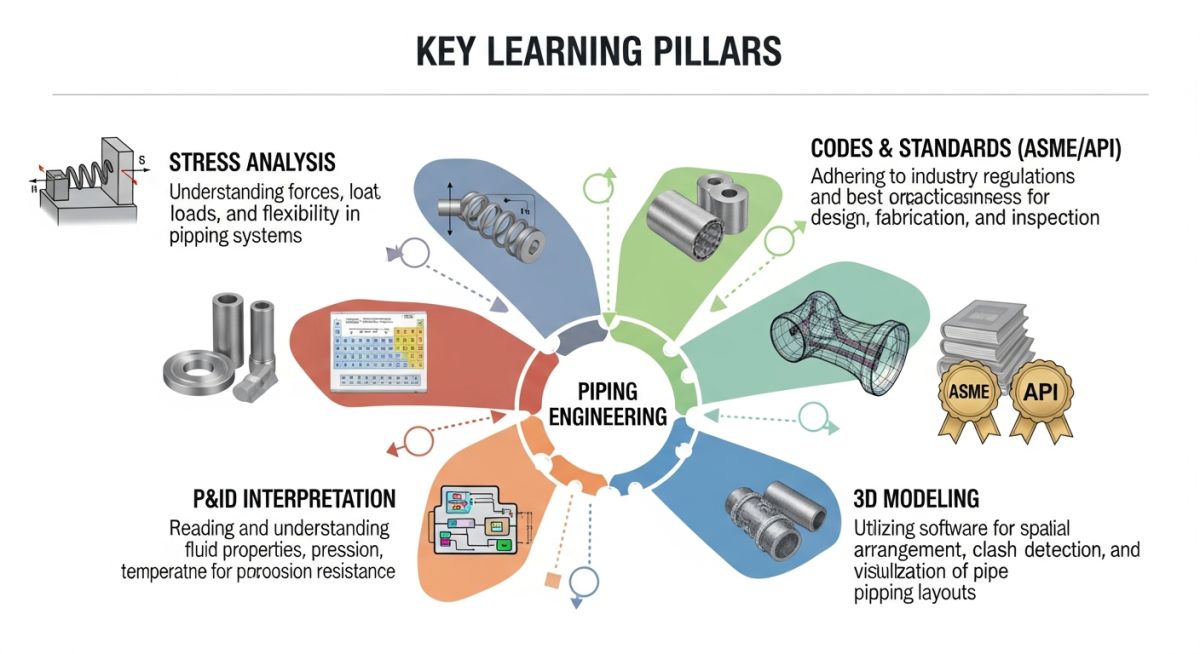
To succeed in modern engineering, procurement, and construction (EPC) environments, you must understand the physics of fluid flow, the metallurgy of piping materials, and the structural mechanics of pipe support systems. A comprehensive online curriculum must cover these three pillars in detail. Let us break down the technical requirements you should look for when selecting a program.
1. Code Compliance and Standards
Any course worth its salt must focus heavily on international design codes. You must become intimately familiar with ASME B31.3 (Process Piping) and ASME B31.1 (Power Piping). These codes dictate the safety factors, allowable stresses, and testing procedures for industrial piping systems worldwide.
2. Pipe Wall Thickness Calculations
A fundamental skill taught in advanced online piping engineering courses is calculating the minimum required wall thickness of a pipe under internal pressure. According to ASME B31.3 Section 304.1.2, the formula for the design thickness (t) of straight pipe under internal pressure is:
Where:
- P = Internal design gage pressure (psi or MPa)
- D = Outside diameter of the pipe (inches or mm)
- S = Allowable stress value for the material from Table A-1 (psi or MPa)
- E = Quality factor from Table A-1A or Table A-1B
- W = Weld joint strength reduction factor
- Y = Coefficient from Table 304.1.1
Let us walk through a practical design scenario. Suppose we are designing a carbon steel pipe using ASTM A106 Grade B material for a process line operating under the following conditions:
- Design Pressure (P) = 300 psi
- Outside Diameter (D) for an 8-inch NPS pipe = 8.625 inches
- Design Temperature = 400 degrees Fahrenheit
- Allowable Stress (S) at 400 degrees Fahrenheit = 20,000 psi
- Quality Factor (E) for seamless pipe = 1.0
- Weld Joint Factor (W) = 1.0
- Coefficient (Y) for ferritic steel at 400 degrees Fahrenheit = 0.4
Plugging these values into our design equation:
t = 2587.5 / (2 * (20000 + 120))
t = 2587.5 / 40240
t = 0.0643 inches
To find the nominal thickness, we must add a corrosion allowance (typically 0.0625 inches or 1/16 inch) and account for the standard mill tolerance of 12.5 percent:
t_nominal = t_subtotal / (1 – 0.125) = 0.1268 / 0.875 = 0.1449 inches
Comparing this to standard pipe schedules, an 8-inch Schedule 40 pipe has a nominal wall thickness of 0.322 inches, which safely exceeds our calculated minimum nominal thickness of 0.1449 inches.
In my years of auditing stress models, the most common failures occur because junior engineers rely blindly on CAESAR II outputs without understanding the underlying mechanics of ASME B31.3. Always perform manual sanity checks on wall thickness and expansion loop sizing before finalizing your 3D models.
Evaluating Top Online Piping Engineering Courses Effectively
Course Selection Criteria: Selecting the right online piping engineering courses requires evaluating curriculum depth, software integration, industry-recognized certifications, and alignment with ASME B31.3 and ASME B31.1 design codes.
To help you navigate the crowded market of online training, I have compiled a comprehensive comparison matrix of the primary course categories available today. This table highlights the core software, primary design codes, and target audiences for each learning path.
| Course Category | Core Software | Primary Code Focus | Target Audience | Key Deliverable |
|---|---|---|---|---|
| Piping Layout & Design | SP3D, PDMS, AutoCAD | ASME B31.3, ASME B16.5 | Draftsmen, Junior Designers | 3D Plant Models & Isometrics |
| Pipe Stress Analysis | CAESAR II, AutoPIPE | ASME B31.3, ASME B31.1 | Mechanical & Stress Engineers | Stress Reports & Support Loads |
| Piping Materials Engineering | Excel, Material Databases | ASTM, API 5L, ASME B16.34 | Materials Engineers, Buyers | Piping Material Specifications (PMS) |
| Process Utility Piping | HYSYS, Pipe-Flo | ASME B31.9, ASME B31.5 | Process & Utility Engineers | Line Sizing & P&ID Development |
Technical Mapping & Specifications Matrix
The following matrix maps key technical entities and physical parameters that you must master during your online training. These concepts form the backbone of any professional piping engineering role.
| Technical Entity | Acronym | Core Physical Parameter | Applicable Standard | Industry Application |
|---|---|---|---|---|
| Piping Material Specification | PMS | Corrosion Allowance, Pressure-Temp Rating | ASME B16.5 | Standardizing components across a project |
| Pipe Stress Analysis | PSA | Thermal Expansion, Sustained & Occasional Loads | ASME B31.3 Chapter II | Preventing fatigue and nozzle overload |
| Piping & Instrumentation Diagram | P&ID | Fluid State, Volumetric Flow Rate | ISA 5.1 | Defining process connectivity and control loops |
| Valve Design Standard | VDS | Wall Thickness, Pressure Class | API 600 / ASME B16.34 | Selecting isolation and control valves |
Syllabus Verification Checklist for Piping Programs
Syllabus Verification: A comprehensive syllabus audit ensures that online piping engineering courses cover critical stress analysis, material selection, and 3D modeling workflows required by modern EPC firms.
Before investing your hard-earned money or your company’s training budget in an online program, you must verify that the curriculum meets real-world engineering demands. Use this checklist to audit any course syllabus you are considering.
Syllabus Audit & Verification Checkpoints
-
ASME Code Coverage: Does the course explicitly cover ASME B31.3 (Process Piping) and ASME B31.1 (Power Piping) design rules, including wall thickness calculations and stress limits?
-
Hands-on Software Training: Are there practical, step-by-step tutorials using industry-standard software like CAESAR II, AutoPIPE, or SmartPlant 3D?
-
Material Selection & Metallurgy: Does the curriculum teach you how to select materials based on temperature, pressure, and fluid corrosivity using ASTM and API standards?
-
Pipe Support Design: Are there modules dedicated to selecting and locating rigid, spring, and snubber supports to manage thermal expansion?
-
Instructor Credentials: Is the course taught by a practicing engineer with at least 10 to 15 years of active field experience in EPC projects?
Field Case Study: Real-World Application
The Problem: Thermal Expansion Failure in a Steam Line
During a major refinery expansion project, a junior mechanical engineer was tasked with routing a 12-inch high-pressure steam line operating at 650 degrees Fahrenheit. Lacking formal training in pipe stress analysis, the engineer routed the line directly from the steam header to the turbine inlet nozzle with minimal flexibility. When the system was commissioned, the thermal expansion of the pipe generated massive forces that exceeded the allowable nozzle loads on the turbine, causing a critical alignment failure and halting commissioning.
The Solution: Targeted Training and Redesign
The EPC firm immediately enrolled the engineering team in an advanced online piping engineering course focusing on CAESAR II and ASME B31.1 stress analysis. Applying their new knowledge, the team calculated the thermal growth of the line and designed a proper 3D expansion loop. They also replaced rigid supports with variable spring hangers to absorb vertical thermal movement.
By implementing these changes, the nozzle loads were reduced by 85 percent, bringing them well within the limits specified by API 611. The plant was safely commissioned with zero further structural issues. This case highlights why comprehensive training is not just a career booster, but a critical safety requirement for industrial projects.
Frequently Asked Engineering Questions
What is the difference between ASME B31.1 and ASME B31.3 in online piping engineering courses?
Do online piping engineering courses provide hands-on training with CAESAR II?
How do I verify if an online piping engineering course is recognized by major EPC companies?
What mathematical background is required to succeed in advanced pipe stress analysis modules?
Can I transition from a mechanical engineering background to a piping designer role using online courses?
How do online courses cover material selection and piping specifications?
Complete Course on
Piping Engineering
Check Now
Key Features
- 125+ Hours Content
- 500+ Recorded Lectures
- 20+ Years Exp.
- Lifetime Access
Coverage
- Codes & Standards
- Layouts & Design
- Material Eng.
- Stress Analysis