What Are Refractory Metals? Properties & Applications of Refractory Metals
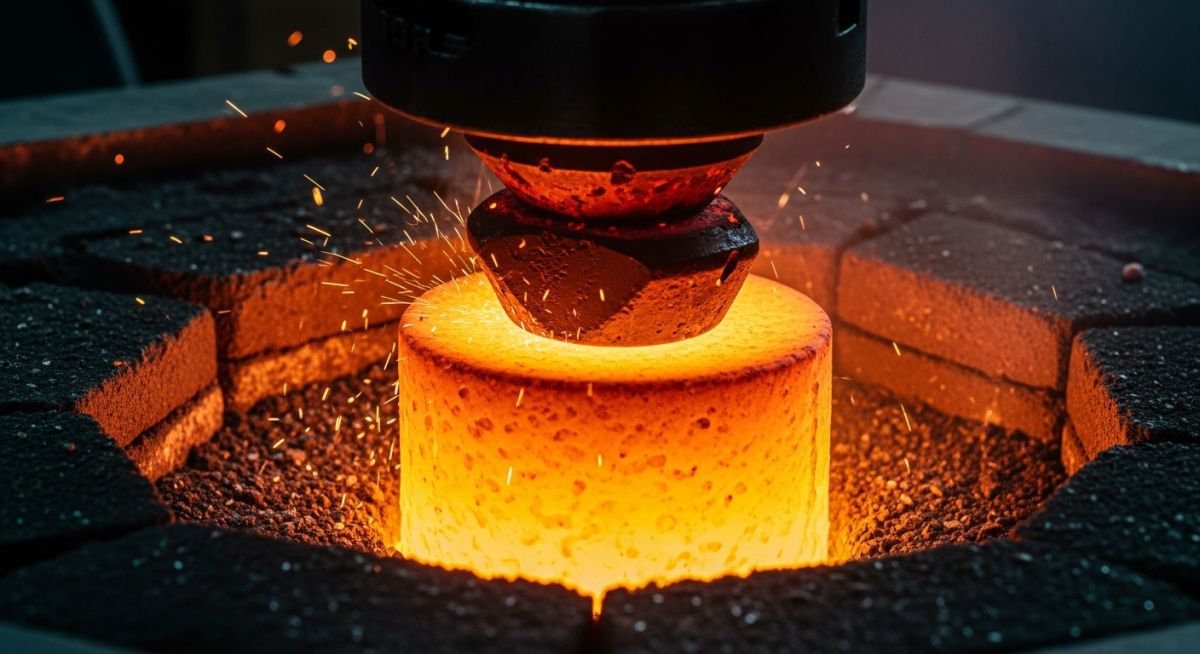
In my 20-plus years of piping and metallurgical engineering, I have seen materials fail in ways that would surprise most junior designers. When you are dealing with process temperatures exceeding 1500 degrees Celsius, standard stainless steels and nickel alloys simply turn to butter. That is where refractory metals step in. These elements are the unsung heroes of the extreme-temperature industrial world, holding their shape and strength where other metals liquefy.
Throughout my career, specifying these materials has always required a deep understanding of their unique physical properties and temperamental fabrication limits. They are not easy to work with, they are expensive, and they do not tolerate oxygen at high temperatures. However, when your process demands absolute structural integrity under extreme thermal loads, there is simply no substitute.
Key Engineering Takeaways
- Melting Points: All primary refractory metals melt at temperatures well above 2000 degrees Celsius, with tungsten leading at 3422 degrees Celsius.
- Thermal Expansion: They exhibit exceptionally low coefficients of thermal expansion, minimizing thermal fatigue in cyclic operations.
- Oxidation Vulnerability: Despite their high melting points, they oxidize rapidly in air at elevated temperatures and require vacuum or inert atmospheres.
- Density and Weight: Elements like tungsten and tantalum are extremely dense, which is advantageous for radiation shielding but challenging for weight-sensitive designs.
Complete Course on
Piping Engineering
Check Now
Key Features
- 125+ Hours Content
- 500+ Recorded Lectures
- 20+ Years Exp.
- Lifetime Access
Coverage
- Codes & Standards
- Layouts & Design
- Material Eng.
- Stress Analysis
Understanding the Core Properties of Refractory Metals
Refractory Metal Properties: The physical and mechanical characteristics of these elements are defined by their high atomic density, low thermal expansion coefficients, and exceptional resistance to thermal shock. These attributes ensure structural integrity in high-vacuum and high-temperature environments governed by ASTM B387 and ASTM B386 standards.
To design successfully with these materials, we must look closely at their atomic structures. The five classic refractory metals (tungsten, molybdenum, niobium, tantalum, and rhenium) share a body-centered cubic (BCC) crystal structure, except for rhenium which is hexagonal close-packed (HCP). This atomic arrangement gives them their immense strength but also makes them susceptible to a distinct ductile-to-brittle transition temperature (DBTT).
Thermal Stress and Expansion Calculations
In high-temperature piping and vessel design, thermal stress is the primary cause of premature failure. Because refractory metals have low coefficients of thermal expansion (CTE), they generate significantly lower thermal stresses than stainless steels when subjected to temperature gradients.
The thermal stress (S) generated in a constrained component can be calculated using the following engineering formula:
Where:
- S: Thermal stress (Pascals)
- E: Modulus of Elasticity (Pascals)
- alpha: Coefficient of Thermal Expansion (per Kelvin)
- delta_T: Temperature difference across the component (Kelvin)
- nu: Poisson’s ratio (dimensionless)
Because the CTE (alpha) of tungsten is roughly one-third that of austenitic stainless steel, the resulting thermal stress under identical temperature gradients is dramatically reduced. This makes refractory alloys highly resistant to thermal shock and thermal fatigue cracking.
Field Warning: High-Temperature Oxidation Catastrophe
Do not let the high melting points fool you. In my field experience, I have seen molybdenum heating elements completely vaporize within hours because of a minor vacuum seal leak. Refractory metals react aggressively with oxygen at temperatures above 400 degrees Celsius, forming volatile oxides that offer no protective barrier. They must always operate in a high vacuum, an inert gas atmosphere (such as argon or helium), or be protected by specialized silicide coatings.
Individual Element Profiles
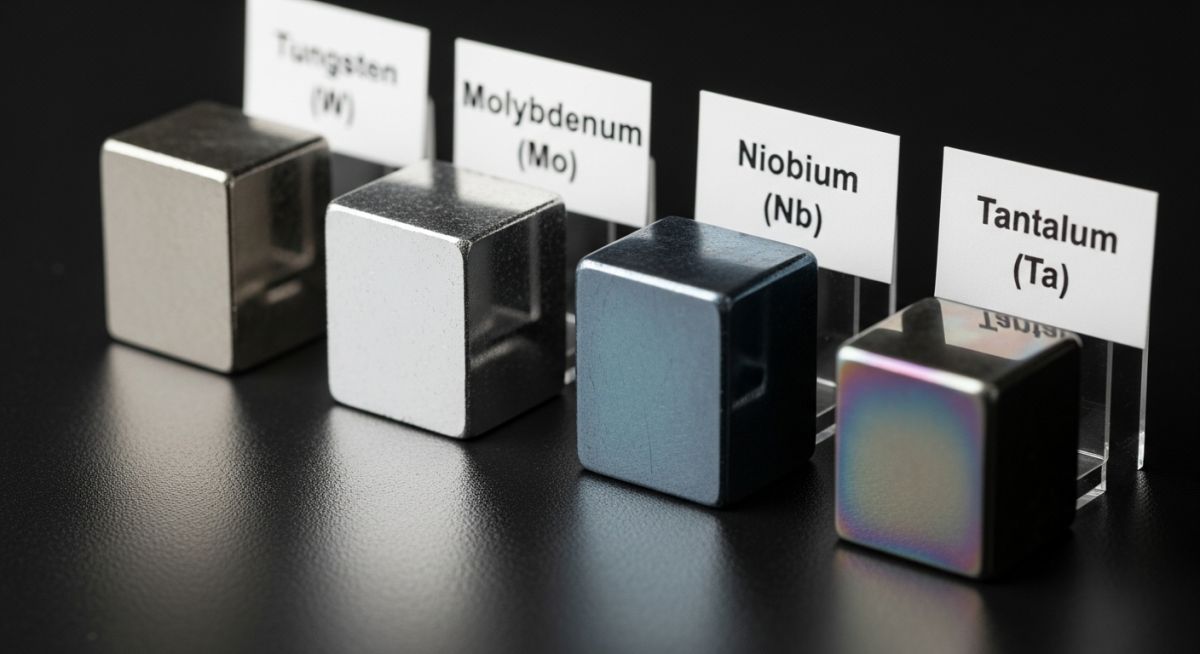
Each of the primary refractory elements has a distinct personality in the workshop and on the project site:
- Tungsten (W): The king of melting points. It is incredibly heavy, hard, and brittle at room temperature. It is used for rocket nozzles, electrical contacts, and radiation shielding.
- Molybdenum (Mo): The workhorse of the group. It is more ductile and easier to fabricate than tungsten while still maintaining excellent strength at temperatures up to 1900 degrees Celsius.
- Tantalum (Ta): The corrosion champion. Tantalum is almost completely inert to acid attack at temperatures below 150 degrees Celsius, making it invaluable for chemical reactors and pharmaceutical equipment.
- Niobium (Nb): The lightweight option. With a lower density than the others, niobium is alloyed with titanium for aerospace applications and superconducting magnets.
Comparing Key Engineering Data of Refractory Metals
Refractory Metal Specifications: The comparative physical properties of tungsten, molybdenum, tantalum, and niobium outline their specific operational limits under extreme thermal loads. These values dictate material selection for aerospace, nuclear, and chemical processing systems operating under ASME Section VIII Division 1 guidelines.
| Metal Element | Melting Point (°C) | Density (g/cm³) | Thermal Conductivity (W/m·K) | CTE (µm/m·K) | Elastic Modulus (GPa) |
|---|---|---|---|---|---|
| Tungsten (W) | 3422 | 19.30 | 174 | 4.5 | 411 |
| Molybdenum (Mo) | 2623 | 10.22 | 138 | 4.8 | 329 |
| Tantalum (Ta) | 3017 | 16.69 | 57 | 6.3 | 186 |
| Niobium (Nb) | 2477 | 8.57 | 54 | 7.3 | 105 |
Technical Mapping & Specifications Matrix
| Material Class | Key ASTM Standard | Primary Industrial Application | Critical Limitation |
|---|---|---|---|
| Pure Tungsten | ASTM B760 | X-ray targets, furnace heating elements | Extreme room-temperature brittleness |
| TZM Alloy (Mo-Ti-Zr) | ASTM B387 | High-temperature structural components, dies | Rapid oxidation above 500°C |
| Pure Tantalum | ASTM B364 | Chemical heat exchangers, bayonet heaters | High material cost and density |
| Niobium C-103 | ASTM B652 | Rocket engine thrust chambers, nozzles | Requires protective silicide coatings |
Quality Control Checklist for Refractory Alloys
Refractory Quality Control: The inspection and verification of high-temperature metallic components require strict adherence to non-destructive testing and dimensional tolerance protocols. These procedures prevent premature brittle failure and ensure compliance with ASTM E1417 and ASME Section V standards.
When receiving or installing refractory metal components on-site, standard inspection methods are not enough. Because of their high ductile-to-brittle transition temperatures, minor surface scratches can act as severe stress risers, leading to catastrophic cracking during thermal cycling.
Field Inspection Protocol
-
Liquid Penetrant Testing (PT): Perform 100% surface dye penetrant testing on all machined or welded areas to detect micro-cracks in accordance with ASTM E165.
-
Atmosphere Verification: Verify that the vacuum furnace or inert gas purge system achieves a vacuum level of at least 10 to the power of minus 4 Torr before heating molybdenum or tungsten components.
-
Handling Precautions: Ensure installers wear clean, lint-free cotton gloves. Skin oils contain salts that can cause localized corrosion and embrittlement at high temperatures.
-
Preheating for Fabrication: Confirm that any bending, forming, or shearing of tungsten or molybdenum is performed above their specific DBTT (typically 200 to 400 degrees Celsius).
-
Fastener Torque Control: Use calibrated torque wrenches on refractory fasteners. Over-tightening can cause immediate thread shearing due to low room-temperature shear strength.
Field Case Study: Real-World Application
Refractory Field Performance: The practical application of molybdenum alloy components in high-temperature vacuum furnaces demonstrates the critical need for precise thermal stress management. This analysis highlights the mitigation of thermal cracking through proper material selection and structural design under ASME Section VIII guidelines.
The Problem: Repeated Heating Element Failures
At a high-vacuum sintering facility, the heating elements made of standard nickel-chromium alloys were failing every three months. The process operated at 1350 degrees Celsius, which was pushing the nickel alloys to their absolute thermal limit. The elements suffered from severe creep, sagging, and eventual electrical short-circuiting against the furnace shielding. This caused unscheduled shutdowns, costing the plant thousands of dollars in lost production.
The Solution: Upgrading to Lanthanated Molybdenum
I was brought in to redesign the heating assembly. We replaced the nickel-chromium elements with lanthanated molybdenum (Mo-La) sheets. The addition of lanthanum oxide increases the recrystallization temperature of molybdenum, preventing the grain growth that leads to extreme brittleness after heating. We also redesigned the ceramic support insulators to allow for unrestricted thermal expansion during the rapid heating cycles.
The Outcome and Engineering Recommendation
The results were immediate. The new lanthanated molybdenum elements operated continuously for over four years without a single failure. The sagging issue was completely eliminated due to molybdenum’s high modulus of elasticity and creep resistance at 1350 degrees Celsius.
My recommendation for any engineer facing similar high-temperature structural failures is to evaluate the total cost of ownership. While the initial material cost of the molybdenum elements was four times higher than the nickel-chromium elements, the elimination of maintenance downtime paid for the upgrade within the first six months of operation.
Frequently Asked Engineering Questions
Refractory Metal FAQs: The common technical inquiries regarding high-temperature metals address fabrication challenges, oxidation limits, and welding procedures. These answers provide direct engineering guidance in accordance with AWS D10.18 and ASME Section IX codes.
What is the primary difference between refractory metals and superalloys?
Why are refractory metals so difficult to weld?
Can refractory metals be used in oxidizing environments?
What is the ductile-to-brittle transition temperature (DBTT)?
How does tantalum resist extreme chemical corrosion?
What are the main applications of niobium in aerospace?
