What is a Framework Agreement? | Difference between Framework Agreements and Framework Contracts
In my 20+ years of EPC and piping project execution, one of the most misunderstood procurement concepts I’ve seen is the difference between a framework agreement and a framework contract. I’ve seen projects delayed, budgets overrun, and vendor disputes arise simply because teams didn’t structure these agreements correctly.
Whether you are handling bulk piping materials, valves, or construction services, understanding how these procurement tools work can directly impact cost control, execution speed, and risk management.
✅ Key Takeaways from Field Experience:
- Framework agreements set terms and conditions but don’t guarantee purchase volumes
- Framework contracts are legally binding commitments with defined scope and quantities
- Using framework agreements in EPC projects significantly reduces tendering time and procurement delays
- Most large projects use call-off contracts under framework agreements
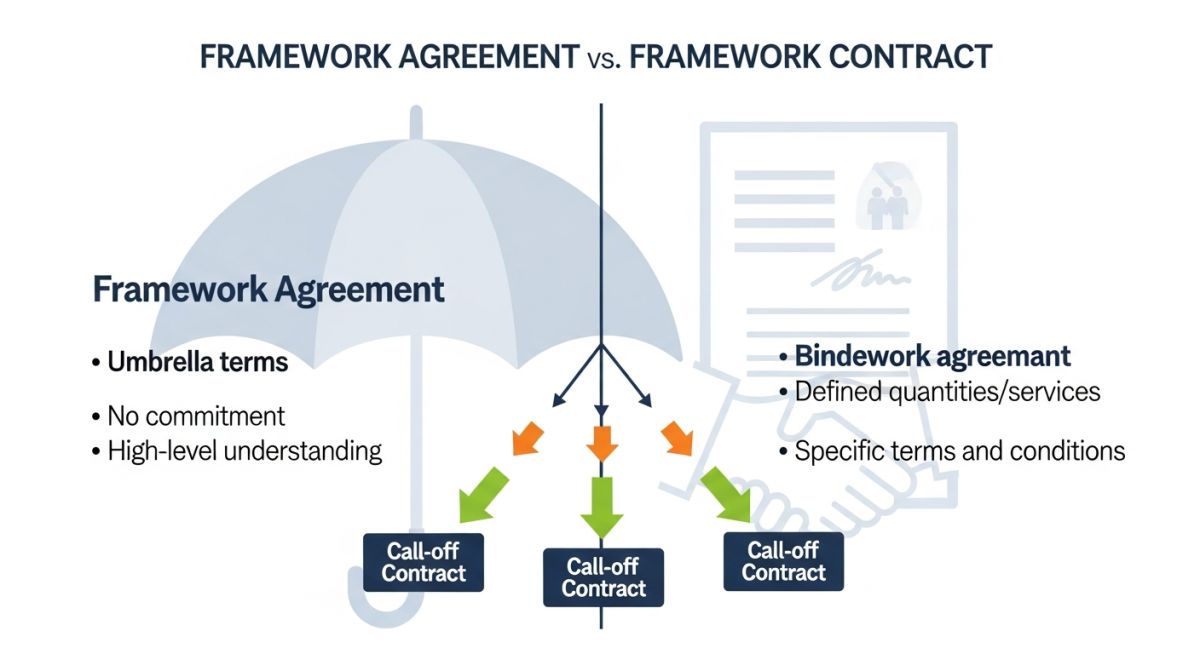
A framework agreement is a long-term arrangement with suppliers that defines pricing, terms, and conditions without committing to specific quantities. In contrast, a framework contract is a legally binding agreement with defined deliverables and obligations. Framework agreements enable faster procurement through call-off orders, while contracts ensure execution certainty.
Interactive Engineering Quiz
Q1: What is the key characteristic of a framework agreement?
Complete Course on
Piping Engineering
Check Now
Key Features
- 125+ Hours Content
- 500+ Recorded Lectures
- 20+ Years Exp.
- Lifetime Access
Coverage
- Codes & Standards
- Layouts & Design
- Material Eng.
- Stress Analysis
What is a Framework Agreement in Procurement?
In my experience across large EPC projects, a framework agreement is essentially an umbrella arrangement with pre-qualified vendors that defines commercial terms such as pricing structure, delivery conditions, quality expectations, and contractual clauses. However, it is important to understand that it does not create an immediate purchase obligation.
These agreements are widely used in global procurement environments and are referenced in standards aligned with structured procurement methodologies such as OGC Framework Procurement Guidelines, where flexibility and speed of execution are prioritized.
Why Use a Framework Agreement in EPC Projects?
In piping and construction projects, procurement delays can directly impact project timelines. A framework agreement allows you to bypass repetitive tendering cycles by creating a ready-to-use vendor ecosystem.
- Reduces procurement lead time significantly
- Ensures vendor standardization across multiple sites
- Improves price stability in volatile markets
- Enables rapid issuance of call-off orders
Duration of a Framework Agreement
Typically, framework agreements span between 1 to 4 years, depending on project size and procurement strategy. European procurement frameworks often limit duration based on compliance standards such as EU Directive 2014/24/EU.
In EPC environments, I recommend aligning duration with:
- Project lifecycle phases (Engineering, Procurement, Construction)
- Commodity price volatility cycles
- Vendor performance evaluation timelines
Advantages of Framework Agreements
- Speed: Eliminates repeated tendering cycles
- Flexibility: Allows procurement based on real-time needs
- Cost Efficiency: Negotiated pricing benefits large-scale projects
- Risk Reduction: Pre-approved vendors reduce quality issues
Disadvantages of Framework Agreements
- No guarantee of business volume for vendors
- Risk of price mismatch due to long-term volatility
- Vendor complacency if not monitored properly
- Requires strong governance and tracking systems
Framework Agreement Process
1. Consideration for Framework Agreement
Identify repetitive procurement needs such as piping materials, valves, or fabrication services. This is typically aligned with procurement planning systems.
2. Establishing Framework Agreements
Vendor selection is carried out using competitive bidding processes following structured methodologies like CIPS Procurement Guidelines.
3. Monitoring Framework Arrangements
Vendor performance must be monitored on KPIs such as delivery timelines, inspection quality, and cost control. Regular audits are critical in EPC projects.
| Criteria | Framework Agreement | Framework Contract |
|---|---|---|
| Legal Binding | Not fully binding (no obligation to purchase) | Legally binding agreement |
| Scope | General terms & pricing structure | Defined scope, quantity, and deliverables |
| Usage | Used for future procurement flexibility | Used for immediate execution |
| Orders | Requires call-off orders | Orders defined within agreement |
| Duration | Long-term (1–4 years) | Project-specific duration |
| Flexibility | High flexibility | Low flexibility |
Field Case Study: Real-World Application
In one of my refinery EPC projects in North India, we faced a major procurement bottleneck during the piping bulk phase. Each package team was issuing independent tenders for valves and fittings. This resulted in:
- Price variation of up to 18% across sites
- Vendor quality inconsistencies
- Delay of 4–6 weeks in procurement cycle
The absence of a structured framework approach led to commercial disputes and inspection failures during execution.
We implemented a centralized framework agreement with three approved vendors covering pricing bands, delivery timelines, and quality benchmarks aligned with CIPS Procurement Best Practices.
- Procurement cycle reduced by 35%
- Uniform quality compliance across sites
- Cost savings of approximately 12% through volume leverage
- Faster emergency ordering using call-off contracts
This clearly demonstrated that framework agreements are not just contractual tools—they are strategic accelerators in EPC execution.
My Recommendation: Always use framework agreements for repetitive, high-volume procurement categories such as piping, valves, and structural materials. Reserve framework contracts for clearly defined scopes like equipment packages or construction jobs.
Frequently Asked Engineering Questions
What is the main purpose of a framework agreement?
Are framework agreements legally binding?
What is a call-off contract in a framework agreement?
How long should a framework agreement last?
When should I use a framework contract instead?
What are common mistakes in framework agreements?
