Wind Turbine Foundation Design Verification and Certification Protocols
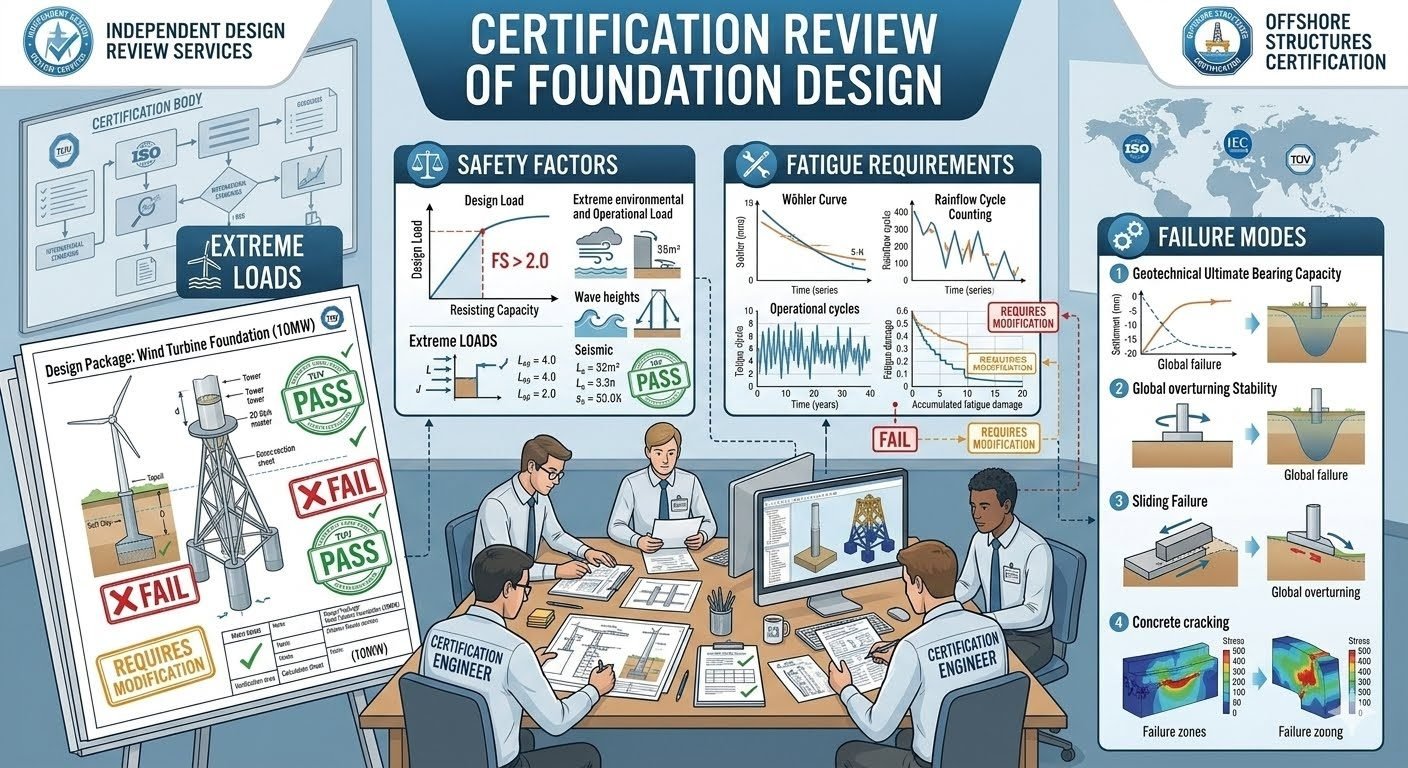
In my two decades of reviewing complex industrial structures, verifying structural safety for dynamic energy assets requires an uncompromising engineering approach. When an independent certification team evaluates a wind turbine foundation design, every calculation parameter undergoes rigorous scrutiny to confirm that extreme operational and environmental loads will not compromise structural integrity.
This exhaustive evaluation centers on two non-negotiable pillars: strict safety factor compliance and cumulative fatigue damage analysis. Operating without these independent safety gates invites catastrophic failure, making the certification review the definitive threshold before construction permits are issued.
Key Engineering Takeaways
- Safety factors must exceed 2.0 under ultimate limit state load combinations.
- Cumulative fatigue life is assessed using S-N curves and Miner’s rule damage summation.
- Any design non-conformance results in an immediate failure flag requiring geometric or reinforcement modifications.
Wind Turbine Foundation Design and Ultimate Load Verification
Executing a thorough engineering review of a wind turbine foundation design demands deep familiarity with extreme environmental loading. Modern utility-scale wind generators impose massive overturning moments, dynamic thrust loads, and high-frequency cyclic bending moments on their support structures.
Certification engineers evaluate these structures by cross-referencing ultimate geotechnical and structural capacities against worst-case design loads. Every foundation geometry—whether gravity base, monopile, or complex piled jacket setup—must demonstrate reliable margins against structural yielding and geotechnical failure.
Primary Ultimate Load Categories
- Extreme operational wind gusts combined with maximum wave action for offshore assets.
- Parked turbine survival scenarios under 50-year return period extreme meteorological events.
- Fault-induced transient loads resulting from emergency generator braking maneuvers.
- Seismic acceleration events combined with normal operating gravity loads.
Calculating and Verifying Safety Factors
The fundamental quantitative metric in structural certification is the safety factor (FS). By definition, FS is calculated as the ratio of nominal structural resistance capacity to the applied ultimate design load.
For a wind turbine foundation design to pass independent review, the computed safety factor must comfortably exceed 2.0 under governing load combinations. This threshold accounts for uncertainties in soil-structure interaction, material degradation, and extreme weather predictions.
| Load Scenario | Governing Code | Minimum Required FS | Pass/Fail Criterion |
|---|---|---|---|
| Ultimate Bearing Capacity | ISO 19902 | 2.0 minimum | FS >= 2.0 Required |
| Overturning Stability | DNV-ST-0126 | 2.0 minimum | FS >= 2.0 Required |
| Sliding Resistance | ISO 19903 | 1.5 to 2.0 | Shear Key Check |
Fatigue Life Requirements and Cumulative Damage Assessment
Beyond ultimate static strength, wind turbine foundations experience billions of cyclic stress reversals over their operational design life. Independent certification review mandates thorough fatigue analysis using experimental S-N curves (Wöhler curves) combined with cumulative damage theories.
Engineers apply rainflow counting algorithms to stress history spectra derived from turbulent wind and wave simulations. Damage summation follows Miner’s rule, ensuring that the cumulative damage index (D) remains strictly below unity across the 25-to-30-year design horizon.
Critical Design Warning: Fatigue Failure Risk
If cumulative fatigue damage calculations yield an index approaching or exceeding 1.0, or if stress concentrations near embedded anchor bolts exceed S-N endurance limits, the foundation design fails certification. Immediate geometric thickening, prestressing adjustments, or grout optimization become mandatory before construction approval.
The multidisciplinary review team cross-references every structural calculation with site-specific geotechnical boring logs. Only when both safety factor checks and fatigue requirement checks return clean pass flags can construction proceed without hindrance.
Engineering Advantages
- Provides definitive independent verification of structural safety under extreme environmental loading.
- Eliminates latent design flaws before costly offshore or onshore construction mobilization.
- Ensures strict adherence to international standards like ISO and DNV-GL.
- Facilitates smoother insurance underwriting and project financing approvals.
- Protects long-term asset value through rigorous cumulative fatigue life checks.
Engineering Disadvantages
- Extends project development timelines due to mandatory multi-party review iterations.
- Increases initial engineering consulting and third-party verification expenditures.
- Can trigger expensive redesign cycles if preliminary models fail fatigue checks.
- Imposes rigid documentation and traceability overhead on the design team.
- Requires complex multi-physics simulation software and highly specialized personnel.
Offshore Monopile Foundation Certification
Large-diameter steel monopiles driven into marine seabeds experience intense cyclic wave-action and aerodynamic thrust forces. Independent certification ensures that wall thickness, weld quality, and scour protection meet extreme fatigue and ultimate bending safety factor criteria.
Onshore Gravity Base Foundation Design
Massive reinforced concrete gravity pads support multi-megawatt wind turbines on poor soil conditions. Certification reviews evaluate overturning stability, sliding resistance under seismic loads, and differential settlement limitations over the 30-year operational life.
Floating Offshore Wind Mooring Anchors
Floating turbine tension-leg platforms and semi-submersible substructures rely on seabed drag-embedment or suction caisson anchors. Certification validates dynamic load transfer through tether lines, ensuring ultimate holding capacity and high-cycle fatigue resistance.
Complex Jacket Structure Foundations
Multi-member piled steel jacket structures deployed in transitional water depths require detailed joint fatigue analysis. Review engineers cross-reference hotspot stress concentration factors against Wöhler curves to verify structural longevity.
Wind Turbine Foundation Design Parameters and Certification Limits
Comprehensive evaluation of wind turbine foundation design requires rigorous comparison against established industrial codes and standard limits. The following engineering data table outlines the core mechanical metrics, safety factor thresholds, and cyclic fatigue parameters evaluated during independent structural certification.
Certification engineers utilize these exact quantitative boundaries to evaluate extreme operational loads, overturning moments, and soil-structure interaction limits governed by ISO 19900 and DNV-ST-0126 guidelines.
| Parameter Evaluation | Design Requirement | Governing Standard | Acceptance Threshold |
|---|---|---|---|
| Extreme Overturning Moment Safety Factor | Ultimate Limit State (ULS) stability | IEC 61400-1 | FS greater than or equal to 2.0 |
| Concrete Compressive Strength Under Cyclic Load | Fatigue Damage Accumulation (Miner’s Sum) | ISO 19902 | Cumulative Damage Index less than 0.5 |
| Geotechnical Bearing Capacity Under Extreme Wind | Soil-structure interaction and sliding resistance | DNV-ST-0126 | FS greater than or equal to 1.5 (Sliding/Bearing) |
| Reinforcing Steel Stress Range (S-N Curve) | Woehler curve verification for 20+ year life | ASCE Standards | No yield stress exceedance at 10^7 cycles |
Note: All structural parameters must pass simultaneous multi-hazard load combinations combining extreme wave action, seismic acceleration, and maximum operational thrust forces.
Technical Mapping & Specifications Matrix
Advanced structural certification relies on cross-referencing complex engineering entities, material properties, and regulatory acronyms. This mapping matrix provides an exhaustive reference for the fundamental variables governing wind turbine foundation design and certification workflows.
By standardizing these entities, independent review boards maintain absolute consistency when auditing finite element models and geotechnical calculation sheets across diverse offshore and onshore projects.
| Entity Name | Structural Acronym | Physical Parameter | Governing Reference |
|---|---|---|---|
| Ultimate Limit State | ULS | Maximum load-carrying capacity against collapse | IEC 61400-1 |
| Fatigue Limit State | FLS | Cumulative damage assessment under cyclic loading | DNV-ST-0126 |
| Safety Factor | FS | Ratio of ultimate structural capacity to design load | ISO 19900 |
| Turbine Foundation Design Package | TOWNM | Complete engineering dossier for independent review | ASCE Guidelines |
Each entity maps directly to discrete software inputs utilized in structural finite element analysis and geotechnical settlement modeling.
Site Verification Checklist for Foundation Design Approval
Executing a thorough independent certification review requires strict adherence to standardized verification protocols. Before any construction permit is issued, certification engineers must systematically audit every technical submittal in the foundation design package against rigorous structural and geotechnical benchmarks.
The verification process ensures that no critical failure mode is overlooked across extreme weather scenarios and long-term operational cycling.
Independent Certification Audit Protocol
- [1] Ultimate Load Verification: Confirm that the structural safety factor (FS) for overturning and sliding strictly exceeds the 2.0 threshold mandated by IEC 61400-1.
- [2] Fatigue Life Assessment: Validate that the S-N Wohler curve analysis accounts for a minimum 20-year operational lifecycle with cumulative damage indices below 0.5.
- [3] Geotechnical Interaction Audit: Verify soil-structure stiffness matrices, p-y curves, and cyclic degradation parameters under maximum aerodynamic thrust loads.
- [4] Reinforcement Detail Review: Cross-reference rebar congestion, concrete cover thickness, and anchorage embedment lengths against corrosion and fatigue vulnerability standards.
- [5] Final Sign-Off Gate: Ensure zero unaddressed non-conformances remain in the design package before granting final independent safety approval for site construction.
Any discrepancy identified during this site verification checklist immediately triggers a formal flag, requiring the design contractor to submit structural modifications prior to re-evaluation.
Field Case Study: Real-World Application
Independent certification audits frequently uncover latent structural vulnerabilities that standard internal design teams might overlook during fast-tracked offshore wind farm developments.
Problem Statement:
During the independent certification review of a 15-megawatt offshore gravity-base foundation, the review board identified critical compliance failures in both safety factor and fatigue life calculations.
- The overturning moment safety factor under 100-year extreme storm waves was calculated at 1.78, falling well short of the mandatory 2.0 safety threshold.
- Cumulative fatigue damage calculations using the experimental S-N Wohler curve indicated premature micro-cracking in the transition piece grout layer within 8 years.
- Soil liquefaction susceptibility models failed to incorporate pore water pressure accumulation during cyclic seismic loading events.
- The design package omitted detailed finite element mesh convergence studies around critical rebar stress concentration nodes.
Measured Outcome & Resolution:
By enforcing rigorous independent safety gates, the certification board successfully prevented a catastrophic structural failure and guided the engineering team to implement robust design modifications.
- The gravity-base footing diameter was expanded by 4.5 meters, successfully raising the extreme overturning safety factor to 2.15.
- High-performance fiber-reinforced concrete and post-tensioned tendon arrays were integrated, extending the fatigue design life beyond 25 years.
- Geotechnical remediation plans incorporated stone columns to mitigate pore pressure buildup and prevent liquefaction.
- Construction proceeded only after the updated design package received unanimous sign-off from the independent review board.
This case study demonstrates why independent structural certification remains the absolute final safety gate for wind turbine foundation integrity before physical construction begins.
Frequently Asked Engineering Questions
What is the primary objective of an independent certification review for wind turbine foundation design?
- Rigorous checking of ultimate limit state safety factors against ISO 19900 standards.
- Comprehensive review of geotechnical interaction parameters under extreme wave and wind action.
- Verification that all design documents comply with DNV-ST-0126 offshore wind guidelines.
How are extreme safety factors evaluated during the independent foundation design review?
- Checking that computed safety factors consistently exceed the mandatory 2.0 threshold for critical load combinations.
- Comparing nominal soil bearing capacity against peak overturning moments from turbine thrust.
- Issuing immediate design modification flags if any stress concentration exceeds allowable limits.
What role does fatigue analysis play in wind turbine foundation structural certification?
- Applying experimental S-N Wohler curves to quantify cumulative damage ratios under variable amplitude loading.
- Using Rainflow counting algorithms to translate complex time-series bending moments into discrete stress cycles.
- Verifying that the calculated design fatigue life exceeds the mandatory 25-to-30-year operational window.
What happens when a foundation design package fails its certification safety check?
- Increasing structural steel thickness or concrete cross-section dimensions at high-stress nodal joints.
- Modifying pile embedment depths or gravity base ballasting to improve overturning resistance.
- Resubmitting revised structural calculations for a complete re-evaluation cycle.
Why is independent third-party review mandatory for offshore wind turbine foundations?
- Meeting stringent insurance underwriting prerequisites for multi-million-dollar offshore energy assets.
- Validating complex finite element models against established empirical testing data.
- Ensuring full compliance with international maritime safety and environmental protection treaties.
Field Recommendation
- If site-specific geotechnical investigations reveal high seismic activity or soft marine clay, select a piled jacket foundation over a gravity base, because jacket structures provide superior lateral stiffness and significantly lower long-term settlement risks under cyclic loading.
- When initial finite element safety factor evaluations yield values between 2.0 and 2.1, do not rely on standard margins; proactively increase structural wall thickness by at least 10 percent to absorb unmodeled dynamic amplification effects during extreme 100-year storm events.
- If cumulative fatigue damage ratios approach 0.85 near welded tubular joints during early design reviews, immediately upgrade the steel grade or introduce weld profiling and toe grinding to improve the local S-N curve performance before submitting for final certification approval.
- Always mandate independent cross-functional workshops between the primary structural design team and the third-party certification engineers early in the FEED phase to align on soil-structure interaction assumptions and prevent costly redesign delays prior to fabrication.
Complete Course on
Piping Engineering
Check Now
Key Features
- 125+ Hours Content
- 500+ Recorded Lectures
- 20+ Years Exp.
- Lifetime Access
Coverage
- Codes & Standards
- Layouts & Design
- Material Eng.
- Stress Analysis
