Pump Priming: The Physics of Preventing Air Lock
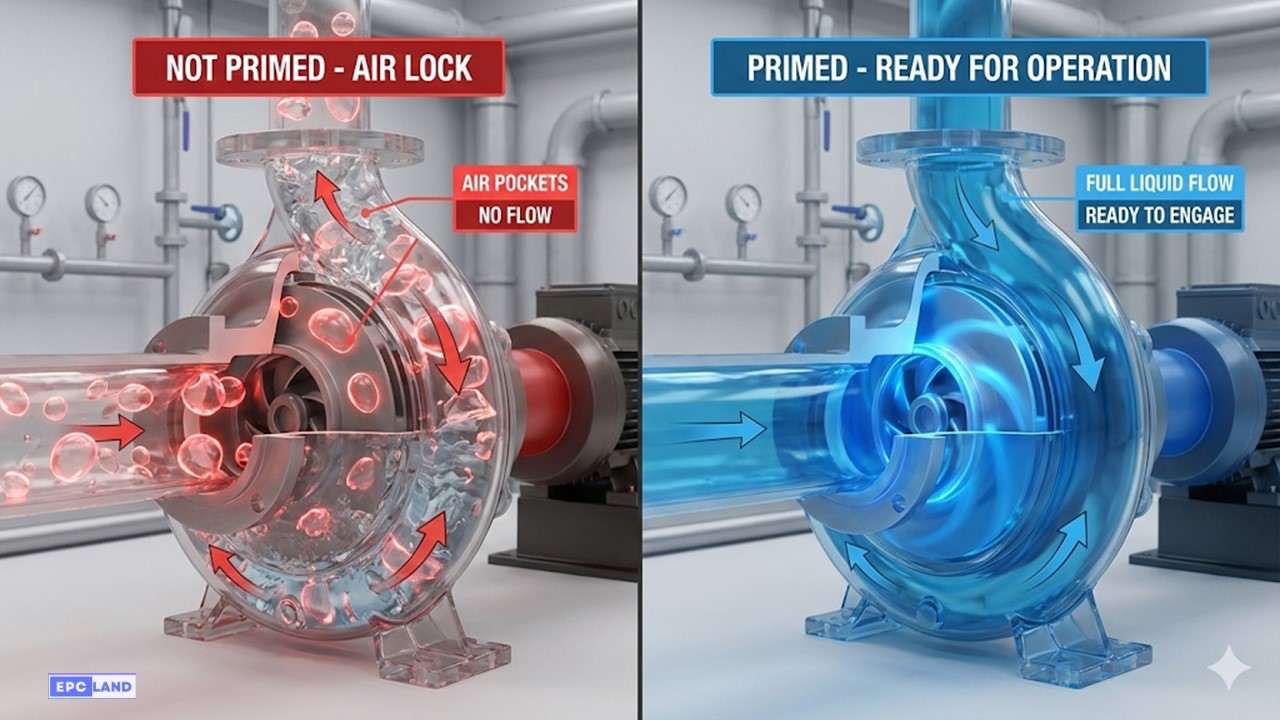
A centrifugal pump filled with air (left) cannot function; it must be filled with liquid (right) to generate pressure.
Before hitting the “Start” button on any centrifugal system, an operator must ensure the equipment is ready. Pump Priming is the essential preparatory step of removing air, gas, or vapor from the pump casing and suction piping and filling them completely with the liquid to be pumped. Without this step, a standard centrifugal pump is little more than an expensive fan—it will spin rapidly but pump absolutely nothing.
What is Pump Priming?
Technically, priming is the displacement of air in the suction line and impeller eye by liquid. Because liquids are incompressible and much denser than air, the rotating impeller can only impart energy (pressure) if it is fully submerged. If air remains, the pump suffers from “Air Lock” and cannot generate the suction pressure required to lift the fluid.
Quick Navigation
Test Your Hydraulics Knowledge
Do you understand why air is the enemy of centrifugal pumps?
Loading Question…
Explanation:
Complete Course on
Piping Engineering
Check Now
Key Features
- 125+ Hours Content
- 500+ Recorded Lectures
- 20+ Years Exp.
- Lifetime Access
Coverage
- Codes & Standards
- Layouts & Design
- Material Eng.
- Stress Analysis
The Physics: Why Air is the Enemy
To understand Centrifugal Pump Priming, you must understand density. A centrifugal pump works by throwing fluid outward from the center of the impeller. This creates a vacuum at the eye (center), which draws more fluid in.
However, the pump is designed to move liquids (Water density ≈ 1000 kg/m³), not gases (Air density ≈ 1.2 kg/m³). If the casing is filled with air, the impeller still spins, but the mass of the air is too low to generate the centrifugal force required to overcome the discharge pressure or lift the suction valve.
Engineering Formula: Head vs. Pressure
A centrifugal pump generates constant Head (H) in meters, but the Pressure (P) depends on the density (ρ) of the fluid inside.
With Water:
P = 1000 × 9.81 × H
Result: High Pressure (Suction Created)
With Air:
P = 1.2 × 9.81 × H
Result: ~0 Pressure (No Suction)
*This is why an unprimed pump cannot lift water from a sump. The air pressure generated is simply too weak to push the check valve open.
Standard Methods of Pump Priming
Since the pump cannot expel the air itself, we must intervene. There are three primary methods used in industry to prevent Air Lock in Pumps.

1. Manual Priming (The Foot Valve Method)
This is the most common method for small setups. It relies on a Foot Valve—a check valve located at the very bottom of the suction pipe submerged in the sump.
- Process: Water is poured into the pump casing via a funnel. The foot valve prevents this water from draining back into the well. As water fills the pipe, air is forced out through an air vent valve.
- Pros: Cheap and simple.
- Cons: If the foot valve leaks (debris/corrosion), the prime is lost during shutdown.
2. Vacuum Priming System
For large industrial pumps where manual filling is impossible, a Vacuum Priming System is used. A small auxiliary vacuum pump (or ejector) is connected to the discharge of the main pump. It sucks the air out of the casing, pulling the water level up from the sump until the main pump is full.
How Self-Priming Pumps Work
Engineers often ask about the Self-Priming Pump Working Principle. Unlike standard pumps, these units have a built-in water reservoir surrounding the impeller.
| Step | Action Inside the Pump |
|---|---|
| 1. Retention | After the first run, the casing design retains a small volume of liquid even when the pump stops. It never drains completely. |
| 2. Recirculation | On restart, the impeller churns this retained water with the air in the suction line, creating a foamy mixture. |
| 3. Separation | The air separates from the water in the discharge chamber and escapes. The water sinks back to the impeller to collect more air. |
| 4. Full Prime | Once all air is evacuated, the pump operates like a standard centrifugal pump. |
Advanced Priming Techniques & Industry Applications
While manual priming is common for small pumps, industrial facilities utilize more robust methods to ensure reliability. Understanding the difference between Ejector Priming and Gravity Flooding can save hours of downtime.
| Method | How It Works | Ideal Application |
|---|---|---|
| Ejector Priming | Uses compressed air or steam to create a vacuum venturi, sucking air out of the casing. | Large pumps where manual filling is unsafe; Hazardous fluids. |
| Gravity Priming | Locating the pump below the liquid source (Flooded Suction). Gravity fills the line naturally. | Storage tank transfer; Submerged pumps. The most reliable method. |
| Vacuum Pump | A dedicated small vacuum pump removes air from the main pump’s suction line. | Large vertical turbine pumps; Power plant cooling water systems. |
⚠️ Top 3 Priming Mistakes to Avoid
Even experienced operators make these errors, leading to “False Prime” situations where the gauge shows pressure, but the pump still fails.
- Skipping the Air Vent: You cannot fill a bottle with water if you don’t let the air out. Always open the casing high-point vent while filling.
- Ignoring Suction Leaks: A tiny hairline crack or loose flange gasket on the suction piping will pull in air continuously, breaking the prime vacuum.
- Rushing the Process: Closing the vent valve the moment water spurts out is a mistake. Wait for a steady, bubble-free stream to ensure all air pockets are gone.
Pump Priming Across Industries
💧 Water Treatment
Pumps here move millions of gallons daily. Automatic Vacuum Priming systems are standard to ensure pumps restart immediately after power outages without manual intervention.
🛢️ Oil & Gas
Crude oil contains dissolved gases. If pressure drops, gas bubbles out (Cavitation). Priming here involves strict NPSH (Net Positive Suction Head) calculations to keep the fluid liquid.
🧪 Chemical Processing
Hazardous acids cannot be poured manually via a funnel. These systems use Seal-less Mag-Drive Pumps or Flooded Suction designs to eliminate the risk of exposure during priming.
🌾 Agriculture
Irrigation pumps often pull from open canals. They rely heavily on simple Foot Valves. A clogged foot valve is the #1 cause of irrigation pump failure.
Case Study: The Hidden Cost of a Leaky Foot Valve
In automated systems, Pump Priming is often taken for granted. In this analysis, we examine a cooling water failure at a chemical plant where a $50 component failure destroyed a $15,000 pump.
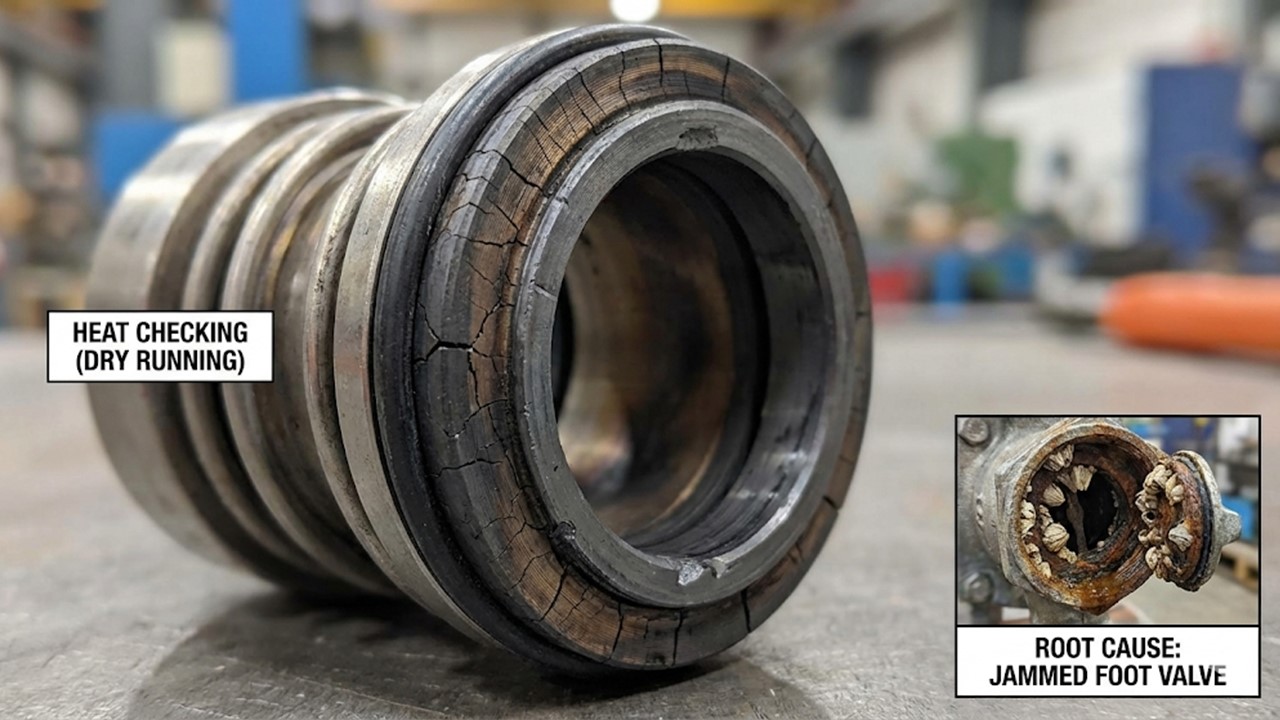
Figure 2: “Heat Checking” cracks on the mechanical seal face caused by lack of lubrication during a dry run.
Project Data
Location
Agrochemical Plant, Gujarat, India
Equipment
P-201 (Vertical Cooling Water Pump)
Priming Method
Manual Fill + Foot Valve
Failure Mode
Dry Run / Seal Shatter
The Problem: Loss of Prime
The pump was set to “Auto-Start” based on tank level. During a 48-hour weekend shutdown, the Foot Valve Function was compromised. A small piece of welding slag had lodged in the valve seat, preventing it from closing tightly.
The Chain Reaction:
1. Drainage: Gravity slowly pulled the water out of the suction line back into the sump over 24 hours. The pump casing became filled with air.
2. Auto-Start: On Monday morning, the PLC sent a start signal. The motor energized, and the impeller spun at 2900 RPM.
3. The Dry Run: Because the pump was air-locked, it moved no water. Without liquid to lubricate and cool the Silicon Carbide mechanical seal faces, friction raised the temperature to >400°C in minutes. The faces cracked (heat checked) and shattered.
Engineering Solution
Replacing the seal was expensive, but the fix focused on Preventing Pump Dry Run permanently.
- Hardware Fix: Replaced the cast-iron foot valve with a robust Stainless Steel basket strainer valve to prevent debris ingress.
- Instrumentation: Installed a “Low Power Load” switch. If the motor draws unusually low current (indicating it is spinning air/unloaded) for more than 10 seconds, the system trips automatically.
- Protocol: Operators now check the suction gauge before auto-start; a reading of 0 confirms loss of static head (prime).
Key Takeaway
A Foot Valve is a simple device, but it is the single point of failure for manual priming systems. For critical services, never rely solely on a check valve holding pressure—install instrumentation to detect loss of prime before the seal is destroyed.
EPCLand YouTube Channel
2,500+ Videos • Daily Updates
Frequently Asked Questions
Do Positive Displacement (PD) pumps need priming?
Generally, no. Priming in pumps is strictly a requirement for centrifugal types. Positive Displacement pumps (like Gear, Piston, or Diaphragm pumps) operate by mechanically expanding and contracting a cavity. This action creates a strong enough vacuum to pull air out of the suction line and draw liquid in without manual filling, making them naturally self-priming.
What is the difference between “Venting” and “Priming”?
While related, they are distinct steps. Priming refers to filling the suction line and impeller eye with liquid. Venting is the act of opening a high-point valve on the pump casing to release the trapped air while the priming liquid fills the system. You cannot fully prime a pump without venting the displaced air.
How do I know if my pump is properly primed?
The most reliable indicator is the Suction Pressure Gauge. Before starting, the gauge should show a positive static head pressure (if the tank is elevated). During operation, a stable discharge pressure indicates a successful prime. A fluctuating or zero pressure reading typically indicates an Air Lock or a leaking Foot Valve.
What is priming of pump in simple terms?
Simply put, priming of pump means manually or automatically replacing the air inside the pump with the liquid you want to move. Because a standard pump fan (impeller) cannot “grab” air to push it, you must give it a solid column of water to push against to start the flow.
Final Thoughts for 2026
Pump Priming is not just a startup procedure; it is a fundamental reliability requirement. As we move into 2026, smart pumping systems with automated vacuum primers and dry-run protection logic are becoming standard. However, the basic physics remains unchanged: if there is air in the eye, the pump will die.
