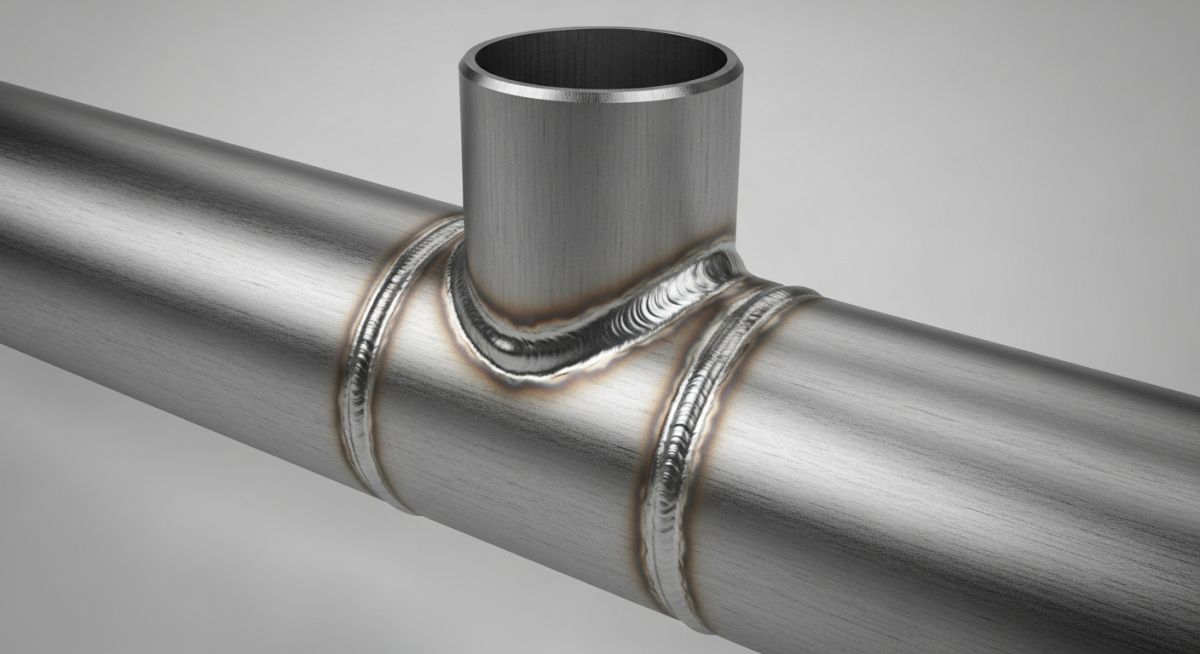
What is a Weldolet Fitting and How Does It Work?
In my 20 years of managing piping stress analysis and piping design for high-pressure petrochemical plants, I have seen many engineers struggle with branch connection integrity. When a process line requires a branch connection that is smaller than the main run pipe, you have a few choices: a standard reducing tee, a stub-in connection, or an integrally reinforced outlet fitting (commonly known as an Olet). Among these, the weldolet fitting stands out as the workhorse for high-stress, high-pressure applications.
I remember a project in 2014 where a critical steam line experienced severe vibration. The original design used simple stub-ins, which quickly developed fatigue cracks at the weld crotch. We replaced them with properly engineered weldolets, and the line has run flawlessly ever since. Understanding how these fittings distribute stress and how they differ from alternatives like sockolets is a fundamental skill for any piping designer.
- Weldolets provide a 90-degree branch connection with built-in reinforcement, eliminating the need for reinforcing pads.
- The branch connection is completed using a butt weld, making it ideal for high-temperature and high-pressure services.
- Design and dimensions are governed by the MSS SP-97 standard.
- Unlike sockolets, which use socket welds for small-bore piping, weldolets are suitable for all pipe sizes and allow for full radiographic inspection.
Why Choose a Weldolet Fitting for Piping?
When you cut a hole in a run pipe to connect a branch, you weaken the run pipe. To compensate for this loss of strength, pressure piping codes like ASME B31.3 require you to perform area replacement calculations. You must ensure that the metal area available for reinforcement around the opening is equal to or greater than the area removed by the hole.
A weldolet fitting is specifically designed to solve this problem. Instead of welding a reinforcing pad (re-pad) around a stub-in, which is labor-intensive and prone to trapping moisture, the weldolet has the necessary reinforcement forged directly into its body. This is why it is classified as an Integrally Reinforced Branch Connection Outlet (MSS SP-97).
In my experience, the crotch area of a branch connection (the transition zone between the run and branch) is the most highly stressed region. Standard stub-ins create sharp geometric transitions that act as severe stress risers. Weldolets feature a smooth, generous crotch radius that transitions the stress lines gradually, significantly reducing the Stress Intensification Factor (SIF).
ASME B31.3 Area Replacement Calculations
To understand how a weldolet fitting satisfies code requirements, let us look at the area replacement formula. The required reinforcement area (A1) is calculated as:
Where:
• d1 is the effective length of the opening in the run pipe.
• th is the nominal required thickness of the header/run pipe.
• beta is the angle between the branch and the header (90 degrees for a standard weldolet, making sin(beta) equal to 1).
The available area (A2 + A3 + A4) includes the excess thickness in the run pipe, the excess thickness in the branch pipe, and the cross-sectional area of the weld metal and the fitting itself. Because the weldolet is forged with extra wall thickness at its base, it provides a massive contribution to the available reinforcement area, easily satisfying the code without external pads.
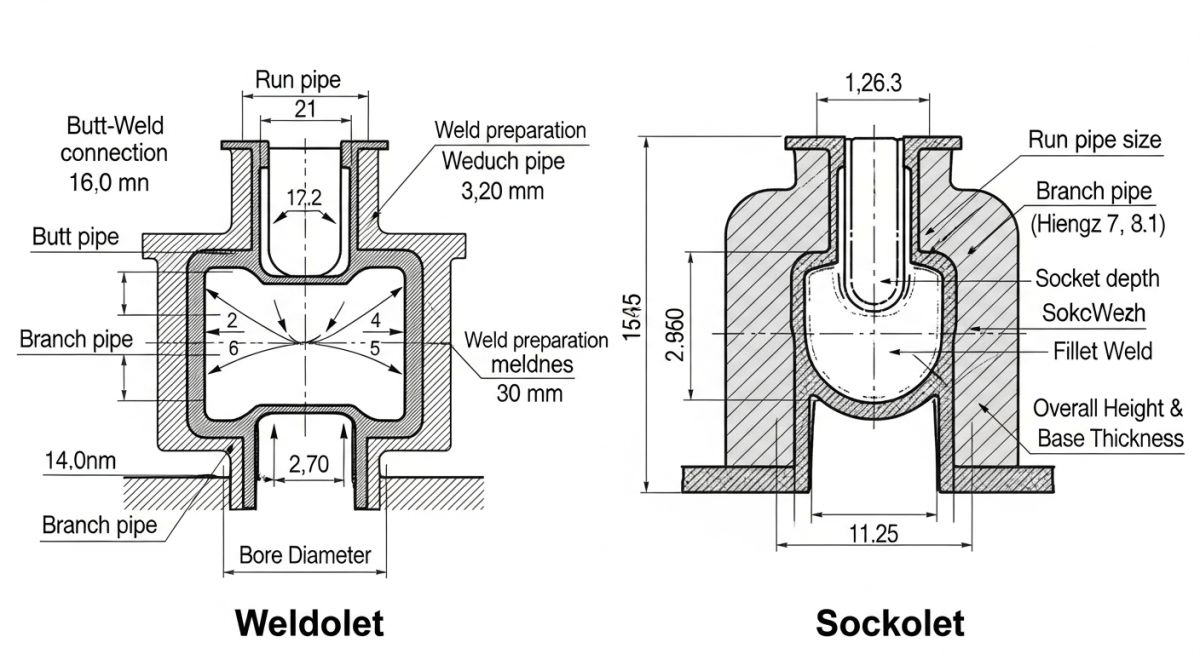
Weldolet vs Sockolet: Key Differences
While both are branch connection fittings, their end connections and application limits differ significantly:
- End Connection: A weldolet has a beveled end that is butt-welded to the branch pipe. A sockolet has a socket end where the branch pipe is inserted and then fillet-welded.
- Size Range: Weldolets are used for all sizes, from 1/2 inch up to 60 inches or more. Sockolets are typically restricted to small-bore piping (2 inches and smaller).
- Nondestructive Testing (NDT): Butt welds on weldolets can be fully radiographed (RT) or ultrasonically tested (UT). Socket welds on sockolets can only be inspected using magnetic particle (MT) or liquid penetrant (PT) testing, making them less desirable for highly toxic or lethal services.
- Stress Performance: Weldolets have superior fatigue resistance because butt welds distribute thermal and mechanical stresses more uniformly than fillet welds.
The dimensions of a weldolet fitting are standardized under MSS SP-97. The table below outlines the typical dimensions for Standard Weight (STD) and Extra Strong (XS) weldolets. Note that the height (A) is the critical dimension for piping layout designers when calculating cut lengths.
| Branch Size (NPS) | Run Size Range (NPS) | Height A – STD (inches) | Height A – XS (inches) | Width B – Base (inches) | Approx. Weight (lbs) |
|---|---|---|---|---|---|
| 1/2″ | 36″ – 3/4″ | 0.75″ | 0.75″ | 1.38″ | 0.30 |
| 1″ | 36″ – 1-1/4″ | 1.00″ | 1.00″ | 2.00″ | 0.80 |
| 2″ | 36″ – 2-1/2″ | 1.50″ | 1.50″ | 3.50″ | 2.70 |
| 4″ | 36″ – 5″ | 2.00″ | 2.00″ | 6.00″ | 9.10 |
| 6″ | 36″ – 8″ | 3.00″ | 3.12″ | 8.88″ | 23.00 |
| Fitting Type | Branch Connection Type | Primary Standard | Pressure Rating / Schedule | Best Suited For |
|---|---|---|---|---|
| Weldolet | Butt Weld | MSS SP-97 | STD, XS, Sch 160, XXS | High pressure, high temperature, dynamic loads |
| Sockolet | Socket Weld | MSS SP-97 | 3000#, 6000#, 9000# | Small bore piping (NPS 2 and under), low-stress lines |
| Threadolet | Threaded (NPT) | ASME B1.20.1 | 3000#, 6000# | Instrument connections, vents, drains |
| Elbolet | Butt / Socket / Threaded | MSS SP-97 | Matches pipe schedule | Connections on 90-degree long radius elbows |
How to Inspect a Weldolet Fitting Onsite?
During my field audits, I often find that installation errors are the root cause of premature branch connection failures. Welders sometimes struggle with the variable gap around the curved run pipe, leading to poor root penetration. Use this checklist to ensure your installations meet the highest engineering standards.
-
Material Verification: Cross-reference the heat number stamped on the weldolet body with the Material Test Report (MTR) to confirm correct chemistry and yield strength.
-
Curvature Match: Ensure the curved base of the weldolet matches the nominal diameter of the run pipe. A fitting designed for a 12-inch pipe must never be forced onto an 8-inch pipe.
-
Root Gap and Fit-up: Verify a uniform root gap of 1/16 inch to 3/32 inch between the fitting base and the run pipe before tack welding.
-
Preheat Requirements: Apply preheating in accordance with ASME B31.3 Table 330.1.1, especially for heavy-wall carbon steel or low-alloy steels (P-No. 3, 4, and 5).
-
Weld Profile Inspection: Ensure the final weld transitions smoothly from the run pipe to the fitting body without undercut or excessive reinforcement.
Field Case Study: Real-World Application
At a natural gas processing facility, a 2-inch bypass line was branched off a 10-inch compressor discharge line. The original contractor used a standard stub-in connection with a reinforcing pad. Within six months of commissioning, the plant experienced an unscheduled shutdown due to a gas leak.
Upon inspection, we discovered a circumferential fatigue crack at the toe of the fillet weld joining the branch pipe to the run pipe. The high-frequency vibration from the reciprocating compressor had concentrated stress directly at the sharp geometric transition of the stub-in.
I was brought in to redesign the branch connection. We cropped out the damaged section of the 10-inch run pipe and installed a new spool piece. Instead of a stub-in, we specified an ASTM A105 Extra Strong weldolet fitting.
The weldolet’s forged body provided a smooth, contoured transition that redistributed the dynamic stress. We performed a full radiographic test (RT) on the butt weld to ensure zero defects. The compressor was restarted, and vibration monitoring showed a 65% reduction in localized stress levels. The line has now been operating for over eight years without a single issue.
This case highlights why relying on cheap stub-ins for dynamic, high-vibration lines is a false economy. Specifying a high-quality weldolet fitting upfront saves hundreds of thousands of dollars in lost production and emergency repairs.
Frequently Asked Engineering Questions
What is the primary difference between a Weldolet and a Sockolet?
Which standards govern the design and dimensions of a weldolet fitting?
Can a weldolet fitting be used on a run pipe of any size?
Why are weldolets preferred over reinforcing pads (re-pads)?
How do you specify a weldolet fitting in a piping specification?
Is post-weld heat treatment (PWHT) required for weldolets?
Complete Course on
Piping Engineering
Check Now
Key Features
- 125+ Hours Content
- 500+ Recorded Lectures
- 20+ Years Exp.
- Lifetime Access
Coverage
- Codes & Standards
- Layouts & Design
- Material Eng.
- Stress Analysis



