Table of Contents
What is Von Mises Theory of Failure? Formula for Von Mises Stress
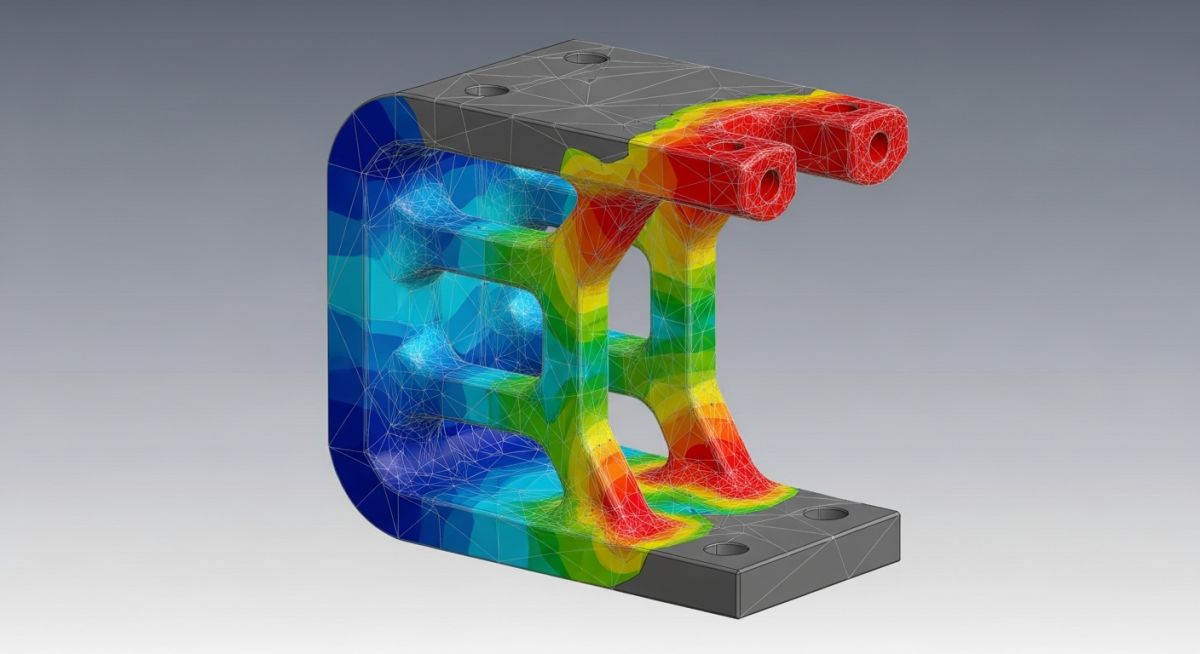
In my 20-plus years of designing high-pressure piping systems and offshore structures, I have seen many engineers rely blindly on finite element analysis (FEA) software. They look at a beautiful, multi-colored stress plot, see a red zone, and panic. Or worse, they see a green zone and assume everything is safe without understanding the underlying physics. When we evaluate ductile materials like carbon steel or stainless steel under complex, multi-axial loading, the single most important tool in our engineering arsenal is the Von Mises yield criterion. Let me take you through how this theory works, why it is the industry standard, and how to apply its formula to prevent catastrophic field failures.
- Understand that hydrostatic pressure does not cause yielding in ductile metals; shape distortion is the true driver of failure.
- The Von Mises stress is an equivalent uni-axial stress, not a physical stress you can measure directly with a strain gauge.
- Using this theory allows for up to 15% higher allowable stress limits compared to the conservative Tresca criterion.
- Never apply this theory to brittle materials like cast iron, which fail under maximum tensile stress rather than shear or distortion.
- Always validate FEA software outputs with manual hand calculations using the principal stress equations.
Understanding the Von Mises Theory of Failure
To grasp the physical meaning of this theory, we must look at how materials store energy. When a structural component is loaded, it deforms and stores strain energy. This total strain energy can be split into two distinct parts: volumetric strain energy (which changes the volume of the material without changing its shape) and distortion strain energy (which changes the shape of the material without changing its volume).
In my field investigations of high-pressure piping, I have observed that hydrostatic pressure (equal stress in all three principal directions) does not cause plastic yielding. You could submerge a block of steel miles deep in the ocean, and it would not yield because the volumetric compression is uniform. Yielding only occurs when the material is sheared or distorted. This is why the Von Mises theory is also known as the Distortion Energy Theory or the Shear Energy Theory.
The Mathematical Formula for Von Mises Stress
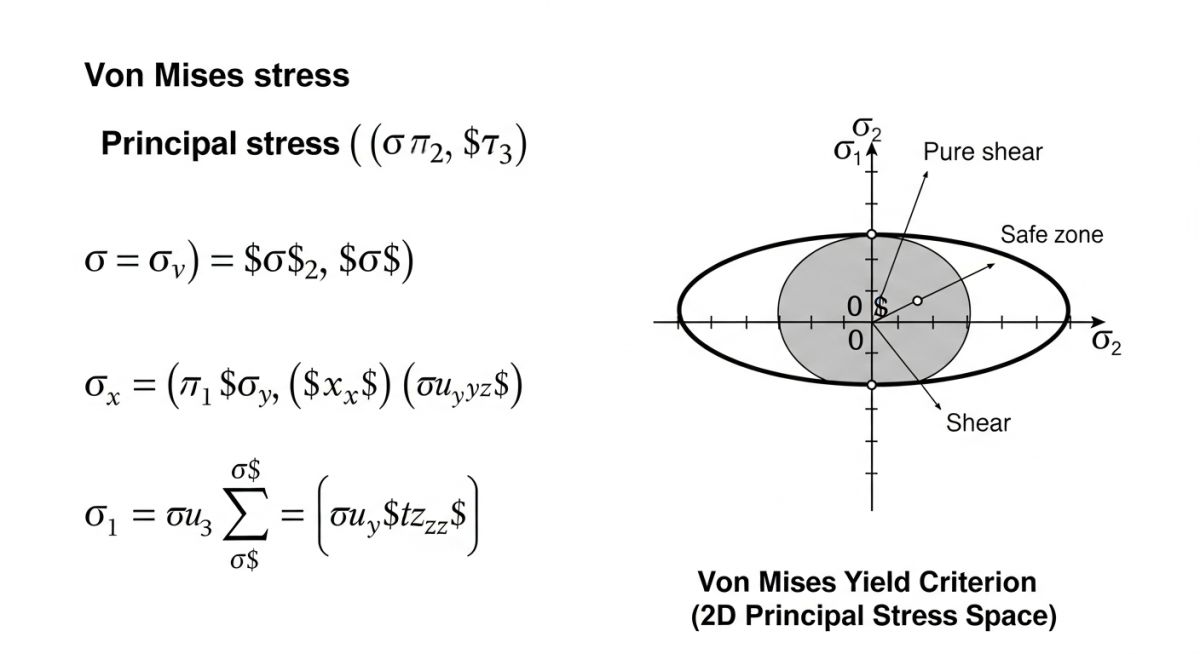
In a general three-dimensional stress state, the stress at any given point is defined by three normal stresses and three shear stresses. The Von Mises equivalent stress (often denoted as σv or σe) simplifies this complex state into a single scalar value.
When expressed in terms of the three principal stresses (σ1, σ2, and σ3), the formula is written as:
If you are working with raw stress components from an FEA model or strain gauge rosette in Cartesian coordinates (x, y, z), the formula expands to account for shear stresses (τxy, τyz, τzx):
The 2D Plane Stress Simplification
For many practical engineering problems, such as thin-walled pressure vessels or flat plates, we can assume a state of plane stress where the out-of-plane stress is zero (σ3 = 0). Under these conditions, the formula simplifies significantly:
This 2D equation represents an ellipse when plotted on a graph of σ1 versus σ2. This geometric boundary is known as the Von Mises Yield Ellipse. Any combination of principal stresses that falls inside this ellipse indicates that the material remains in the safe elastic region. If the stress state touches or crosses the boundary of the ellipse, plastic yielding occurs.
Do not use the Von Mises yield criterion for brittle materials such as cast iron, glass, or high-carbon hardened steels. Brittle materials do not undergo plastic deformation before failure; they fail suddenly due to crack propagation caused by tensile stresses. For these materials, you must use the Maximum Principal Stress Theory (Rankine Theory) or risk catastrophic, unpredicted structural failure.
When designing pressure vessels under ASME Section VIII Division 2, we utilize these exact equations to perform elastic-plastic stress analysis. The code allows us to map out the stress intensity and compare the equivalent Von Mises stress against the design yield strength, ensuring a consistent safety factor across all loading combinations.
Comparing Yield Theories for Ductile Materials
In structural design, choosing the correct failure theory directly impacts both safety and project cost. The table below compares the three primary classical failure theories used in mechanical and piping engineering.
| Failure Theory | Physical Basis | Yield Condition (2D) | Material Suitability | Design Conservatism |
|---|---|---|---|---|
| Von Mises (Distortion Energy) | Shear strain energy per unit volume | σ12 – σ1σ2 + σ22 = Sy2 | Highly ductile metals (Steel, Aluminum, Copper) | Highly accurate; optimizes material weight (up to 15% lighter than Tresca) |
| Tresca (Maximum Shear Stress) | Maximum absolute shear stress | Max(|σ1 – σ2|, |σ2 – σ3|, |σ3 – σ1|) = Sy | Ductile metals (often used in conservative piping codes) | Very conservative; represented by a hexagon inscribed inside the Von Mises ellipse |
| Rankine (Maximum Principal Stress) | Maximum normal tensile stress | Max(σ1, σ2) = Sut | Brittle materials (Cast Iron, Concrete, Ceramics) | Unsafe for ductile materials under pure shear loading |
Technical Mapping & Specifications Matrix
When setting up FEA post-processors or writing custom calculation sheets, you must map your variables to the correct physical parameters. The matrix below outlines these relationships in accordance with international standards.
| Parameter Name | Common Symbol | Physical Definition | ASME / API Code Reference |
|---|---|---|---|
| Von Mises Equivalent Stress | σv / SEQV | The single uni-axial tensile stress value that represents the same distortion energy as the actual combined stress state. | ASME Sec VIII Div 2, Part 5 |
| Yield Strength | Sy / fy | The stress level at which a material exhibits a specified limiting permanent set (typically 0.2% offset). | ASME Sec II Part D |
| Shear Yield Strength | Ssy / τy | The limit of shear stress a material can withstand before plastic deformation. Calculated as 0.577 * Sy under Von Mises. | AISC 360 Specification |
| Hydrostatic Stress | σh / σm | The average of the three principal stresses, representing uniform volumetric tension or compression. | API RP 2A-WSD |
Applying the Von Mises Theory of Failure
When you are reviewing FEA reports or signing off on structural designs, you cannot simply trust the software’s default settings. Use this field-tested checklist to verify that the Von Mises stress calculations are accurate and code-compliant.
-
Material Ductility Verification: Confirm that the material elongation is greater than 5%. If the material is brittle, reject the Von Mises analysis and request a Maximum Principal Stress evaluation.
-
Mesh Convergence Study: Ensure that the high-stress regions (such as nozzle-to-shell junctions) have a refined mesh. Von Mises stress values at sharp corners can artificially spike due to singularities.
-
Principal Stress Extraction: Extract the individual principal stresses (σ1, σ2, σ3) at the critical node and manually calculate the Von Mises stress to verify the FEA solver’s mathematical integrity.
-
Boundary Condition Assessment: Verify that the support constraints do not introduce artificial stress concentrations that distort the local equivalent stress field.
-
Code-Allowable Comparison: Ensure that the calculated Von Mises stress is compared against the allowable stress limit (which includes the appropriate safety factor), not the raw yield strength of the material.
Field Case Study: Real-World Application
During a routine shutdown inspection on an offshore gas production platform, NDT technicians discovered severe surface cracking at the crotch corner of a high-pressure gas bypass manifold. The manifold was fabricated from ASTM A106 Grade B carbon steel and operated under combined thermal expansion, internal pressure, and structural vibration. The original design team had checked the system using simple 1D beam elements, verifying only the axial and hoop stresses individually. They completely overlooked the combined torsional and shear stresses acting at the complex branch connection.
I was brought in to lead the failure investigation. We built a high-fidelity 3D solid FEA model of the branch connection. By extracting the full tri-axial stress state and calculating the true Von Mises equivalent stress, we discovered that the combined stress at the crotch corner reached 355 MPa. This exceeded the material’s minimum specified yield strength of 240 MPa by nearly 50%, explaining the rapid plastic deformation and subsequent fatigue cracking. We redesigned the connection using an integrated sweepolet fitting to distribute the load, reducing the peak Von Mises stress to a safe 155 MPa, which was well within the allowable limits of ASME B31.3.
My direct recommendation for any engineer dealing with combined loading is simple: never rely on single-axis stress checks. When a component is subjected to simultaneous bending, torsion, and pressure, you must evaluate the system using the Von Mises stress formula to capture the true multi-axial stress state.
Frequently Asked Engineering Questions
What is the physical meaning of Von Mises stress?
Why is Von Mises stress preferred over Tresca stress for ductile materials?
Can Von Mises stress be higher than the yield strength?
How does hydrostatic pressure affect the Von Mises yield criterion?
What is the relationship between shear yield strength and tensile yield strength?
Is Von Mises theory applicable to composite or anisotropic materials?
===FAQ_BLOCK===

📚 Recommended Resources: Von Mises theory of failure
Read these Guides
Related posts:
![A mechanical sucker rod pumpjack operating in an oil field at sunset]()
What is Sucker Rod Pump System in Oil Production?
![Piping material engineer reviewing technical specifications on a tablet in an industrial plant.]()
How a Piping Material Engineer Drives Industrial Project Success
![Industrial refinery plant showing various types of static equipment]()
What is Static Equipment? Types and List of Static Equipments
![Side-by-side comparison of industrial process piping and power plant steam piping systems.]()
Differences Between ASME B31.3 and B31.1: B31.3 vs B31.1
![Large industrial steel storage tank under construction with cranes and scaffolding]()
Storage Tank Construction Method Statement: Step-by-Step Engineering Guide
![Cutaway diagram of a globe control valve highlighting the internal valve trim components]()
What is a Valve Trim? Types, Components, and Selection