Technical Content Verified
Updated: January 2026 | Engineering Standards Audit
Thermocouples: Definition, Applications, Parts, Working, Types, and Selection
Thermocouples are the most widely utilized temperature sensors in the industrial world, offering a robust and cost-effective solution for measuring thermal gradients across extreme ranges. By leveraging the fundamental principles of thermoelectricity, these devices convert thermal energy directly into an electrical signal, making them indispensable in everything from jet engines to domestic water heaters.
What are Thermocouples?
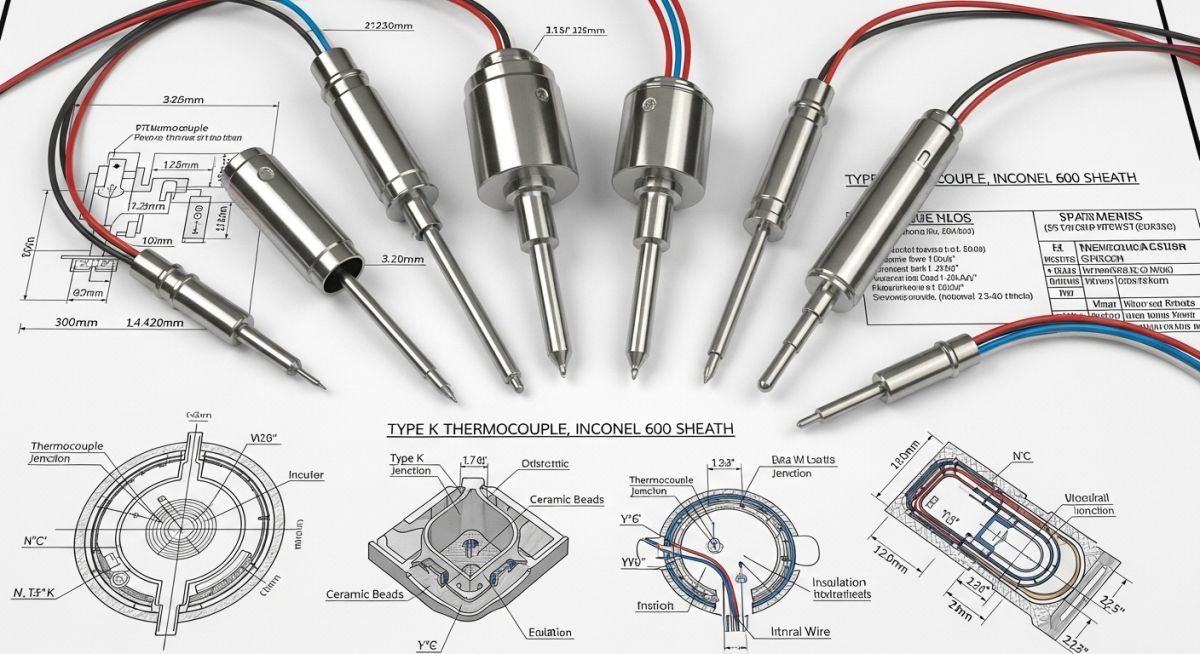
Thermocouples are active temperature sensors consisting of two dissimilar metal wires joined at one end to form a junction. When this junction experiences a temperature change relative to the reference junction, it generates a small voltage (millivolts) via the Seebeck effect, which is then calibrated to represent precise temperature data.
In This Technical Guide
- 1. Industrial Thermocouples Applications
- 2. The Seebeck Effect: How They Work
- 3. Engineering Selection Criteria
- 4. Primary Components and Construction
- 5. Comparative Guide to Types
- 6. Color Coding Standards
- 7. Oil and Gas Industry Uses
- 8. Design Codes and Standards
- 9. Root Cause Failure Analysis
- 10. How to Read Output Data
- 11. Reference Tables and Millivolts
- 12. Water Heater Applications
Engineering Knowledge Check: Thermocouples
Question 1 of 5
Complete Course on
Piping Engineering
Check Now
Key Features
- 125+ Hours Content
- 500+ Recorded Lectures
- 20+ Years Exp.
- Lifetime Access
Coverage
- Codes & Standards
- Layouts & Design
- Material Eng.
- Stress Analysis
Industrial Thermocouples Applications in Modern Engineering
The versatility of Thermocouples allows them to be deployed across a vast spectrum of industrial sectors. Unlike RTDs (Resistance Temperature Detectors), which are often fragile, these sensors excel in high-vibration and high-temperature environments. In power generation, they monitor turbine exhaust gases; in the automotive sector, they measure cylinder head temperatures; and in plastic extrusion, they ensure the precise melt temperature of polymers.
- Aerospace: Monitoring jet engine combustion chambers and exhaust nozzles.
- Metallurgy: Precise control of molten metal temperatures in blast furnaces and kilns.
- Food & Beverage: Ensuring pasteurization temperatures meet safety standards in large-scale vats.
- HVAC: Boiler flame sensing and flue gas temperature monitoring for efficiency.
The Seebeck Effect: How Do Thermocouples Work?
At the heart of every measurement lies the Seebeck Effect, discovered by Thomas Johann Seebeck in 1821. This phenomenon occurs when two dissimilar metal conductors are joined at two points (junctions) and a temperature difference is maintained between these points. This thermal gradient creates an electromotive force (EMF), resulting in a measurable millivolt signal.

The voltage generated is proportional to the temperature difference between the Measuring Junction (Hot Junction) and the Reference Junction (Cold Junction). To translate this voltage into an accurate temperature, modern instrumentation uses Cold Junction Compensation (CJC). This process compensates for the temperature at the point where the thermocouple wires connect to the measurement device, ensuring the reading reflects only the temperature at the sensing tip.
Engineering Criteria for Industrial Thermocouples Selection
Selecting the correct Thermocouples assembly is a critical engineering task that directly impacts process safety and sensor longevity. Engineers must evaluate several environmental and physical factors based on standards such as ASTM E230.
| Selection Factor | Engineering Consideration |
|---|---|
| Temperature Range | Determine the maximum and minimum operating peaks to avoid sensor degradation. |
| Chemical Environment | Evaluate if the atmosphere is oxidizing, reducing, or inert (affects sheath choice). |
| Response Time | Consider junction grounding. Grounded junctions offer faster response; ungrounded provide electrical isolation. |
| Physical Constraints | Diameter and length requirements of the probe relative to the process thermowell. |
Primary Thermocouples Components and Material Construction
A standard industrial Thermocouples assembly consists of more than just wires. To survive harsh industrial conditions, the internal elements are protected by several layers of specialized materials, often governed by ASME B40.9 standards.
- Thermo-elements: Two dissimilar wires (e.g., Chromel and Alumel) that form the sensor.
- Insulation: Mineral Insulated (MI) cables commonly use Magnesium Oxide (MgO) powder to provide high-dielectric strength and thermal conductivity while preventing wire contact.
- Protective Sheath: Typically made of Stainless Steel (SS316), Inconel 600, or Ceramic for high-temperature protection against corrosion and mechanical impact.
- Termination: This can be a ceramic terminal block inside a weather-proof connection head or a specialized thermocouple plug/socket.
Comparative Guide to Different Thermocouples Types
Type K Thermocouple: The General Purpose Standard
The Type K Thermocouple (Chromel / Alumel) is the most popular choice in modern instrumentation due to its wide temperature range (-200 to +1260 degrees Celsius) and low cost. It is highly resistant to oxidation but can be susceptible to “green rot” in reducing atmospheres or if exposed to sulfur.
Type J Thermocouple: Best for Reducing Atmospheres
Composed of Iron and Constantan, the Type J Thermocouple is ideal for vacuum and reducing environments. It has a narrower temperature range than Type K (0 to 750 degrees Celsius) because the iron wire oxidizes rapidly above this limit. It is frequently found in plastics manufacturing and molding.
Type T Thermocouple: Ideal for Cryogenic Ranges
The Type T Thermocouple (Copper / Constantan) is extremely stable at low temperatures. It is the preferred sensor for cryogenic applications and food processing, where accuracy between -200 and 350 degrees Celsius is vital. Because both conductors are non-magnetic, it is also useful in specific laboratory settings.
Type E Thermocouples: Highest Sensitivity Output
The Type E Thermocouples (Chromel / Constantan) offer the highest EMF output per degree of all standard base-metal types (approximately 68 microvolts per degree Celsius at 1000 degrees Celsius). This high sensitivity makes them excellent for detecting very small temperature changes in non-oxidizing environments.
Type N Thermocouples: Superior Oxidation Resistance
Often called the “Improved Type K,” Type N Thermocouples (Nicrosil / Nisil) were developed to overcome the instabilities (such as “green rot”) found in Type K. They offer better stability and resistance to high-temperature oxidation, making them ideal for gas turbine and furnace monitoring where long-term accuracy is paramount.
Type R and S Thermocouples: Platinum-Rhodium Excellence
These “Noble Metal” Thermocouples utilize Platinum and Rhodium. Type S is often used as the standard for calibration between the freezing point of antimony (630.74 degrees Celsius) and gold (1064.43 degrees Celsius). They are incredibly stable but very expensive and fragile, requiring ceramic protection tubes.
Type B Thermocouples: Extreme High-Temperature Measurement
Specifically designed for extreme heat, Type B Thermocouples can measure up to 1700 degrees Celsius. They have a unique characteristic where the millivolt output is nearly zero below 50 degrees Celsius, effectively eliminating the need for cold-junction compensation in many ambient temperature applications.
Comparative Data: Technical Specifications for Thermocouples
| Type | Materials (+ / -) | Range (Celsius) | Sensitivity (µV/C) |
|---|---|---|---|
| K | Chromel / Alumel | -200 to 1260 | 41 |
| J | Iron / Constantan | 0 to 750 | 52 |
| T | Copper / Constantan | -200 to 350 | 43 |
| R/S | Pt-Rh / Pt | 0 to 1450 | 10 |
Color Coding Standards for Thermocouples (ANSI vs. IEC)
Identifying Thermocouples in the field is managed through standardized color coding of the insulation and connectors. It is vital for engineers to know if they are working with ANSI (American) or IEC (International) standards, as the colors differ significantly.
ANSI MC96.1 (USA)
- Type K: Yellow (+) / Red (-)
- Type J: White (+) / Red (-)
- Type T: Blue (+) / Red (-)
- Note: Negative lead is always RED in ANSI.
IEC 60584-3 (International)
- Type K: Green (+) / White (-)
- Type J: Black (+) / White (-)
- Type T: Brown (+) / White (-)
- Note: The outer jacket color matches the positive lead.
The Math Behind Thermocouples: Interpreting Millivolt Data
The relationship between temperature and voltage is non-linear and is defined by the following polynomial equation used in digital controllers:
Where V is the thermoelectric voltage and T is the temperature. For quick field checks, technicians refer to Thermocouples Reference Tables, which provide the millivolt output for every degree of temperature assuming a reference junction of 0 degrees Celsius.
Root Cause Analysis of Common Thermocouples Failures
Even the most robust Thermocouples can fail due to the harsh environments they inhabit. Common failure modes include:
- Decalibration: Atmospheric contamination (e.g., carbon diffusion) alters the chemical composition of the wires, shifting the EMF output.
- Open Circuit: Mechanical vibration or thermal shock causing the junction to break.
- Insulation Resistance Breakdown: High moisture or high temperature causing the MgO insulation to leak current, leading to erratic readings.
- Shunt Errors: In very long probes, if the insulation fails mid-way, a “virtual junction” is created, and the instrument reads the temperature at the leak point rather than the tip.
Specialized Thermocouples for Water Heater Safety Systems
In domestic and industrial water heaters, Thermocouples act as a critical safety “Flame Sensor.” The sensor is placed in the pilot light flame. The heat generates a small current (approx. 20-30 mV) that holds an electromagnetic gas valve open. If the pilot light goes out, the thermocouple cools, the voltage drops, and the spring-loaded valve snaps shut, preventing dangerous gas leaks.
EPCLand YouTube Channel
2,500+ Videos • Daily Updates
Case Study: Resolving Drift Issues in High-Pressure Steam Thermocouples

Project Data
- Facility Type: 500MW Combined Cycle Power Plant
- Application: Superheated Steam Header Monitoring
- Operating Temperature: 540 degrees Celsius
- Operating Pressure: 170 Bar
- Original Sensor: Type K Mineral Insulated Thermocouple
Failure Analysis
During a routine maintenance audit, the plant engineers noticed a consistent 12 to 15-degree Celsius negative drift in the temperature readings compared to secondary verification sensors. Laboratory analysis of the failed Thermocouples revealed “Green Rot” (preferential oxidation of chromium) caused by a lack of oxygen inside the stainless steel sheath at high temperatures, which altered the thermoelectric EMF.
The Engineering Fix
The engineering team performed a full technical upgrade, replacing all Type K sensors with Type N Thermocouples. Unlike Type K, the Nicrosil/Nisil alloys in Type N provide significantly higher resistance to oxidation and better long-term stability in high-pressure steam environments. Additionally, the sheath material was upgraded from SS316 to Inconel 600 to prevent chromium depletion.
Lessons Learned
- Temperature range is not the only selection factor; the chemical atmosphere (oxidizing vs. reducing) is equally critical.
- In high-criticality steam headers, Type N offers a superior lifespan and lower drift rates compared to the standard Type K.
- Regular verification against a secondary reference sensor is essential for detecting gradual decalibration before it impacts plant efficiency.
Frequently Asked Questions about Industrial Thermocouples
What is the main difference between Thermocouples and RTDs?
When should I use a grounded vs. ungrounded Thermocouple junction?
Can I use regular copper wire to extend a Thermocouple circuit?
How do I test if a Thermocouple has failed?
Final Technical Summary
Understanding the physics and limitations of Thermocouples is fundamental for any instrumentation or process engineer. From the initial selection of alloys like Chromel and Alumel to the implementation of cold-junction compensation, every step in the measurement chain affects the final accuracy of the data.
As industrial processes become more complex in 2026, choosing the right sensor—whether it is a rugged Type N for turbines or a sensitive Type E for lab work—ensures plant safety, reduces energy waste, and prevents costly equipment failures. Always consult the latest ASME B40.9 or IEC 60584 standards to ensure your installation meets global engineering requirements.
📚 Recommended Resources: Thermocouples
Read these Guides
- 📄 Heat Exchanger Fouling Factor: Significance, Calculation & 2026 Standards
- 📄 Engineering Guide to High Temperature and High-Pressure Piping (2026)
- 📄 Refinery Rescue: How We Quelled a CRU Catalyst Runaway Reaction and Lessons Learned
- 📄 Interactive Refinery Furnace Quiz: Test Your Coking & Downtime Troubleshooting Skills!




Related posts:
![High-grade industrial Wing Nut Types and Applications for mechanical assemblies.]()
Wing Nut Types and Applications: The 2026 Engineering Guide
![Industrial Monorail Crane Systems installed in a modern manufacturing plant 2026.]()
Monorail Crane Systems: Design, Types & 2026 Standards Guide
![Lead engineer performing a Factory Acceptance Test FAT on an industrial skid system 2026]()
Factory Acceptance Test FAT: The 2026 Engineering Guide to Zero-Defect Delivery
![Professional engineering workspace showing a Basis of Design document layout for a 2026 project.]()
Basis of Design: How to Write a BOD for Engineering Projects in 2026
![Industrial Flare Knockout Drum Sizing and installation in a refinery relief system.]()
Flare Knockout Drum Sizing: Design & API 521 Standards (2026 Guide)
![Advanced Reboiler Control Systems in a modern petrochemical refinery 2026.]()
Reboiler Control Systems: Engineering Guide to Precision Control 2026