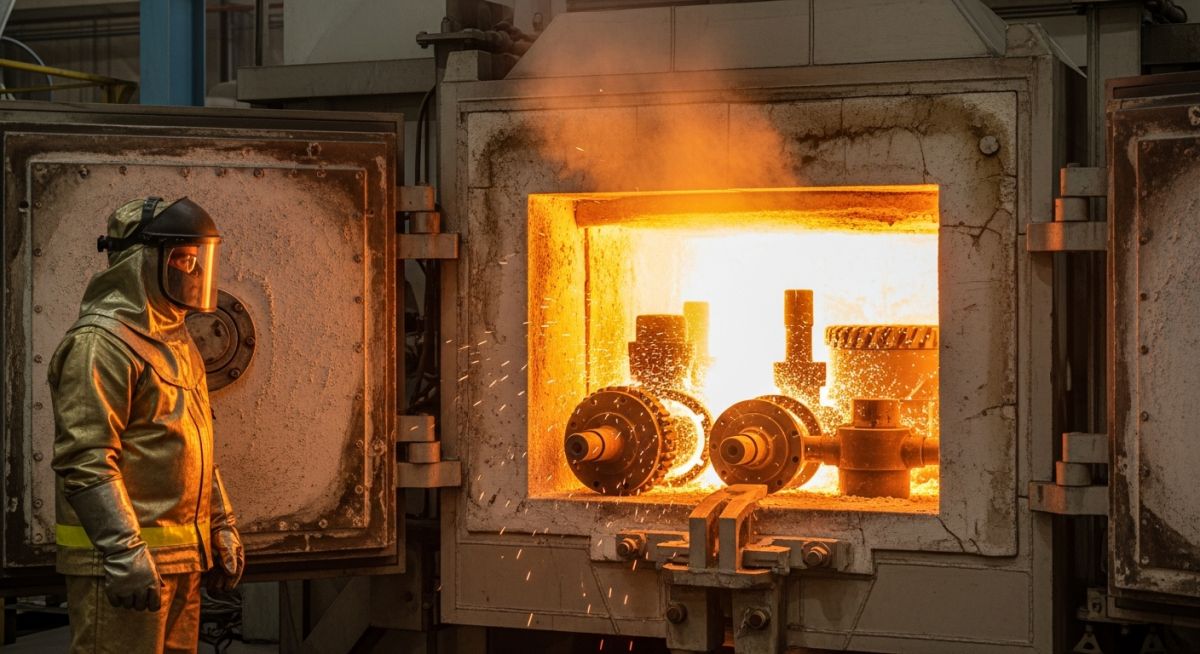
Author: Atul Singla | Senior Piping Engineer | Last Updated: May 2026 What is Case Hardening of Steel? Complete Engineering Guide I still remember a shutdown job in a cement plant where a set of hardened gears failed just months after installation. On paper, everything looked perfect — material, hardness, inspection reports. But when I examined the surface under magnification, the issue was obvious: the case hardening depth was wrong. The surface couldn't withstand abrasion, and the core strength never had a chance to perform. That incident changed how I look at case hardening of steel. It's not just a heat treatment — it’s a precision-controlled engineering decision that directly impacts wear life, fatigue strength, and unexpected failure. Key Takeaways Case hardening creates a hard outer layer while keeping the steel core tough and ductile. Incorrect case depth is one of the most common causes of field failure in gears and shafts. Processes like carburizing and nitriding control hardness, wear resistance, and fatigue life. Selection between case hardening and surface hardening depends on load, stress, and application. Field verification and controlled heat treatment cycles decide long-term equipment reliability. SGE Featured Snippet (50 Words): Case hardening of steel is a heat treatment process that hardens the outer surface while maintaining a tough core. It improves wear resistance and fatigue strength through methods like carburizing and nitriding. This process is widely used in gears, shafts, and heavy industrial components. Interactive Engineering Quiz 1. What is the main objective of case hardening of steel? Increase core brittleness Harden the surface while keeping the core tough Reduce carbon content in steel Make the entire component uniformly hard Explanation: Case hardening improves surface hardness while preserving a ductile core, increasing wear resistance and fatigue life. 2. Which process involves diffusion of carbon into the steel surface? Carburizing Nitriding Annealing Tempering Explanation: Carburizing introduces carbon at high temperature to create a hardened case layer on steel surfaces. 3. Why does improper case depth lead to failure? It increases weight It changes chemical composition completely It reduces wear resistance and fatigue strength It eliminates hardness entirely Explanation: If case depth is too shallow, surface wear occurs quickly; if too deep, it may lead to brittleness and cracking under load. Previous Next What is Case Hardening of Steel? In my experience as a piping and mechanical engineer, case hardening of steel is one of those processes that looks simple in textbooks but behaves very differently in real plant conditions. At its core, it is a thermo-chemical heat treatment process where the outer surface of a steel component is hardened while keeping the inner core softer and ductile. The logic is straightforward: the surface handles wear, friction, and contact stress, while the core absorbs impact and prevents brittle fracture. This combination is the backbone behind reliable gears, shafts, cam systems, and valve components. Field Warning: I have seen multiple failures where engineers assumed “higher hardness everywhere” is better. That assumption destroys fatigue life. A brittle component cracks faster than a balanced one. --- Case Hardening Definition & Metallurgical Mechanics Technically speaking, case hardening is based on controlled diffusion of alloying elements such as carbon or nitrogen into the steel surface at elevated temperatures. Once diffusion occurs, quenching transforms the microstructure into martensite, which provides very high hardness. The process can be broken into three engineering stages: Diffusion Stage: Carbon or nitrogen atoms penetrate the steel lattice. Soaking Stage: Controlled time ensures uniform case depth. Quenching & Transformation: Rapid cooling forms martensitic structure. The hardness profile typically follows a gradient: Surface hardness: 55–65 HRC Intermediate layer: Gradual hardness drop Core hardness: 25–35 HRC (tough and ductile) --- Purpose of Case Hardening of Steel When I evaluate component failures in plants, I always go back to the purpose behind the material selection. The purpose of case hardening of steel is not just hardness — it’s performance under combined loading conditions. Improve wear resistance under sliding and rolling contact Increase fatigue strength due to compressive surface stresses Maintain impact resistance via ductile core Extend component life in abrasive environments In rotating equipment like pumps and compressors, I’ve seen properly case-hardened components run for years without measurable degradation. --- Reason for Case Hardening in Engineering Design The reason for case hardening comes directly from real-world load conditions. Components rarely experience a single type of stress. Instead, they handle combinations: Contact stress (gear tooth interaction) Sliding wear (valves, cams) Cyclic fatigue loading Shock and impact loads If a component is fully hardened, it becomes brittle. If it remains soft, it wears out quickly. Case hardening solves this contradiction. --- Metals Suitable for Case Hardening of Steel Not all metals respond well to case hardening. From my field inspections, material selection is often ignored — and that leads to failure even before installation. Material Suitability Reason Low Carbon Steel (0.1–0.25%) Excellent Allows carbon addition during carburizing Alloy Steel (Cr, Mo, Ni) Very Good Improves hardenability and fatigue resistance Medium Carbon Steel Moderate Limited diffusion potential High Carbon Steel Poor Already hard, prone to cracking I always recommend low-carbon alloy steels when designing for case hardening applications. --- Case Hardening of Steel Process In plant-scale operations, the case hardening of steel process must be tightly controlled. Even small deviations in temperature or time can change case depth dramatically. Common Industrial Methods: Carburizing: Carbon diffusion at 900–950°C followed by quenching Nitriding: Nitrogen diffusion at 500–550°C without quenching Cyaniding: Fast process using molten salt bath Carbonitriding: Combination of carbon and nitrogen diffusion Each method produces different hardness profiles and case depths. For example: Process Typical Depth Hardness Carburizing 0.5 – 2.5 mm High Nitriding 0.1 – 0.6 mm Very High Carbonitriding 0.3 – 0.75 mm Moderate to High --- Engineering Standards for Case Hardening In my projects, I never rely on supplier claims without verifying against international standards. Some widely used standards include: ASTM A255 – Hardenability of steel ISO 2639 – Case depth measurement SAE J423 – Carburizing specifications Verification involves microhardness testing, metallographic examination, and case depth checks using controlled etching. --- Case Hardening Depth & Process Visualization This diagram reflects what I usually explain during site training sessions — the case depth gradient is the most misunderstood parameter. Engineers often ask for higher hardness, but what really matters is how that hardness transitions from surface to core. Critical Insight: Always validate effective case depth instead of total case depth. Effective depth defines actual load-carrying performance. Applications of Case Hardening Process On site, I rarely see case hardening treated as a “lab-only” process. It directly decides whether equipment survives or fails under real loading. In my projects across cement, refinery, and rotating equipment packages, these are the areas where case hardening of steel consistently delivers measurable benefits: Gears (Spur, Helical, Bevel): Surface resists pitting and scuffing; core handles torque shocks. Shafts and Splines: High contact stress zones remain hard while the shaft body stays tough. Camshafts & Followers: Sliding wear is controlled through hard lobes with ductile backing. Valve Stems & Seats: Erosion and corrosion resistance improve in high-temperature service. Chain Components & Pins: Repeated cyclic loading benefits from compressive surface stress. Field Warning: If operating conditions include heavy impact loading (hammer mills, crushers), blindly increasing surface hardness can initiate micro-cracks. Always match case depth with load cycles and contact stress. --- What is the Difference Between Surface Hardening and Case Hardening? I’ve seen design teams mix these two and pay the price later. The difference is not academic—it changes failure modes entirely. Parameter Case Hardening Surface Hardening (Induction/Flame) Mechanism Diffusion of carbon/nitrogen Rapid localized heating + quenching Depth Control Time & temperature dependent (precise) Coil design & frequency dependent Material Need Low carbon preferred Medium/high carbon required Distortion Risk Moderate (quenching stage) Lower (localized heating) Typical Use Gears, bearings, precision parts Large shafts, rail wheels, localized zones From a selection standpoint: Use case hardening when you need controlled depth and long fatigue life. Use surface hardening when you need localized hard zones with minimal distortion. --- Advantages of Case Hardening Process When done right, the advantages are not small—they directly translate into uptime and maintenance savings. Dual Property Control: Hard surface + tough core in one component. Improved Fatigue Life: Compressive residual stress delays crack initiation. Wear Resistance: Abrasion and contact damage are minimized. Extended Equipment Life: Reduced replacement and shutdown frequency. Lower Total Cost of Ownership: Less downtime outweighs heat treatment cost. Practical Limitation: Distortion during quenching is real. Always plan post-machining allowance and include stress-relief steps where needed. --- Case Depth Calculation & Physical Verification On paper, specifying “1 mm case depth” is easy. On site, verifying it is where engineering discipline shows up. Empirical Estimation (Carburizing): Case depth roughly follows diffusion kinetics and is often approximated by: Case Depth (mm) ≈ k × √t Where: k = diffusion constant (depends on temperature) t = time (hours) But I never rely only on calculation. I insist on physical verification: Microhardness Profile: Measure hardness vs depth using Vickers scale Effective Case Depth (ECD): Depth at 50 HRC threshold Metallography: Etching reveals martensitic layer clearly Standards like ISO 2639 guide proper measurement practice, and I always push vendors to submit full hardness gradients, not just a single value. --- Field Case Study: Real-World Application Problem Statement: In a cement plant gearbox, pinion gears showed abnormal wear and pitting within 5–6 months. Vendor reported “case hardened” condition with 58 HRC surface hardness, but no case depth verification was provided. I conducted a teardown inspection and extracted samples for lab analysis. The microhardness profile showed that the effective case depth was only 0.25 mm against a requirement of 1.2 mm. The root cause was shortened carburizing duration during production to meet delivery timelines. We recalculated diffusion time and specified a revised heat treatment cycle. Along with it, I enforced inspection checks: hardness profile chart, metallographic report, and batch traceability. Measured Outcome: Gearbox life improved from 6 months to over 3 years of continuous operation without abnormal wear. Maintenance shutdown frequency dropped sharply. Field Lesson Learned: Never accept a single hardness number. Always demand effective case depth validation. That one parameter decides whether your equipment survives or fails silently. --- Reference and Further Studies ASTM A255 – Hardenability of Steel ISO 2639 – Determination of Case Depth SAE J423 – Carburizing Steels --- About Me I’m Atul Singla, Senior Piping Engineer, with over 20 years of field experience across EPC projects, rotating equipment, and failure analysis. Most of what I’ve shared here comes from actual shutdowns, root cause investigations, and lessons learned the hard way on site. --- Executive FAQs What is effective case depth in steel? Effective case depth is the distance from the surface to the point where hardness drops to around 50 HRC. This is the portion that actually carries load and resists wear. Which is better: carburizing or nitriding? Carburizing provides deeper case depth suitable for gears and heavy load parts. Nitriding offers high surface hardness with minimal distortion, ideal for precision components. Why does case hardening improve fatigue life? The hardened surface introduces compressive stresses that resist crack initiation under cyclic loading, delaying fatigue failure significantly. What causes distortion during case hardening? Rapid quenching creates uneven thermal stresses, especially in complex geometries. Proper fixturing and controlled cooling reduce this effect. Can high carbon steel be case hardened? It is not preferred because high carbon steel is already hard and prone to cracking. Low carbon steels are ideal for controlled diffusion processes. How do I verify case hardening quality on site? Use hardness testing along the depth, metallographic examination, and ensure compliance with standards like ISO 2639. Never rely on supplier certificates alone. 📚 Recommended Resources: Case Hardening of Steel Read these Guides 📄 A36 Steel: Composition, Properties, and Real-World Engineering Applications 📄 Rockwell Hardness Scale for Hardness Test 📄 What is Nitriding Process? Benefits, Types & Real Field Applications 📄 Wing Nut Types and Applications: The 2026 Engineering Guide