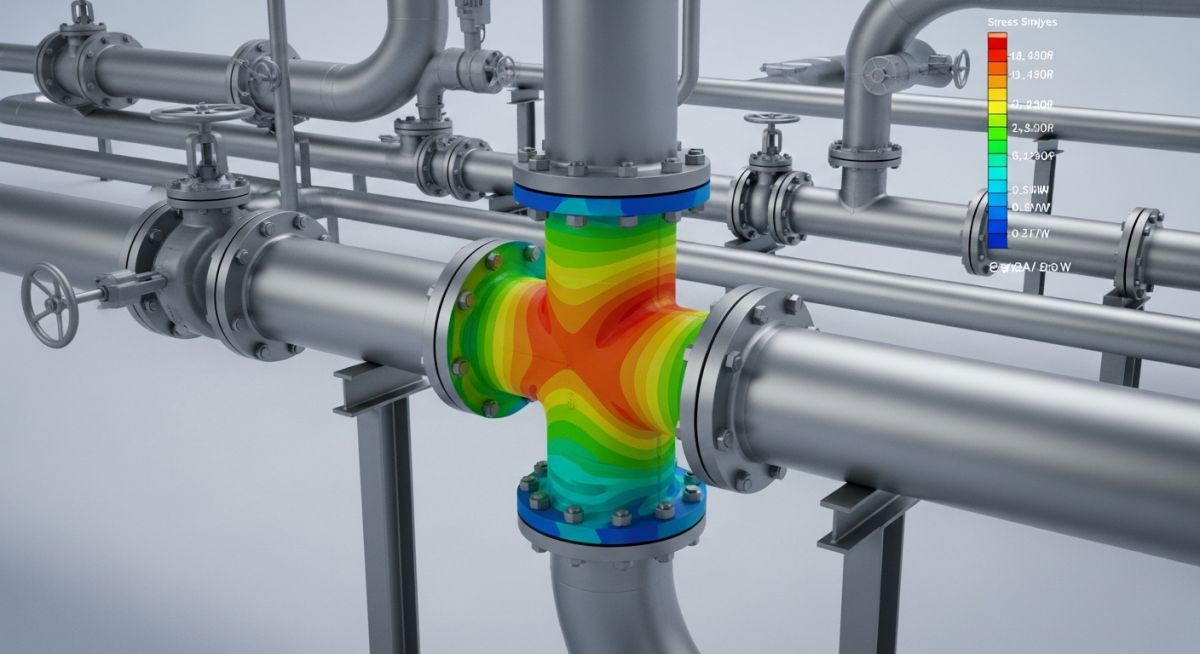
✅ Edited and Verified by the Epcland Engineering Team ASME B31.3 2024 Changes: 5 Key Updates Every Piping Engineer Must Know Imagine opening a stress model that passed perfectly last year. You re-run it using the latest code settings, and suddenly, the sustained stresses at the tees turn bright red. What happened? You just encountered the ASME B31.3 2024 "Stress Analysis Shock." The transition from the legacy Appendix D to the mandatory ASME B31J for Stress Intensification Factors (SIFs) is just one of the major shifts in the new edition. This guide decodes the critical changes in the 2024 Process Piping Code so you can keep your projects compliant and safe. 🧪 Pre-Read Quiz: Are You Up to Date on 2024? Table of Contents 1. The Big One: Mandatory ASME B31J (Appendix D is Dead) 2. ASTM A105 Flanges & The "Curve A" Penalty 3. Leak Testing: Reassembly Rules (Para 345.2.3) 4. Severe Cyclic Conditions: Updated Criteria 5. Visual Examination & Undercut Limits 6. Calculation Example: Impact Test Temp ASME B31.3 - 2024 Edition Process Piping Code Status Status: Active & Mandatory Date of Issuance February 2025 Effective Date August 2025 Next Scheduled Edition 2026/2027 *Projects contracted after the Effective Date must comply with the 2024 rules unless otherwise specified by the owner. 🔄 Detailed Change Log: 2022 vs 2024 Paragraph / Table 2022 Edition (Old) 2024 Edition (New) Implication Table A-1 Old Stress Values for A333 Gr 6 Updated allowable stress values (Higher/Lower) Recalculate Para 302.3.5 Fatigue Curve A Clarification on Severe Cyclic Conditions Check Design Chap IX (High Pressure) K-Factor Limits New toughness requirements added New Test Note: This is a summary. Always refer to the official ASME code book for full text. ASME B31.3 2024 | Interactive Summary ⚙️ ASME B31.3 2024 Interactive Guide Code Revision Summary Sections 📊 Dashboard 📐 Design 🔩 Materials 🔍 Inspection 🧪 Testing Pro Tip Check the Inspection tab for the new rules on 100% RT in Category M service. © 2024 Interactive Summary | ASME B31.3 Standard Code Summary Overview of the most impactful changes in the 2024 edition. Change Distribution 🛠️ Design ASME B31J Stress Indices 🧬 Materials Higher Super Duplex Limits 📸 NDE 100% RT for Category M Design & Stress Severe Cyclic Conditions The 2024 update introduces explicit thresholds to determine when these conditions apply, removing ambiguity for designers. ASME B31J Adoption Calculation of SIFs and Stress Indices must now default to ASME B31J standards unless specific test data is available. Eq. 1a Updates Equations for sustained and occasional stresses now more accurately account for axial loads in aboveground piping systems. Materials & Fabrication Temperature Limit: UNS S32750 WPS Detail Must identify each separate welding process (e.g., Root vs Fill). Backing Gas Acceptable discoloration must now be defined in the engineering design. Inspection & NDE Category M: 100% RT Mandatory 100% Radiography for butt welds handling toxic substances. This is a significant safety upgrade for lethal service. Removed Attachment Welds Surfaces where temporary attachments are removed now require mandatory Visual and (for specific P-Nos) MT/PT examination. Progressive Sampling Clarified language for lot-based sampling to reduce interpretation disputes between inspectors and contractors. Testing & Components Pneumatic Test Safety Max Limit: 1.1x Design Pressure Joint Re-assembly Disassembled mechanical joints no longer require a mandatory leak re-test if initially successful. Nonmetallic Support New mandatory spacing and bonding rules for HDPE/GRE piping systems. 1. The "Stress Analysis Shock": Sustained Stress Indices (Para 320.1) In previous editions, Appendix D was deleted, and ASME B31J became the mandatory standard for calculating Stress Intensification Factors (SIFs). However, the 2024 edition drops another bombshell regarding Sustained Stress (gravity + pressure). The Change: Previously, if specific data wasn't available, the code allowed using a default sustained stress index of 0.75i (where i is the SIF). The 2024 edition has updated Para 320.1 to change this default to 1.0 (or strict reference to B31J). Impact: This removes a "non-conservative" assumption. Using 1.0 instead of 0.75i effectively increases the calculated sustained stress at fittings by 33% in the absence of specific test data. Old CAESAR II models re-run under 2024 rules might suddenly show "Red" (Fail) at Tees and Elbows for sustained loads. Fig 1: Expect higher calculated sustained stresses at intersections under the new 2024 defaults. 2. ASTM A105 Flanges: The Note 65 "Cold Warning" Carbon Steel ASTM A105 flanges have historically been the workhorse of the industry. However, recent editions demoted them to Curve A (poor toughness). The 2024 edition reinforces this with the new Note 65 in Table A-1. The Warning: The code now explicitly recommends that for A105 flanges operating colder than -18°C (0°F), the designer should consider "additional requirements" (i.e., impact testing or normalization). Procurement Action: Do not buy "off-the-shelf" A105 for Canadian or Northern US winters without specifying "Killed Carbon Steel, Normalized, with Charpy V-Notch (CVN) at -29°C" or switching to A350 LF2. 3. Leak Testing: The Reassembly Breakthrough (Para 345.2.3) This is a massive win for construction efficiency. In the past, if you hydro-tested a spool and then had to disconnect a flange to install a gasket or valve, you technically voided the test for that joint (unless it was a flanged joint, which had a limited exemption). The 2024 Update: Para 345.2.3 now permits all mechanical joints (threaded, flanged, tubing) that have been leak tested to be taken apart and reassembled without an additional leak test, provided the reassembly follows a qualified procedure (e.g., controlled bolt torqueing). This aligns B31.3 with practical maintenance needs. "The 2024 Code acknowledges reality: Disassembling a tested flange to install a blind or gasket shouldn't trigger a full system re-hydro, provided you have a qualified assembly procedure." 4. Severe Cyclic Conditions & Visuals The definition of "Severe Cyclic Conditions" (high fatigue risk) continues to evolve. If a line is designated as Severe Cyclic: Visual Exam: Zero undercut is allowed. NDE: 100% Radiography (RT) is typically required for butt welds. 2024 Clean-up: The acceptance criteria for "Surfaces After Weld Removal" has been revised, ensuring that when you grind off a temporary attachment, you don't leave stress raisers that could initiate cracks. 💡 See Also: Top 5 Modules of ASME B31.3 5. Calculation: Minimum Design Metal Temperature (MDMT) With the A105 changes, verifying exemption from Impact Testing is critical. Here is how you determine if your flange needs a Charpy Test. 🧮 Solved Example: A105 Flange Impact Exemption Scenario: You are selecting an ASTM A105 Flange (Class 300) for a line operating at -20°C. The nominal thickness (T) is 25mm. Step 1: Identify the Curve (Table A-1 / Fig 323.2.2A) Material: ASTM A105 Curve Assignment: Curve A (Most brittle/conservative) Step 2: Check Exemption Temperature for 25mm Using Figure 323.2.2A, find the intersection of 25mm thickness and Curve A. Curve A at 25mm ≈ -8°C (Approx) Step 3: Compare with Design Temp Design Temp (-20°C) < Exemption Temp (-8°C) Result: IMPACT TESTING REQUIRED Conclusion: Standard A105 fails here. You must order A105 with Charpy Testing or upgrade to ASTM A350 LF2 (Curve D). 🚨 Critical Impact Requires immediate review of standard specs. Material Stress Value changes (Thickness Check). New PWHT (Heat Treatment) requirements. Changes to Impact Testing temperatures. ⚠️ Moderate Impact Procedural updates needed. Updates to inspection (NDE) acceptance criteria. Clarifications on valve pressure ratings. New definitions for "Owner's Inspector". ✅ Editorial/Minor No technical action required. Typographical corrections. Updated references to other standards (API/ASTM). Reformatting of tables/charts. Frequently Asked Questions (FAQ) Do I need to re-run old stress analysis reports for existing plants? Generally, no. Code changes are not retroactive for built plants unless you are performing a re-rating or a major modification. However, for new tie-ins or repairs on existing lines, the new design work must comply with the 2024 edition, which might require using B31J SIFs for the new scope. Can I still use the old Appendix D for SIF calculations? No. Appendix D has been deleted. While some software allows you to toggle "Legacy SIFs," doing so typically violates the mandatory reference to ASME B31J in the recent B31.3 editions. You must use the B31J method for code compliance. Does the "Reassembly without Re-testing" rule apply to welded joints? Absolutely not. Para 345.2.3 specifically targets mechanical joints (flanges, threaded unions, compression fittings). Any welded or brazed joint that is made after the pressure test requires a new test (or a rigorous NDE alternative outlined in the code). Why is ASME B31.3 stricter on A105 flanges now? Data showed that modern A105 manufacturing sometimes yields coarse-grain microstructures with poor toughness at low temperatures. By pushing it to Curve A, the Code forces engineers to verify toughness (via Charpy impact testing) for cold applications, preventing brittle fracture risks. Conclusion The ASME B31.3 2024 Edition marks a definitive shift from "empirical rules of thumb" to "analytical precision." The complete adoption of ASME B31J for stress factors and the stricter controls on material toughness (A105 Note 65) prove that the code is evolving to address modern failure modes. For the piping engineer, the takeaway is clear: Update your specifications. Ensure your material requisitions call for toughness testing on cold carbon steel, and verify your stress analysis software is set to use B31J by default. Ignoring these updates isn't just a code violation—it's a safety risk your project cannot afford. 🚀 Master Piping Engineering? Don't just read about it. Get the full industry-ready training. View Complete Course About the Author: This guide was developed by the Epcland Engineering Team, a collective of Senior Piping Engineers and Stress Analysts dedicated to practical, field-verified engineering education.