Sustainable Aviation Fuel Explained: Engineering Pathways for Global Decarbonization
In my two decades of experience within the midstream and downstream sectors, I have witnessed few transitions as complex as the shift toward Sustainable Aviation Fuel. Unlike ground transportation, which can leverage electrification, aviation remains tethered to high energy-density liquid hydrocarbons. The engineering challenge lies not just in the chemistry of synthesis, but in the rigorous certification required to ensure safety at 35,000 feet.
We are moving beyond pilot-scale demonstrations into industrial-scale deployment. This article dissects the thermodynamic and chemical engineering realities of the primary production pathways, providing the technical clarity needed for project feasibility studies and infrastructure integration.
Key Engineering Takeaways
- SAF must adhere to ASTM D7566, ensuring full compatibility with existing turbine hardware.
- HEFA technology currently dominates the market due to its high maturity and feedstock availability.
- Alcohol-to-Jet (AtJ) and Power-to-Liquid (PtL) represent the next frontier for scalability and carbon intensity reduction.
- Infrastructure integration requires careful management of fuel density, aromatic content, and lubricity additives.
Complete Course on
Piping Engineering
Check Now
Key Features
- 125+ Hours Content
- 500+ Recorded Lectures
- 20+ Years Exp.
- Lifetime Access
Coverage
- Codes & Standards
- Layouts & Design
- Material Eng.
- Stress Analysis
Sustainable Aviation Fuel Production Pathways and Engineering Design
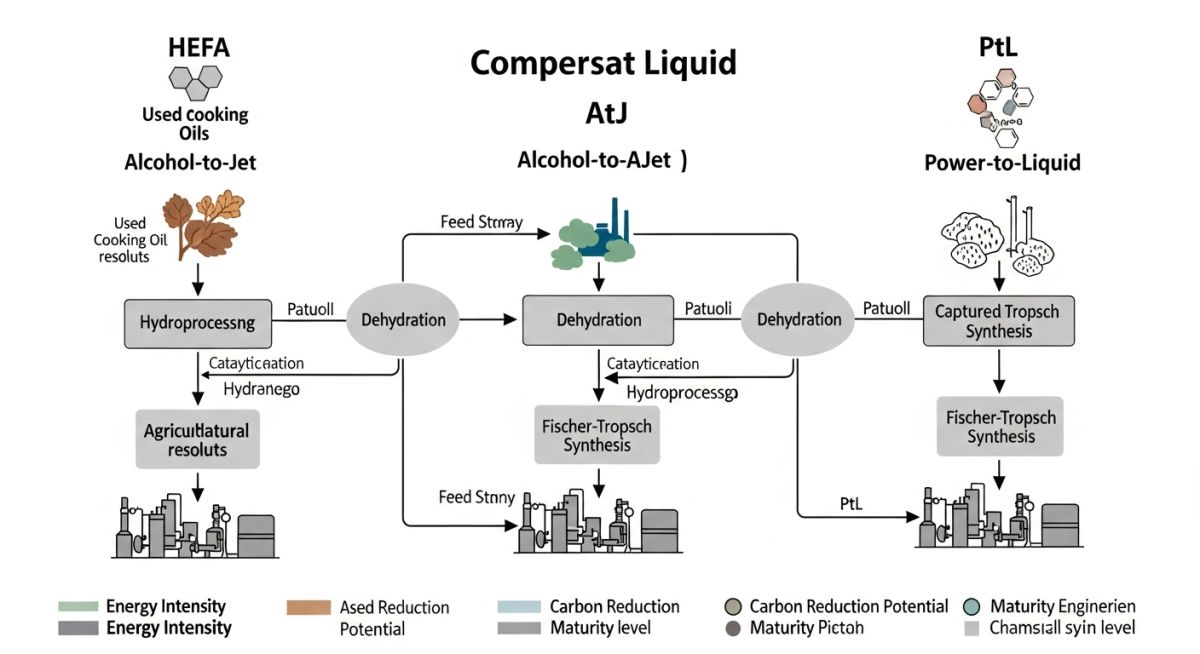
Sustainable Aviation Fuel Production Pathways: These chemical processes convert diverse feedstocks into paraffinic kerosene through hydroprocessing, catalytic dehydration, or Fischer-Tropsch synthesis to meet stringent aviation safety standards.
The engineering of SAF production is governed by the need to replicate the molecular structure of conventional kerosene. Conventional Jet A is a complex mixture of hydrocarbons, primarily alkanes, cycloalkanes, and aromatics, with carbon numbers typically ranging from C8 to C16. To achieve “drop-in” status, synthetic fuels must replicate these physical properties, specifically freezing point, flash point, and viscosity.
Hydroprocessed Esters and Fatty Acids (HEFA)
HEFA is currently the most mature technology, utilizing lipid feedstocks such as used cooking oil, tallow, or vegetable oils. The process involves two primary stages: hydrodeoxygenation and hydroisomerization. In the first stage, triglycerides are reacted with hydrogen over a catalyst (typically NiMo or CoMo) to remove oxygen and saturate double bonds. This produces a mixture of linear alkanes.
The second stage, hydroisomerization, is critical. Linear alkanes have high freezing points, which are unsuitable for high-altitude flight. By passing these alkanes over a noble metal catalyst (e.g., Platinum on Alumina), we introduce branching into the carbon chains, effectively lowering the freezing point to meet the ASTM D7566 requirements.
Engineering Design Limitation: Hydrogen Intensity
The hydrogen demand for HEFA is significant. For every ton of feedstock, the process requires substantial hydrogen input to achieve complete deoxygenation. In my experience, the bottleneck for many projects is not the feedstock supply, but the availability of low-carbon hydrogen (green hydrogen) to ensure the final fuel achieves the desired lifecycle carbon intensity reduction.
Alcohol-to-Jet (AtJ) Technology
AtJ technology expands the feedstock base to include ethanol or isobutanol derived from agricultural residues or municipal solid waste. The process follows a sequence: dehydration, oligomerization, and hydrogenation. First, alcohols are dehydrated to form olefins (e.g., ethylene or propylene). These olefins are then oligomerized to form longer-chain hydrocarbons in the kerosene range.
The final step involves hydrogenation to saturate the olefins, resulting in a high-quality paraffinic kerosene. The flexibility of AtJ allows for the production of specific carbon chain lengths, which can be optimized for better combustion characteristics. However, the energy intensity of the distillation and dehydration steps requires careful heat integration within the refinery design to maintain economic viability.
Power-to-Liquid (PtL) Synthesis
PtL, or e-fuels, represents the long-term solution for aviation decarbonization. This pathway utilizes captured carbon dioxide and green hydrogen to produce syngas, which is then converted via the Fischer-Tropsch process. The engineering complexity here is immense, requiring high-pressure reactors and precise control over the syngas ratio (H2:CO) to maximize the yield of C8-C16 hydrocarbons.
The thermodynamic efficiency of PtL is currently lower than HEFA, but it offers the highest potential for scalability as it is not limited by biomass availability. The design must account for the intermittent nature of renewable energy inputs, necessitating robust energy storage or flexible reactor operation protocols.
SAF Implementation Trade-offs: Evaluating the technical, economic, and operational impacts of transitioning to synthetic aviation fuels within existing global supply chains.
Technical Advantages
- Drop-in Compatibility: Fully compliant with ASTM D7566, requiring zero engine modifications.
- Reduced Particulates: Lower aromatic and sulfur content leads to significantly reduced non-volatile particulate matter emissions.
- Feedstock Versatility: Pathways like AtJ and PtL decouple fuel production from food-based land use.
- Lifecycle Carbon Reduction: Potential for up to 80% reduction in lifecycle greenhouse gas emissions compared to fossil jet fuel.
Technical Disadvantages
- High Capital Expenditure: Complex hydroprocessing and synthesis units require significant upfront investment.
- Feedstock Logistics: HEFA pathways face supply chain constraints and competition with the renewable diesel market.
- Energy Intensity: PtL pathways require massive amounts of renewable electricity, impacting overall process efficiency.
- Lubricity Challenges: Synthetic paraffins lack natural aromatics, often requiring the addition of lubricity improvers to meet ASTM standards.
Sustainable Aviation Fuel Deployment: Integrating synthetic kerosene into commercial, military, and regional aviation sectors to meet international net-zero targets.
Commercial Long-Haul Aviation
Commercial airlines are the primary drivers for SAF adoption, utilizing HEFA-based blends to meet CORSIA (Carbon Offsetting and Reduction Scheme for International Aviation) requirements. The engineering focus here is on blending logistics at major hub airports, ensuring that the fuel meets the 50% maximum blend limit currently permitted by ASTM standards.
Military Tactical Operations
Defense sectors are increasingly testing SAF to improve energy security and reduce the logistical burden of fuel transport in remote theaters. Military-grade SAF must maintain performance under extreme temperature fluctuations, requiring rigorous testing of fuel stability and seal compatibility in high-performance turbine engines.
Regional Air Mobility
For regional carriers, SAF provides a pathway to decarbonize short-haul flights where battery-electric propulsion is currently limited by weight-to-energy ratios. The application involves decentralized production models, where local agricultural waste is converted into fuel to serve regional hubs, minimizing the carbon footprint of fuel distribution.
The engineering selection of a Sustainable Aviation Fuel (SAF) production pathway depends heavily on feedstock availability, carbon intensity scores, and the maturity of the catalytic conversion process. In my experience, while HEFA remains the current industry standard due to its high technology readiness level, emerging pathways like Power-to-Liquid (PtL) offer superior long-term scalability despite higher initial capital expenditure requirements.
The following table outlines the critical engineering metrics that define these pathways. Engineers must evaluate these parameters against site-specific constraints, such as proximity to hydrogen sources for PtL or lipid collection networks for HEFA, to ensure project viability and compliance with ASTM D7566 standards.
| Pathway | Primary Feedstock | Technology Maturity | Carbon Reduction |
|---|---|---|---|
| HEFA | Used Cooking Oil, Fats | Commercial (TRL 9) | 70-85% |
| Alcohol-to-Jet | Ethanol, Isobutanol | Demonstration (TRL 7-8) | 60-80% |
| Power-to-Liquid | CO2, Green Hydrogen | Pilot/Demo (TRL 5-6) | 90-99% |
When designing these facilities, I always emphasize that carbon reduction percentages are highly sensitive to the energy source used for hydrogen production. For PtL, the use of grid electricity versus dedicated renewable energy can shift the lifecycle assessment (LCA) results by over 40 percentage points, making the integration of renewable power purchase agreements a fundamental engineering requirement.
Navigating the regulatory and technical landscape of aviation decarbonization requires a deep understanding of the interplay between chemical conversion processes and international fuel standards. This matrix maps the core entities, acronyms, and governing standards that every project lead must master to ensure successful facility certification and market entry.
By aligning your project specifications with these established frameworks, you mitigate the risk of non-compliance during the rigorous ASTM fuel testing phases. I have found that early engagement with certification bodies, using these specific technical parameters as a baseline, significantly accelerates the path to commercial fuel production.
| Entity/Acronym | Technical Scope | Standard Reference |
|---|---|---|
| HEFA | Hydroprocessed Esters and Fatty Acids | ASTM D7566 Annex A2 |
| AtJ | Alcohol-to-Jet Conversion | ASTM D7566 Annex A5 |
| PtL | Fischer-Tropsch Synthetic Paraffinic Kerosene | ASTM D7566 Annex A1 |
| LCA | Lifecycle Carbon Assessment | ISO 14040/14044 |
The technical mapping provided above serves as a foundational guide for project scoping. In my experience, the most successful projects are those that integrate these standards into the front-end engineering design (FEED) phase, ensuring that every unit operation is optimized for the specific chemical requirements of the final synthetic kerosene product.
Verifying a site for Sustainable Aviation Fuel production involves more than just assessing land availability; it requires a rigorous audit of utility infrastructure, feedstock logistics, and environmental compliance. During my site selection audits, I prioritize the proximity to existing refinery infrastructure to leverage shared utilities and logistics, which can reduce capital expenditure by up to 20 percent.
Site Verification Checkpoints
- ✓Feedstock Logistics: Confirm reliable access to lipid or biomass supply chains within a 200-mile radius to minimize transportation carbon footprint.
- ✓Hydrogen Infrastructure: Evaluate the availability of industrial-grade hydrogen or the feasibility of on-site electrolysis for PtL pathways.
- ✓Grid Capacity: Ensure the local electrical grid can support high-load electrolysis units or provide sufficient renewable energy credits.
- ✓Regulatory Compliance: Validate that the site meets local environmental zoning for chemical processing and hazardous material storage.
- ✓ASTM Certification Path: Confirm the facility design allows for the specific sampling and testing protocols required by ASTM D7566.
Once these checkpoints are satisfied, the engineering team must conduct a detailed mass and energy balance. This balance is the heart of the facility design, dictating the sizing of reactors, heat exchangers, and separation columns. I always recommend performing a sensitivity analysis on feedstock quality, as variations in lipid composition can significantly impact catalyst life and product yield in HEFA units. By maintaining a strict adherence to this checklist, you ensure that the facility is not only technically sound but also economically resilient in a volatile energy market.
Problem: Catalyst Deactivation in HEFA Processing
A mid-scale HEFA facility experienced premature catalyst deactivation, leading to a 15% drop in synthetic kerosene yield within the first six months of operation.
- Inconsistent feedstock quality containing high levels of phosphorus and alkali metals.
- Inadequate pre-treatment stage for removing contaminants from used cooking oil.
- Temperature excursions in the hydrotreating reactor causing carbon deposition.
- Lack of real-time monitoring for feed impurities at the inlet stream.
Outcome: Optimized Pre-treatment and Yield Recovery
The implementation of a multi-stage guard bed system and enhanced feed filtration restored production efficiency and extended catalyst life by 40%.
- Installed advanced guard beds to capture phosphorus and metal contaminants.
- Implemented automated feed analysis to adjust pre-treatment parameters in real-time.
- Optimized reactor temperature profiles to minimize side reactions and coking.
- Achieved consistent compliance with ASTM D7566 specifications for jet fuel.
My recommendation for similar projects is to never underestimate the importance of the pre-treatment section. While the hydrotreating reactor is the core of the process, the longevity of the entire plant is dictated by the quality of the feed entering the catalyst bed. Investing in robust analytical instrumentation at the front end is the most effective way to protect your capital investment.
Frequently Asked Engineering Questions
How does HEFA technology differ from conventional refining?
- HEFA requires high-pressure hydrogen to remove oxygen from fatty acids, a step not present in standard crude distillation.
- The process produces a highly pure, sulfur-free paraffinic product that must be blended with conventional jet fuel to meet density requirements.
- Catalyst selection is specialized for deoxygenation rather than the desulfurization typical of crude oil refineries.
What are the primary challenges of Power-to-Liquid production?
- High electricity demand for water electrolysis, which necessitates massive, low-cost renewable energy integration.
- The complexity of capturing and purifying CO2 from industrial sources or direct air capture.
- The high capital cost of Fischer-Tropsch synthesis units compared to established hydroprocessing infrastructure.
Why is ASTM D7566 certification critical for SAF?
- The fuel cannot be legally used in commercial aircraft engines.
- Engine manufacturers will not provide warranties for fuel that does not meet these rigorous safety and performance specifications.
- The fuel lacks the necessary lubricity and seal-swelling properties required for safe operation in existing aircraft fuel systems.
How does feedstock quality impact reactor performance?
- Poison the active sites of the hydrotreating catalyst, leading to rapid deactivation.
- Cause fouling in heat exchangers, increasing pressure drop and reducing thermal efficiency.
- Lead to the formation of unwanted byproducts that complicate the downstream separation and distillation processes.
What role does hydrogen play in SAF production?
- Removing oxygen from lipid feedstocks to produce hydrocarbons.
- Saturating double bonds in the hydrocarbon chain to improve fuel stability.
- Facilitating the cracking of long-chain molecules into the specific carbon range required for jet fuel.
Can existing refineries be retrofitted for SAF?
- Repurposing existing hydrotreating units to handle lipid feedstocks instead of crude oil fractions.
- Upgrading metallurgy in specific sections to handle the different corrosive properties of bio-based feeds.
- Installing new pre-treatment units to ensure the feed meets the stringent purity requirements of the hydrotreating catalyst.
