Scope of Piping Engineering: A Complete Industry Roadmap
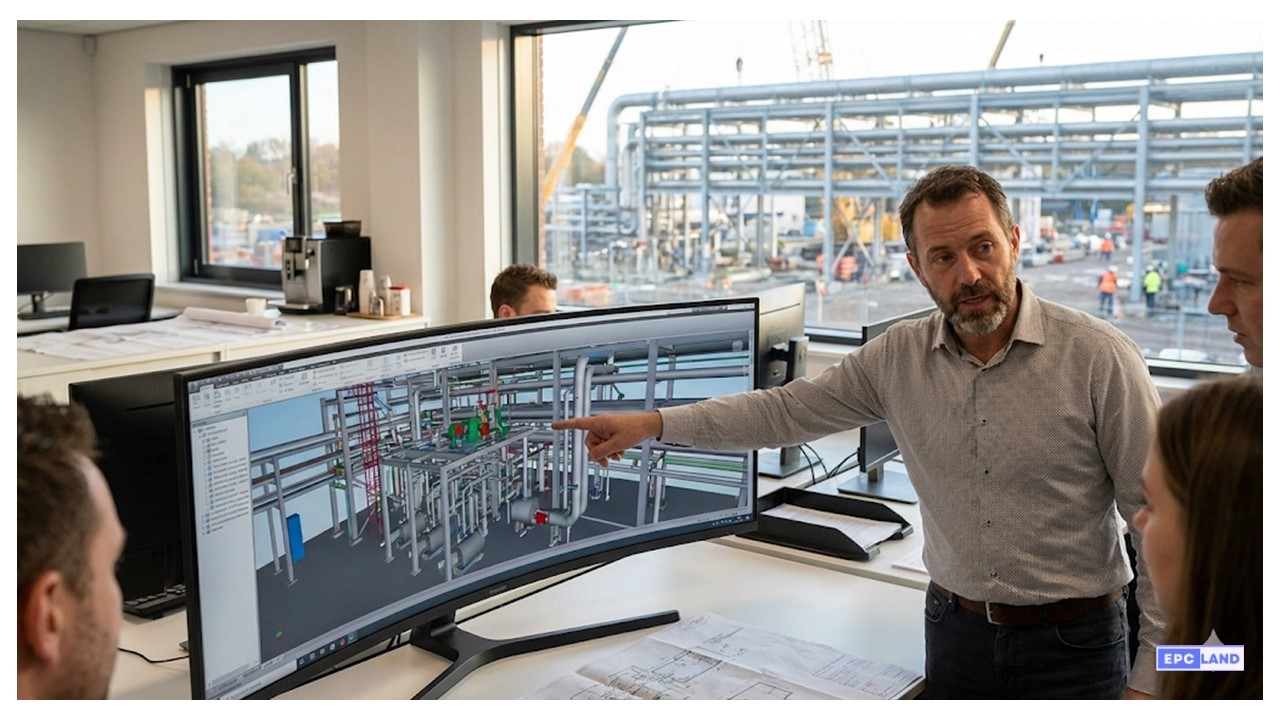
The Scope of Piping Engineering extends far beyond simply connecting Point A to Point B. In the modern EPC (Engineering, Procurement, and Construction) landscape, it represents the “arteries” of any industrial facility. From the initial conceptual layout to complex stress analysis and material selection, the piping discipline is the central coordinator that dictates the safety, constructability, and operability of plants in the Oil & Gas, Power, and Chemical sectors.
What is the Core Scope?
The technical scope includes three main pillars: Design (Layout, 3D Modeling, Isometrics), Engineering (Stress Analysis, Hydraulics, Material Specifications), and Field Engineering (Construction support, Testing). It requires mastering the interaction between fluid mechanics, structural integrity, and spatial logic.
⚡ Quick Navigation
Quiz: Test Your Discipline Knowledge
1. Which stage of the project defines the initial “Scope of Piping”?
Complete Course on
Piping Engineering
Check Now
Key Features
- 125+ Hours Content
- 500+ Recorded Lectures
- 20+ Years Exp.
- Lifetime Access
Coverage
- Codes & Standards
- Layouts & Design
- Material Eng.
- Stress Analysis
The EPC Piping Scope of Work
Understanding the Scope of Piping Engineering requires looking at the project lifecycle. In an EPC (Engineering, Procurement, Construction) context, the piping discipline consumes the most man-hours and sits on the critical path. The EPC piping scope of work evolves through three distinct phases, each with specific deliverables.
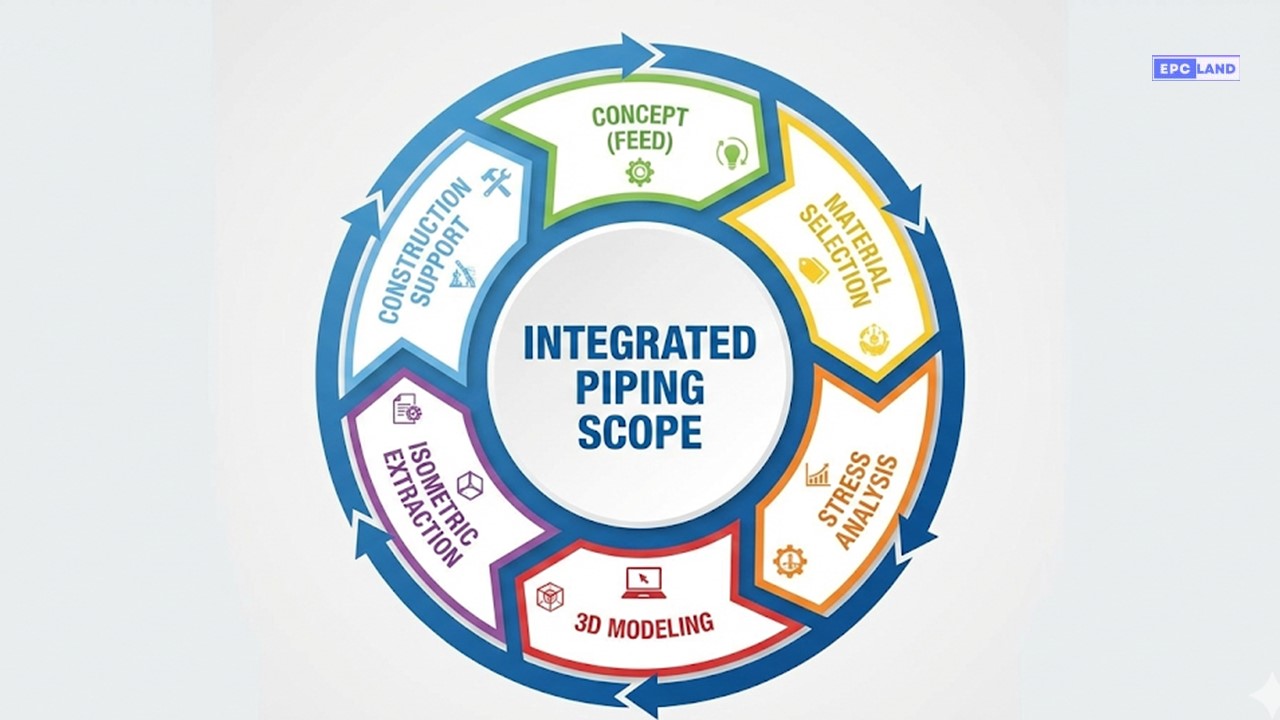
1. Front-End Engineering Design (FEED)
In this initial phase, the scope is to define the “boundary conditions.” The team develops the Plot Plan (overall plant layout) and preliminary Piping Material Specifications (PMS). The goal is to estimate the bulk material quantities (MTO) with ±10% accuracy to order long-lead items like high-pressure valves or exotic alloy pipes.
2. Detailed Engineering
This is where the bulk of the Scope of Piping Engineering lies. The 3D model is built to “Issued for Construction” (IFC) status. Every pipe, flange, and bolt is modeled. A critical aspect here is the Piping layout and stress analysis interaction. Layout engineers route the pipe, but Stress Engineers must verify that the route can expand and contract thermally without overloading the equipment nozzles. This often leads to an iterative loop of re-routing and re-analyzing.
Piping Design Engineer Roles and Responsibilities
The title “Piping Engineer” is a broad umbrella. In a large EPC company, the Piping design engineer roles and responsibilities are split into specialized sub-disciplines:
📐 Layout Engineer
The “Architect” of the plant. Responsible for routing pipes in the 3D model, ensuring maintenance access, and avoiding clashes with structural steel or cable trays. They own the Plot Plan and General Arrangement Drawings (GADs).
🔩 Materials Engineer
The “Metallurgist.” They define the Piping Material Classes (PMS) based on fluid properties (corrosion, temperature, pressure). They create the Valve Material Specifications (VMS).
🔥 Stress Analysis Engineer
The “Physicist.” They use software like CAESAR II to calculate loads, stresses, and displacements. They decide where to place springs, expansion joints, and rigid supports.
🏗️ Support Engineer
Specifically designs the physical supports (shoes, trunnions, guides) that hold the pipe. They interface heavily with the Civil/Structural department to transfer loads.
📐 Core Calculation: ASME B31.3 Wall Thickness
A fundamental part of the Scope of Piping Engineering is determining the required pipe schedule (thickness) to withstand internal pressure. This is governed by ASME B31.3 (Process Piping).
Barlow’s Formula (Modified):
t = (P × D) / [2 × (S × E + P × Y)]
Where:
- t: Required Pressure Design Thickness (mm).
- P: Internal Design Pressure (MPa).
- D: Outside Diameter of pipe (mm).
- S: Allowable Stress of material at design temp (MPa).
- E: Quality Factor (1.0 for seamless).
- Y: Coefficient (typically 0.4 for ferritic steels < 482°C).
Example Scenario:
Design a 10-inch (273 mm OD) Carbon Steel (A106 Gr. B) pipe for 50 Bar (5 MPa) at 200°C.
Assume S = 138 MPa.
1. Numerator: 5 × 273 = 1365
2. Denominator Inner: (138 × 1.0) + (5 × 0.4) = 138 + 2 = 140
3. Denominator Total: 2 × 140 = 280
4. Calculation: 1365 / 280 = 4.875 mm
Result: The minimum thickness is 4.88 mm. Adding corrosion allowance (e.g., 3mm) and mill tolerance (12.5%), the engineer selects Schedule 40 (9.27 mm).
Standard Piping Engineering Software List
Proficiency in specific tools is mandatory for modern engineers. Below is the industry-standard Piping engineering software list used in 2026.
| Software Name | Primary Function | Typical Deliverable |
|---|---|---|
| Aveva E3D / PDMS | 3D Plant Modeling | 3D Model, Clash Reports, MTO |
| Hexagon SP3D | 3D Plant Modeling | Intelligent Model, Isometrics |
| CAESAR II | Pipe Stress Analysis | Stress Isometrics, Load Sheets |
| Navisworks | Model Review & Visualization | Walkthroughs, Clash Detection |
| AutoCAD | 2D Drafting | Plot Plans, P&IDs, Support Details |
The Engineering Data Flow: Inputs vs. Outputs
A critical part of defining the Scope of Piping Engineering is understanding boundaries. Piping engineers do not work in isolation; they convert upstream inputs (from Process & Mechanical) into downstream deliverables (for Construction).
IN Key Inputs (Receive)
- P&IDs: Piping & Instrumentation Diagrams from the Process Dept. (The “Logic” of the plant).
- Equipment Drawings: Vendor GADs for pumps, vessels, and compressors (to define nozzle locations).
- Civil Data: Structural steel elevations and foundation locations.
OUT Key Deliverables (Produce)
- Isometrics (FC): Fabrication drawings for individual spools.
- GADs: General Arrangement Drawings for site erection.
- MTO: Material Take-Off (Bill of Materials) for procurement.
- Stress Reports: Confirmation of code compliance (ASME B31.3).
EPCLand YouTube Channel
2,500+ Videos • Daily Updates
Case Study: The “Reverse Engineering” Scope
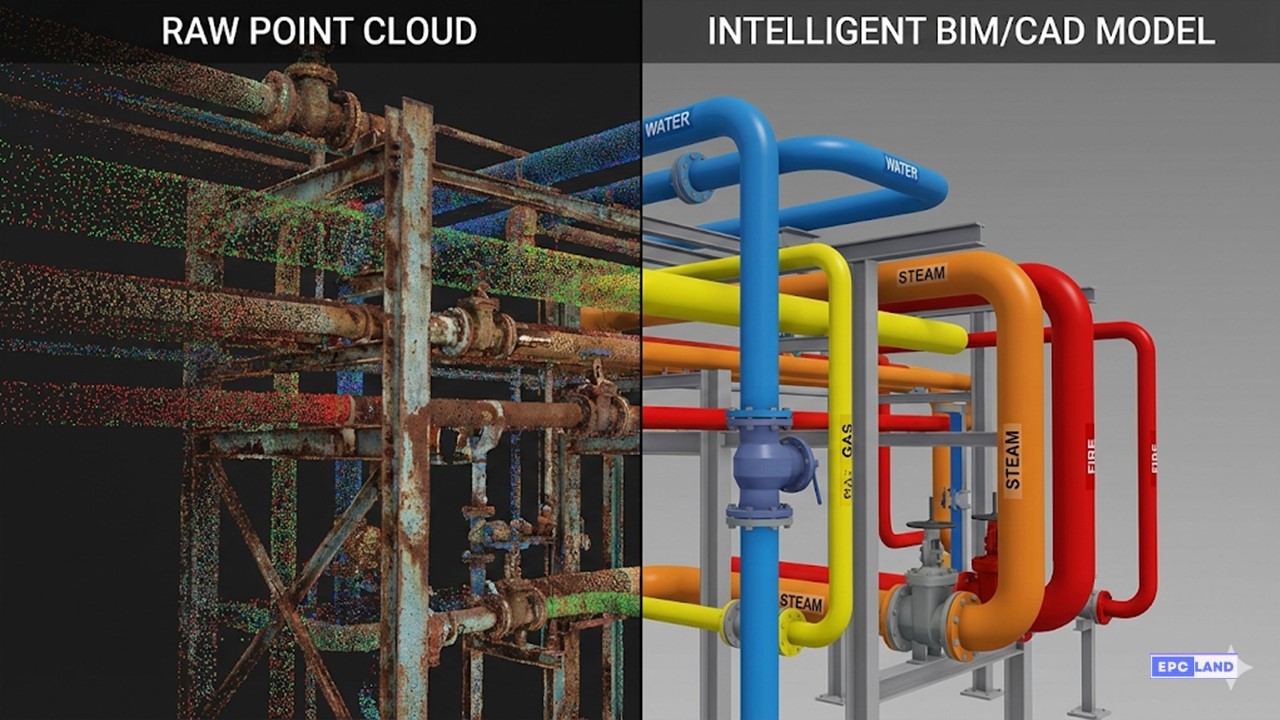
Figure 2: Transforming raw LiDAR Point Cloud data (Left) into an Intelligent E3D Piping Model (Right).
Project Profile
Refinery Debottlenecking
Gujarat, India
Technology Stack
LiDAR Scanning
Aveva LFM & E3D
Result
0% Field Clashes
Savings: $1.2M USD
The Challenge: “Blind” Engineering
A 35-year-old petrochemical unit required the installation of a new 24-inch cooling water loop through a heavily congested pipe rack. The client provided original 1990s paper drawings, but a preliminary site walk revealed significant discrepancies. Pipes had sagged, supports had shifted, and undocumented maintenance lines cluttered the route.
Defining the Scope of Piping Engineering based on these drawings would have been disastrous. If the team had designed the new spools using the old data, the new pipe would have clashed with existing structural beams during installation, leading to costly hot-work and shutdown delays.
The Modern Scope: Laser-to-Model
The engineering team expanded their scope to include a comprehensive “Digital Twin” creation strategy:
- Data Capture: Terrestrial laser scanners captured the facility in high-definition 3D, generating a “Point Cloud” of over 500 million points with ±2mm accuracy.
- Hybrid Modeling: Instead of modeling the entire plant (which is costly), the engineers only modeled the “tie-in points” and the potential clash zones. The rest of the Point Cloud was referenced directly in the design software (Aveva E3D).
- Virtual fit-up: The new piping route was designed through the virtual cloud. The software automatically detected clashes between the new design cylinder and the existing scan points.
Conclusion: The Future of the Profession
This project highlights a shift in the profession. The Future of piping engineering 2026 is no longer just about calculating pressure drops or selecting flanges; it is about Spatial Data Management. By integrating laser scanning into the scope, the team delivered 150 prefabricated spools that fit perfectly on the first attempt, proving that modern tools can eliminate the historical “field-fit weld” allowance.
The Market Reality: Challenges & Trends (2026)
The Scope of Piping Engineering is not immune to global economic shifts. While demand is high, the nature of employment is changing. Understanding these market forces is crucial for career longevity.
The “Gig” Economy
A surge in experienced freelancers has allowed smaller EPCs to reduce fixed overheads. This creates high competition for permanent roles but opens lucrative opportunities for subject matter experts (e.g., specialized Stress Analysis consultants).
Oil Price Dependency
Traditional piping roles are tethered to crude oil prices. However, the shift to Petrochemicals (plastics, fertilizers) which now accounts for 88% of oil demand, provides a buffer against pure energy market dips.
Top Global Employers
For those seeking stability, the “Tier 1” Engineering Contractors and Client Owners remain the gold standard. These companies define the global EPC piping scope of work.
| EPC Contractors (The Builders) | Client Owners (The Operators) |
|---|---|
| Bechtel, Fluor, Worley | ExxonMobil, Shell, BASF |
| Technip Energies, Petrofac | Saudi Aramco, SABIC |
| L&T Hydrocarbon, Toyo | Dow Chemical, LyondellBasell |
*Note: List represents major global players active in 2026.
🚀 The “Non-Technical” Scope
Technical knowledge gets you the job, but Soft Skills get you promoted. In the role of a Piping Project Engineer, you are often the “glue” between disciplines.
- Negotiation: Convincing vendors to expedite valve delivery without increasing cost.
- Conflict Resolution: Mediating between Civil (who need space for beams) and Piping (who need space for elbows).
- Commercial Acumen: Understanding how a “small” design change impacts the project’s profit margin.
Frequently Asked Questions (Career & Technical)
What is the typical Career path for piping engineers?
Is Piping Engineering limited to Oil & Gas?
Does a Piping Engineer need to go to the construction site?
What are the prerequisites to enter this field?
The Verdict: A Future-Proof Discipline
The Scope of Piping Engineering in 2026 is robust and evolving. It is shifting from manual drafting to intelligent 3D modeling and data management. As the world transitions to cleaner energy, the demand for skilled piping engineers to design Hydrogen and LNG infrastructure will only grow.
© 2026 Epcland Engineering. All rights reserved.

Related posts:
![refinery catalyst safety quiz]()
Test Your Knowledge: Refinery Catalyst Safety & CRU Operations Quiz
![CRU catalyst runaway reaction]()
Refinery Rescue: How We Quelled a CRU Catalyst Runaway Reaction and Lessons Learned
![refinery furnace quiz]()
Interactive Refinery Furnace Quiz: Test Your Coking & Downtime Troubleshooting Skills!
![furnace coking downtime]()
Real-World Fix: How We Overcame Unexpected Furnace Coking Downtime in Our Preheat Unit
![hydrotest troubleshooting quiz]()
Interactive Hydrotest Troubleshooting Quiz: Master Leak Detection Skills
![Hydrotest leak detection]()
Hydrotest Leak Detection: A Practical Case Study in On-Site Problem Solving


