What is FRP Pipe Made Of? The Science of FRP Pipe Material Composition

Walk into any modern desalination plant or chemical processing facility, and you will see miles of lightweight, non-corrosive piping. But have you ever wondered why some FRP pipes look “fuzzy” after five years while others look brand new after twenty? The answer lies in the FRP Pipe Material Composition. It is not just “plastic and glass”—it is a sophisticated “sandwich” of thermosetting resins, specialized glass reinforcements, and catalytic additives. Understanding this chemistry is the difference between a system that survives 50 years of caustic service and one that fails due to structural delamination in months.
Key Takeaways
- FRP Pipe Material Composition is a dual-phase system: The Resin Matrix provides chemical resistance, while the Fiberglass Reinforcements provide structural load-bearing capacity.
- The pipe wall is not uniform; it consists of distinct layers, including a resin-rich “liner” for corrosion protection and a structural “cage” of filament-wound fibers.
- Modern standards like ASME NM.1 and AWWA C950 dictate the exact glass-to-resin ratios required for different pressure classes.
Featured Snippet: What is the Material Composition of FRP Pipe?
The FRP Pipe Material Composition consists of three primary components: a Thermosetting Resin Matrix (Polyester, Vinyl Ester, or Epoxy), Glass Fiber Reinforcements (Surface Veils and Continuous Rovings), and Additives (Fillers, UV Stabilizers, and Pigments). This composite structure creates a high strength-to-weight ratio and superior corrosion resistance compared to metallic piping.
Founder’s Insight
“In my experience, engineers often overlook the Surface Veil in the material stack. While the continuous roving provides the ‘muscle,’ it is the veil that protects the structural fibers from chemical attack. If your FRP Pipe Material Composition lacks a high-quality C-glass veil, you are effectively leaving your pipe’s skeleton exposed to the elements.”
— Atul Singla, Founder of Epcland
Table of Contents
- The Core: Fiberglass Reinforcements
- The Matrix: Types of Resins used in FRP Pipes
- The Role of Fillers in Material Composition
- Curing Chemistry: Promoters & Inhibitors
- Longevity: UV Stabilizers and Pigments
- Standards: ASME NM.1 & AWWA C950
- Case Study: Material Composition Failures
- Expert Insights: 50-Year Design Lessons
Complete Course on
Piping Engineering
Check Now
Key Features
- 125+ Hours Content
- 500+ Recorded Lectures
- 20+ Years Exp.
- Lifetime Access
Coverage
- Codes & Standards
- Layouts & Design
- Material Eng.
- Stress Analysis
Material Science Challenge: FRP Pipe Composition
Test your knowledge on resins, reinforcements, and key additives.
Question 1 of 5
Which component of the FRP Pipe Material Composition primarily provides the hoop and axial tensile strength?
The Core of FRP Pipe Material Composition: Fiberglass Reinforcements
The "F" in FRP (Fiberglass Reinforced Plastic) is the structural component. The fibers themselves, typically E-Glass (Electrical Glass) or C-Glass (Chemical Glass), provide the high tensile strength needed to resist internal pressure and external loads. Without these reinforcements, the resin matrix would have the strength of mere plastic. The arrangement of these fibers is dictated by the manufacturing method, primarily Filament Winding, which lays fibers in precise hoop (circumferential) and helical (axial) patterns.
The fiberglass component is stratified into distinct layers, each with a specific purpose in the FRP Pipe Material Composition, moving from the inside-out.
Importance and Types of Fiberglass Reinforcements
Surface Veils (SV): The Chemical Barrier
The innermost layer, in contact with the fluid. A Surface Veil (typically a thin layer of C-Glass or synthetic fiber) is used with a high ratio of pure resin to create a Corrosion Resistance Barrier (CRB). Its function is to prevent fluid from "wicking" up the main structural fibers, which would lead to premature structural failure.
Continuous Roving (CR): The Structural Backbone
This is the primary structural component, composed of long, continuous strands of E-glass fiber. During filament winding, the CR is precisely laid in a helix/hoop pattern. The hoop windings resist internal pressure (burst strength), and the helical (axial) windings resist bending and tensile forces, making it the most critical part of the load-bearing FRP Pipe Material Composition.
Chopped Strand Mat (CSM): Multi-Directional Strength
CSM is composed of randomly oriented, short-cut glass fibers held together by a binder. It is typically used in the liner to bulk up the corrosion barrier and occasionally in the structural layer to provide multi-directional reinforcement, particularly in complex geometries like fittings.
Woven Roving (WR): Impact Resistance
A textile-like reinforcement where fibers are woven together. While less common in standard pipe bodies made by winding, WR is essential for hand-layup parts, fittings, and flanges where it provides excellent mechanical strength and impact resistance.

The Polymer Matrix: Types of Resins in FRP Pipe Material Composition
The resin is the 'glue' that binds the fibers together and, more importantly, provides the pipe's primary defense against chemical attack. The type of thermosetting resin is the single most important factor in determining the pipe's operating temperature and chemical resistance profile.
Key Resin Systems
Polyester Resins: Economical and Versatile
Orthophthalic and Isophthalic Polyesters are the most common and cost-effective resins. They are widely used in water services (e.g., AWWA C950 for municipal lines) and mildly corrosive industrial applications. Isophthalic variants offer better chemical resistance than Orthophthalic but are generally unsuitable for strong acids or caustics above moderate temperatures.
Vinyl Ester Resins: The Corrosion Gold Standard
Vinyl Esters are structurally similar to polyesters but have reactive sites only at the ends of the molecular chain, making them far more resistant to chemical attack (hydrolysis). They are the material of choice for the corrosion barrier in highly aggressive environments, such as concentrated hydrochloric acid or strong caustic solutions.
Epoxy Resins (GRE): High-Performance Engineering
Glass Reinforced Epoxy (GRE) is specified for high-pressure, high-temperature applications, especially in the Oil & Gas and marine industries (e.g., cooling water, firewater). Epoxy resins provide superior mechanical properties, creep resistance, and higher temperature limits than polyesters and vinyl esters.
Fire Retardant Resins: Specialized Safety Applications
These resins, typically vinyl esters or polyesters, contain halogenated compounds (bromine or chlorine) or aluminum trihydrate (ATH) fillers. They are critical for pipes used in high-risk areas like offshore platforms or tunnels where reduced smoke and flame spread is non-negotiable.
Why Fillers are Critical to FRP Pipe Material Composition
While the resin and glass are the stars, inert inorganic **Fillers** are essential to the cost, processability, and final properties of the pipe. Fillers, commonly **calcium carbonate** or **silica sand**, are typically added to the structural layers and, in some manufacturing processes, form a sand-filled core (the "S" in GRP or GRVE).
The key functions of fillers include:
- Cost Reduction: Resin is the most expensive component; fillers significantly reduce the final material cost.
- Shrinkage Control: They help minimize the volume shrinkage of the resin during curing, reducing internal stress and potential micro-cracking.
- Stiffness Enhancement: In the case of sand, fillers drastically increase the pipe's stiffness (Elastic Modulus), which is critical for resisting deflection in underground installations.
- Improved Fire Resistance: Fillers like Aluminum Trihydrate (ATH) release water vapor when heated, making the composite more fire-resistant.
The Chemistry of Curing: Promoters, Accelerators, and Inhibitors
Thermosetting resins cure through an irreversible chemical reaction (polymerization). This process must be carefully controlled to ensure the pipe fully hardens with minimal residual stress. The **FRP Pipe Material Composition** includes trace chemical additives that control the polymerization rate.
The Catalytic System
- Initiators (Catalysts): Such as Methyl Ethyl Ketone Peroxide (MEKP), are mandatory to start the chemical cross-linking process.
- Accelerators (Promoters): Chemical compounds (e.g., Cobalt Napthenate) that speed up the breakdown of the initiator, shortening the pot life and gel time of the resin.
- Inhibitors: Substances added by the resin manufacturer to stabilize the resin and prevent it from curing prematurely. They are critical for controlling the **shelf life** or storage stability of the resin before use.
The precise balance of these components controls the exothermic reaction of the resin, ensuring a complete and safe cure on the winding machine mandrel.
Longevity Factors: UV Stabilizers and Pigments in FRP Pipes
Fiberglass is an excellent material, but the resin matrix itself is vulnerable to environmental degradation, particularly from solar radiation. For above-ground and outdoor installations, the exterior layer of the **FRP Pipe Material Composition** must be UV-protected.
**UV Stabilizers** (e.g., hindered amine light stabilizers, or HALS) are chemical additives that protect the polymer chain from high-energy photons. However, the most effective protection comes from **Pigments**, specifically carbon black or dark-colored paints. These physically block UV light from penetrating the resin, preventing the resin from becoming brittle, a process known as **photodegradation**. A pipe lacking adequate UV protection will exhibit "fiber blooming" and exterior cracking, drastically reducing its operational life.
Engineering Standards for FRP Pipe Material Composition (ASME NM.1 & AWWA C950)
For a composite pipe to be used in critical infrastructure, its material composition and manufacture must conform to rigorous codes. These standards specify not only the testing procedures but also the minimum material requirements, ensuring reliability.
| Standard | Application | Key Material Requirement |
|---|---|---|
| ASME NM.1 | High-Pressure, General Industrial, and Chemical Service (Process Piping) | Specifies minimum wall thickness, glass-to-resin ratio, and long-term hydrostatic strength (LTHS) testing. |
| AWWA C950 | Water Transmission & Distribution (Water/Wastewater) | Governs stiffness and strength requirements, focusing on the pipe's ability to resist burial loads and ring deflection. |
| ASTM D2992 | General Test Method | Procedure for obtaining the Long-Term Hydrostatic Strength (LTHS) to determine the design stress base. |
| API 15HR/15LR | Oilfield High-Pressure (HR) and Low-Pressure (LR) Pipe | Focuses on material stability in hydrocarbon service and high cyclic fatigue resistance. |
FRP Pipe Material Composition: Stress Ratio Calculator
Calculate the actual Safety Factor based on the required Long-Term Hydrostatic Strength (LTHS).
Don't miss this video related to FRP Pipe
Summary: Master Piping Engineering with our complete 125+ hour Certification Course: ......
Case Study: Failure Modes Rooted in Incorrect Material Composition
Background & Incident
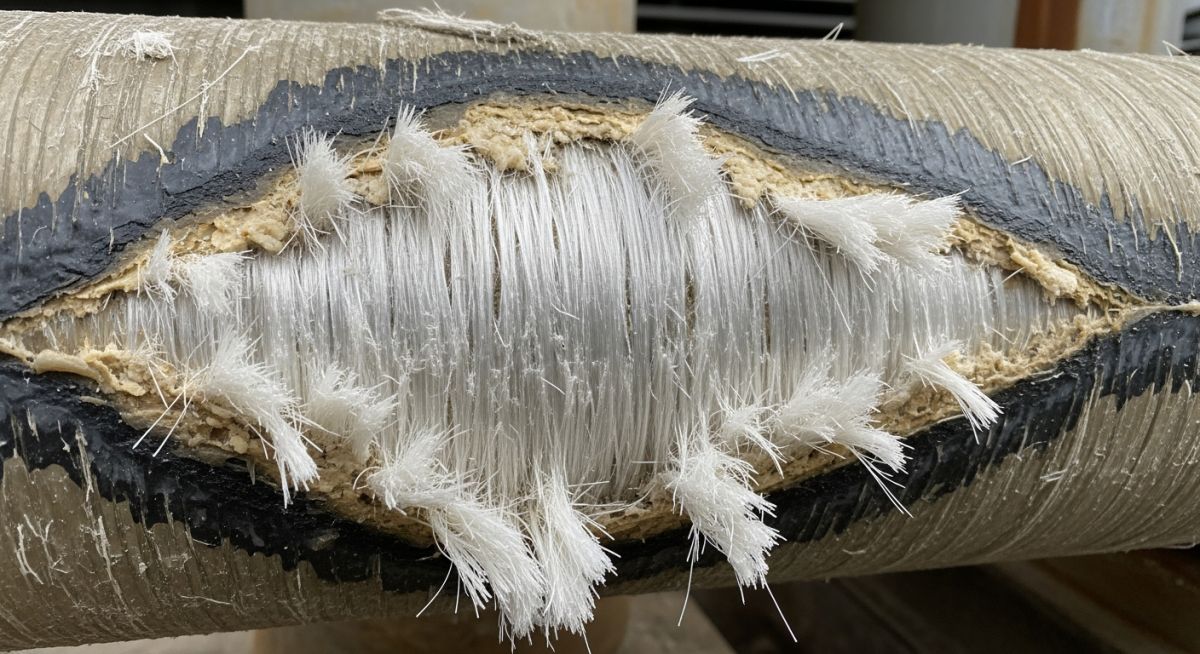
A major chemical facility installed a new 6-inch GRP line to transport a 15% sodium hypochlorite (NaOCl) solution at 50°C. Due to an aggressive cost-saving measure, the procurement team substituted the specified **Vinyl Ester Resin** liner with a cheaper, standard **Isophthalic Polyester Resin** in the **FRP Pipe Material Composition**. The structural layers maintained the correct glass type. Within 10 months, the pipe began to show signs of external weeping and internal discoloration.
Root Cause Analysis (RCA)
Sodium hypochlorite is a highly aggressive oxidizing agent. The RCA confirmed the premature failure was due to a **Chemical Degradation** of the Isophthalic Polyester liner. The caustic fluid rapidly penetrated the resin matrix through the process of **hydrolysis** (reaction with water) and **oxidation**. Once the resin matrix in the corrosion barrier was compromised, the fluid wicked into the structural glass fibers. This is known as **Fiber Blooming**, which dramatically reduced the load-bearing capacity of the pipe, leading to catastrophic structural failure and rupture.
Failure Data Summary
- Failing Component: Pipe Body Liner
- Original Spec Resin: Vinyl Ester
- Installed Resin: Isophthalic Polyester
- Primary Mode: Chemical Hydrolysis / Fiber Blooming
- Failure Time: Less than 1 Year
Lessons Learned & Preventive Action
The critical lesson is that the **FRP Pipe Material Composition** is non-negotiable based on chemical service. The cost of a Vinyl Ester liner is marginal compared to the cost of a premature pipe replacement and facility downtime. Procurement standards were revised to mandate a 3-point check of the Material Test Report (MTR) against the purchase order specification for all liner resins, especially in oxidizing and high-temperature services.
Expert Insights: Optimizing Material Selection for 50-Year Design Life
Designing an FRP pipeline that lasts half a century requires moving beyond basic pressure calculations and focusing on the nuances of the **FRP Pipe Material Composition**. Here are my essential rules for material optimization:
- ● Dual Resin Strategy: Always specify a Vinyl Ester or Epoxy for the innermost **Corrosion Resistance Barrier (CRB)**, but feel free to use a more economical Polyester for the outer **Structural Layer**. This optimizes both chemical resistance and cost without sacrificing mechanical integrity.
- ● The 3mm Liner Rule: Never accept a CRB (Corrosion Resistance Barrier) thinner than 3mm. Below this thickness, the risk of micro-cracks and fiber wicking increases exponentially, regardless of the resin quality.
- ● The Glass-to-Resin Ratio: In the structural layer, demand a high glass content (typically 65-75% by weight). This ensures maximum mechanical strength. Conversely, the inner liner must be resin-rich (low glass content) to maximize chemical protection. Get the supplier to prove these ratios with MTRs.
- ● Thermal Cycling: For lines with frequent temperature swings, choose Epoxy (GRE) systems over Polyesters/Vinyl Esters. GRE offers better resistance to thermal fatigue and has a lower coefficient of thermal expansion, ensuring the **FRP Pipe Material Composition** remains stable.