ASME B31.3 Fluid Service Categories: The Complete 2026 List & Guide
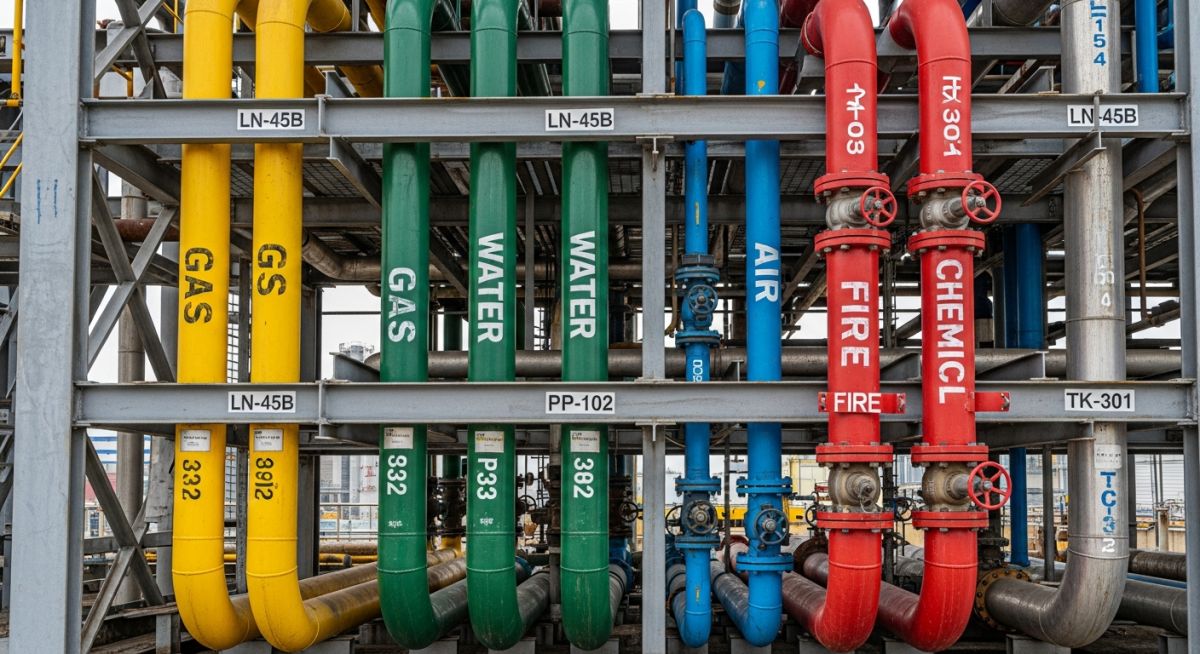
Figure 1: Correct fluid service classification is the foundation of piping code compliance.
In the world of Process Piping, one size does not fit all. The ASME B31.3 Fluid Service Categories are the governing rules that dictate how a piping system must be designed, fabricated, and inspected based on the specific risks associated with the fluid it carries.
What are the Fluid Service Categories in ASME B31.3?
Defined in Paragraph 300.2 of the code, ASME B31.3 Fluid Service Categories classify piping systems into five distinct levels based on pressure, temperature, and fluid hazard. They are:
- Category D: Non-toxic, non-flammable fluids (e.g., Utility Water) with low pressure/temperature limits.
- Category M: Toxic fluids where a single exposure can cause irreversible harm (e.g., Chlorine).
- High Pressure (Chapter IX): Services exceeding ANSI Class 2500 ratings.
- Severe Cyclic Conditions: Services subject to high fatigue stress.
- Normal Fluid Service: The default category for all fluids not meeting the above criteria.
Misclassifying a line is a critical error. Over-specifying a “Category D” line as “Normal” wastes budget on unnecessary NDE (Non-Destructive Examination). Conversely, under-specifying a lethal “Category M” line as “Normal” creates a catastrophic safety risk. This guide breaks down the selection logic to ensure your Line List is 100% compliant.
Table of Contents
Quiz: Can you classify these lines?
Complete Course on
Piping Engineering
Check Now
Key Features
- 125+ Hours Content
- 500+ Recorded Lectures
- 20+ Years Exp.
- Lifetime Access
Coverage
- Codes & Standards
- Layouts & Design
- Material Eng.
- Stress Analysis
1. What is Fluid Service in Piping Engineering?
In ASME B31.3, the term Fluid Service does not merely refer to the chemical name of the liquid or gas flowing through the pipe. Instead, it is a risk-based classification that considers the combination of the fluid’s properties (toxicity, flammability) and the operating conditions (pressure, temperature).
According to Paragraph 300.2, determining the Fluid Service Category is the responsibility of the Owner. This decision is critical because it dictates the “Code Rigor”—the level of quality control, inspection, and material toughness required. A “Normal” service line might require 5% X-Ray inspection, whereas a “Category M” line might require 20% to 100% inspection to prevent lethal leaks.
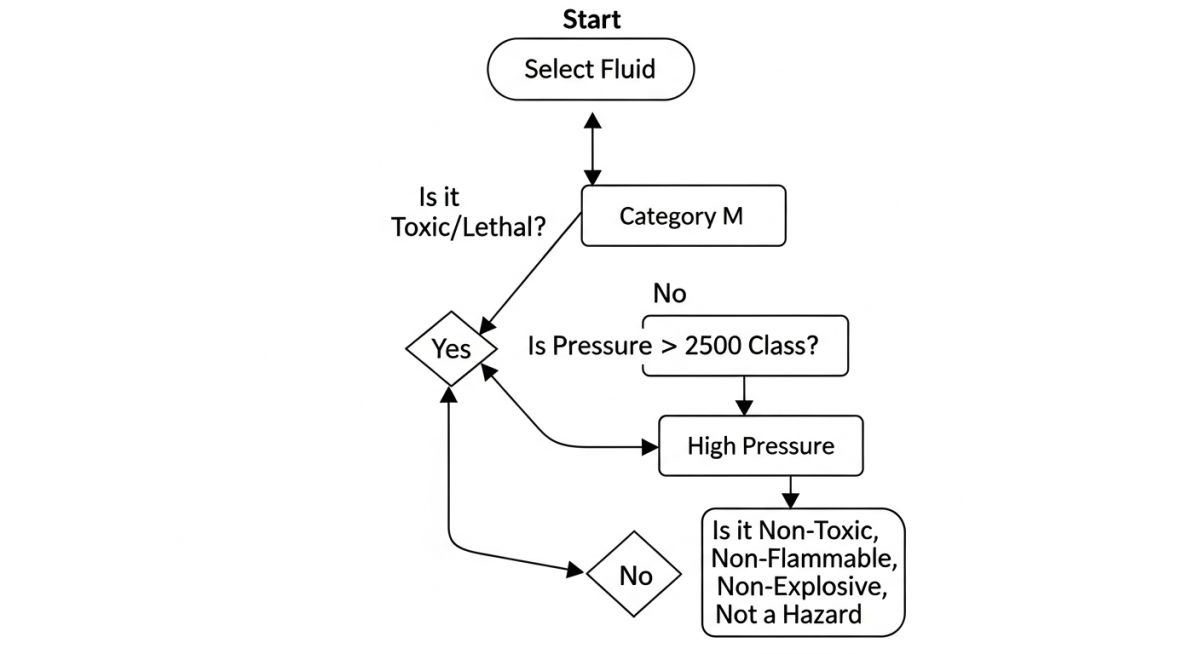
The Owner’s Responsibility
The Code explicitly states that the owner is responsible for designating the fluid service. However, in practice, the EPC Contractor’s Process Engineer proposes the category in the Line List, and the Owner approves it.
2. The 5 Standard Fluid Categories (Detailed)
Understanding the nuance between these categories can save a project millions in NDE costs or save lives by preventing toxic releases. Here are the detailed criteria for the first two categories.
2.1. Category D Fluid Service
Category D Fluid Service is the “Cost Saver” category. It applies to fluids that are innocuous (harmless) and operate under mild conditions. If a line meets all the following criteria, it can be classified as Category D:
- ✓ Non-flammable, non-toxic, and not damaging to human tissues.
- ✓ Design Gage Pressure does not exceed 150 psi (1,035 kPa).
- ✓ Design Temperature is between -29°C (-20°F) and 186°C (366°F).
Engineering Impact: Category D lines usually require only “Visual Examination” rather than expensive Radiography (RT) or Ultrasonic Testing (UT).
2.2. Category M Fluid Service
Category M Fluid Service is the “Lethal” category. It applies to fluids where the potential for personnel injury is high, even with immediate medical treatment.
Definition Criteria (Para 300.2)
“Fluid service in which the potential for personnel exposure is judged to be significant and in which a single exposure to a very small quantity of a toxic fluid, caused by leakage, can produce serious irreversible harm…”
- Examples: Hydrogen Sulfide (H2S), Phosgene, Methyl Isocyanate.
- Strict Requirements:
- 20% Random Radiography (minimum) vs 5% for Normal.
- Stricter Impact Testing (Toughness) requirements.
- Sensitive Leak Testing is mandatory.
Key Note: Just because a fluid is hazardous does not automatically make it Category M. If the design prevents exposure (e.g., double-walled piping) or if the fluid is only “harmful” but not “irreversible,” it might remain Normal Fluid Service.
2.3. High Pressure Fluid Service
This category applies when the owner designates that the piping system requires the rigorous rules of Chapter IX (High Pressure Piping).
- Threshold: Generally, this category is selected when the design pressure exceeds the rating of ASME B16.5 Class 2500 flanges for the specified design temperature.
- Implications:
- Requires more complex stress analysis (fatigue analysis).
- Standard pipe schedules are often insufficient; custom wall thicknesses are calculated using stricter formulas.
- 100% Radiography (RT) is standard.
2.4. Severe Cyclic Conditions
This is not based on the fluid itself, but on the stress conditions. It applies when the piping system is calculated to operate at high stress levels with many thermal cycles or significant vibration, leading to a high potential for fatigue failure.
Requirement: 100% Visual Examination and 100% Volumetric NDE (RT/UT) are required to ensure no weld defects exist that could propagate cracks.
2.5. Normal Fluid Service
Normal Fluid Service is the “Catch-All” category. If a fluid is not Category D, not Category M, and not High Pressure, it defaults to Normal.
Critical Engineering Myth-Buster:
Many engineers mistakenly classify flammable hydrocarbons (like Gasoline or Methane) as Category M. This is incorrect. Flammability alone does not trigger Category M. Most refinery and petrochemical piping is “Normal Fluid Service,” requiring 5% Random Radiography.
3. Fluid Classification List (Common Examples)
While every project has its own “Line List” approved by the owner, the following table represents industry-standard classifications for common process fluids in 2026.
| Fluid Name | Typical Category | Engineering Justification |
|---|---|---|
| Utility Water / Air | Category D | Non-toxic, non-flammable. Only if P < 150 psi and T < 186°C. |
| Steam (Low Pressure) | Normal / Cat D | Often classified as Normal due to temperature risks, but can be Cat D if T < 186°C. |
| Natural Gas / Methane | Normal Service | Flammable but not “Lethal” in trace amounts. Standard 5% RT applies. |
| Hydrogen Sulfide (H2S) | Category M | Highly toxic. Single exposure can be fatal. Requires strict NDE. |
| Chlorine (Dry/Wet) | Category M | Lethal gas. Leaks cause irreversible lung damage. |
| Sulfuric Acid (H2SO4) | Normal Service | Corrosive but usually not “Category M” unless specific concentration/temp risks exist. |
| LDPE Reactor Feed | High Pressure | Pressures > 2500 Class (often > 2000 bar). Chapter IX rules apply. |
*Note: This table is for educational purposes. Final classification is always the responsibility of the Owner per ASME B31.3 Para 300.2.
Engineering Formula: Wall Thickness Calculation
The Fluid Service Category influences the Allowable Stress (S) and Quality Factor (E) used in the wall thickness formula (304.1.2):
t = (P × D) / [2 × (S × E × W) + (2 × Y × P)]
Where:
- t = Pressure Design Thickness
- P = Internal Design Pressure
- E = Quality Factor (Higher inspection in Cat M/Normal = Higher E)
- W = Weld Joint Strength Reduction Factor
Fluid Service Wizard (ASME B31.3)
Determine the correct piping classification and NDE requirements based on your design parameters.
Single exposure causes irreversible harm (e.g., H2S, Chlorine).
Exceeds ASME B16.5 Class 2500 rating for the temp?
High fatigue stress expectation?
Resulting Classification
Normal Fluid Service
NDE Requirement (Typical):
5% Random Radiography
Impact Testing:
Required if MDMT < Curve B (Typically -29°C)
Don't miss this video related to ASME B31.3 Fluid Service Categories

Summary: Master Piping Engineering with our complete 125+ hour Certification Course: ......
Master NDE & Testing Matrix
Summary of ASME B31.3 Inspection Requirements (2026 Edition)
| Fluid Category | Visual Exam (VT) | Volumetric (RT/UT) | Leak Testing |
|---|---|---|---|
| Category D | Per Owner's Spec (Typically Random) |
None Required |
Service Test
At operating pressure |
| Normal Service | Min. 5% of Fab (Random Sampling) |
5% Random |
Hydrostatic (1.5x) OR Pneumatic (1.1x) |
| Category M | 100% of Fab (All welds & components) |
Min. 20% Random |
Hydrostatic (1.5x) + Sensitive Leak Test |
| Severe Cyclic | 100% of Fab | 100% Volumetric | Hydrostatic (1.5x) |
| High Pressure (Ch IX) | 100% of Fab | 100% Volumetric | Hydrostatic (1.25x) |
The "Progressive Sampling" Rule
For Normal Service (5% Random RT): If a weld fails inspection, ASME B31.3 requires inspecting two additional welds by the same welder. If either of those fail, the sampling increases progressively until 100% of that welder's work is inspected. This is why "5%" often turns into "100%" if quality is poor.
Case Study: The $500k Over-Specification Error
The Scenario: During the construction of a large Ethylene Cracker, the "Cooling Water Return" system consisted of over 2,500 meters of large-bore (30-inch to 42-inch) Carbon Steel piping. The design pressure was only 6 Bar (87 psi), and the temperature was ambient (35°C).

The Engineering Error
The Junior Process Engineer, unsure of the classification rules, defaulted the entire line list to "Normal Fluid Service" to be "safe."
- ✖ Unnecessary NDE: Normal Service requires 5% Random Radiography (RT). For 30" pipe, this meant hundreds of large X-ray shots.
- ✖ Site Disruption: RT requires clearing the site (cordoning off areas) for radiation safety, stopping other work in the vicinity.
The Cost Impact
Extra NDE Costs
$180,000
Cost of RT crews and film.
Schedule Delay Costs
$320,000
Due to "Night Shift Only" radiography restrictions.
Total Waste
$500,000+
The Solution: Re-Classification to Category D
A Senior Piping Lead reviewed the Line List and noted that the fluid was non-toxic, non-flammable, < 150 psi, and < 186°C. The service was re-classified to Category D.
Result: Radiography requirements dropped to 0%. The acceptance criteria changed to "Visual Examination" (VT) only. The NDE crew was demobilized, and piping installation proceeded during the day shift without interruption.
Frequently Asked Questions (FAQ)
Who is responsible for selecting the Fluid Service Category?
According to ASME B31.3 Paragraph 300.2, the Owner is ultimately responsible for selecting the Fluid Service Category. While the EPC contractor (Process Engineer) typically recommends the classification in the Line List, the Owner must approve it because it dictates the long-term safety and maintenance requirements of the facility.
Is Hydrogen Gas (H2) considered Category M Fluid Service?
No. Hydrogen is highly flammable and explosive, but it is not "toxic" in the sense that a single small exposure causes irreversible bodily harm (like Chlorine or Phosgene). Therefore, Hydrogen is typically classified as Normal Fluid Service, not Category M.
Can Steam lines be classified as Category D?
Yes, provided the design conditions are within the limits. If the steam pressure is less than 150 psi (10.3 bar) and the temperature is less than 186°C (366°F), it meets the criteria for Category D. High-pressure superheated steam, however, would fall under Normal Fluid Service.
What happens if I misclassify a Category M fluid as Normal?
This is a major code violation and a safety hazard. Category M requires specific safeguards like 20% RT and sensitive leak testing. Using Normal Service rules (5% RT) increases the risk of undetected weld defects, which could lead to a lethal leak. In a court of law following an accident, this would be considered gross negligence.
Conclusion: Classification is the First Step to Safety
Mastering the ASME B31.3 Fluid Service Categories is not just an academic exercise—it is a daily requirement for Piping Engineers in 2026. Correct classification strikes the perfect balance between project cost and operational safety.
Whether you are saving money by utilizing Category D for utility water or protecting lives by enforcing Category M for lethal services, your decision on the Line List defines the integrity of the entire plant.
