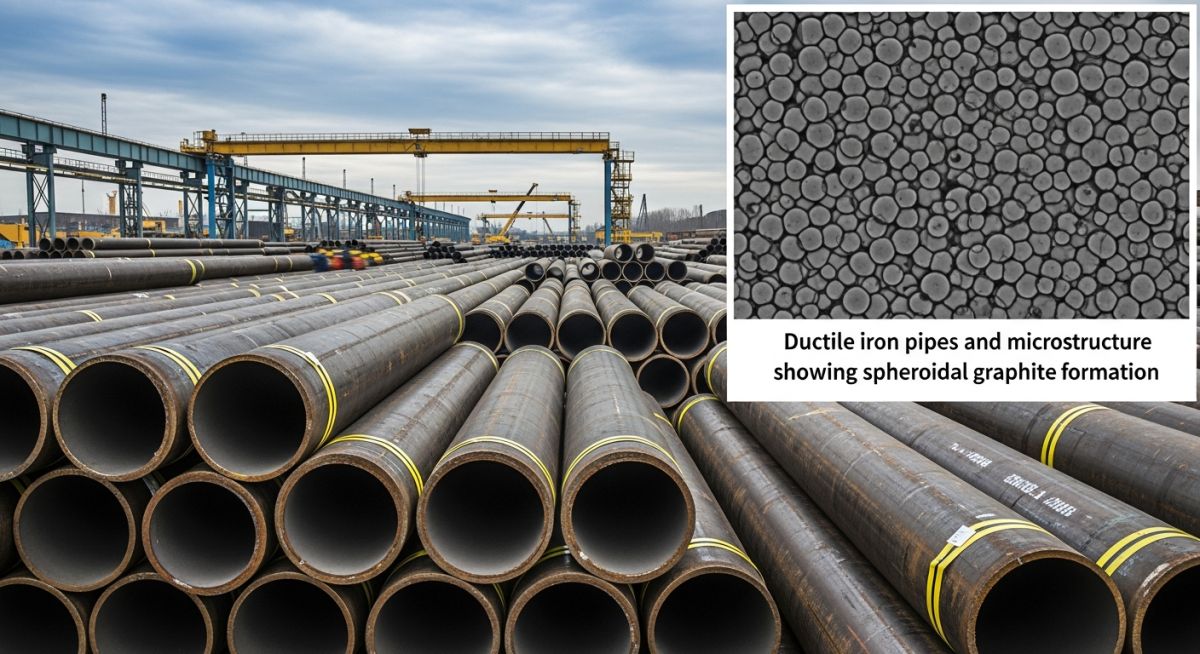
What is Ductile Iron? | Types, Properties, and Applications of Ductile Iron
In my 20+ years of piping engineering experience, ductile iron has consistently been one of the most reliable materials for underground pipelines, pump casings, and pressure-retaining components. Unlike traditional cast iron, ductile iron offers exceptional strength and flexibility — a combination that has prevented countless field failures in water, oil, and industrial systems.
I’ve personally seen projects where incorrect material selection between cast iron and ductile iron resulted in catastrophic cracks during hydrotesting. That’s why understanding ductile iron is not just academic — it’s critical for real-world reliability, safety, and lifecycle cost.
🔍 Key Engineering Takeaways
- Ductile iron contains spheroidal graphite, improving strength and ductility.
- It offers a superior balance of toughness, corrosion resistance, and cost-effectiveness.
- Widely used in pipelines, valves, automotive parts, and heavy castings.
- ASTM A536 defines standard grades based on strength and elongation.
- Outperforms cast iron in impact resistance and pressure applications.
📘 Quick Answer (50 Words)
Ductile iron, also known as nodular iron or spheroidal graphite iron, is a cast iron type with improved mechanical properties due to spherical graphite formation. It provides high strength, ductility, and impact resistance, making it ideal for pipelines, automotive components, and pressure-bearing applications compared to brittle conventional cast iron.
Interactive Engineering Quiz
Q1. What gives ductile iron its high ductility?
Metallurgy of Ductile Iron
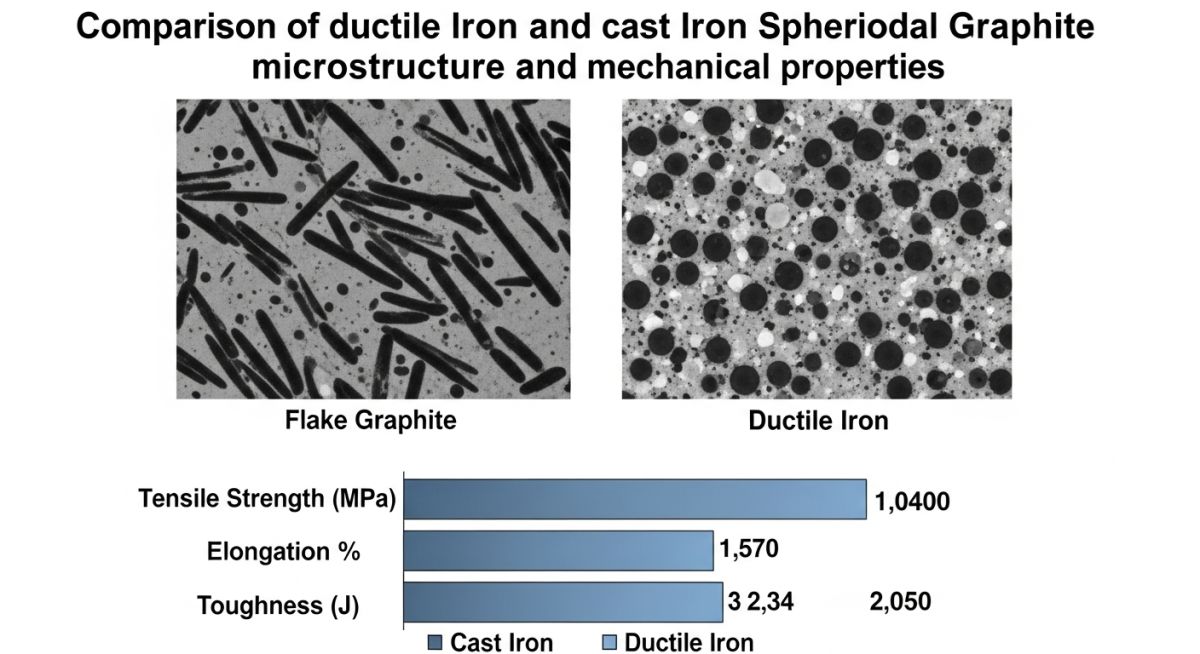
In my field experience, the defining transformation in ductile iron comes from altering graphite morphology during solidification. Unlike gray cast iron, where graphite forms in flakes, ductile iron uses magnesium treatment to form spheroidal (nodular) graphite. This rounded structure significantly reduces stress concentration points, improving ductility and tensile strength.
The process involves adding magnesium or cerium to molten iron. This modifies graphite growth kinetics, forcing carbon to precipitate as nodules rather than flakes. The matrix surrounding these nodules can be ferritic, pearlitic, or a combination, depending on cooling rate and alloy additions.
Ductile Iron Composition
The typical chemical composition of ductile iron is carefully controlled to achieve desired mechanical properties:
- Carbon: 3.2% – 3.8%
- Silicon: 2.2% – 2.8%
- Manganese: 0.1% – 0.5%
- Magnesium: 0.03% – 0.05%
- Sulfur: < 0.02%
- Phosphorus: < 0.05%
Magnesium plays the most critical role in nodularization, while silicon enhances graphitization. Excess sulfur can neutralize magnesium, which is why desulfurization is essential before treatment.
Types of Ductile Iron
Based on matrix structure, ductile iron is broadly classified into:
- Ferritic Ductile Iron: High ductility and corrosion resistance
- Pearlitic Ductile Iron: Higher strength and wear resistance
- Martensitic Ductile Iron: Very high hardness (heat treated)
- Austempered Ductile Iron (ADI): Exceptional strength-to-weight ratio
Properties of Ductile Iron
From a design standpoint, ductile iron offers a unique balance of properties:
- Tensile Strength: 400–900 MPa
- Elongation: Up to 18%
- Excellent impact resistance
- Good fatigue strength
- Superior machinability compared to steel
Applications of Ductile Iron
In EPC and industrial projects, I’ve repeatedly specified ductile iron for:
- Water and sewage pipelines
- Valve bodies and pump casings
- Automotive crankshafts and gears
- Heavy machinery components
| Grade | Tensile Strength (MPa) | Yield Strength (MPa) | Elongation (%) | Matrix Type |
|---|---|---|---|---|
| 60-40-18 | 414 | 276 | 18 | Ferritic |
| 65-45-12 | 448 | 310 | 12 | Ferritic-Pearlitic |
| 80-55-06 | 552 | 379 | 6 | Pearlitic |
| 100-70-03 | 689 | 483 | 3 | Fully Pearlitic |
These ASTM grades define ductile iron’s mechanical performance. In piping systems, I typically prefer 60-40-18 for its excellent elongation and fracture resistance, especially in underground installations where soil movement and external loading are concerns.
Field Case Study: Real-World Application
During a slurry pipeline project, I evaluated material selection between ductile iron and carbon steel. The design pressure was moderate, but the fluid had abrasive characteristics. Carbon steel offered better erosion resistance, but corrosion risk and lifecycle cost were high.
Additionally, soil conditions indicated potential external corrosion, raising concerns about maintenance and coating integrity over long-term service life.
I recommended ductile iron with internal cement mortar lining and external polyethylene coating. This configuration delivered:
- Enhanced corrosion resistance in buried conditions
- Adequate abrasion resistance due to lining protection
- Lower lifecycle cost compared to coated carbon steel
- Improved installation reliability due to flexibility
Final Recommendation: For buried pipelines in moderate abrasive service, lined ductile iron provides the best balance of durability, cost, and maintainability.
In my experience, failures rarely come from basic material strength—they originate from incorrect environmental assumptions. Ductile iron, when paired with the right lining and coating system, can outperform traditional materials in real field conditions.
