Masterclass in Distillation Column Pressure Control (2026)
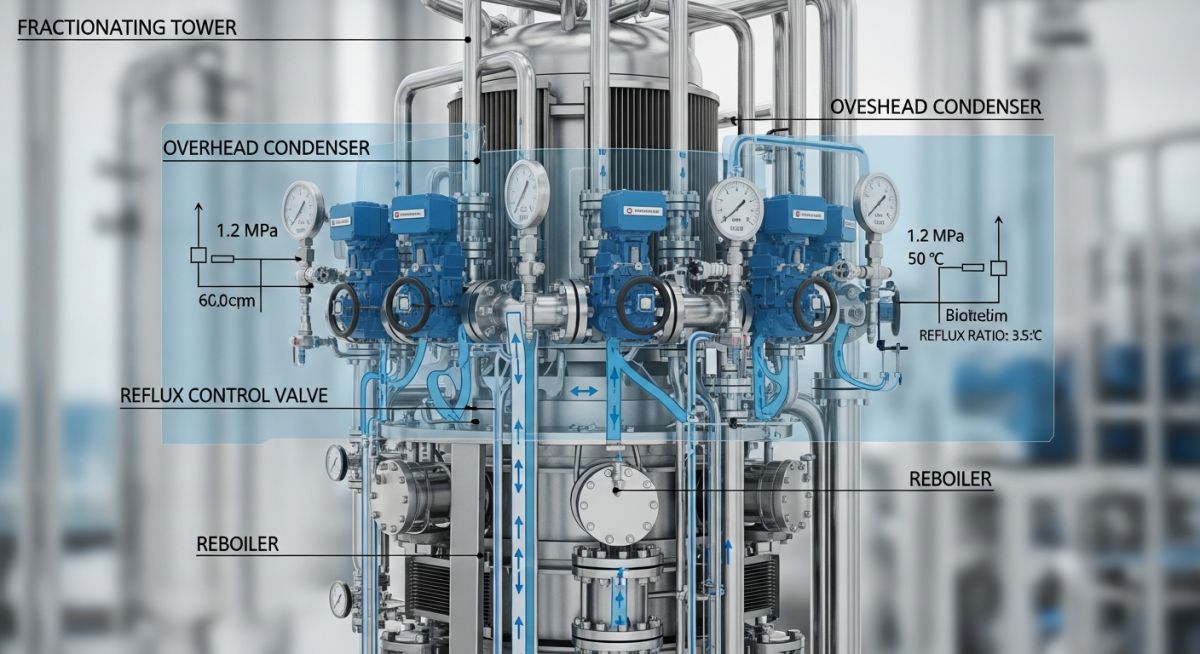
Imagine you are on the night shift when the overhead condenser suddenly loses sub-cooling, causing the column pressure to spike and safety valves to chatter. This isn’t just a simulation; it is the reality of poor Distillation Column Pressure Control. Whether you are dealing with non-condensable build-up or sluggish flooded condenser response, mastering these dynamics is the difference between a stable plant and an emergency shutdown. This guide provides the high-fidelity engineering logic required to dominate pressure stability in 2026.
Key Engineering Takeaways
- Identify the critical differences between vapor-space control and liquid-level pressure modulation.
- Master the mechanics of flooded condenser systems to minimize inert gas interference.
- Implement ASME-compliant pressure-equalizing lines for seamless reflux drum operation.
What is Distillation Column Pressure Control?
Distillation Column Pressure Control is the process of maintaining a constant internal environment to ensure consistent relative volatility. It is achieved by balancing the energy removed at the condenser with the energy added at the reboiler, typically by manipulating vapor removal, coolant flow, or heat transfer area.
“In my 20 years of process design, I’ve seen that pressure control is often the ‘heartbeat’ of the entire separation unit. If your pressure oscillates, your composition control doesn’t stand a chance. Focus on the hydraulics of your equalizing lines first.”
– Atul Singla, Founder of EPCLand
Table of Contents
- General Guidelines for Distillation Column Pressure Control
- Managing Pressure Control in Atmospheric Column Systems
- Advanced Distillation Column Pressure Control Techniques
- Distillation Column Pressure Control Standards: ASME & API Compliance
- Troubleshooting Distillation Column Pressure Control Failures
Complete Course on
Piping Engineering
Check Now
Key Features
- 125+ Hours Content
- 500+ Recorded Lectures
- 20+ Years Exp.
- Lifetime Access
Coverage
- Codes & Standards
- Layouts & Design
- Material Eng.
- Stress Analysis
Knowledge Check: Pressure Control Engineering
Test your expertise on 2026 Distillation Standards
1. What is the primary purpose of a pressure-equalizing line in a flooded condenser system?
General Guidelines for Distillation Column Pressure Control
Maintaining precise Distillation Column Pressure Control is non-negotiable for achieving product purity and operational stability. In engineering practice, the pressure is the primary variable that dictates the boiling points of the components within the tower. A fluctuation in pressure directly alters the relative volatility, often making the separation of light and heavy ends significantly more difficult. To ensure robust performance, engineers must design the control loop to address both the speed of the disturbance and the thermal lag of the condenser.
The gold standard for high-performance units involves minimizing the "dead time" between a pressure change and the corrective action. For instance, according to the principles outlined by AIChE (American Institute of Chemical Engineers), the selection of the control point—whether at the top, bottom, or the reflux drum—depends heavily on the presence of non-condensable gases and the type of condenser used.
Managing Pressure Control in Atmospheric Column Systems
Atmospheric columns present a unique challenge because they are theoretically "open" to the environment. However, strict environmental regulations and safety protocols in 2026 require that these systems utilize sophisticated venting and blanketing strategies. Distillation Column Pressure Control in an atmospheric setup typically involves a vent line connected to a flare system or a vapor recovery unit (VRU).
The stability of these columns often hinges on the "breathing" capacity of the vent. If the vent is undersized, rapid cooling (such as during a rainstorm) can cause a vacuum collapse, leading to tray damage. Conversely, excessive heating can overpressure the vessel. Engineers utilize split-range controllers that manage a nitrogen blanket for pressure makeup and a vent valve for pressure relief to maintain a tight band near atmospheric pressure.
Advanced Distillation Column Pressure Control Techniques
When standard throttling methods fail to meet the precision required for high-purity fractionation, engineers pivot toward advanced Distillation Column Pressure Control strategies. These methods focus on manipulating the physics of the heat transfer interface rather than just valve positioning. Adherence to API Standard 521 is critical here, specifically regarding the sizing of depressuring systems and the management of vapor loads during process upsets.
1. Vapor Flow Variations and Inventory Management
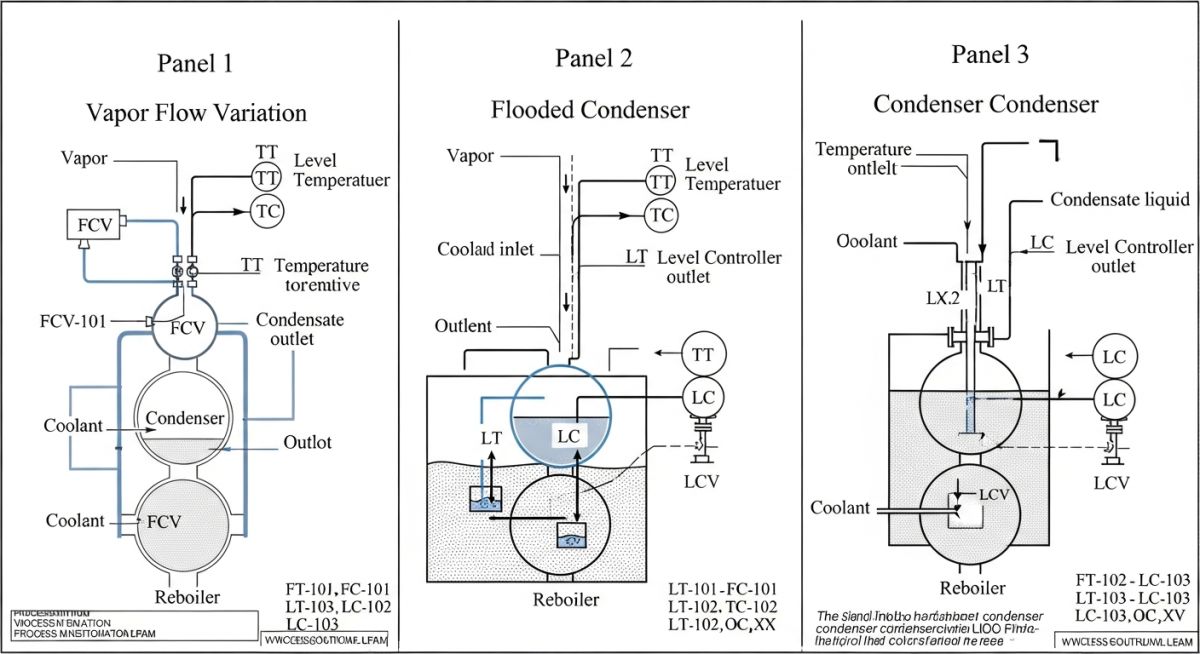
In this configuration, pressure is controlled by regulating the rate at which vapor is removed from the system. This is most effective when non-condensables are present. By modulating the vent rate or the flow to a downstream compressor, the system maintains a stable vapor inventory. This method provides the fastest response time but requires careful integration with the plant's fuel gas or flare headers.
2. Flooded Condenser Control Mechanisms
Flooded condenser control is a sophisticated Distillation Column Pressure Control technique where the liquid level in the condenser is manipulated to vary the effective heat transfer area. By "flooding" the tubes with sub-cooled liquid, the rate of condensation is reduced, causing pressure to rise. Conversely, lowering the level exposes more tubes, increasing condensation and dropping the pressure.
Engineering the Pressure-equalizing Line
The success of a flooded system relies on the Pressure-equalizing Line. This line connects the vapor space of the column overhead to the reflux drum. According to ASME Section VIII design considerations for pressure vessels, this line must be sized to ensure that the reflux drum and the column operate at the same pressure, preventing "liquid slugging" or un-intended drainage of the condenser.
3. Coolant Flow Variation and Heat Sink Control
This involves throttling the cooling water or refrigerant flow through the condenser. While mechanically simple, it is often the least preferred Distillation Column Pressure Control method due to high thermal lag and the risk of fouling when water velocities drop below 3 feet per second (0.9 m/s).
| Control Technique | Response Speed | Primary Advantage | Primary Risk |
|---|---|---|---|
| Vapor Throttling | Ultra-Fast | High Precision | Vapor Loss to Flare |
| Flooded Condenser | Moderate | No Vapor Loss | Inert Accumulation |
| Coolant Variation | Slow | Low Capital Cost | Condenser Fouling |
Pressure Stability Predictor (2026)
Estimate the potential pressure fluctuation based on changes in cooling water flow velocity. Maintain velocities above 0.9 m/s to avoid fouling.
EPCLand YouTube Channel
2,500+ Videos • Daily Updates
Engineering Case Study: Resolving Pressure Surges in a Refinery ADU
The Challenge: Non-Condensable Inertia
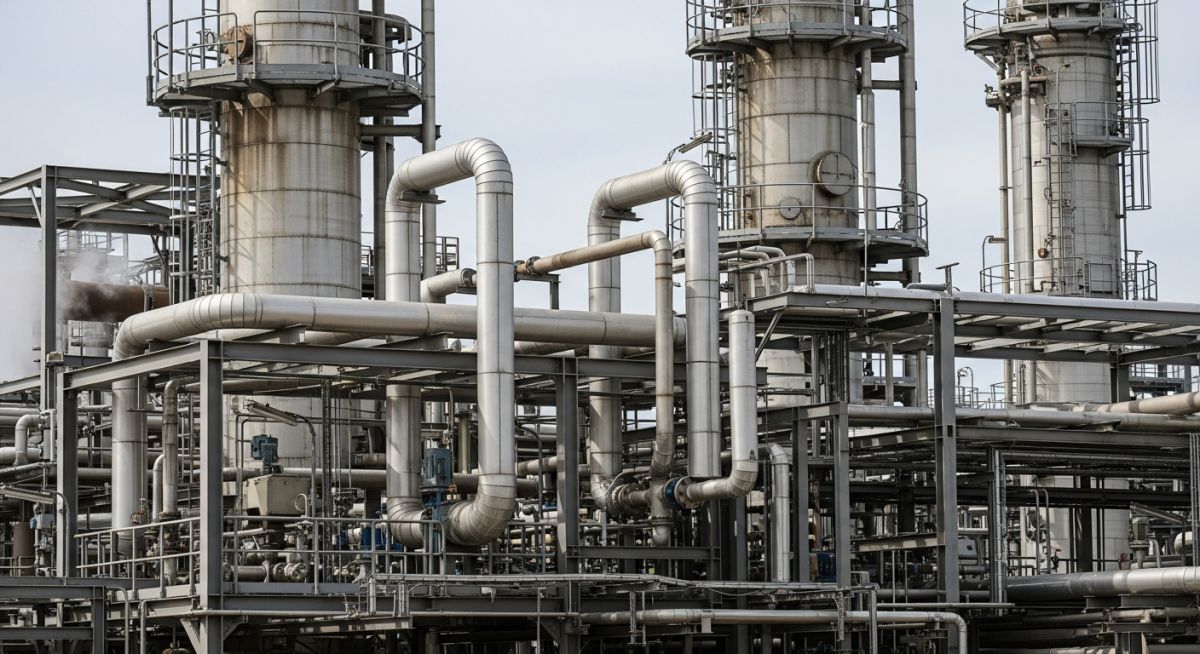
A major refinery unit faced persistent Distillation Column Pressure Control oscillations every time the ambient temperature dropped. The existing flooded condenser system was failing to account for the accumulation of nitrogen used in the blanketing system. This resulted in "pressure spiking," where the control valve would over-correct, causing tray weeping and off-spec product.
The Solution: Re-engineered Equalizing Logic
The engineering team implemented a Pressure-equalizing Line upgrade and a split-range vent strategy. By installing a small vent valve on the reflux drum vapor space, non-condensables were purged automatically when the flooded level reached its upper limit. This restored the heat transfer area's sensitivity and stabilized the column pressure within a 0.05 bar margin.
Don't miss this video related to Distillation Column

Summary: Master Piping Engineering with our complete 125+ hour Certification Course: ......
Expert Insights: Lessons from 20 years in the field
- • Prioritize the Vapor Inventory: In high-vacuum columns, the physical volume of vapor acts as a buffer. Never underestimate the impact of small air leaks on your Distillation Column Pressure Control loop tuning.
- • Equalizing Line Slope: Ensure your pressure-equalizing lines are sloped back toward the reflux drum or the column to prevent liquid pockets, which create erratic pressure "slugs" and false readings.
- • Split-Range Integrity: Always calibrate your nitrogen makeup and vent valves with a small "deadband" to prevent both valves from being open simultaneously, which wastes expensive inert gas.
- • Sub-cooling Sensitivity: If your flooded condenser system is sluggish, check the sub-cooling temperature. Excess sub-cooling reduces the "condensing power" of the level change, making the control loop less effective.
Frequently Asked Questions: Distillation Column Pressure Control
What is the most common method for Distillation Column Pressure Control?
The most common method is the flooded condenser technique. It is favored in 2026 because it avoids the loss of valuable hydrocarbons to the flare system by manipulating the liquid level on the heat transfer surface to regulate condensation rates.
How does pressure affect the distillation separation efficiency?
Pressure inversely affects relative volatility. As Distillation Column Pressure Control allows the pressure to rise, the alpha (separation factor) decreases, meaning more reflux and energy are required to achieve the same product purity.
Why is a pressure-equalizing line necessary?
In flooded systems, the pressure-equalizing line ensures the reflux drum and column overhead are at the same pressure. Without it, liquid would back up into the column or drain uncontrollably, destroying the stability of the pressure loop.
What happens to pressure control when non-condensables build up?
Non-condensables "blanket" the heat transfer area, causing the pressure to rise regardless of the control valve position. This requires a dedicated vent valve or a split-range controller to purge the inerts from the top of the condenser or the reflux drum.
Can I use coolant flow variation for high-fouling water?
It is highly discouraged. Throttling coolant flow reduces velocity, which leads to rapid scale formation and fouling. For these cases, a hot vapor bypass or flooded condenser scheme is much more reliable for long-term operation.
Why does my pressure oscillate during rainstorms?
This is likely due to lack of insulation on the overhead vapor line or the condenser. Sudden external cooling increases the condensation rate faster than the Distillation Column Pressure Control system can react, causing a vacuum or pressure drop.
📚 Recommended Resources: Distillation Column
Read these Guides
🎓 Advanced Training



Related posts:
![High-grade industrial Wing Nut Types and Applications for mechanical assemblies.]()
Wing Nut Types and Applications: The 2026 Engineering Guide
![Industrial Monorail Crane Systems installed in a modern manufacturing plant 2026.]()
Monorail Crane Systems: Design, Types & 2026 Standards Guide
![Lead engineer performing a Factory Acceptance Test FAT on an industrial skid system 2026]()
Factory Acceptance Test FAT: The 2026 Engineering Guide to Zero-Defect Delivery
![Professional engineering workspace showing a Basis of Design document layout for a 2026 project.]()
Basis of Design: How to Write a BOD for Engineering Projects in 2026
![Industrial Flare Knockout Drum Sizing and installation in a refinery relief system.]()
Flare Knockout Drum Sizing: Design & API 521 Standards (2026 Guide)
![Advanced Reboiler Control Systems in a modern petrochemical refinery 2026.]()
Reboiler Control Systems: Engineering Guide to Precision Control 2026