Brent Oil vs Crude Oil: Understanding Benchmarks & Engineering Specs
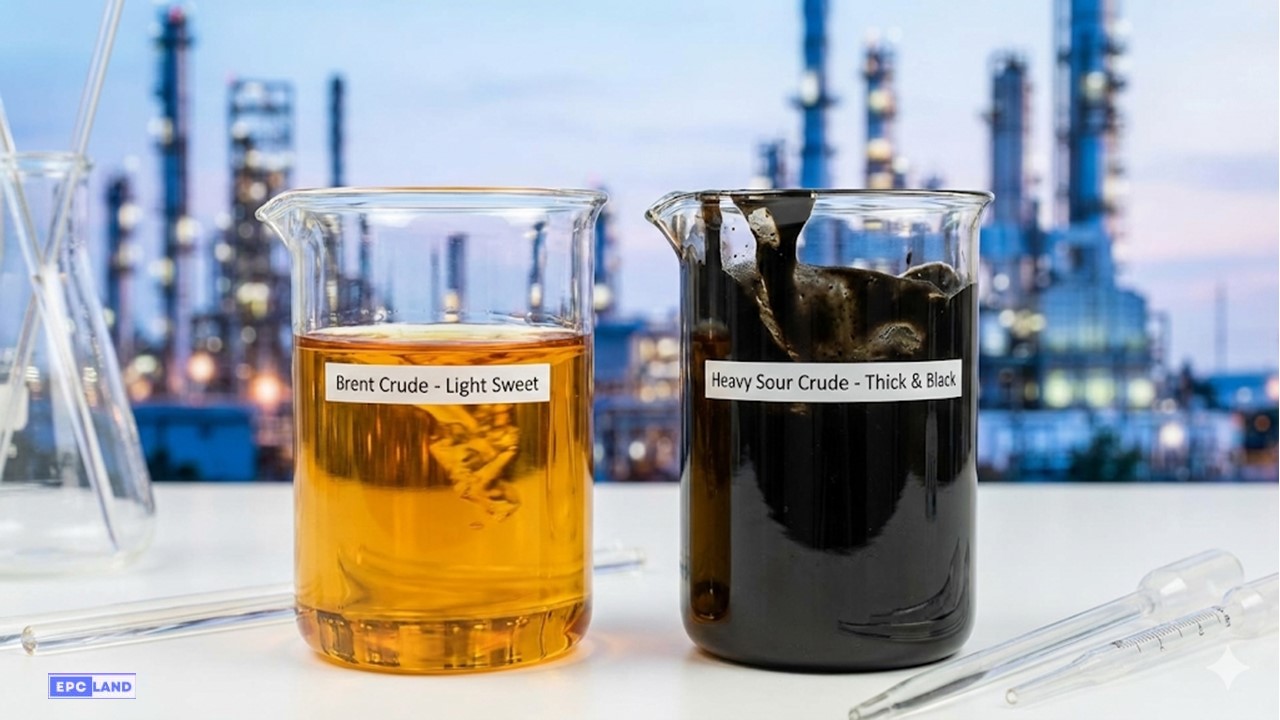
Visualizing the difference: High-value Light Sweet Crude (Left) vs. Low-value Heavy Sour Crude (Right).
When investors discuss energy markets, the comparison of Brent Oil vs Crude Oil often causes confusion. To clarify immediately: Crude Oil is the raw material extracted from the earth, while Brent is a specific classification (or benchmark) of that crude oil. For chemical engineers and refinery planners, distinguishing between these benchmarks—specifically Brent (Europe) and WTI (USA)—is critical for determining refinery margins, metallurgy requirements, and processing complexity.
The Short Answer
Think of “Crude Oil” as the category (like “Coffee”), and “Brent” as a specific premium blend (like “Arabica”). Brent is a Light Sweet Crude extracted from the North Sea. It is the global standard because it is easily transported by sea, whereas other crudes (like WTI) are land-locked by pipelines.
Quick Navigation
Test Your Crude Knowledge
Can you distinguish between the global benchmarks?
Loading Question…
Explanation:
Complete Course on
Piping Engineering
Check Now
Key Features
- 125+ Hours Content
- 500+ Recorded Lectures
- 20+ Years Exp.
- Lifetime Access
Coverage
- Codes & Standards
- Layouts & Design
- Material Eng.
- Stress Analysis
The “Big Three”: Global Crude Oil Benchmarks
Because crude oil varies wildly in quality and location, traders use “Benchmark Crudes” as reference points for pricing. While there are hundreds of crude streams globally, three primary benchmarks dominate the 2026 market. Understanding the WTI vs Brent difference is essential for any energy professional.
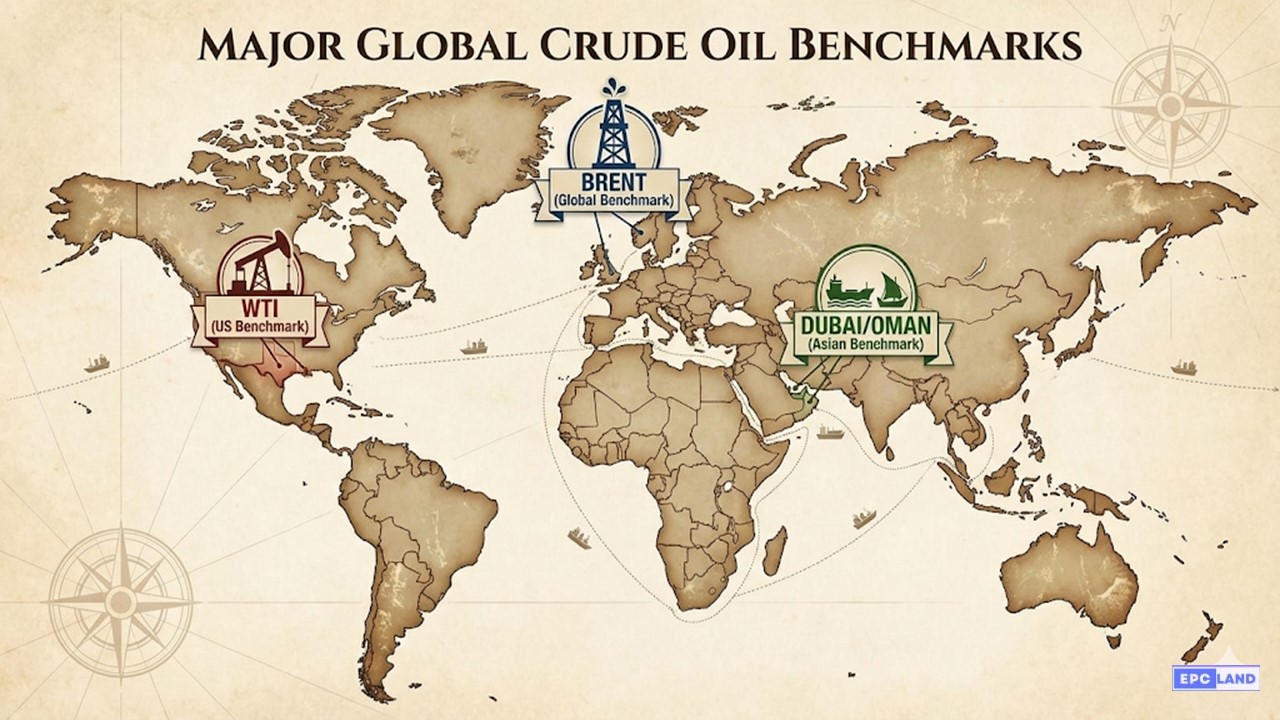
| Feature | Brent Crude | WTI (West Texas Intermediate) | Dubai / Oman |
|---|---|---|---|
| Origin | North Sea (Europe) | Texas / North Dakota (USA) | Middle East (UAE / Oman) |
| Market Role | Global Price Setter (Used for ~60% of world trade) | US Benchmark (Domestic Pricing) | Asian Benchmark (China/Japan imports) |
| Transport | Seaborne (Tankers) – Flexible | Pipeline (Landlocked) – Cushing, OK | Seaborne (Tankers) |
| Quality | Light Sweet | Very Light Sweet | Medium Sour |
1. Brent Crude (The Global Standard)
Brent is actually a blend from several oil fields in the North Sea (Brent, Forties, Oseberg, Ekofisk, and Troll—often called BFOET). Its dominance comes from logistics: because it is extracted at sea, it can be loaded directly onto tankers and shipped anywhere. This makes it a true indicator of global oil supply/demand mechanics.
2. WTI (The American Standard)
West Texas Intermediate is lighter and sweeter than Brent, theoretically making it more valuable. However, WTI often trades at a discount to Brent. Why? Logistics. WTI is landlocked. It flows via pipeline to Cushing, Oklahoma. If the pipelines or storage tanks at Cushing are full, the price drops locally, regardless of global demand.
The Chemistry: Sweet vs. Sour & Light vs. Heavy
To understand refinery economics, you must look beyond the price tag and look at the assay. The value of a crude oil barrel is determined by two critical chemical properties: API Gravity and Sulfur Content.
1. Density (API Gravity)
Measures how heavy the oil is compared to water.
- Light (> 31.1° API): Flows like water. Yields high gasoline/diesel. (e.g., WTI, Brent).
- Heavy (< 22.3° API): Flows like molasses. Yields mostly asphalt/residue. Requires complex “Coking” units to process.
2. Corrosivity (Sweet vs. Sour)
Measures the percentage of sulfur by weight.
- Sweet Crude (< 0.5% Sulfur): Low pollution, low corrosion. Premium price.
- Sour Crude (> 1.5% Sulfur): Smells like rotten eggs (H2S). Highly corrosive to refinery piping. Discounted price.
Refinery Economics: The “Complexity” Factor
This chemistry dictates the Refinery complexity for heavy crude.
- Simple Refineries (Hydroskimming): Can only buy expensive Light Sweet Crude (Brent/WTI). If they try to run Heavy Sour crude, their pipes will corrode, and they will produce too much low-value asphalt that they cannot sell.
- Complex Refineries (Full Conversion): Invest billions in “Upgrading Units” (Delayed Cokers, Hydrocrackers) and high-alloy metallurgy. This allows them to buy cheap Heavy Sour crude and crack it into high-value diesel. They make their profit on the “Spread” (price difference) between Brent and Heavy Crude.
💰 The Refiner’s Margin Formula:
Gross Margin = (Value of Products Sold) – (Cost of Crude + OpEx)
*A complex refinery thrives when the price gap between Brent and Heavy Crude is wide ($10+ per barrel).
Why Brent Rules the World: Market Mechanics
We established that Brent is “Light Sweet” and seaborne. But why does a field in the North Sea control 60% of the world’s oil pricing? The answer lies in the Real-World Impact of logistics and stability.
1. The “Seaborne” Advantage
WTI is landlocked in Oklahoma. If US pipelines (like the Keystone XL or Colonial Pipeline) get clogged, WTI prices crash locally. Brent is extracted at sea and loaded directly onto VLCCs (Very Large Crude Carriers). It can sail to China, India, or Rotterdam instantly. This liquidity makes it a more reliable global indicator.
2. The “Stability” Premium
The North Sea (UK/Norway) is a geopolitically stable region with transparent laws. Compare this to other major producers (Middle East, Russia, Venezuela) where conflicts or sanctions can disrupt supply overnight. Traders pay a premium for Brent’s reliability.
The Forgotten Benchmark: The OPEC Reference Basket (ORB)
While engineers focus on Brent/WTI, policy-makers watch the OPEC Basket. This is a weighted average of crudes from 13 OPEC countries (including Saudi Arabia, Iran, Iraq, and Nigeria).
- Composition: Generally heavier and more sour than Brent/WTI.
- Purpose: Used by OPEC to set production quotas. If the ORB price drops too low, OPEC cuts supply to drive prices back up.
- Engineering Impact: Changes in the OPEC Basket drive “Capital Expenditure” (CAPEX). When OPEC cuts supply, crude prices rise, and oil companies approve new refinery projects.
Real-World Impact: From Pump to Project
A fluctuation in Brent Oil doesn’t just change stock tickers; it impacts reality in two distinct ways:
Brent price directly correlates to Gasoline/Diesel prices. Because Brent is the benchmark for imports, a $10 spike in Brent usually triggers an immediate hike at the fuel pump and higher airfare tickets globally.
High Brent prices ($80+) mean bigger budgets for Maintenance & Upgrades. Low prices (<$50) force refineries to cut costs, delaying retrofits (like the one in our Case Study below) and increasing safety risks.
EPCLand YouTube Channel
2,500+ Videos • Daily Updates
Case Study: The “Sweet-to-Sour” Retrofit Disaster
The most dangerous decision a refinery manager can make is to process cheaper, sour crude in a unit designed for Sweet Brent Oil without verifying the metallurgy. In this case study, we analyze a piping rupture that caused a $15 Million fire.
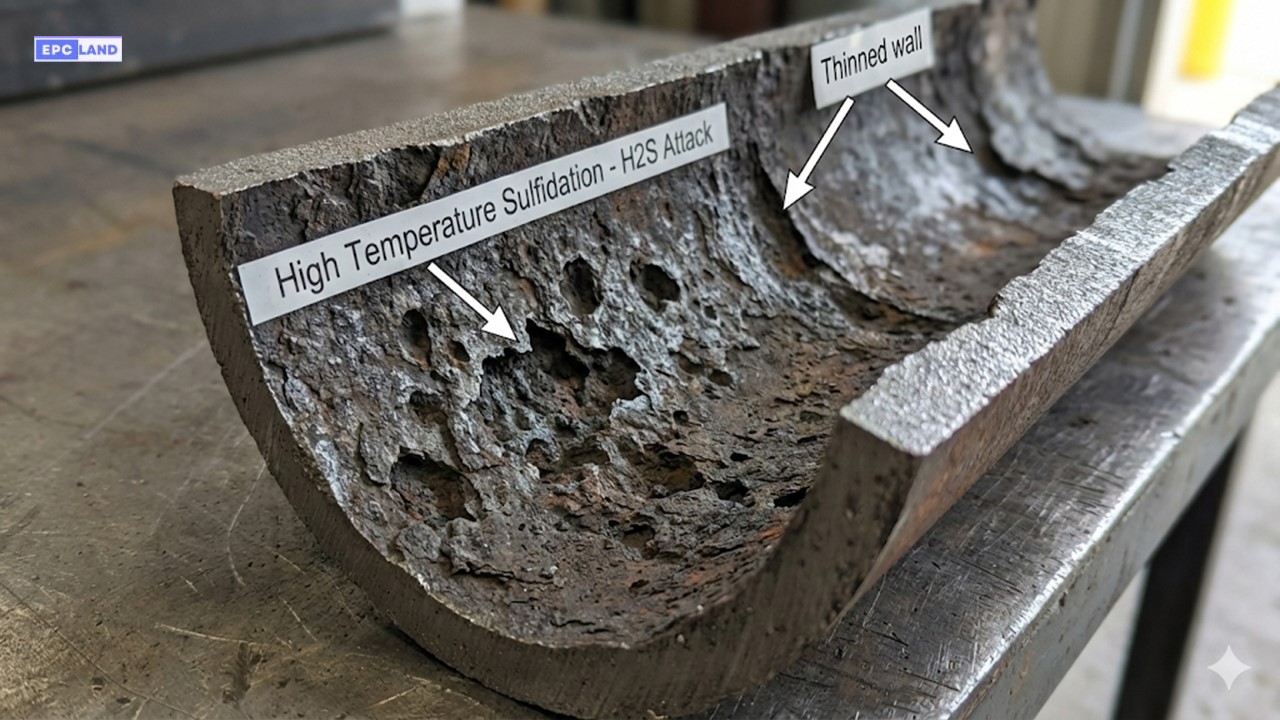
Figure 2: Cross-section of a transfer line showing 60% wall thickness loss due to sulfidation.
Project Data
Location
Independent Refinery, Southern Europe
Original Design
North Sea Brent (0.3% Sulfur)
New Feedstock
Urals Blend (1.8% Sulfur) – “Sour”
Failure Mechanism
High Temp Sulfidation (API 571)
The Problem: Ignoring the Chemistry
To capture a higher margin, the refinery purchased a cargo of Sour Crude at a $5/barrel discount compared to Brent. The operations team assumed that blending the sour crude (20% mix) would be safe.
The Engineering Failure: The Crude Distillation Unit’s transfer line—the pipe connecting the furnace to the column—operates at 360°C (680°F). It was built from standard Carbon Steel (ASTM A106 Gr B).
According to the McConomy Curves (the industry standard for corrosion rates), Carbon Steel has zero resistance to sulfur attack above 260°C. When the sulfur content spiked, the corrosion rate accelerated from 2 mpy (mils per year) to over 50 mpy. Within 18 months, the pipe wall thinned to the point of rupture, releasing a vapor cloud that ignited.
The Fix: Material Upgrades
This incident highlights the immense Refinery complexity for heavy crude processing. To safely run the cheaper feedstock, the facility had to rebuild the hot sections of the unit.
- Metallurgy Upgrade: The transfer line was replaced with 9-Chrome (9Cr-1Mo) alloy steel. The added Chromium forms a protective sulfide scale that resists attack.
- Monitoring: Installation of real-time UT (Ultrasonic Testing) sensors on elbows to monitor thickness loss.
- Compliance: Strict adherence to API 939-C (Sulfidation Corrosion in Refineries).
Key Lesson
Saving money on the feedstock (Brent vs. Sour) is only profitable if your hardware can survive the chemistry. The “Cheap” crude cost the refinery $15 Million in repairs and 3 weeks of downtime.
Frequently Asked Questions
Why is Brent usually more expensive than WTI?
The WTI vs Brent difference (or “spread”) is largely logistical. Brent is seaborne, meaning it can easily reach any port globally, keeping demand high. WTI is landlocked in the US Midwest. If US production surges and pipelines clog up at Cushing, OK, the local supply glut forces WTI prices down relative to Brent.
What are the main Crude Oil Benchmarks for 2026?
The “Big Three” remain dominant: Brent (Europe/Global), WTI (Americas), and Dubai/Oman (Middle East/Asia). However, the “Shanghai International Energy Exchange (INE)” crude futures are gaining traction as a benchmark for Chinese demand.
Can a car run on Crude Oil?
No. Even light sweet Brent crude contains wax, gums, and various boiling point fractions. It would clog fuel injectors immediately. It must pass through a Crude Distillation Unit to be separated into gasoline or diesel cuts.
What are the key Brent Crude Oil price factors?
Prices are driven by: 1. Geopolitics (Stability in the Middle East/Russia), 2. OPEC+ Policy (Production cuts vs. flooding the market), and 3. Global GDP (Demand from China and India). Since Brent is waterborne, it is most sensitive to international shipping disruptions (e.g., Suez Canal blockages).
Final Thoughts for 2026
Understanding the distinction between Brent Oil vs Crude Oil is more than vocabulary—it is the foundation of energy economics. Whether you are an engineer selecting materials for a sour crude retrofit or an investor watching the WTI-Brent spread, the chemistry of the barrel dictates the profit of the plant.
