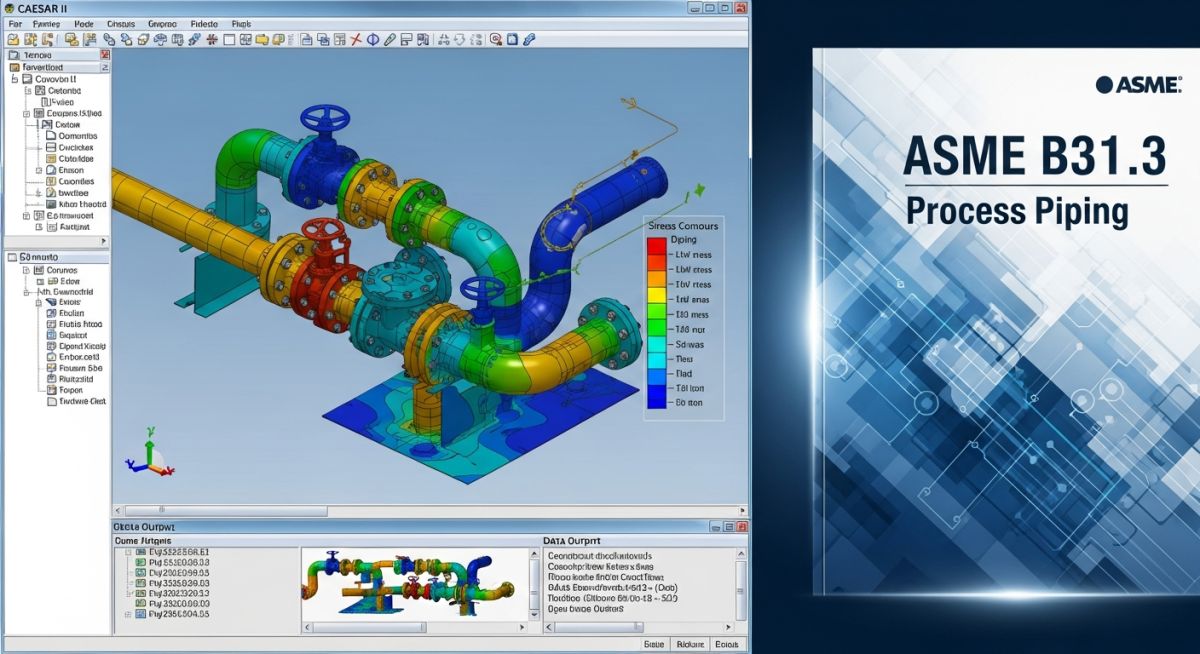
Mastering ASME B31.3 CAESAR II Updates for Stress Analysis
In my 20+ years of piping engineering experience, I have seen code revisions completely redefine how we execute stress analysis. The transition from the legacy ASME B31.3 Appendix D formulas to the modern ASME B31J standard is the most significant shift in our industry in decades. If you are still running stress models in CAESAR II using outdated default settings, you are likely generating highly inaccurate SIFs (Stress Intensification Factors) and k-factors. This can lead to either dangerously under-designed piping systems or excessively over-designed support structures that inflate project costs.
When I review models from junior engineers, the most common error I spot is a failure to align the CAESAR II configuration file with the specific code year mandated by the project specifications. The latest editions of ASME B31.3 make the use of ASME B31J SIFs the default requirement, rendering old Appendix D calculations obsolete for new designs. Understanding how to implement these changes in CAESAR II is no longer optional—it is a mandatory requirement for modern piping compliance.
Key Takeaways for Stress Engineers
- Learn how the deletion of Appendix D impacts your daily CAESAR II modeling workflow.
- Understand the mathematical application of Sustained Stress Indices (SSI) to prevent localized piping failures.
- Master the configuration steps in CAESAR II to seamlessly toggle between legacy and modern B31J SIF calculations.
- Discover how to audit and verify your stress models to pass rigorous third-party design reviews.
How to Apply ASME B31.3 CAESAR II Updates
ASME B31.3 CAESAR II updates implementation: The execution of specific software configuration steps, including selecting the correct code year, enabling ASME B31J SIFs, and defining sustained stress index parameters within the CAESAR II configuration module to align with current ASME B31.3 requirements.
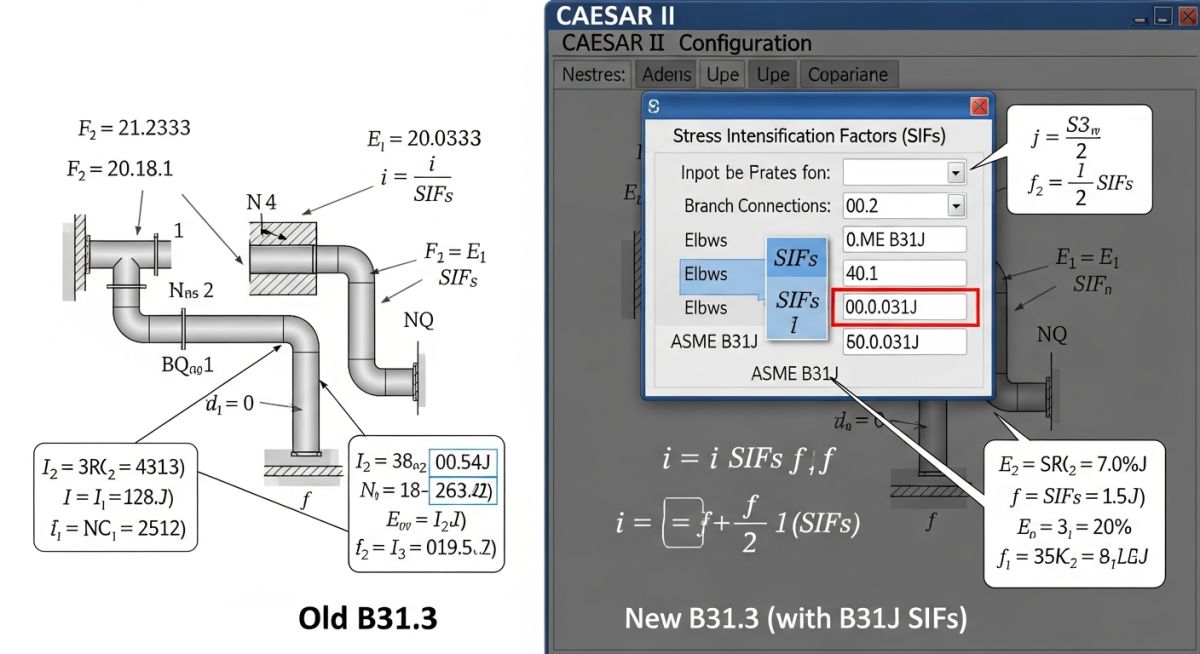
The most profound change in recent ASME B31.3 editions is the formal transition of SIF and flexibility factor calculations to ASME B31J. Historically, CAESAR II relied on Appendix D, which used simplified, simplified formulas developed in the 1950s. These legacy formulas often failed to accurately predict stresses in thin-walled, large-diameter piping, as well as in modern branch connections like weldolets.
The Physics of Sustained Stress Index (SSI)
In older code editions, SIFs were only applied to expansion (displacement) stress ranges. Sustained loads (weight and pressure) were calculated using nominal stresses without considering localized stress concentrations at fittings. The latest ASME B31.3 codes correct this by introducing the Sustained Stress Index (SSI), denoted as I_s. This index is applied directly to the bending terms in the sustained stress equation.
The sustained stress (S_L) is now calculated using the following plain-text formula:
Where:
• P is the internal design pressure.
• A_p is the cross-sectional area of the pipe inside diameter.
• A_m is the metal cross-sectional area.
• F_a is the longitudinal force from sustained loads such as weight.
• I_i and I_o are the in-plane and out-of-plane sustained stress indices (SSI), which default to 0.75 times the expansion SIF (i) unless otherwise specified by B31J.
• M_i and M_o are the in-plane and out-of-plane bending moments.
• Z is the corroded section modulus of the pipe.
Step-by-Step CAESAR II Configuration
To implement these changes correctly in your CAESAR II model, follow this exact sequence:
- Open the CAESAR II Piping Input module and navigate to the Environment tab.
- Select the appropriate ASME B31.3 code year (e.g., 2022 or 2024) from the drop-down menu.
- In the SIFs & Factors section, check the box for Use B31J. This instructs the software to pull SIFs and k-factors from the B31J database rather than the legacy Appendix D.
- Open the Configuration Editor from the main menu, select Computational Control, and verify that Sustained Stress Index (SSI) is set to “Apply SSI to Sustained Cases”.
- Run the error checker and review the output log to ensure no legacy SIF overrides are conflicting with the new B31J calculations.
Key Benefits of ASME B31.3 CAESAR II Updates
ASME B31.3 CAESAR II updates benefits: The optimization of piping design margins, reduction of over-conservative piping support structures, and mitigation of localized overstress failures achieved by utilizing modern B31J SIFs and updated sustained stress methodologies.
By utilizing the latest code updates, stress engineers can avoid the massive over-conservatism inherent in the old Appendix D rules, particularly for piping tees and branch connections. The table below outlines how different code editions handle these critical parameters within CAESAR II.
| ASME B31.3 Edition | SIF Source | Sustained Stress Index (SSI) | CAESAR II Default Action |
|---|---|---|---|
| Pre-2016 Editions | Appendix D (Legacy Formulas) | Not Applied (SSI = 1.0) | Calculates sustained stress without localized fitting stress. |
| 2016 & 2018 Editions | Appendix D or Optional B31J | Optional (User-defined) | Requires manual toggle to enable B31J calculations. |
| 2020 & 2022 Editions | ASME B31J (Mandatory Default) | Mandatory (SSI = 0.75 * i) | Automatically applies B31J SIFs if code year is selected. |
| 2024 Edition | ASME B31J (Refined Tables) | Mandatory (Fully Integrated) | Enforces strict validation of branch connection geometry. |
To ensure your design team uses the correct terminology and software inputs, refer to this technical mapping matrix. It links physical parameters to their corresponding CAESAR II input fields and code references.
| Entity / Acronym | Technical Definition | CAESAR II Input Field | Standard Reference |
|---|---|---|---|
| B31J SIF | Experimental stress intensification factor for piping components. | “Use B31J” Checkbox / SIF Multipliers | ASME B31J |
| SSI (I_s) | Sustained Stress Index applied to bending moments in sustained cases. | Configuration Editor -> SSI Toggle | ASME B31.3 Para 320 |
| k-Factor | Flexibility factor representing the ratio of fitting flexibility to straight pipe. | Flexibility Factor Override | ASME B31.3 Para 319.3.6 |
| W_L | Weld joint strength reduction factor for elevated temperature service. | Weld Joint Efficiency (W_L) | ASME B31.3 Para 302.3.5 |
How to Verify Your Stress Analysis Models
CAESAR II model verification: The structured quality assurance process of auditing input geometry, boundary conditions, material properties, and code-specific configuration settings in CAESAR II to guarantee compliance with ASME B31.3 requirements.
Before submitting any piping stress report for client approval, I require my team to run through a rigorous verification protocol. This checklist ensures that the latest ASME B31.3 updates are active and that the software is not running on outdated default assumptions.
Mandatory Quality Assurance Checkpoints
-
Code Year Validation: Verify that the active piping code in the CAESAR II input spreadsheet matches the exact year specified in the project design basis (e.g., ASME B31.3-2022).
-
B31J SIF Activation: Confirm that the “Use B31J” checkbox is enabled for all branch connections, tees, and elbows. Check that no legacy Appendix D overrides remain in the SIF spreadsheet.
-
Sustained Stress Index (SSI) Verification: Open the CAESAR II configuration file and verify that the SSI is set to apply to sustained load cases. The default value must align with the 0.75 multiplier rule.
-
Corrosion Allowance Application: Ensure that the corrosion allowance is correctly subtracted from the wall thickness for both sustained stress calculations and SIF calculations, as mandated by recent code updates.
-
Weld Joint Strength Reduction Factors: For systems operating above 800°F (427°C), verify that the temperature-dependent weld joint strength reduction factor (W_L) is manually entered in the material properties tab.
Field Case Study: Real-World Application
To resolve this issue without completely rerouting the massive flare line, we used CAESAR II to evaluate several mitigation strategies. By applying ASME B31J rules, we determined that adding a 12mm thick reinforcing pad (re-pad) to the branch connections would reduce the localized SIFs sufficiently to bring the system back into compliance.
This modification was executed during a planned turnaround, preventing a potential localized fatigue failure at the branch welds. This case study highlights why relying on legacy code methods for thin-walled piping is a major risk.
Frequently Asked Engineering Questions
Why did ASME B31.3 delete Appendix D in favor of ASME B31J?
How does CAESAR II calculate the Sustained Stress Index (SSI)?
Can I still run CAESAR II models using the old Appendix D rules?
What is the difference between SIF and SSI in piping stress analysis?
How do weld joint strength reduction factors (W_L) affect CAESAR II outputs?
Do I need a separate license for ASME B31J in CAESAR II?
===FAQ_BLOCK===
Complete Course on
Piping Engineering
Check Now
Key Features
- 125+ Hours Content
- 500+ Recorded Lectures
- 20+ Years Exp.
- Lifetime Access
Coverage
- Codes & Standards
- Layouts & Design
- Material Eng.
- Stress Analysis