ASME B31.3 vs ASME B31.12: The Hydrogen Penalty & Compliance Guide
The Core Difference
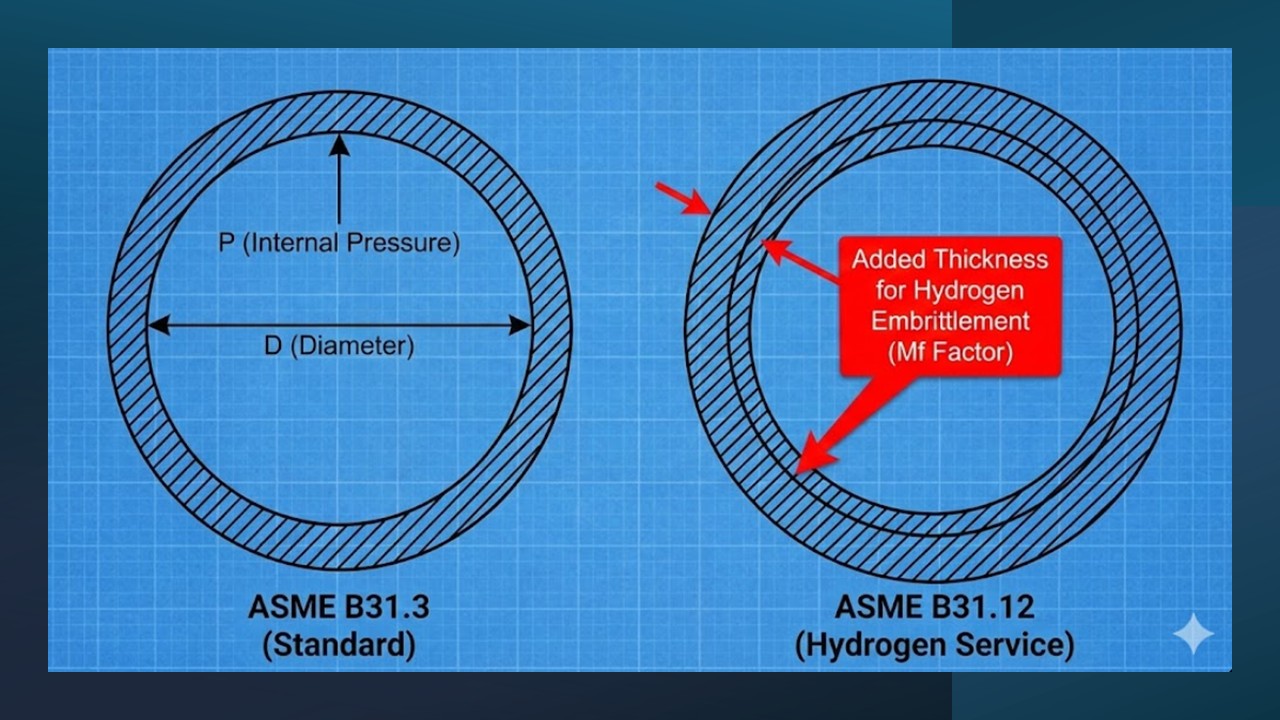
The fundamental difference between ASME B31.3 (Process Piping) and ASME B31.12 (Hydrogen Piping) is the treatment of material properties in hydrogen environments. While B31.3 uses a Weld Joint Strength Reduction Factor (W), B31.12 mandates a Material Performance Factor (Mf) to derate allowable stresses based on hydrogen embrittlement risks. This often results in 10-25% thicker walls for B31.12 compliance compared to B31.3 for the exact same pressure and temperature.

⚡ Engineer’s Knowledge Check
Question 1 of 5Which factor replaces the Weld Joint Strength Reduction Factor (W) in ASME B31.12 pressure design?
Complete Course on
Piping Engineering
Check Now
Key Features
- 125+ Hours Content
- 500+ Recorded Lectures
- 20+ Years Exp.
- Lifetime Access
Coverage
- Codes & Standards
- Layouts & Design
- Material Eng.
- Stress Analysis
Why B31.3 is “Dangerous” for Hydrogen in 2026
For decades, engineers used ASME B31.3 for hydrogen piping within plant boundaries. However, as hydrogen pressures rise (for electrolysis and mobility applications) and steel grades become stronger, the “general process piping” code fails to account for the atomic migration of hydrogen into the steel lattice.
This is why ASME B31.12 was developed. It isn’t just a copy-paste of B31.3; it introduces a fundamental penalty on your design strength called the Material Performance Factor ($M_f$). Ignorance of this factor is the #1 reason why legacy B31.3 designs fail compliance checks in modern Green Hydrogen projects.
The Mathematics of the “Thickness Penalty”
Let’s look at the wall thickness calculation formulas. At first glance, they look identical, but one variable changes everything.
ASME B31.3 (Process Piping)
- S: Allowable Stress
- E: Quality Factor
- W: Weld Strength Reduction Factor (Usually 1.0 for low temp)
ASME B31.12 (Hydrogen IP)
- S: Allowable Stress
- E: Quality Factor
- Mf: Material Performance Factor (< 1.0)
*Note: Formulas simplified for straight pipe under internal pressure (Equation 3a basis).
“In ASME B31.12, the material is guilty until proven innocent. The $M_f$ factor assumes the steel will lose strength due to hydrogen embrittlement, immediately penalizing the allowable stress and forcing a thicker wall.”
Understanding $M_f$ Values (The Penalty)
The $M_f$ factor is determined by the material’s yield strength and the design pressure. High-strength steels suffer the worst penalties because they are more susceptible to Hydrogen Induced Cracking (HIC).
| Material Grade (API 5L) | Specified Min Yield (ksi) | ASME B31.3 Factor | ASME B31.12 Factor ($M_f$) | Resulting Thickness Impact |
|---|---|---|---|---|
| Grade B / X42 | 42 ksi | 1.0 | 1.00 | No Change |
| X52 | 52 ksi | 1.0 | 0.877 (Typical) | ~14% Thicker |
| X60 | 60 ksi | 1.0 | 0.824 | ~21% Thicker |
| X70 | 70 ksi | 1.0 | 0.776 | ~28% Thicker (Huge Cost) |
*Values are illustrative based on B31.12 Table IX-5A logic. Design pressures < 2000 psi generally have better factors, but high-pressure systems face severe derating.
Critical Comparison: Fabrication & QC
It’s not just about wall thickness. If you specify a B31.12 piping system using B31.3 fabrication procedures, your welders will likely fail the project requirements.
1 Hardness Control
B31.12 mandates a maximum hardness (typically 22 HRC) to prevent embrittlement. B31.3 only requires this for specific corrosive services (NACE).
2 Preheat Requirements
B31.12 often requires preheating for all carbon steel thicknesses to drive out moisture/hydrogen, whereas B31.3 allows exemptions based on thickness.
EPCLand YouTube Channel
2,500+ Videos • Daily Updates
Frequently Asked Questions
Can I use ASME B31.3 for Hydrogen Piping?
Technically, yes, but with severe caveats. While B31.3 lists hydrogen as a fluid service, ASME B31.12 is the specific code for Hydrogen Piping and Pipelines. Using B31.3 requires rigorous supplementary specifications to match the safety margins of B31.12, specifically regarding hydrogen embrittlement and hardness control.
What is the Material Performance Factor (Mf) in B31.12?
The Material Performance Factor (Mf) is a penalty factor introduced in ASME B31.12 to derate the allowable stress of materials in hydrogen service. It accounts for the loss of ductility and tensile strength caused by hydrogen embrittlement. B31.3 does not use Mf.
Is ASME B31.12 retroactive for existing pipelines?
Generally, codes are not retroactive for built infrastructure unless mandated by a local regulator (like PHMSA in the USA) or if you are performing a “Change of Service” (e.g., converting a Natural Gas line to Hydrogen). In conversion cases, a B31.12 assessment is usually mandatory.
Does B31.12 require Post Weld Heat Treatment (PWHT)?
It is far more common in B31.12 than B31.3. B31.12 often requires PWHT to lower the hardness of the Heat Affected Zone (HAZ) to below 22 HRC (237 HB), which is critical for preventing Hydrogen Induced Cracking.
Final Verdict: Safety over Habits
Transitioning from ASME B31.3 to B31.12 is painful. The calculations result in thicker walls, the welding procedures are stricter, and the material testing is more expensive.
However, hydrogen is not merely a flammable gas; it is an atomic migrant that degrades steel from the inside out. Using B31.3 without modification for high-pressure hydrogen is an engineering gamble. In 2026, adherence to the Material Performance Factor ($M_f$) isn’t just “good practice”—it is the baseline for liability protection and operational safety.

Related posts:
![High-grade industrial Wing Nut Types and Applications for mechanical assemblies.]()
Wing Nut Types and Applications: The 2026 Engineering Guide
![Industrial Monorail Crane Systems installed in a modern manufacturing plant 2026.]()
Monorail Crane Systems: Design, Types & 2026 Standards Guide
![Lead engineer performing a Factory Acceptance Test FAT on an industrial skid system 2026]()
Factory Acceptance Test FAT: The 2026 Engineering Guide to Zero-Defect Delivery
![Professional engineering workspace showing a Basis of Design document layout for a 2026 project.]()
Basis of Design: How to Write a BOD for Engineering Projects in 2026
![Industrial Flare Knockout Drum Sizing and installation in a refinery relief system.]()
Flare Knockout Drum Sizing: Design & API 521 Standards (2026 Guide)
![Advanced Reboiler Control Systems in a modern petrochemical refinery 2026.]()
Reboiler Control Systems: Engineering Guide to Precision Control 2026