What is an Anchor Flange? Applications, Dimensions, and Technical Features

Key Engineering Takeaways:
- Thrust Control: Learn how the Anchor Flange restrains axial movement in pipelines.
- Standard Compliance: Understanding custom dimensions versus ASME B16.5 requirements for 2026 projects.
- Installation Excellence: Why concrete encasement is the “secret sauce” for Anchor Flange performance.
What is an Anchor Flange?
An Anchor Flange is a custom-forged, high-pressure pipeline fitting used to restrain axial movement caused by internal pressure or thermal expansion. Unlike standard flanges, it features a unique protruding shoulder (or hub) that is typically encased in a concrete thrust block, effectively transferring pipeline thrust to the earth.
“In my 20 years of field inspections, I’ve seen manifold failures that could have been avoided with a single, well-placed Anchor Flange. It isn’t just a fitting; it’s the physical insurance policy for your downstream equipment.”
— Atul Singla, Founder of Epcland
Complete Course on
Piping Engineering
Check Now
Key Features
- 125+ Hours Content
- 500+ Recorded Lectures
- 20+ Years Exp.
- Lifetime Access
Coverage
- Codes & Standards
- Layouts & Design
- Material Eng.
- Stress Analysis
Anchor Flange Mastery Quiz
Test your 2026 Engineering Competency
What is the primary structural purpose of an Anchor Flange shoulder?
Primary Uses of Anchor Flanges in Pipeline Engineering
The Anchor Flange serves as the primary structural interface between a pressurized pipeline and its foundation. Unlike standard flange connections that facilitate disassembly, the Anchor Flange is a monolithic forging designed to be permanently welded into the line. Its primary role is to act as a “thrust restrainer,” preventing the longitudinal movement of the pipe string. In 2026, as pipeline networks expand into more volatile geological zones, the reliance on these components for system integrity has never been higher.
1. Thermal Expansion Control
Large diameter pipelines experience significant axial growth when transporting heated fluids or when exposed to ambient temperature swings. Without an Anchor Flange, this expansion can exert massive forces on sensitive equipment like pumps, compressors, and pig launchers. By embedding the Anchor Flange in a concrete block, engineers effectively “pin” the pipeline, forcing expansion to be absorbed by expansion loops or soil friction rather than downstream components.
2. High-Pressure Thrust Restraint
At changes in direction (elbows), diameter (reducers), or at dead ends (blind flanges), internal pressure creates unbalanced thrust forces. An Anchor Flange is utilized to counteract these forces, ensuring the pipeline remains stationary under maximum operating pressure (MAOP). This is critical in 2026 for hydrogen-ready pipelines where pressure fluctuations can be more frequent.
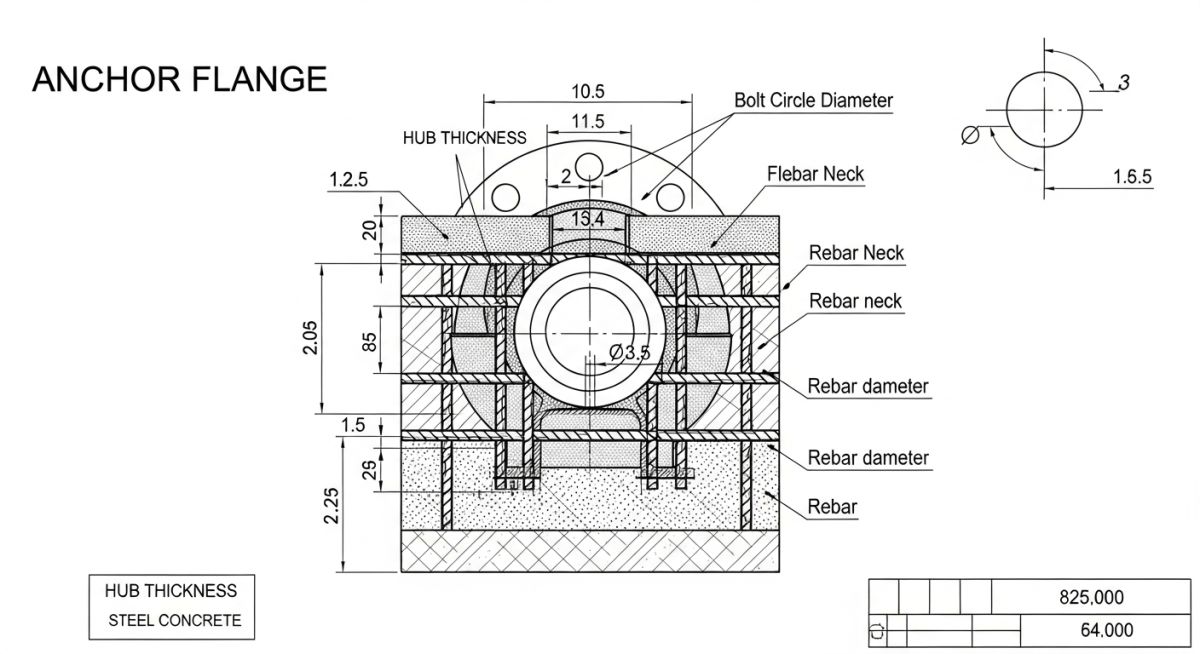
Critical Design Features of an Anchor Flange
To understand why an Anchor Flange is superior to traditional anchoring methods, one must look at its metallurgical and geometric configuration. It is specifically engineered to handle shear, bending, and axial loads simultaneously.
- Integral Shoulder: The most distinct feature is the raised circular collar. This shoulder provides the bearing surface that transfers loads to the concrete structure.
- Hub Geometry: The transition from the pipe wall thickness to the flange shoulder is carefully tapered to minimize stress concentrations, a critical requirement for high-cycle fatigue resistance.
- Matching Bore: Each Anchor Flange is custom-bored to match the internal diameter (ID) of the connecting pipe, ensuring piggability and smooth flow without turbulence.
Anchor Flange Dimensions and ASME Compliance
Engineering an Anchor Flange in 2026 requires a strict adherence to material yield strengths and pressure ratings defined by ASME B16.5 (for sizes up to 24″) and ASME B16.47 (for larger diameters). While the external dimensions of the “anchor shoulder” are often custom-designed based on the bearing capacity of the concrete thrust block, the hub and neck must meet the wall thickness requirements of the matching pipeline.
| Nominal Pipe Size (NPS) | Standard Class (PSI) | Typical Shoulder OD (mm) | Axial Load Capacity (kN) |
|---|---|---|---|
| 12″ (DN 300) | Class 600 | 480 – 520 | ~2,450 |
| 24″ (DN 600) | Class 900 | 840 – 910 | ~6,800 |
| 36″ (DN 900) | Class 1500 | 1250 – 1380 | ~15,200 |
Material Selection and Ordering Information for Anchor Flanges
Because an Anchor Flange is a safety-critical component, material certification is paramount. For modern high-yield pipelines, the forging must match the strength of the pipe to ensure weld compatibility and stress distribution.
Ordering Specification Checklist:
- ✔ Material Grade: ASTM A694 (F42 to F70) or ASTM A105.
- ✔ Design Code: ASME B31.3, B31.4, or B31.8.
- ✔ Pipe Schedule: Specify the exact WT (Wall Thickness).
- ✔ Corrosion Allowance: Typically 1.5mm to 3.0mm.
- ✔ Coating: Fusion Bonded Epoxy (FBE) for buried service.
- ✔ NDE Requirements: UT (Ultrasonic) and MPI (Magnetic Particle).
Engineering Standards Reference
For 2026 projects, ensure your Anchor Flange design complies with MSS SP-44 (Steel Pipeline Flanges) if using sizes between 12″ and 60″. If the application involves “Sour Service,” compliance with NACE MR0175/ISO 15156 is non-negotiable to prevent hydrogen-induced cracking in the forged body.
Anchor Flange Thrust Force Calculator
Estimate the static axial thrust (force) that your Anchor Flange must transfer to the concrete block based on internal pressure. (Calculations for 2026 Engineering Standards).
Estimated Axial Thrust Force
*Based on F = P × A (Pressure x Area). Does not include thermal expansion strain forces.
Don’t miss this video related to Flange
Summary: Master Piping Engineering with our complete 125+ hour Certification Course: ……
Anchor Flange Failure Case Study: Thermal Stress Mitigation

The Problem
A 30-inch natural gas pipeline in a high-temperature desert region experienced 4 inches of axial creep, causing the downstream ESD (Emergency Shut Down) valve to misalign and leak.
The Solution
Engineers retrofitted a custom-forged Anchor Flange (ASTM A694 F65) 50 meters upstream of the station, encased in a 15-cubic-meter reinforced concrete thrust block.
2026 Outcome
Post-installation monitoring confirmed zero movement at the station manifold. The Anchor Flange successfully absorbed 4.2 million Newtons of force.
Technical Analysis
The failure occurred because the original design relied solely on soil friction to dampen expansion. In sandy, loose-fill environments, soil friction coefficients are often overestimated. By 2026 standards, any pipeline transitioning from a buried state to an above-ground facility (like a compressor station) must utilize an Anchor Flange to create a “fixed point.”
Key Lesson: When calculating Anchor Flange dimensions for thermal loads, always use the maximum possible temperature differential (T2 – T1) rather than the average operating temperature to ensure the shoulder thickness can withstand the peak shear stress.
Expert Insights: Lessons from 20 years in the field
-
●
The Concrete Bond: Never skip the application of an epoxy-based bonding agent or mechanical rebar ties around the Anchor Flange shoulder. If the flange “slips” within the concrete block, the entire thrust restraint system fails.
-
●
NDE is Non-Negotiable: In 2026, we mandate 100% Volumetric Ultrasonic Testing (UT) on the transition area between the hub and the shoulder. This is where 90% of manufacturing forging defects (laminations) are discovered.
-
●
Piggability Matters: Always specify the “Matching Bore” to the decimal. Even a 2mm mismatch between the Anchor Flange and the pipe can damage expensive smart pigs during inspection runs.