Mastering Ball Valve Seat Selection for High-Pressure Systems
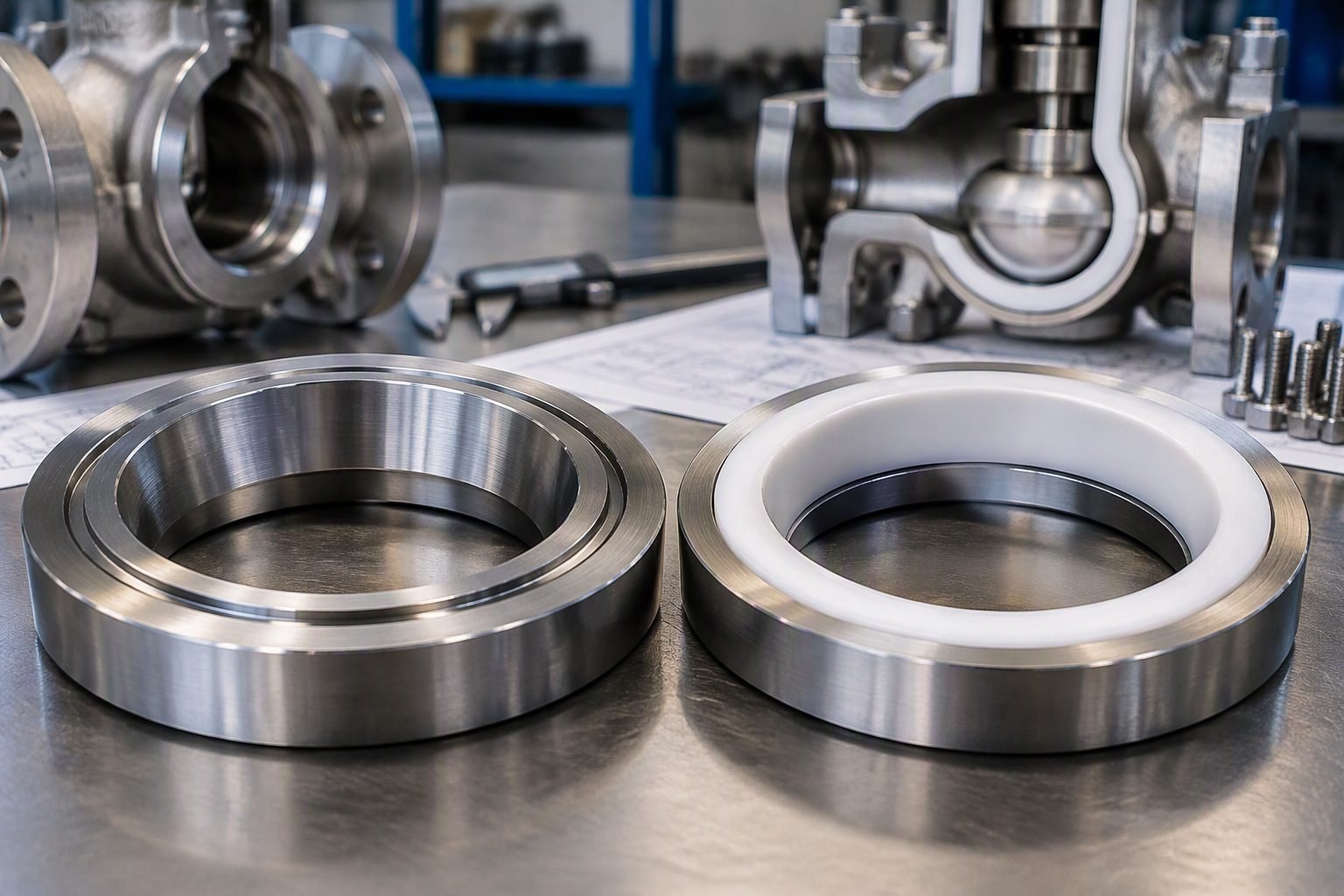
In my two decades of reviewing piping system failures, improper valve seat selection remains a primary root cause of fugitive emissions and premature plant shutdowns. When inspecting a disassembled ball valve on the workbench—where a scratched metal seat ring sits alongside a pristine, smooth white virgin PTFE ring—the stark reality of material limitations becomes immediately apparent.
Process engineers frequently struggle to balance the exceptional bubble-tight sealing capabilities of elastomeric and polymeric inserts against the extreme thermal and abrasive resilience of hardened alloy metal seats. Making the wrong choice in high-pressure or erosive slurry services will quickly compromise pressure boundary integrity.
Key Engineering Takeaways
- Soft PTFE seats provide Class VI bubble-tight shutoff but are limited by cold flow deformation and temperature ceilings.
- Metal-to-metal seats handle abrasive slurries and temperatures exceeding 400 degrees Celsius but demand precise lapping to achieve Class V leakage rates.
- ASME B16.34 and API 6D design frameworks dictate the mandatory pressure-temperature derating boundaries for every seat material grade.
Engineering Principles of Ball Valve Seat Selection
Navigating the intricacies of ball valve seat selection requires a deep understanding of fluid dynamics, mechanical stress distribution, and material science. When designing a high-pressure piping network, the valve seat is the ultimate line of defense between containment and environmental release.
Soft seats, typically manufactured from PTFE, RPTFE, PEEK, or PCTFE, rely on elastic deformation to wrap around the spherical ball surface. This compliance guarantees zero leakage, satisfying FCI 70-2 Class VI standards effortlessly.
Polymer Deformation and Temperature Limits
Virgin PTFE offers an exceptionally low coefficient of friction, reducing actuator torque requirements significantly. However, its susceptibility to cold flow under continuous mechanical load introduces severe design constraints.
As operating temperatures approach 200 degrees Celsius, PTFE loses its tensile strength rapidly. This triggers extrusion into the flow stream when subjected to high differential pressures.
Critical Design Warning: PV Limit Exceeded
Exceeding the Pressure-Velocity (PV) limit of polymeric seats in high-frequency cycling services causes frictional thermal degradation. This results in sudden, catastrophic blowout of the seat ring and loss of containment.
Metal-to-Metal Seating Mechanics
When processing abrasive catalyst fines, high-temperature steam, or hydrocarbons above 400 degrees Celsius, soft polymers fail instantly. Engineers must transition to metal-seated ball valve constructions.
Metal seats utilize hardened material pairs, such as Stellite overlay on 316 stainless steel or tungsten carbide coatings applied via High-Velocity Oxygen Fuel (HVOF) spraying. These hardfacings protect the substrate from abrasive wear.
Achieving a tight seal between two rigid metal surfaces requires extreme manufacturing precision. Lapping the ball and seat together as a matched set ensures intimate contact geometry across the entire seating band.
Spring-Energized Design Considerations
Metal seats cannot rely on bulk material elasticity to maintain contact with the floating ball. Consequently, metal-seated designs incorporate spring-energized mechanisms, such as Inconel wave springs or Belleville washers.
These springs exert a constant pre-load force against the seat ring, pushing it firmly against the ball even under low-pressure conditions. As line pressure increases, upstream pressure assists the mechanical load, driving the upstream seat tighter against the ball sphere.
Thermal expansion coefficients must be calculated meticulously across the full operating temperature range. If the valve body expands faster than the trim components, the spring preload can drop, causing immediate bypass leakage.
Advantages & Disadvantages
Soft Seating Advantages
- Achieves absolute bubble-tight shutoff meeting FCI 70-2 Class VI requirements effortlessly.
- Lower operating torque reduces actuator sizing and capital expenditure costs.
- Exceptional chemical resistance against aggressive acids and corrosive chemical media.
- Self-wiping action on the ball surface prevents minor particulate entrapment.
- Lower initial procurement cost for standard commercial utility services.
Metal Seating Disadvantages
- Higher manufacturing complexity and lapping time drive up initial procurement costs.
- Subject to scratching and scoring when exposed to unrefined particulate slurries.
- Stricter leakage classifications, typically limited to Class IV or Class V without special coatings.
- Higher breakout torque demands oversized pneumatic or electric actuators.
- Vulnerable to galling if surface hardness ratios between ball and seat are mismatched.
Real-World Applications
Refining Hydrocracker Isolation Services
High-pressure hydroprocessing units handle heavy gas oils containing abrasive catalyst fines at elevated temperatures. Metal-seated ball valves with tungsten carbide coatings provide the necessary surface hardness to resist erosive wear, ensuring reliable emergency isolation without seat destruction.
Cryogenic Liquefied Natural Gas Transfer
Transferring LNG at negative 162 degrees Celsius requires specialized soft-seated ball valves featuring modified TFE or PCTFE inserts. These specialized polymers retain sufficient elasticity under cryogenic conditions to prevent flashing and maintain bubble-tight containment.
Chlor-Alkali Chemical Processing
Manufacturing chlorine and caustic soda demands exceptional chemical inertness to prevent rapid corrosion of internal pressure boundaries. Virgin PTFE and PEEK soft seats provide complete resistance against aggressive chemical attack, eliminating fugitive emissions.
Supercritical Steam Power Generation
Power plant auxiliary steam systems operating above 500 degrees Celsius exceed the thermal decomposition threshold of all known polymers. Stellite-faced metal-seated ball valves are mandatory to withstand extreme thermal shock and prevent catastrophic seat blowout.
Ball Valve Seat Materials Comparison and ASME Limits
Ball valve seat selection directly dictates the operational pressure boundaries, temperature envelopes, and shutoff classification of industrial piping assemblies. In my experience across hydrocarbon processing and power generation facilities, misjudging the seat material relative to particulate loading is the leading cause of premature seat degradation and fugitive emissions. The following comparative matrix outlines the mechanical, thermal, and chemical performance limits of soft polymer configurations versus hardfaced metallic designs in accordance with ASME B16.34 and API 6D guidelines.
Reviewing these operational parameters ensures compliance with fugitive emission mandates (EPA Method 21) and prevents catastrophic blowouts during severe thermal cycling events. Pay close attention to differential pressure thresholds when specifying soft PTFE versus tungsten carbide coatings.
| Seat Material | Max Temp (°C / °F) | Max Pressure Class | Shutoff Class (ISO 5208) | Primary Service Limitation |
|---|---|---|---|---|
| Virgin PTFE | 200°C (392°F) | ASME Class 600 | Rate A (Bubble-tight) | Prone to cold flow, extrusion at high delta-P, vulnerable to abrasive slurries. |
| Glass-Filled PTFE (RTFE) | 230°C (446°F) | ASME Class 900 | Rate A (Bubble-tight) | Higher friction torque, can scratch polished ball spheres if particulates embed. |
| PEEK (Polyetheretherketone) | 260°C (500°F) | ASME Class 1500 | Rate A (Bubble-tight) | Expensive, sensitive to aggressive concentrated sulfuric acid at elevated temps. |
| Stellite 6 Hardfaced Metal | 540°C (1004°F) | ASME Class 2500 | Rate V to Rate IV | Requires lapping pairs, higher initial leakage rates compared to soft seats. |
| Tungsten Carbide (HVOF) | 450°C (842°F) | ASME Class 2500 | Rate V (High pressure) | Brittle under severe mechanical shock, susceptible to thermal shock cracking. |
Note: All pressure-temperature ratings must be cross-verified against the specific body material grouping listed in ASME B16.34 Table 2 to prevent pressure boundary failure during hydrostatic testing.
Technical Mapping & Specifications Matrix
Navigating valve engineering standards requires a precise grasp of governing bodies, acronyms, and mechanical design criteria. To establish a rigorous framework for ball valve seat selection, I have structured this comprehensive data matrix mapping out primary industry entities, codes, and physical parameters.
This matrix acts as a technical cross-reference for piping designers and integrity engineers ensuring that structural limits align with fluid dynamics and pressure containment requirements.
| Entity / Acronym | Governing Standard | Physical Parameter | Engineering Significance |
|---|---|---|---|
| ASME B16.34 | ASME | Pressure-Temperature Ratings | Defines wall thickness and material stress limits for valve bodies and trim. |
| API 6D | API | Pipeline Valve Specifications | Governs design, manufacturing, testing, and documentation for ball valves. |
| ISO 5208 | ISO | Pressure Testing of Metallic Valves | Establishes allowable seat leakage rates (Rates A through G). |
| PTFE / RTFE | ASTM D4894 | Polymer Yield Strength | Provides low friction coefficient but limits continuous service temperature. |
| Stellite 6 | AWS A5.13 | Cobalt-Base Hardfacing Alloy | Delivers exceptional galling, erosion, and high-temperature wear resistance. |
Cross-referencing these entities guarantees that procurement and quality control departments align with rigorous international safety and environmental mandates.
Ball Valve Seat Selection Site Verification Checklist
Proper engineering specification requires systematic site verification before purchasing and installing ball valves. In my field audits, skipping structured verification steps invariably leads to mismatched trim materials and expensive unplanned shutdowns. Use this comprehensive checklist to evaluate operational parameters and ensure complete code compliance.
Pre-Installation Engineering Verification Protocol
-
Fluid Phase and Viscosity Review:
Confirm whether process fluid is clean gas, viscous liquid, or multi-phase slurry to determine seat abrasive resistance requirements.
-
Maximum Temperature Envelope Check:
Verify that normal operating and upset temperatures do not exceed polymer thermal limits (ASTM D4894) or require metal-seated alternatives.
-
Differential Pressure Assessment:
Calculate maximum shutoff pressure drop across the ball sphere to prevent soft seat cold flow extrusion or dynamic spring overload.
-
Leakage Class Specification (ISO 5208):
Establish whether process isolation demands bubble-tight Rate A shutoff or permits allowable metallic Rate V bypass rates.
-
Fugitive Emissions Compliance:
Ensure seat energizers and body seal configurations meet low-emission standards (EPA Method 21 / ISO 15848).
-
Actuator Torque Sizing Verification:
Verify that breakaway and running torque calculations incorporate friction coefficients specific to selected metal or soft seat pairs.
Completing these verification steps safeguards capital investment and guarantees long-term operational reliability across demanding industrial plant environments.
Field Case Study: Real-World Application
During a commissioning phase at a high-pressure catalytic cracking unit, severe seat failure occurred within three weeks of initial startup. The project utilized standard virgin PTFE seated ball valves on a hydrocarbon slurry letdown service operating at 180°C and 6.8 MPa differential pressure. The operational mismatch resulted in catastrophic leakage and forced an unplanned facility shutdown.
The Problem: Soft Seat Extrusion and Particulate Erosion
The soft virgin PTFE seats suffered structural collapse due to severe thermal and mechanical loading limits.
- Continuous operating temperatures pushed PTFE past its crystalline melting threshold, inducing severe cold flow deformation.
- High differential pressure forced the softened polymer into the ball port clearance gap, causing tearing.
- Entrained catalyst fines cut grooves into the exposed soft seat surfaces, destroying bubble-tight sealing integrity.
- Actuator breakaway torque spiked drastically, shearing the valve stem pin during remote closure commands.
The Outcome: Metal-Seated Tungsten Carbide Upgrade
Replacing the soft-seated valves with engineered metal-seated ball valves resolved the operational instability permanently.
- Installed trunnion-mounted ball valves featuring HVOF applied tungsten carbide coatings on both the ball and seat rings.
- Incorporated spring-loaded seat energizers to maintain constant mechanical contact across thermal transients.
- Achieved stable ISO 5208 Rate V shutoff while successfully withstanding erosive catalyst slurry impingement.
- Eliminated fugitive emissions and operated continuously through two full turnaround cycles without maintenance intervention.
Engineering Recommendation: Always perform a rigorous multiphase fluid analysis during the front-end engineering design phase. Never specify soft polymer seats when particulate loading or severe pressure drops are present.
Frequently Asked Engineering Questions
What is the primary temperature limit for soft-seated PTFE ball valves?
Soft-seated PTFE valves generally operate safely up to 200°C (392°F). Exceeding this thermal threshold causes material degradation and rapid seat deformation.
- Virgin PTFE limits: Maximum continuous service is restricted to 180°C.
- Reinforced PTFE (RPTFE): Extends the thermal threshold up to 220°C.
- Compliance reference: Check pressure-temperature ratings in ASME B16.34.
How do metal-seated ball valves achieve reliable shutoff compared to soft seats?
Metal-seated valves rely on precision-machined, matched ball-and-seat sets to minimize leakage paths. They cannot achieve absolute zero leakage like soft seats but meet strict industrial standards.
- Leakage classification: Typically rated to Class IV or Class V per FCI 70-2.
- Mated sets: Balls and seats are lapped together as a unique pair.
- Testing protocols: Verified using high-pressure gas or liquid tests under API 598.
When should I specify metal-seated construction over soft PTFE seats?
I specify metal seats when the process fluid contains abrasive solids or operates at extreme temperatures. Soft seats fail rapidly under these severe conditions.
- Slurry service: Catalyst loops, mining slurries, and fly ash handling.
- High temperatures: Applications exceeding 250°C where polymers soften.
- Standard compliance: Designed to meet robust shell wall thicknesses per ASME B16.34.
What causes premature failure in soft-seated ball valves?
Premature failure usually stems from thermal cycling, abrasive particles embedding in the polymer, or fluid velocity erosion. Once the soft seat is scored, bubble-tight shutoff is lost.
- Particulate embedding: Hard particles scratch the ball during cycling.
- Cold flow: High localized stresses cause the PTFE to deform permanently.
- Cavitation damage: High pressure drops destroy the soft polymer matrix.
How does seat selection impact the operating torque of a ball valve?
Metal-seated ball valves require significantly higher operating torque than soft-seated alternatives. This directly impacts actuator sizing and overall system costs.
- Friction coefficient: Metal-on-metal contact creates high breakout torque.
- Actuator sizing: Requires a larger safety margin, often 1.3 to 1.5 times calculated torque.
- Soft seat advantage: PTFE provides self-lubricating properties, lowering torque demands under API 6D.
Based on my 20+ years of piping engineering experience, selecting the correct seat design is a balance between process chemistry, temperature limits, and budget constraints. I recommend the following field-tested guidelines for your next project:
- If your process fluid contains catalyst fines, sand, or abrasive particulates at concentrations above 0.5% by weight, choose metal-seated valves with tungsten carbide coatings because soft PTFE seats will suffer rapid scoring and fail within weeks.
- When designing clean utility lines, nitrogen headers, or low-pressure water systems under 150°C where absolute zero leakage is mandatory, select reinforced PTFE seats because they achieve bubble-tight shutoff at a fraction of the cost of metal-seated alternatives.
- If your piping system experiences rapid thermal cycling between ambient and high temperatures, avoid soft seats entirely because the differential thermal expansion will cause cold flow, leading to catastrophic seat bypass.
- In my experience, always size your pneumatic actuators with a minimum 40% torque safety factor when specifying metal-seated valves to prevent sticking after long periods of static open or closed operation.
Complete Course on
Piping Engineering
Check Now
Key Features
- 125+ Hours Content
- 500+ Recorded Lectures
- 20+ Years Exp.
- Lifetime Access
Coverage
- Codes & Standards
- Layouts & Design
- Material Eng.
- Stress Analysis
