
FuelEU Maritime and RFNBO Opportunities for Shipping Decarbonization
In my two decades of experience within the piping and energy infrastructure sector, I have rarely seen a regulatory shift as transformative as the FuelEU Maritime initiative. This regulation is not merely a suggestion; it is a hard-coded mandate that forces the shipping industry to pivot away from heavy fuel oils toward sustainable alternatives. As we navigate the complexities of FuelEU Maritime compliance, the integration of RFNBOs—specifically green ammonia and green methanol—has become the primary technical challenge for fleet owners and port engineers alike.
The transition requires more than just fuel switching; it demands a complete overhaul of bunkering infrastructure, storage tank metallurgy, and engine combustion systems. My focus here is to break down the technical requirements of these fuels, ensuring that your engineering teams can meet the stringent carbon intensity targets set by the European Union while maintaining operational safety and efficiency.
Key Takeaways for Engineering Teams
- Understand the GHG intensity reduction trajectory mandated by the EU through 2050.
- Evaluate the material compatibility challenges of green ammonia vs. green methanol.
- Identify the critical role of RFNBO certification in achieving compliance credits.
- Prepare for infrastructure upgrades in bunkering and on-board storage systems.
Complete Course on
Piping Engineering
Check Now
Key Features
- 125+ Hours Content
- 500+ Recorded Lectures
- 20+ Years Exp.
- Lifetime Access
Coverage
- Codes & Standards
- Layouts & Design
- Material Eng.
- Stress Analysis
FuelEU Maritime and RFNBO Technical Deep-Dive
FuelEU Maritime Compliance Engineering: A comprehensive technical approach to reducing the lifecycle greenhouse gas intensity of maritime fuels through the adoption of RFNBOs and advanced energy conversion systems.
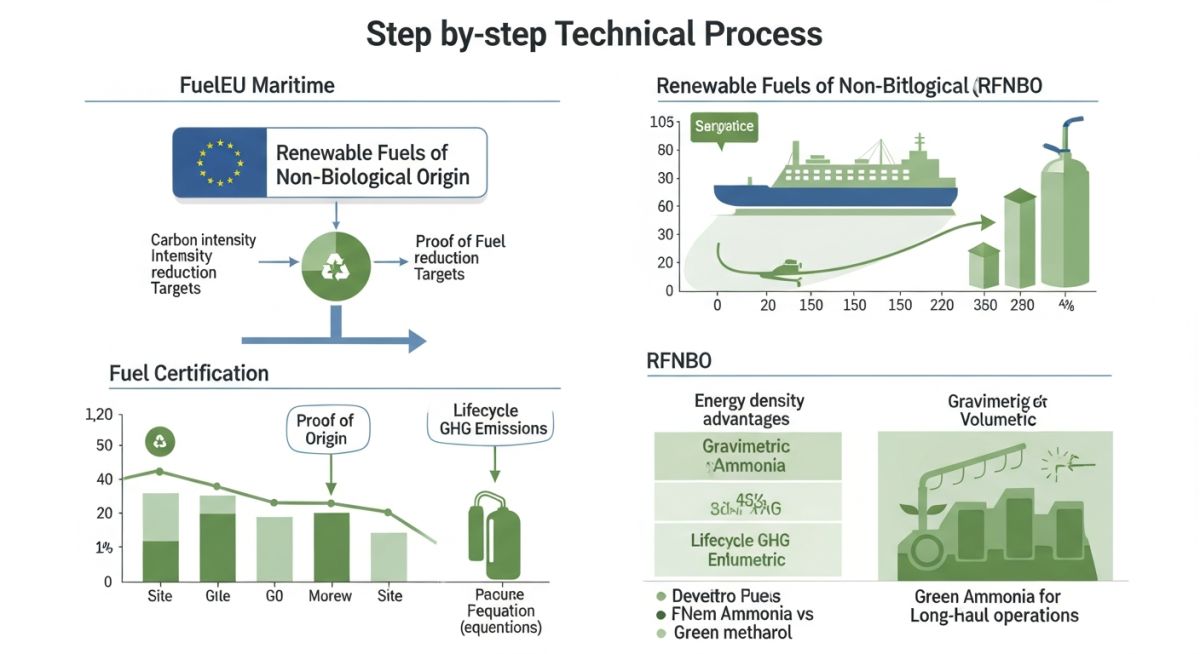
The core of the FuelEU Maritime regulation lies in the lifecycle assessment of fuel energy. Unlike previous regulations that focused solely on tailpipe emissions, this framework accounts for the entire well-to-wake carbon footprint. For engineers, this means the selection of fuel is no longer just about energy density; it is about the carbon intensity (CI) score of the production pathway. RFNBOs, defined under the Renewable Energy Directive (RED III), provide the most significant pathway for compliance due to their near-zero lifecycle emissions.
Green Ammonia: Material and Safety Parameters
Green ammonia (NH3) is a frontrunner for long-haul shipping due to its zero-carbon combustion. However, from a piping engineering perspective, it presents significant challenges. Ammonia is highly toxic and corrosive to copper-based alloys. We must specify stainless steel (typically 316L) or carbon steel with specific stress-corrosion cracking (SCC) mitigation strategies. The design pressure for liquid ammonia storage typically ranges from 10 to 20 bar, requiring robust pressure relief systems and double-walled piping to prevent catastrophic leaks.
Engineering Warning: Ammonia Stress Corrosion Cracking
In my experience, the presence of oxygen and water in ammonia systems significantly accelerates SCC in carbon steel welds. Post-weld heat treatment (PWHT) is mandatory for all ammonia-wetted pressure components to reduce residual stresses below the threshold for crack initiation. Always reference ASME B31.3 for process piping design in these high-risk environments.
Green Methanol: Combustion and Storage
Green methanol (CH3OH) is easier to handle than ammonia but requires larger storage volumes due to its lower volumetric energy density. Methanol is a solvent, which means it can degrade standard elastomers and seals. We must ensure that all gaskets and O-rings are compatible with alcohol-based fuels, typically utilizing PTFE or specialized fluoroelastomers. The combustion of methanol in dual-fuel engines is well-understood, but the fuel supply system must be designed to handle the lower lubricity of methanol, often requiring fuel additives or specialized pump coatings to prevent premature wear.
To calculate the required fuel volume for a voyage, we use the energy density ratio. If the energy density of HFO is approximately 40 MJ/kg and methanol is 20 MJ/kg, the storage capacity must be doubled to maintain the same range. This impacts the vessel’s deadweight and trim, requiring a multidisciplinary approach between the naval architect and the piping engineer.
RFNBO Implementation Analysis: A critical evaluation of the technical and operational trade-offs associated with transitioning to green ammonia and methanol in maritime applications.
Advantages
- Significant reduction in lifecycle GHG emissions meeting EU targets.
- Ammonia offers high energy density compared to hydrogen gas.
- Methanol utilizes existing liquid fuel bunkering infrastructure with modifications.
- RFNBOs provide long-term regulatory immunity against carbon taxation.
- Green methanol is liquid at ambient conditions, simplifying storage.
Disadvantages
- Ammonia toxicity requires stringent safety and containment protocols.
- Methanol requires double the storage volume of conventional fuels.
- High capital expenditure for engine retrofits and fuel supply systems.
- Limited global availability of certified green RFNBO bunkering.
- Material compatibility issues with standard seals and copper alloys.
Maritime Decarbonization Deployment: Strategic implementation of RFNBO-ready systems across diverse shipping sectors to ensure compliance with evolving international and regional environmental standards.
Deep-Sea Container Shipping
Large-scale container vessels are currently piloting green methanol dual-fuel engines to navigate the FuelEU Maritime transition. These systems utilize specialized fuel injection pumps and high-pressure piping to manage methanol’s unique viscosity and lubricity characteristics during long-haul transoceanic voyages.
Ammonia-Powered Bulk Carriers
Bulk carriers operating on fixed routes are ideal candidates for green ammonia, where bunkering infrastructure can be centralized at major industrial ports. The engineering focus here is on the integration of ammonia-scrubbing systems and rigorous leak detection sensors to protect the crew and the environment.
Short-Sea Ro-Ro Ferries
Short-sea shipping routes benefit from the rapid refueling capabilities of green methanol, allowing for quick turnaround times in busy ports. These vessels often incorporate modular fuel storage tanks that can be easily upgraded as the regulatory landscape for RFNBOs continues to evolve.
The FuelEU Maritime regulation mandates a progressive reduction in the yearly average greenhouse gas intensity of the energy used on-board by ships. As an engineer, I evaluate these targets against the baseline established in 2020, which serves as the reference point for all future compliance calculations. The transition requires a shift from traditional heavy fuel oils toward low-carbon and renewable fuels, specifically targeting the integration of Renewable Fuels of Non-Biological Origin (RFNBOs).
The table below outlines the reduction trajectory required for compliance. Note that these percentages represent the maximum allowable greenhouse gas intensity relative to the 2020 reference value. Failure to meet these thresholds results in significant financial penalties, calculated based on the energy deficit and the cost of non-compliance units. My experience suggests that early adoption of dual-fuel propulsion systems is the most robust strategy to mitigate these long-term regulatory risks.
| Compliance Year | Reduction Target (%) | Primary Fuel Focus |
|---|---|---|
| 2025 | 2.0% | Bio-blends / LNG |
| 2030 | 6.0% | RFNBO / Green Methanol |
| 2035 | 14.5% | Green Ammonia / Hydrogen |
| 2040 | 31.0% | Advanced RFNBOs |
Navigating the regulatory landscape of FuelEU Maritime requires a precise understanding of the technical entities involved in the decarbonization chain. From the production of green hydrogen via electrolysis to the final combustion or fuel cell conversion on a vessel, every step must be documented to ensure compliance with the EU Renewable Energy Directive. This matrix maps the critical components, their associated standards, and their role in the maritime energy transition.
Engineers must ensure that the fuel supply chain, from bunkering to storage, adheres to international safety standards such as the IMO IGF Code. The following matrix provides a high-level overview of the technical parameters and regulatory references that govern the adoption of alternative fuels in the shipping sector. By aligning your project specifications with these entities, you ensure that your vessel remains compliant throughout its operational lifecycle.
| Entity | Standard/Ref | Technical Parameter |
|---|---|---|
| RFNBO | RED III | Carbon Intensity |
| Green Ammonia | ISO 18531 | Energy Density |
| Green Methanol | ASTM D1152 | Flash Point |
| Fuel Cell | IEC 62282 | Efficiency Ratio |
Achieving compliance under FuelEU Maritime is not merely a paperwork exercise; it requires a fundamental audit of your vessel’s energy systems and fuel procurement strategy. As a lead engineer, I have developed this verification checklist to ensure that your technical infrastructure is prepared for the stringent reporting requirements and the transition to RFNBO-compliant fuels. Use this list to audit your current fleet status and identify gaps in your decarbonization roadmap.
- ☐ Fuel Monitoring System: Verify that your flow meters and data loggers are calibrated to ISO 9001 standards for accurate greenhouse gas intensity reporting.
- ☐ RFNBO Certification: Ensure all bunkered renewable fuels possess valid Proof of Sustainability (PoS) certificates as required by the EU Renewable Energy Directive.
- ☐ Storage Compatibility: Confirm that existing fuel tanks and piping materials are compatible with the chemical properties of green ammonia or methanol, specifically regarding corrosion resistance and seal integrity.
- ☐ Bunkering Infrastructure: Audit the port-side bunkering facilities to ensure they meet the safety requirements for low-flashpoint fuels as defined in the IMO IGF Code.
- ☐ Emission Reporting: Implement a digital MRV (Monitoring, Reporting, and Verification) tool that integrates directly with your engine management system to automate compliance data submission.
Regular site verification is mandatory. I recommend conducting these audits on a quarterly basis to account for changes in fuel availability and evolving regulatory interpretations. Documentation of these checks is essential for the annual compliance review by the European Maritime Safety Agency (EMSA).
The Challenge: Retrofitting for Green Ammonia
A major shipping operator faced significant hurdles when attempting to retrofit a fleet of container vessels for green ammonia propulsion to meet the 2030 FuelEU Maritime targets.
- Incompatibility of existing carbon steel piping with ammonia-induced stress corrosion cracking.
- Lack of standardized bunkering infrastructure at key European ports.
- High capital expenditure required for dual-fuel engine conversion and specialized storage tanks.
- Regulatory uncertainty regarding the certification of RFNBO-derived ammonia.
The Outcome: Successful Compliance Integration
By adopting a phased transition strategy, the operator successfully achieved compliance while minimizing operational downtime.
- Implemented stainless steel piping upgrades to mitigate corrosion risks.
- Secured long-term supply agreements for certified green ammonia, ensuring a stable RFNBO source.
- Achieved a 12% reduction in greenhouse gas intensity within the first 18 months of operation.
- Leveraged digital monitoring tools to automate the reporting process, reducing administrative overhead by 30%.
My recommendation for similar projects is to prioritize the material compatibility assessment early in the design phase. Do not underestimate the complexity of the supply chain; securing reliable RFNBO sources is just as critical as the technical engine modifications themselves.
How does FuelEU Maritime define RFNBOs?
- Must be produced using electricity from renewable sources.
- Must demonstrate a lifecycle greenhouse gas saving of at least 70% compared to fossil fuels.
- Must comply with the principle of additionality, ensuring renewable energy used for production does not displace existing grid demand.
What are the primary risks of using green ammonia?
- High toxicity levels require advanced leak detection and containment systems.
- Susceptibility to stress corrosion cracking in standard carbon steel piping.
- Requirement for specialized cryogenic or pressurized storage tanks.
- Need for comprehensive crew training on handling hazardous chemical substances.
How is the greenhouse gas intensity calculated?
- Well-to-tank emissions: Includes extraction, processing, and distribution of the fuel.
- Tank-to-wake emissions: Includes the combustion or conversion process on the ship.
- Standardized emission factors provided by the European Commission for various fuel types.
- Verification by independent third-party auditors to ensure data integrity.
Can green methanol replace heavy fuel oil?
- Requires dual-fuel engines capable of methanol injection.
- Lower energy density necessitates larger fuel storage tanks for the same range.
- Excellent compatibility with existing port infrastructure compared to ammonia.
- Significant reduction in sulfur and particulate matter emissions.
What are the penalties for non-compliance?
- Financial penalties are levied per unit of energy deficit.
- Repeated non-compliance can lead to increased scrutiny and potential operational restrictions.
- Revenue from penalties is reinvested into the maritime decarbonization fund.
- Compliance units can be banked or borrowed within specific limits to manage short-term fluctuations.
How do I start my compliance roadmap?
- Conduct a baseline audit of your fleet’s current greenhouse gas intensity.
- Evaluate the feasibility of retrofitting versus new-build investments based on vessel age.
- Establish partnerships with certified RFNBO suppliers to secure future fuel volumes.
- Engage with classification societies to ensure all technical modifications meet safety and regulatory standards.
