How Does Stainless Steel Oxide Film Formation Prevent Corrosion?
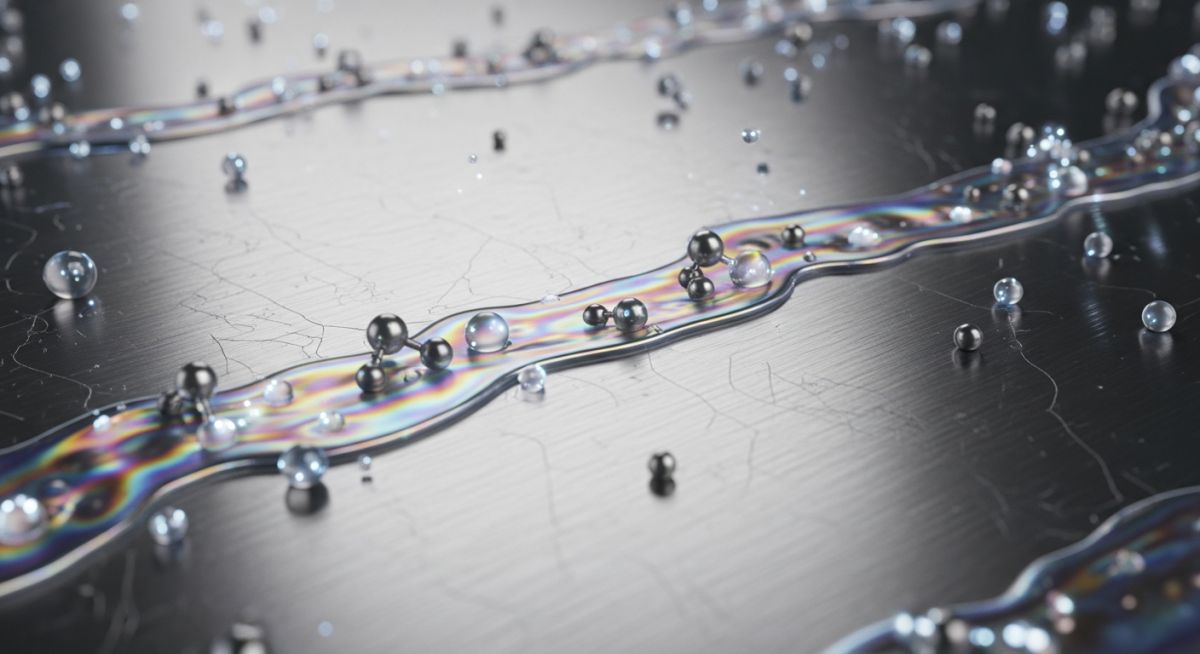
In my 20 years of piping engineering, I have seen countless failures due to poor passivation. Let me tell you, understanding the molecular barrier is what separates a reliable plant from a maintenance nightmare. When we specify stainless steel for highly corrosive process environments, we are not relying on the bulk metal itself to resist attack. Instead, we rely entirely on a self-healing, nanometer-thin barrier. This barrier is the direct result of chromium reacting with oxygen at the molecular level.
If this film is compromised, contaminated, or depleted, the alloy behaves no better than ordinary carbon steel. In this guide, I will walk you through the thermodynamic, kinetic, and metallurgical mechanisms that govern this protective layer, drawing directly from my field experience in chemical processing and high-purity piping systems.
Key Engineering Takeaways
- Chromium Threshold: A minimum of 10.5% chromium is required to establish a continuous, self-healing passive film.
- Pilling-Bedworth Ratio: The chromium oxide layer exhibits a ratio of approximately 2.07, indicating a highly stable, compressive, and non-porous structure.
- Self-Healing Nature: In the presence of oxygen, the passive film reforms almost instantaneously when mechanically damaged.
- Passivation Standards: Field verification must align with ASTM A967 to ensure the complete removal of free iron contaminants.
What Controls Stainless Steel Oxide Film Formation Kinetics?
To truly appreciate how this film works, we must look at the thermodynamics of the system. Chromium has an extremely high affinity for oxygen. When exposed to air or water, chromium oxidizes preferentially over iron. This reaction is represented by the formation of chromium(III) oxide (Cr2O3). According to the Ellingham diagram, the Gibbs free energy of formation for chromium oxide is highly negative, making this reaction spontaneous even at room temperature and under extremely low oxygen partial pressures.
The physical integrity of this oxide layer is evaluated using the Pilling-Bedworth Ratio (PBR). The PBR is defined as:
For chromium oxide on stainless steel, the PBR is approximately 2.07. A ratio between 1 and 2.5 indicates that the oxide layer is under moderate compressive stress. This compressive stress is highly beneficial because it keeps the film cohesive, continuous, and free of cracks. If the ratio were less than 1 (like sodium or magnesium), the oxide would be porous and fail to protect the underlying metal. If it were greater than 2.5 (like iron scale), the excessive compressive stress would cause the film to spall and flake off.
In my experience, welding without proper heat input control can destroy this protective mechanism. When stainless steel is held in the temperature range of 500 to 800 degrees Celsius, chromium carbides precipitate along the grain boundaries. This depletes the adjacent areas of chromium, dropping the local concentration below the critical 10.5% threshold. This phenomenon, known as sensitization, prevents the formation of the passive film and leads to rapid intergranular corrosion.
The kinetics of the film growth follow a logarithmic decay curve. Initially, the film forms rapidly within milliseconds. As the thickness of the chromium oxide layer reaches 1 to 5 nanometers, it acts as an electrical insulator and physical barrier. This barrier drastically slows down the diffusion of metal ions to the surface and oxygen ions to the metal interface, effectively halting further growth.
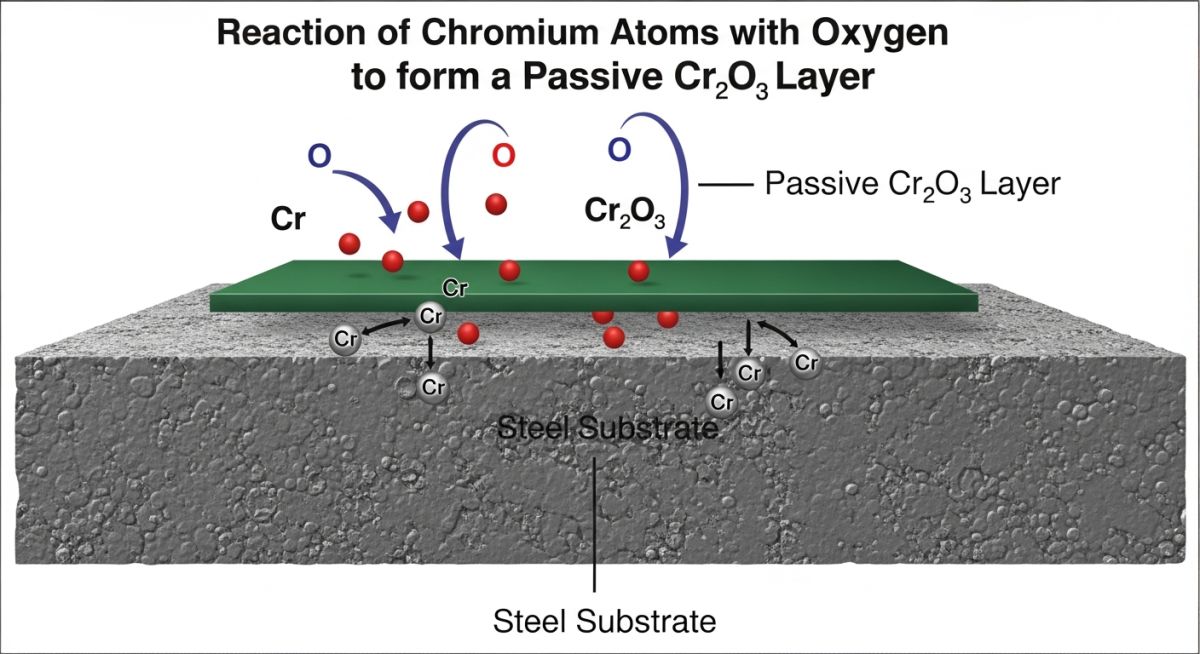
In addition to chromium, alloying elements like molybdenum play a critical role. Molybdenum does not directly form the primary passive film, but it segregates into active pitting sites. There, it forms stable molybdate compounds that block chloride ion penetration, significantly enhancing the pitting resistance of the alloy in marine and chemical environments.
The table below outlines how different grades of stainless steel behave during passivation, highlighting the relationship between chromium content, alloying elements, and the resulting passive film properties.
| Stainless Steel Grade | Nominal Chromium % | Pilling-Bedworth Ratio | Passive Film Thickness (nm) | Critical Pitting Temp (CPT) |
|---|---|---|---|---|
| 304 (Austenitic) | 18.0 – 20.0 | 2.07 | 1.5 – 3.0 | 15°C |
| 316L (Austenitic) | 16.0 – 18.0 | 2.07 | 2.0 – 4.0 | 25°C |
| 904L (Super Austenitic) | 19.0 – 23.0 | 2.08 | 3.0 – 5.0 | 55°C |
| 2205 (Duplex) | 21.0 – 23.0 | 2.07 | 2.5 – 4.5 | 35°C |
This matrix maps the key metallurgical entities involved in passivation to their primary functions, governing standards, and critical field parameters.
| Metallurgical Entity | Primary Function | Governing Standard | Key Parameter |
|---|---|---|---|
| Chromium Oxide (Cr2O3) | Primary passive barrier against general corrosion | ASTM A380 | Cr/Fe ratio greater than 1.5 |
| Molybdenum (Mo) | Resists localized pitting and crevice corrosion | ISO 15156 | PREN greater than 22 for 316L |
| Nitric Acid Passivation | Dissolves free iron and accelerates oxide formation | ASTM A967 | 20-55% concentration at 50°C |
| Citric Acid Passivation | Environmentally friendly chelating agent for iron removal | ASTM A967 | 4-10% concentration at 60°C |
How to Verify Stainless Steel Oxide Film Formation On-Site?
In my field inspections, I never rely on visual checks alone. A clean-looking weld can still have free iron contamination that will rust within days of exposure to moisture. To ensure that the stainless steel oxide film formation has occurred successfully, you must implement a rigorous verification protocol.
Site Verification Checklist
-
Pre-Cleaning Inspection: Verify that all grease, oils, and drawing compounds are completely removed using alkaline cleaners before acid treatment. Hydrocarbons prevent the acid from contacting the metal surface.
-
Water-Wetting Test: Spray the surface with clean, demineralized water. If the water beads up instead of forming a continuous, unbroken film, residual hydrophobic contaminants are still present.
-
Copper Sulfate Test: Apply an acidified copper sulfate solution to the surface for 6 minutes. If free iron is present, copper will plate out as a visible red spot. This test is not recommended for food-contact surfaces.
-
Ferroxyl Test: For critical applications, apply a potassium ferricyanide and nitric acid solution. A blue color indicates free iron contamination. This test is highly sensitive and must be thoroughly rinsed immediately to prevent pitting.
-
Electrochemical Passivation Testing: Use a portable passivation meter to measure the open-circuit potential. This provides a non-destructive, quantitative value of the passive film’s integrity without chemical stains.
Field Case Study: Real-World Application
The Problem: Rouging in a Pharmaceutical WFI System
During a routine inspection of a newly commissioned Water-for-Injection (WFI) piping system fabricated from 316L stainless steel, the plant operators noticed a reddish-brown deposit (rouging) inside the storage tanks and pump impellers. The system was operating at 80°C. The initial assumption was that the material grade was incorrect. However, positive material identification (PMI) confirmed the alloy was indeed 316L. The root cause was traced back to inadequate post-weld pickling and passivation, which left iron-rich oxides on the surface, preventing the formation of a stable chromium oxide film.
The Outcome: Chemical Remediation and Passivation
I recommended a two-step chemical remediation process. First, the system was derouged using a warm, neutral pH chelant solution to dissolve the iron oxides without attacking the base metal. Second, we performed a passivation cycle using a 10% citric acid solution at 60°C for 4 hours, in compliance with ASTM A967.
Post-treatment testing using XPS (X-ray Photoelectron Spectroscopy) showed that the surface chromium-to-iron ratio increased from a poor 0.6 to an excellent 1.8. The system was returned to service, and after two years of continuous operation, no further rouging has been detected.
My direct recommendation for any high-purity or corrosive application is to never skip the post-weld chemical treatment. Mechanical polishing alone is insufficient; chemical passivation is required to deplete surface iron and allow the chromium oxide film to form to its full, protective potential.
Frequently Asked Engineering Questions
What is the minimum chromium content required for passivation?
How does temperature affect the oxide film formation?
What is the difference between pickling and passivation?
Can mechanical polishing destroy the passive film?
How does molybdenum improve corrosion resistance in seawater?
How long does it take for the passive film to self-heal?
===
Complete Course on
Piping Engineering
Check Now
Key Features
- 125+ Hours Content
- 500+ Recorded Lectures
- 20+ Years Exp.
- Lifetime Access
Coverage
- Codes & Standards
- Layouts & Design
- Material Eng.
- Stress Analysis
