
How to Master the Design Review Process for Engineering Projects
In my 20 years of managing piping and EPC projects, I have seen brilliant designs fail on the field simply because of a missed step in the design review process. I remember a project in 2014 where a minor piping clash cost us three weeks of hot work on-site. That taught me that a design review is not just a bureaucratic checkbox; it is the ultimate line of defense.
When we rush through reviews, we inherit massive risks. A structured review process aligns your engineering team, clients, and operations staff. It ensures that every line, valve, and support complies with international standards like ASME B31.3 and API 521.
Key Takeaways from This Guide:
- Understand the core phases of a design review from 30% to 90% completion.
- Learn how to perform critical wall thickness and stress calculations during reviews.
- Discover how to prevent interdisciplinary clashes before they reach the field.
- Access a field-tested checklist for your next engineering review meeting.
- Explore real-world case studies of design review successes and failures.
What is the Design Review Process in Engineering?
The design review process is a gatekeeping mechanism. It ensures that before any steel is cut or any pipe is welded, the design is safe, constructible, and maintainable. In my experience, a successful review requires looking at the design through multiple lenses: process safety, mechanical integrity, operations, and maintenance.
The Mathematics of Verification: Wall Thickness Example
During a design review, we do not just look at 3D models; we audit the underlying calculations. For instance, when reviewing a piping design under ASME B31.3, we must verify the minimum required wall thickness (t) using the following formula:
Where:
- P = Internal design gage pressure (MPa or psi)
- D = Outside diameter of pipe (mm or inches)
- S = Allowable stress value for material at design temperature (MPa or psi)
- E = Quality factor (from ASME B31.3 Table A-1A or A-1B)
- W = Weld joint strength reduction factor
- Y = Coefficient (from ASME B31.3 Table 304.1.1)
Real-World Calculation Verification:
Let us verify a 10-inch NPS (Outside Diameter, D = 273.1 mm) pipe made of ASTM A106 Grade B carbon steel.
The design pressure (P) is 5.0 MPa, and the design temperature is 200 degrees Celsius.
At this temperature, the allowable stress (S) is 137 MPa.
Assuming a seamless pipe, the quality factor (E) is 1.0.
The weld joint factor (W) is 1.0, and the coefficient (Y) is 0.4.
t = 1365.5 / (2 * (137 + 2.0))
t = 1365.5 / 278
t = 4.91 mm
Now, we must add a corrosion allowance of 3.0 mm and account for a 12.5% mill tolerance.
The nominal thickness required is:
During our design review, if the designer selected Schedule 40 (nominal thickness of 9.27 mm), the design is safe. If they selected Schedule 30 (nominal thickness of 7.8 mm) by forgetting the corrosion allowance, the design review process has successfully caught a critical safety non-compliance before procurement.
In my years on-site, I have seen piping systems fail stress analysis because the design team did not account for the cumulative effect of mill tolerances and corrosion allowances. Always verify that the stress analysis model uses the corroded wall thickness, not the nominal thickness.
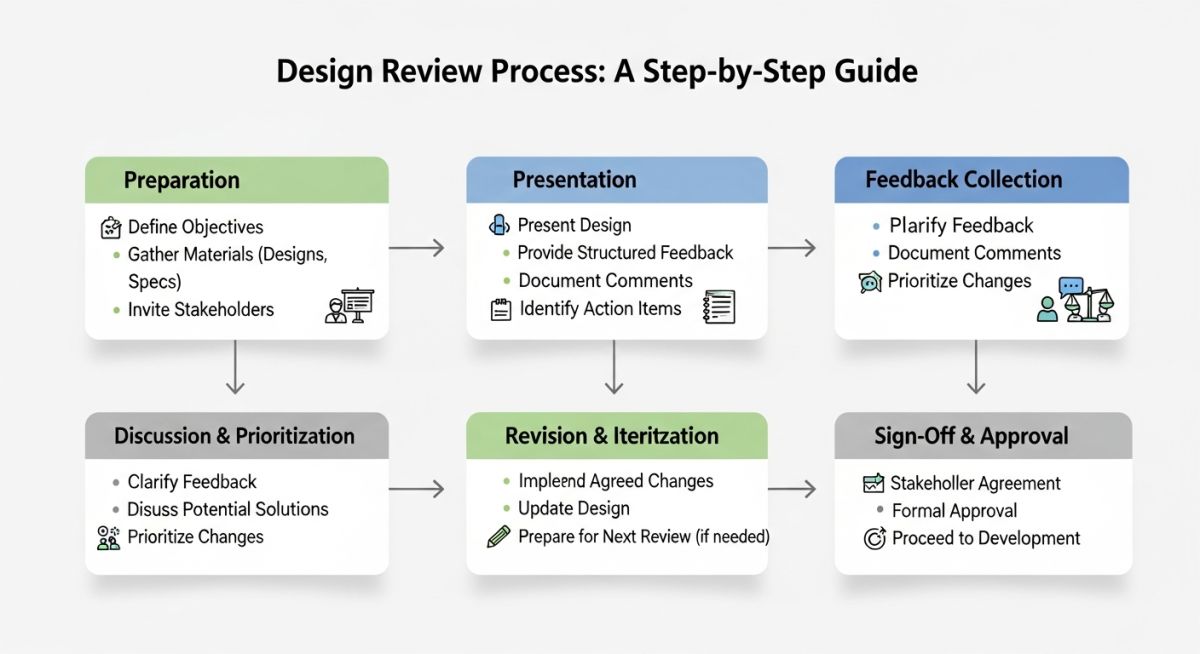
A structured design review process is divided into clear gates. Each gate has specific objectives and requires distinct deliverables to be presented by the engineering team.
| Review Stage | Design Completion % | Primary Focus | Key Deliverables Required |
|---|---|---|---|
| Conceptual / HAZID | 10% – 15% | Feasibility & Major Hazards | Process Flow Diagrams (PFDs), Preliminary Plot Plan |
| Preliminary Review | 30% | Equipment Layout & P&IDs | Frozen P&IDs, Equipment Datasheets, 3D Model (Structures) |
| Critical Review | 60% | Piping Routing & Accessibility | Piping Isometrics, Stress Analysis Reports, Clash Reports |
| Final Review | 90% | Constructibility & Operations | Support Details, MTOs, Final HAZOP Closeout |
This matrix maps the core technical entities, structural acronyms, and physical parameters to their respective international standards.
| Entity / Acronym | Full Technical Name | Physical Parameter / Scope | Standard Reference |
|---|---|---|---|
| HAZOP | Hazard and Operability Study | Process deviation analysis | IEC 61882 |
| P&ID | Piping and Instrumentation Diagram | Process control and piping connectivity | ISA 5.1 |
| MTO | Material Take-Off | Quantity estimation of bulk materials | Project Specific |
| PSV | Pressure Safety Valve | Overpressure protection sizing | API 520 / API 521 |
How to Execute the Design Review Process?
To ensure nothing slips through the cracks, I use a standardized checklist during our 60% and 90% review sessions. This checklist forces the team to look beyond the 3D model and focus on real-world constructibility and safety.
Multi-Disciplinary Design Review Checklist
-
Process Safety & Relief Systems: Verify that all PSV discharge lines are routed to a safe location or flare header in compliance with API 521.
-
Piping Stress & Supports: Confirm that high-temperature lines have sufficient flexibility and that spring hangers are unlocked for thermal movement.
-
Operations & Maintenance Access: Ensure there is a minimum of 2.1 meters of headroom clearance under all piping bridges and that valves are accessible from grade or platforms.
-
Civil & Structural Alignment: Check that pipe rack load capacities match the actual weights of filled pipes, including hydrostatic test water loads.
-
Instrumentation & Control: Verify that flow meters have the required straight-run upstream and downstream piping lengths as specified by the manufacturer.
-
Constructibility & Tie-ins: Confirm that field weld locations are optimized to minimize difficult overhead welds in tight spaces.
Field Case Study: Real-World Application
The Problem: Thermal Expansion Failure in a Steam Header
During a fast-track refinery expansion project, the engineering team bypassed the formal 60% design review process for a 12-inch high-pressure steam line to meet a tight schedule. The piping designer routed the line directly from the boiler to the process unit without a thermal expansion loop, assuming the structural supports would guide the pipe.
When the system was commissioned and reached its operating temperature of 350 degrees Celsius, the thermal expansion generated massive axial forces. This buckled the structural steel supports and cracked the nozzle of a multi-million dollar steam turbine, causing an immediate emergency shutdown.
The Outcome: Rigorous Design Review Saves the Project
I was brought in to lead the root cause analysis and redesign. We immediately implemented a mandatory, multi-disciplinary design review process. We modeled the system in Caesar II stress analysis software and discovered that the axial force exceeded the allowable nozzle limits by 400%.
By redesigning the line with a proper expansion loop and guided supports, we reduced the nozzle loads to safe levels. The redesign was subjected to a rigorous 90% design review with the operations and structural teams present. The plant was safely restarted, and the system has operated without incident for over a decade.
My recommendation is simple: never sacrifice the design review process for the sake of schedule. The time you think you are saving by skipping reviews will be paid back tenfold in field modifications, lawsuits, or catastrophic failures.
Frequently Asked Engineering Questions
What is the difference between a 30%, 60%, and 90% design review?
Who should attend an engineering design review meeting?
How do you handle disagreements during a design review?
What is the role of HAZOP in the design review process?
How do you track and close out design review comments?
Can 3D model reviews replace traditional 2D drawing reviews?
===FAQ_BLOCK===
Complete Course on
Piping Engineering
Check Now
Key Features
- 125+ Hours Content
- 500+ Recorded Lectures
- 20+ Years Exp.
- Lifetime Access
Coverage
- Codes & Standards
- Layouts & Design
- Material Eng.
- Stress Analysis



