Plate Tower vs Packed Tower: Selection, Differences, and Standards 2026
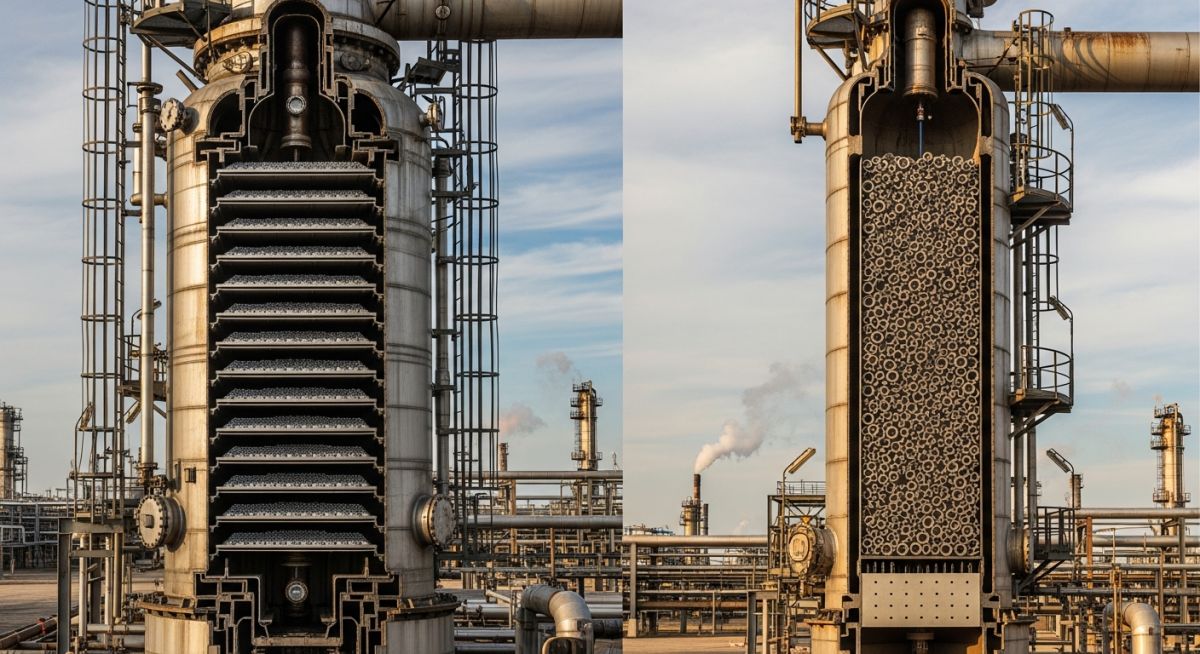
You are standing on the edge of a multi-million dollar procurement decision. The process flow diagram (PFD) requires a high-purity separation, but the feed stock is notoriously corrosive and prone to foaming. Should you opt for the structural rigidity of a Plate Tower or the low-pressure drop efficiency of a Packed Tower? Making the wrong choice doesn’t just hurt your CAPEX; it leads to years of maintenance nightmares and suboptimal throughput. This guide clarifies the selection logic used by Tier-1 EPC firms to ensure operational excellence.
Key Takeaways
- Pressure Drop: Packed towers offer significantly lower pressure drops, making them ideal for vacuum services.
- Maintenance: Plate towers are generally easier to clean and inspect in fouling services due to manway access to individual trays.
- Scale: Large diameter columns (typically over 3 meters) favor plate designs to avoid liquid maldistribution issues common in large-scale packing.
What is the difference between a Plate Tower and a Packed Tower?
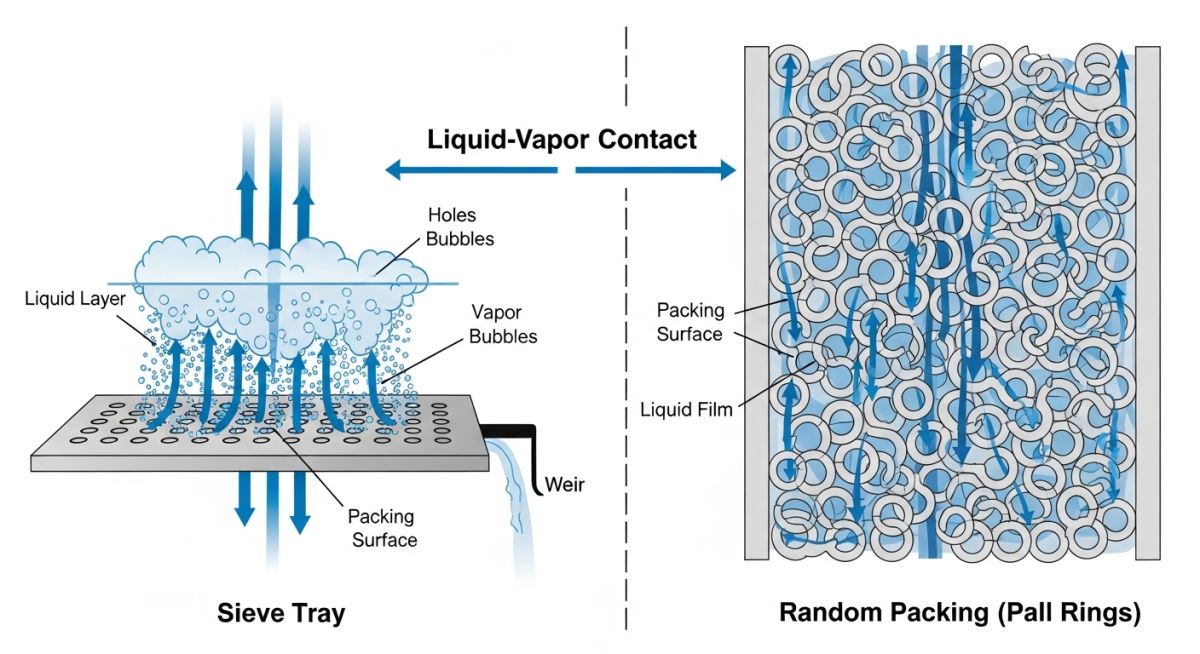
The primary difference between a Plate Tower vs Packed Tower lies in the contact mechanism. Plate towers use discrete stages (trays) for vapor-liquid equilibrium, offering better handling of high flow rates. Packed towers use continuous contact media (random or structured packing), providing lower pressure drop and higher efficiency for heat-sensitive or corrosive materials.
“In my 20 years of plant commissioning, I’ve seen engineers default to packing for its efficiency, only to face massive ‘weeping’ issues because they ignored the minimum wetting rate. In 2026, with energy costs soaring, the decision between Plate Tower vs Packed Tower must be driven by your specific HETP requirements and turndown ratio.”
— Atul Singla, Founder of EPCLand
Table of Contents
Complete Course on
Piping Engineering
Check Now
Key Features
- 125+ Hours Content
- 500+ Recorded Lectures
- 20+ Years Exp.
- Lifetime Access
Coverage
- Codes & Standards
- Layouts & Design
- Material Eng.
- Stress Analysis
Loading question…
Critical Differences: Plate Tower vs Packed Tower Performance
The fundamental engineering distinction in the Plate Tower vs Packed Tower debate centers on the nature of phase contact. In a plate tower, mass transfer occurs stagewise. Vapor bubbles through a liquid pool on each tray, creating a discrete equilibrium step. Conversely, a packed tower facilitates continuous contact along the entire height of the packing material. This structural difference dictates how each system handles pressure drop, liquid holdup, and chemical reactivity. According to technical resources from the American Institute of Chemical Engineers (AIChE), plate towers are generally more robust for varying flow rates, whereas packed towers excel in high-efficiency, low-volume applications.
When evaluating Plate Tower vs Packed Tower efficiency, engineers utilize different metrics: Tray Efficiency (%) for plates and Height Equivalent to a Theoretical Plate (HETP) for packing. A lower HETP indicates a more efficient packing, allowing for a shorter column height to achieve the same separation. However, if the liquid flow rate is too low to adequately “wet” the packing surface, the HETP increases dramatically, leading to poor separation performance—a phenomenon less prevalent in trayed towers where a minimum liquid level is maintained by weirs.
Advantages & Disadvantages of a Packed Tower System
Advantages of Packed Tower
Packed towers are the industry standard for vacuum distillation because they offer a significantly lower pressure drop compared to plate designs. Since vapor does not have to overcome the hydrostatic head of liquid on each tray, the overall energy requirement is reduced. Furthermore, for highly corrosive applications, packing elements can be manufactured from ceramics, carbon, or specialized polymers more cost-effectively than entire tray assemblies. The liquid holdup is also much lower, which is essential when processing heat-sensitive materials that might degrade if kept at high temperatures for extended periods.
Disadvantages of Packed Tower
The most significant drawback of a packed system is its vulnerability to liquid maldistribution. If the liquid is not perfectly distributed across the top of the bed, “channeling” occurs, where vapor and liquid bypass each other, destroying separation efficiency. Additionally, packing is difficult to clean; if your process involves solids or heavy fouling, the packing must often be completely removed and replaced, whereas plate towers allow for mechanical cleaning via manways. In large diameter columns, the weight of the packing and the complexity of the support grids also become limiting design factors.
Comparative Benefits: Advantages & Disadvantages of Plate Tower Designs
Advantages of Plate Column
Plate towers remain the workhorse of heavy industry, particularly in high-pressure distillation and large-scale refinery operations. One of the primary advantages of the Plate Tower vs Packed Tower design is the ability to handle wide fluctuations in vapor and liquid flow rates (high turndown ratio). Engineering standards, such as those detailed by ASME (American Society of Mechanical Engineers), emphasize the structural integrity of tray supports which allow for internal manway access. This makes plate towers significantly easier to inspect and clean in fouling or scaling services. Furthermore, if your process requires internal cooling coils or side-stream draw-offs, plate towers provide the necessary discrete stages to implement these features efficiently.
Disadvantages of Plate Column
The main trade-off is the higher pressure drop per theoretical stage. Vapor must force its way through the liquid depth on each tray, which is disadvantageous for vacuum services where every millimeter of mercury counts. Additionally, plate towers are prone to hydraulic issues such as “weeping” (liquid falling through tray holes) or “flooding” (vapor velocity carrying liquid to the tray above), which can abruptly halt production if not managed within strict operational envelopes.
Engineering Criteria: How to select a Plate Tower vs Packed Tower?
Selection is dictated by a combination of chemical properties and physical constraints. For diameters under 0.6 meters, packed columns are almost always more economical. For large-scale operations involving high liquid-to-gas ratios, plate columns are preferred. Technical guidelines from API (American Petroleum Institute) often recommend plate towers for high-pressure hydrocarbon service due to their predictable performance under variable loads.
| Feature | Plate Tower | Packed Tower |
|---|---|---|
| Pressure Drop | High (approx. 5-10 mmHg per tray) | Low (ideal for Vacuum) |
| Liquid Holdup | High | Low (better for heat-sensitive) |
| Corrosive Service | Expensive (requires exotic alloys) | Economical (Ceramic/Plastic options) |
| Cleaning/Fouling | Easy (Manway access) | Difficult (Requires replacement) |
Evaluating Column Internals for Plate Tower vs Packed Tower
Plate Internals
- Bubble Cap Tray: Excellent turndown; handles very low vapor rates.
- Sieve Tray: Simple, low cost, but high weeping risk.
- Valve Tray: The industry standard for flexibility and efficiency.
Packing Internals
- Raschig Rings: First-gen; low surface area per volume.
- Pall Rings: Modern standard; improved interior wetting.
- Berl Saddles: Superior aerodynamics and lower pressure drop.
📊 Tower Type Selection Calculator (2026 Edition)
Input your process parameters to determine the recommended configuration between Plate Tower vs Packed Tower based on hydraulic and economic factors.
Optimizing a Corrosive Acid Scrubber: Plate Tower vs Packed Tower Selection
The Challenge
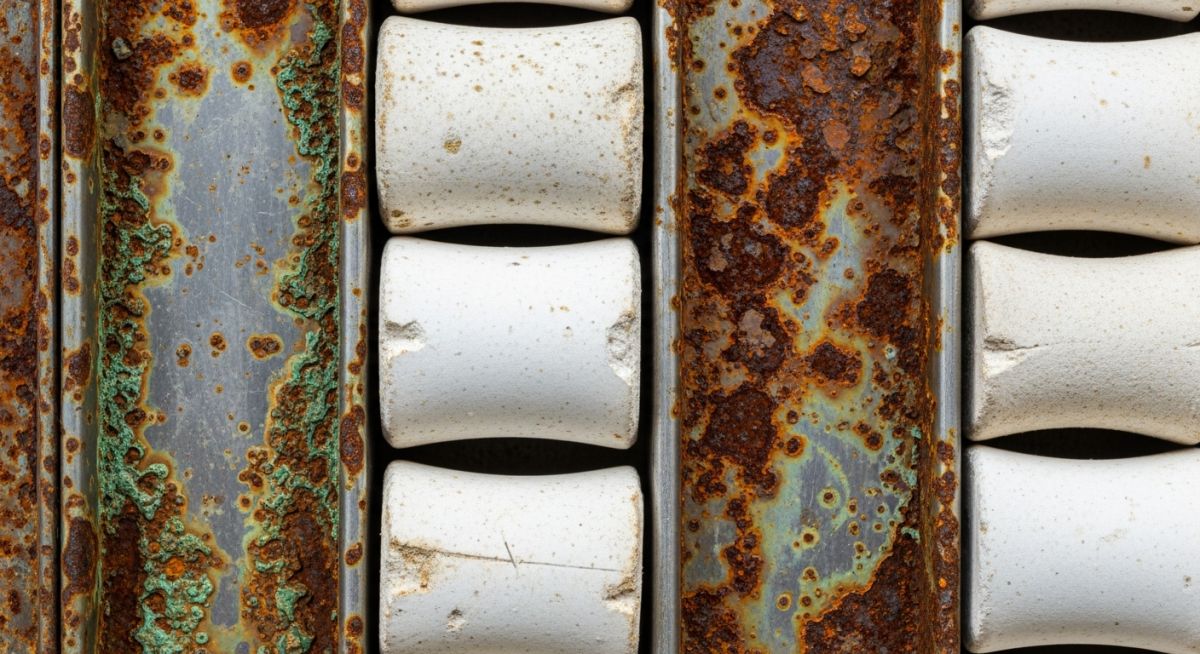
A Tier-1 petrochemical facility in 2026 faced recurring structural failures in a 1.5-meter diameter hydrochloric acid (HCl) absorption column. The original Plate Tower utilized Hastelloy trays, which, despite their high cost, suffered from stress corrosion cracking and required bi-annual shutdowns for tray replacement. The pressure drop across the trays was also limiting the upstream reactor throughput.
The Engineering Shift
The EPC team performed a Plate Tower vs Packed Tower technical audit. By switching to a Packed Tower design using ceramic Raschig rings and a PVDF-lined shell, the project achieved two critical goals:
- Material Inertness: Ceramic packing eliminated the corrosion issues inherent in metal trays.
- Throughput Increase: The pressure drop was reduced by 65%, allowing a 15% increase in vapor load without reaching the flooding point.
Project Metrics
Conclusion: For corrosive, medium-diameter applications, the Packed Tower configuration offers superior ROI over traditional plate designs.
EPCLand YouTube Channel
2,500+ Videos • Daily Updates
Expert Insights: Lessons from 20 years in the field
The “Wetting” Criticality in Packing
Never select a Packed Tower without verifying the Minimum Wetting Rate (MWR). If your liquid load drops below this threshold, the packing dries out, creating “dry spots” that effectively reduce your mass transfer area to zero. In 2026, we utilize advanced computational fluid dynamics (CFD) to ensure the liquid distributor provides at least 40 points per square meter for high-efficiency structured packing.
Pressure Drop vs. Purity Trade-offs
While the Plate Tower vs Packed Tower debate often focuses on CAPEX, the long-term OPEX is driven by pressure drop. In vacuum systems, a 10 mmHg reduction in pressure drop can lower the reboiler temperature by 5-10°C, preventing product thermal degradation and saving thousands in annual utility costs.
Maintenance Realities for 2026
If your process stream has even a 1% chance of polymerizing or carrying solids, the Plate Tower is your only viable option. I have seen packed beds become a solid “brick” of catalyst fines within months, requiring a crane and three weeks of downtime to drill out, whereas a trayed tower could have been water-blasted in 48 hours.
References & Standards
The engineering logic in this guide is derived from the following global regulatory and technical bodies:
