What is an RTJ Flange? | High-Pressure Ring Type Joint Flanges 2026
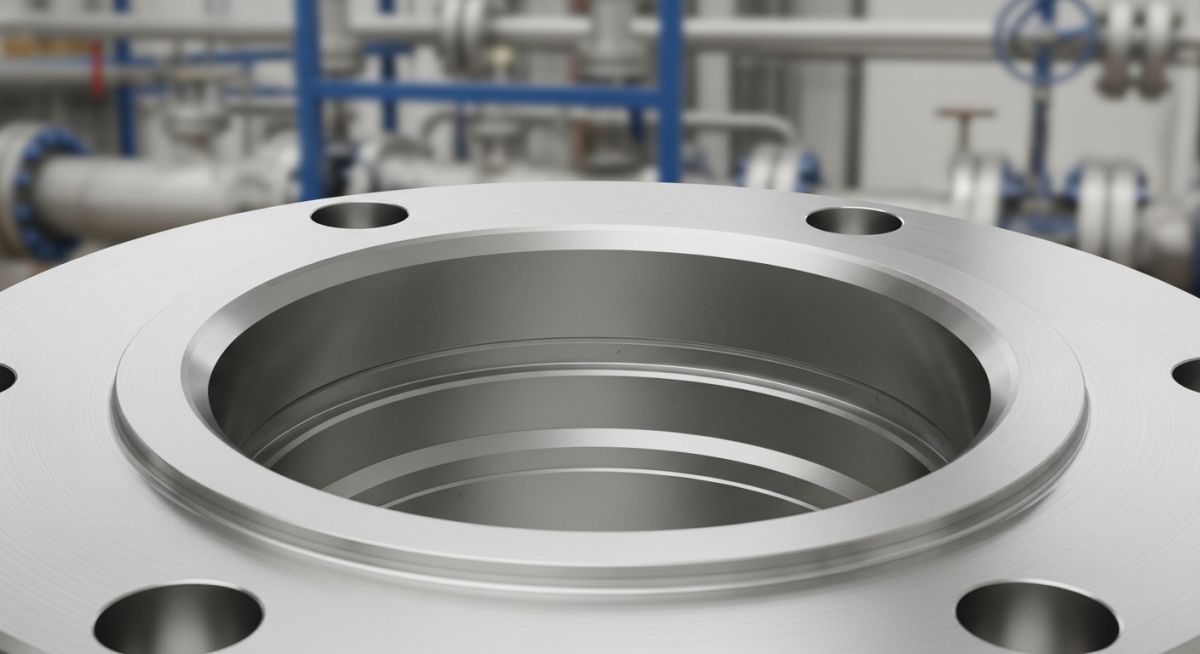
Imagine a subsea manifold operating 2,000 meters below the surface, where a single leak doesn’t just mean downtime—it means an environmental catastrophe and millions in lost revenue. Standard flat-face or raised-face gaskets simply cannot handle the 10,000 PSI surges and extreme thermal cycling of deep-water extraction. This is where the RTJ Flange becomes the backbone of your infrastructure. In this guide, we bypass the basic definitions and dive deep into why this “metal-to-metal” sealing powerhouse is the gold standard for high-stakes engineering in 2026.
Article at a Glance
- High-Pressure Mastery: Discover why RTJ connections are mandatory for Class 900 and above.
- Material Precision: Learn the critical hardness ratio required between the flange groove and the metallic ring.
- Standard Compliance: A complete breakdown of ASME B16.5 and API 6A requirements for 2026 projects.
Quick Answer: What is an RTJ Flange?
An RTJ Flange (Ring Type Joint) is a specialized high-pressure pipe flange featuring a precision-machined circular groove on its face. It creates a robust metal-to-metal seal by compressing a solid metallic ring gasket into the groove, making it ideal for high-temperature and high-pressure applications exceeding 15,000 PSI.
“In my 20 years of piping design, I’ve seen countless field failures caused by incorrect groove machining tolerances. An RTJ Flange is only as good as its surface finish; once that groove is pitted, the metal-to-metal integrity is compromised forever. Always specify a surface finish of 63 micro-inches or smoother.”
— Atul Singla, Founder of EPCLand
Complete Course on
Piping Engineering
Check Now
Key Features
- 125+ Hours Content
- 500+ Recorded Lectures
- 20+ Years Exp.
- Lifetime Access
Coverage
- Codes & Standards
- Layouts & Design
- Material Eng.
- Stress Analysis
Engineering Knowledge Check
Test your technical proficiency on RTJ Flange mechanics and standards.
1. What is the primary reason for choosing an RTJ Flange over a Raised Face (RF) flange in high-pressure service?
What is an RTJ Flange? (The Engineering Definition)
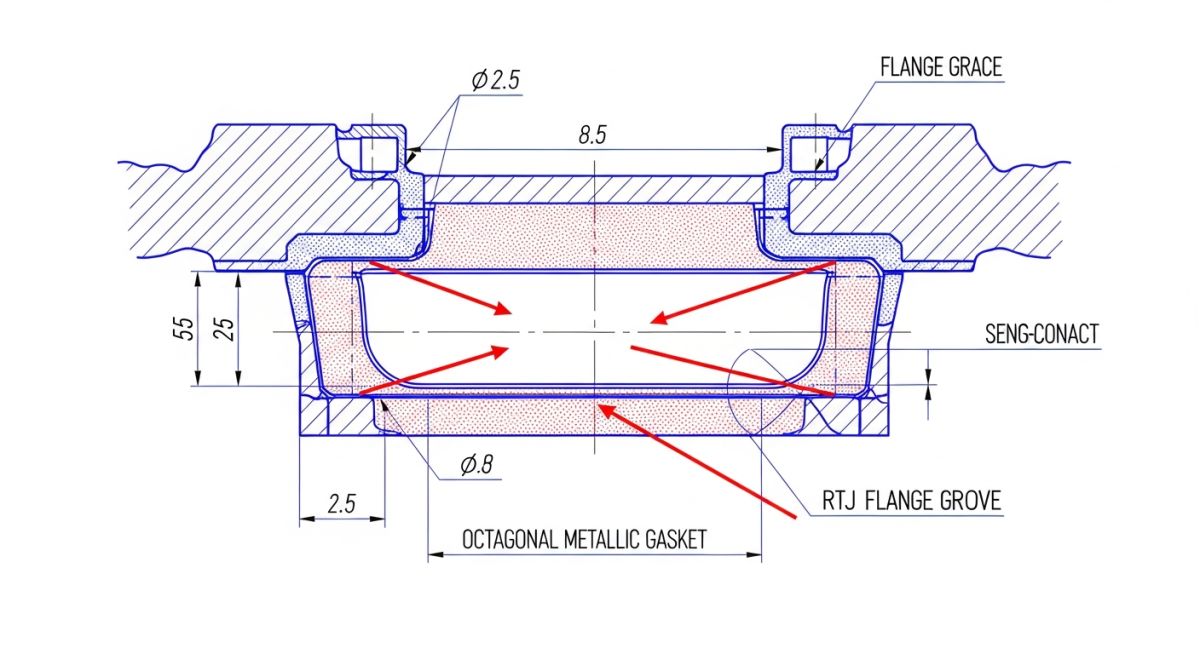
An RTJ Flange, or Ring Type Joint Flange, represents the pinnacle of high-pressure sealing technology in modern piping systems. Unlike standard Raised Face (RF) flanges that rely on a flat gasket compressed between two surfaces, the RTJ Flange utilizes a precision-machined, circular trapezoidal groove. This groove is designed to house a solid metallic ring gasket. When the flange bolts are tightened, the gasket is physically crushed into the groove, creating a metal-to-metal seal that is essentially leak-proof under extreme conditions.
The integrity of an RTJ Flange connection is maintained by “initial line contact” or wedge action between the gasket and the flange groove. As internal pressure increases within the pipe, it actually forces the metallic ring more firmly against the sealing surfaces, a phenomenon known as self-energized sealing. This makes it the preferred choice for hazardous media and high-temperature environments where elastomer-based gaskets would simply disintegrate or fail.
Core Characteristics of the RTJ Flange Design
The defining characteristic of any RTJ Flange is the surface finish and geometry of its groove. According to industry best practices and ASME B16.5 standards, the side walls of the groove must be machined to a surface finish of 63 micro-inches (1.6 micrometers) or smoother to ensure a gas-tight seal.
- ● Metal-to-Metal Interface: Eliminates the risk of gasket “blow-out” which is common in high-pressure steam or hydrocarbon service.
- ● Self-Alignment: The trapezoidal shape of the groove naturally centers the ring gasket during assembly, reducing human error during field installation.
- ● High Bolt Load Tolerance: The robust construction allows for significantly higher torque values, ensuring the seal remains intact during thermal expansion and contraction.
RTJ Flange Materials for Sour Service and High Temps
Material selection for an RTJ Flange is not just about the pipe media, but about the hardness differential between the flange and the gasket. To achieve a proper seal, the gasket must always be softer than the flange groove. Common materials include Carbon Steel (ASTM A105), Stainless Steel (ASTM A182 F304/F316), and high-nickel alloys like Inconel 625 for extremely corrosive “sour service” environments where H2S is present.
In 2026, we are seeing an increased use of duplex and super-duplex stainless steels in RTJ Flange manufacturing to provide the necessary yield strength for ultra-deepwater projects while maintaining excellent resistance to chloride stress corrosion cracking.
Global Codes and Standards for RTJ Flange Manufacturing
Precision is the hallmark of the RTJ Flange. In 2026, global engineering projects adhere strictly to two primary governing bodies. For standard process piping and refinery applications, ASME B16.5 (for sizes up to 24″) and ASME B16.47 (for large-diameter 26″ to 60″ lines) dictate the groove dimensions and pressure-temperature ratings. These standards ensure that an RTJ Flange manufactured in one region is perfectly compatible with a ring gasket produced in another.
However, for the upstream oil and gas sector, specifically wellhead and “Christmas Tree” equipment, the API 6A standard takes precedence. API 6A RTJ Flange designs, such as the 6BX type, are engineered to withstand pressures up to 20,000 PSI. These flanges differ from ASME versions by requiring higher yield strength materials and specialized “BX” gaskets that allow for face-to-face flange contact.
Common RTJ Flange Types and Facing Styles
The RTJ Flange is not a “one-size-fits-all” component. Depending on the mechanical requirements of the piping system, engineers select from several distinct configurations:
- Weld Neck RTJ: The most common type for high-pressure service, featuring a tapered hub for superior stress distribution.
- Slip-On RTJ: Rarely used in ultra-high pressure but available for Class 300 to 600 applications where space is limited.
- Socket Weld RTJ: Utilized for small-bore high-pressure lines where internal welding is not feasible.
- Threaded RTJ: Often found in wellhead applications where welding is prohibited due to explosive hazards.
RTJ Flange Dimensions and Pressure Ratings
Selecting the correct RTJ Flange requires an understanding of the relationship between the ring groove number (R, RX, or BX) and the flange’s pressure class. Below is a comparison table for standard RTJ Flange metrics across common pressure classes.
| Pressure Class | Typical Gasket Type | Sealing Surface | Primary Application |
|---|---|---|---|
| Class 600 | R-Oval / R-Octagonal | Groove Wall | Standard High-Pressure Steam |
| Class 900 – 2500 | R / RX (Self-Energized) | Groove Wall | Subsea & Offshore Piping |
| API 5K – 20K | BX (Pressure-Energized) | Groove & Face Contact | Wellhead / HPHT Wells |
RTJ Flange Gasket Hardness Estimator
Input your RTJ Flange material hardness to determine the maximum allowable Brinell Hardness (HB) for the metallic ring gasket to ensure a proper seal without groove damage.
Standard ASTM A105 is typically 187 HB max.
Enter values to see margin.
Engineering Note: Per ASME B16.20, the gasket should be at least 30-50 HB softer than the RTJ Flange groove to prevent permanent deformation of the flange seating surface.
Engineering Case Study
Scenario: Deepwater Subsea Manifold Pressure Containment

The Challenge
In a 2026 North Sea extraction project, a subsea manifold was required to operate at 12,500 PSI in a corrosive H2S environment. Initial designs using standard gaskets showed potential for “cold flow” and seal degradation during extreme thermal cycling between production temperatures (150°C) and seabed temperatures (4°C).
The Solution
Engineers implemented an RTJ Flange system utilizing API 6A Type 6BX flanges forged from Inconel 718. The connection used RX pressure-energized metallic rings, ensuring that the internal pressure of the well actually enhanced the seal integrity during operation.
The Result: Zero-Leak Performance
“The transition to the RTJ Flange design eliminated the need for mid-life gasket maintenance. After 12 months of monitoring, the system maintained 100% seal integrity despite three emergency shutdown (ESD) thermal cycles. The metal-to-metal seating proved indestructible against the pressure surges.”
Expert Insights: Lessons from 20 years in the field
Designing a high-pressure system around the RTJ Flange requires more than just following a catalog. Through decades of commissioning offshore platforms and refinery units, we have identified these critical technical nuances that often differentiate a successful startup from a multi-million dollar leak:
- ✦ The “Groove Memory” Trap: Never reuse an RTJ Flange ring gasket. Once the metallic ring is compressed, it undergoes plastic deformation to match the groove. Reinstalling a used gasket is a guaranteed failure point in 2026 high-pressure specs.
- ✦ Bolting Friction Factors: For an RTJ Flange to seat correctly, the bolt torque must overcome the friction of the metal-to-metal wedge. Always use a high-quality molybdenum disulfide lubricant and adjust your torque calculations to ensure the target seating stress is reached.
- ✦ Subsea Stand-off: On API 6A flanges, the “stand-off” (the gap between flange faces before tightening) is a critical QC metric. If the faces touch before full torque is applied, the gasket is likely undersized, and the seal will fail under pressure.
- ✦ Plating Considerations: In corrosive environments, many RTJ Flange gaskets are silver or cadmium plated. This isn’t just for corrosion; the plating acts as a “soft” lubricant to help the metal surfaces gall together and form a tighter seal.
References & Standards
For precise manufacturing tolerances and material grades, consult the following official authorities:
Frequently Asked Questions: RTJ Flange Authority
What is the difference between an R-type and RX-type RTJ gasket?
Can I use an RTJ Flange for low-pressure steam?
What is the standard groove finish for an RTJ Flange?
Why did my RTJ Flange fail immediately after installation?
Can I re-machine a damaged RTJ groove?
Is it possible to convert an RTJ Flange to a Raised Face?
📚 Recommended Resources: RTJ Flange
Read these Guides
- 📄 Flange Facing Machine Guide: Engineering Types & Standards 2026
- 📄 Flange Face Types & Finishes: The 2026 Engineering Guide to ASME B16.5
- 📄 The Root Cause of Persistent Leaks: How We Overcame Flange Face Damage Leakage in Process Piping
- 📄 Flange Joint Integrity: The Ultimate Guide to Leak-Free Connections
🎓 Advanced Training
